

I just love all aspects of research. Here's some valuable information I uncovered while writing a western novel.
While writing my Summerside Press book, I came up against a problem. The heroine and her two servants needed to travel from Boston to Golden, New Mexico, by train. On their journey, they would also take an orphaned baby. My dilemma? How to feed the baby. The year is 1892.
I knew that when a mother died, a wet nurse (a mother who was nursing her own infant) would often step in and keep the baby alive. Or the people with the motherless baby would hire a wet nurse. On wagon trains, when a mother of an infant died, other nursing mothers on the wagon train helped feed the child. All this information wouldn't help me.
In my search for information, I found out that the first commercial infant formula was invented in Europe in 1869. The powdered formula was added to warmed cow's milk. A version of this formula was also sold in the US that same year. However, the cost of $1.00 per bottle was prohibitive for most families.
Henri Nestle created a formula, also in Europe, to treat malnourished babies. This formula didn't require adding cow's milk to the powder. When mixed with water, it was the first complete formula. In 1870, Nestle brought his infant formula to the US. It sold for only $.50 per bottle, still a rather high price for most families. But through marketing, this product was available worldwide, including throughout the whole United States.
I'm sure the Nestle name is familiar to you. If you go to the Nestle website, you find that the company is still very active in helping underdeveloped countries feed their babies.

I decided to use Nestle Infant Food in my story.
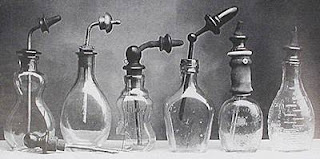
I own a 1897 Sears and Roebuck catalog. In that book, there are a number of formulas available for order. And the nursing bottles are quite interesting. There is one shaped like a banana. Others are teardrop shaped clear glass with writing molded into the side. I've chosen to use the teardrop one to symbolically fit with the tears over the loss of the mother.
And they even had three different colors of rubber nipples in that catalog. Here are some other shapes of baby bottles and nipples.
 I love the way that research leads me to so much interesting information.
Identical triplets born on one of the last wagon trains on the Oregon Trail were separated at birth because their mother died giving birth. They don't find out that they have sisters until near their 18th birthday. Each book is one sister's story. They're available in bookstores everywhere and here:
Maggie's Journey (McKenna's Daughters)

Mary's Blessing (McKenna's Daughters)

Catherine's Pursuit (McKenna's Daughters)

