Showing posts with label Female Aviation Pioneers. Show all posts

Sunday, May 28, 2017

Amelia Earhart - Pioneering Woman in Aviation

by Tamera Lynn Kraft

“Adventure is worthwhile in itself.”  Amelia Earhart

Amelia Earhart, the pioneer woman in aviation is known as much for her final flight as she is for her aviation career. She set out in 1937 to be the first person to fly around the world and was never heard from again.

During World War I, Amelia became a nurse for in a soldier’s convalescence home. There she learned from the pilots what it was like to fly a plane. After the war, her father paid for her flying lessons. She worked odd jobs to buy her first plane. She painted it yellow and called it “Canary”.

In 1928, GP Putnam, a famous author and biographer, approached her about becoming the first woman to fly across the Atlantic Ocean by GP Putnam. She married him two years later. In 1929, she started an international women’s flight organization called the Tuscon Ninety Nines formed in Long Island, New York. She was the first president of the organization that began with ninety-nine members.

In 1932, she became the first woman to ever fly solo across the Atlantic Ocean and the first woman to receive the Airforce Distinguished Flying Cross. Only a few women have been able to receive the same honor.

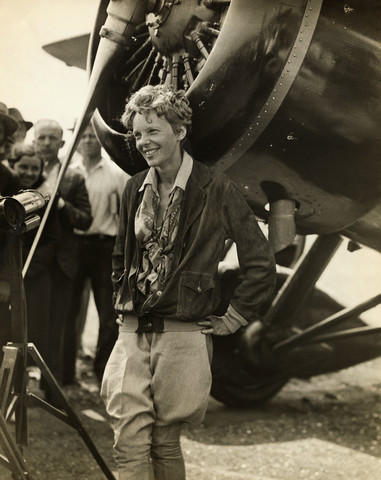
Amelia wore her hair cropped and had a tomboy appearance. While most women of her day wore dresses and didn't cut their hair, she was usually always pictured in a leather flight jacket around an airplane or on a runway. She said it kept her warm during flights in her small aircraft.

On March 17, 1937, Earhart’s first attempt to circumnavigate the world did not get far. After traveling from California to Hawaii, her plane experienced mechanical problems and was grounded. The plane ended up severely damaged and had to be transported back to California for repairs.

Earhart made her final attempt two months later on July 2, 1937. She experienced technical difficulties on the Howland Island approach. There are several theories about what happened ranging from a damaged antenna to confusion on Earhart’s part. There is no way to know for certain. Whatever happened, Earhart and Noonan missed the island and began to run low on fuel. 
The plane crashed.
Amelia Earhart tried to inform rescuers of her location. Transmissions continued for a few days after they ditched, but rescuers couldn't figure out where she was. The U.S. Navy joined the search, but turned up nothing. There was evidence of a crash on Gardner Island, but since the island was uninhabited, it was discounted. Instead, the navy focused on the open ocean. After the official search ended, Earhart’s husband, George Putnam, continued the search on his own. Eventually, he gave up and had her declared dead in 1939.

Following her disappearance, several conspiracy theories emerged. Some claimed Earhart and Noonan were American spies captured and executed by the Japanese. Others believe the Japanese captured the aviators and murdered them, but they were not spies. One bizarre theory claims she returned to America and lived under an assumed name. Whatever happened, she is still a considered a role model for young women everywhere.

Tamera Lynn Kraft has always loved adventures and writes Christian historical fiction set in America because there are so many adventures in American history. She has received 2nd place in the NOCW contest, 3rd place TARA writer’s contest, and was a finalist in the Frasier Writing Contest. Her novel Alice’s Notions and novellas Resurrection of Hope and A Christmas Promise are available on Amazon and at Barnes and Noble.

Sunday, June 14, 2015

First National Women's Air Race

Hello from Carla Stewart!

The Roaring Twenties saw many new innovations and interests across America. Aviation was quickly gaining the attention of the public as a novelty that was here to stay and would change the way people traveled forever. Women, too, were coming into their own during that decade and were as fascinated with flight as much as their male counterparts, although they weren't as widely accepted. They were even scoffed at by many who felt they weren't capable and should remain at home where women belonged. 

Many women, though, were determined and took to the skies in endless competitions for altitude, endurance, and speed records. Early in 1929 there were 75 licensed women pilots in the US, and they had become better acquainted through various competitions. Elizabeth McQueen of the National Women's Aeronautical Association proposed having a National Women's Air Derby similar to the one where men competed. She met with Cliff Harrison in May who was instrumental in founding the race. The National Exchange Club, along with the Cleveland Air Races, organized and sponsored the event that took place in August of 1929. 

To qualify, the women had to be licensed, have 100 hours of solo flying experience, 25 hours of which had to be in cross-country flight. Twenty women, including Amelia Earhart, accepted the challenge and gathered in Santa Monica, CA for a race that would last nine days with 17 stops and culminate in Cleveland, OH. There were two classes. One for heavyweight planes; another for the lighter weight ones. 


Some of the female aviators who competed in the first women’s transcontinental air derby which began in Santa Monica on August 18, 1929. Amelia Earhart is fourth from the right. Louise Thaden, who won the race, is fifth from the right. Photo courtesy of Saint Louis University Libraries.


A large and festive crowd, including many notable Hollywood stars, gathered for the start of the race which was a gunshot in Cleveland transmitted by radio to Clover Field in Santa Monica. Will Rogers was on hand as a reporter and quipped that since he'd seen so many pilots powdering their noses, the race ought to be called the Powder Puff Derby. It was a name that stuck. 

Starting shot of the Women's Air Race - from http://www.air-racing-history.com/


Will Rogers - dubbed the race the Powder Puff Derby - Photo credit: Wiki Commons

The first leg of the the race was short, only to San Bernardino, but trouble was already brewing that first night when oil was discovered in the gas tanks of two planes. Sabotage was suspected but the next day the race continued. Other acts of presumed sabotage occurred early in the race. The wires between the wings of one entrant's plane broke and it was discovered acid had been poured on them. Another pilot's plane malfunctioned and garbage was found in the carburetor. Some thought an investigation was in order, but the women who by now had developed a strong bond, refused. Led by the colorful and passionate contestant Pancho Barnes, they banded together. If someone was trying to sabotage the race, it would likely be stopped, and the saboteurs would win. All the women agreed they wanted to continue.

Pancho Barnes - Photo Credit: Wiki Commons

Amelia Earhart - Photo Credit: Air and Space Museum. Smithsonian Institute

Banquets were held each evening at the the over-night stops. The women jokingly said they were on the "rubber chicken" circuit because of the unwavering menu. Dressed in flight gear by day, the women donned evening gowns each evening to greet and promote women's aviation on their trek across the country.  


Blanche Noyes, one of the women in the 1929 race. Photo credit: The Cleveland Memory Project


At the Phoenix stop, one woman was unaccounted for. Marvel Crosson, a cheerful young aviatrix from Alaska who'd quickly become a favorite of the other women, never arrived. The next day her plane was discovered crashed in the mountains of Arizona. Marvel didn't survive. 

Marvel Crosson


It was a sobering moment for the women who were more determined than ever to finish. 

In El Paso, Texas, the race was temporarily halted due to stormy weather, and the women enjoyed a much-welcomed relaxing evening in the cantinas just across the border in Mexico. While they were there, though, oil magnate, Mr. Halliburton called for the race to stop. ""Women have conclusively proven they cannot fly. Women have been dependent on men for guidance for so long, when they are put to their own resources, they are handicapped." 

The women and the organizers were outraged and sent out a quick rebuttal. "We officially thumb out noses at Mr. Halliburton." The race continued, but not without mishaps. Pancho Barnes crashed her plane, the damage irreparable. One women had to drop out when she came down with typhoid fever. Another got lost and landed in a cow pasture somewhere in Oklahoma. She gained her bearings and continued.   

Ruth Nichols, one of the race contenders. Photo credit: Air and Space Museum, Smithsonian Institute

Their efforts were not going unnoticed. 20,000 people met them in Ft. Worth and swarmed the field to get a glimpse of these brave women. By the time they reached Cleveland, a mob had gathered to greet and congratulate the women. Louise Thaden, flying in a heavyweight Travel Air was declared the winner and a shawl of roses placed on her shoulders. Phoebe Omlie won in the lightweight class. That evening more than 5000 people attended a celebratory banquet in a hangar in Cleveland. Some of the world's top aviators and politicians heralded the women for a great race. It was a new era in aeronautical history. Women had taken their place beside men, proven their skills, and demonstrated courage. 

Louise Thaden, Gladys O’Connell and Ruth Nichols, pioneer female aviators during the first women’s transcontinental air derby in 1929. Thaden won the race. Photo courtesy of Saint Louis University Libraries.


The first National Women's Air Race at a glance: 

  • Dubbed the "Powder Puff Derby" by Will Rogers
  • Twenty entrants 
  • Course from Santa Monica, CA to Cleveland, OH - a 2800 mile race
  • 17 stops in 9 days
  • One fatality - Marvel Crosson of Alaska
  • Fourteen women finished race
  • Winners: Louis Thaden (heavyweight class) and Phoebe Omlie (lightweight)
  • $8000 in total prizes 
By November of 1929, there were 117 licensed women pilots in the US. All were invited to an organizational meeting for the promotion of women in aviation. 99 women attended and became charter members of "The Ninety-Nines". They are still active today. 

http://www.carlastewart.com/books/I included the National Women's Air Race in my most recent release A Flying Affair. Weaving historical facts into fiction has become a passion that has proved to be both challenging and exhilarating. For more information about the Women's Air Race, I recommend you watch Heather A Taylor's award-winning documentary Breaking Through The Clouds. 

Blue Skies! 


Carla Stewart is the award-winning author of six novels. With a passion for times gone by, it is her desire to take readers back to that warm, familiar place in their hearts called “home.” Her 2014 release, The Hatmaker's Heart, was a finalist for the Oklahoma Book Award and the Selah Award. Her newest release is A Flying Affair. Daredevil Mittie Humphreys navigates her heart as well as the skies in this beguiling adventure of grit and determination during the rollicking Roaring Twenties. Learn more about Carla at www.carlastewart.com