By Michelle Shocklee
Growing up in Santa Fe, New Mexico, the Sangre de Cristo mountain range was practically in our backyard. I spent many glorious days hiking and exploring the Rocky Mountains with family and friends. When I married a Texan in 1987, trips to the mountains became infrequent but my love for them has never waned. Now that we live in the Nashville area, the beautiful Blue Ridge Mountains are just a few hours away. Yay!
 |
| Me near the Walker Sisters Cabin |
Like me, most people probably don't think about the history of a national park when they visit one. We're too busy enjoying the fruits of someone else's labor and ideas. Such was the case when hubby and I visited the Great Smoky Mountains National Park for the first time back in the fall of 2018. I had no idea how many people were involved in its creation, as well as how much money and how many years it took for the plans to be approved. There was also quite a bit of controversy and many opponents to overcome before the park could become what we know it as today.
The history of the land:
The Great Smoky Mountains are the former homelands of the Cherokee. Over time, white settlers arrived and the native people were forced to relocate, sadly taking part in what would become known as the Trail of Tears, a series of forced displacements of approximately 60,000 Native Americans from five tribes across the country between the years 1830 and 1850.
 |
Clearcutting in Tennessee, 1936
U.S. National Archives & Records Admin. |
It didn't take long for logging to become a large industry in the area. By the early 20th century, however, people began to realize that clearcutting--the logging practice in which most or all trees in an area are uniformly cut down--was destroying the forest's natural beauty.
The People:
Ann Davis is credited for suggesting a National Park in the Smokies when she and her husband Willis returned from a trip visiting several Western national parks in 1923. This started discussion of the idea with leaders in the area, especially around Knoxville.
One key leader, Colonel David Chapman, played a leading role in the tough battle to bring the park idea to fruition, especially on the Tennessee side of the park. Chapman, president of a Knoxville drug company, became totally committed to the park movement and dealt successfully with multiple obstacles such as opposition from park opponents, lack of funding for land purchase, and controversial condemnation actions. As chairman of the Great Smoky Mountains Conservation Association, he was the Tennessee leader for the park campaign and developed close relationships with parties in both Tennessee and North Carolina working toward creation of the national park.
Paul Fink, Horace Kephart, George Masa, and others were also instrumental in their work as advocates for the park. The group began raising private funds to help the cash-strapped National Park Service acquire land. John D. Rockefeller contributed $5 million, with the US government adding $2 million. Congress finally authorized the project in 1926.
 |
I took this picture of the Walker Sisters cabin after hiking
a couple miles to it, deep in the mountains. |
Saying Goodbye:
Buying the land proved difficult, even with the money in hand. Some 6,000 small farms, large tracts, and other miscellaneous parcels had to be surveyed, appraised, dickered over and sometimes condemned in court. The timber and paper companies had valuable equipment and standing inventory, which required compensation. Some mountain homesteaders, like
the Walker Sisters, were given lifetime leases to remain on their property, although they couldn't hunt, log, or farm on it. Everyone else was evicted.
The park today: |
| I couldn't get over the vibrant colors, even on a cloudy day! |
Today, the park occupies 522,419 acres of gorgeous, well-preserved land in two states--Tennessee and North Carolina. It boasts two visitors' centers, miles and miles of hiking trails, historical buildings, waterfalls, lakes, and recreation areas. The well-maintained roads take you through some of the most beautiful scenery I've ever seen, especially during the fall.
So next time you visit a national park, whisper a little thank you to all the folks who played a role in creating it.
Your turn: What is your favorite National Park you've ever visited? Tell me about it!
Michelle Shocklee is the author of several historical novels and is a Christy Awards and Selah Awards finalist. Her work has been included in numerous Chicken Soup for the Soul books, magazines, and blogs. Married to her college sweetheart and the mother of two grown sons, she makes her home in Tennessee, not far from the historical sites she writes about. Visit her online at
www.MichelleShocklee.com*2021 Christy Awards Finalist*
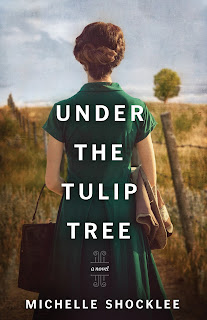
Sixteen-year-old Lorena Leland’s dreams of a rich and fulfilling life as a writer are dashed when the stock market crashes in 1929. Seven years into the Great Depression, Rena accepts a position interviewing former slaves for the Federal Writers’ Project. There, she meets Frankie Washington, a 101-year-old woman whose honest yet tragic past captivates Rena. Frankie’s story challenges Rena’s preconceptions about slavery, but it also connects the two women whose lives are otherwise separated by age, race, and circumstances. Will this bond of respect, admiration, and friendship be broken by a revelation neither woman sees coming?
For purchase options, visit
www.MichelleShocklee.com