

To give you an idea what the 1918's were like, let me give you some highlights about the time.
From 1896 to 1918 the number of passengers traveling by rail tripled. Only a few Americans could afford cars. Henry Ford and his new innovations was about to change all that.
The use of telephones up to 1918 was extremely expensive. The phone companies were working hard to expand their limited lines to much of the country where service was unavailable.
Newspapers were the form of 'getting the news out'. Even small towns often had more than one newspaper. Breaking news that needed to get out was done so by printing another newspaper. These papers were called 'extra'. So now you know why we hear, "Extra, extra, read all about it!" The lad yelling that was letting people know there was breaking news.
Okay now that you have some 1918 background, lets get back to the flu epidemic.
With entertainment big business and all those people getting together, it became a huge concern for public health experts. At the height of the epidemic government officials rushed in and closed many of these entertainment places, fearing the spread of the influenza virus.
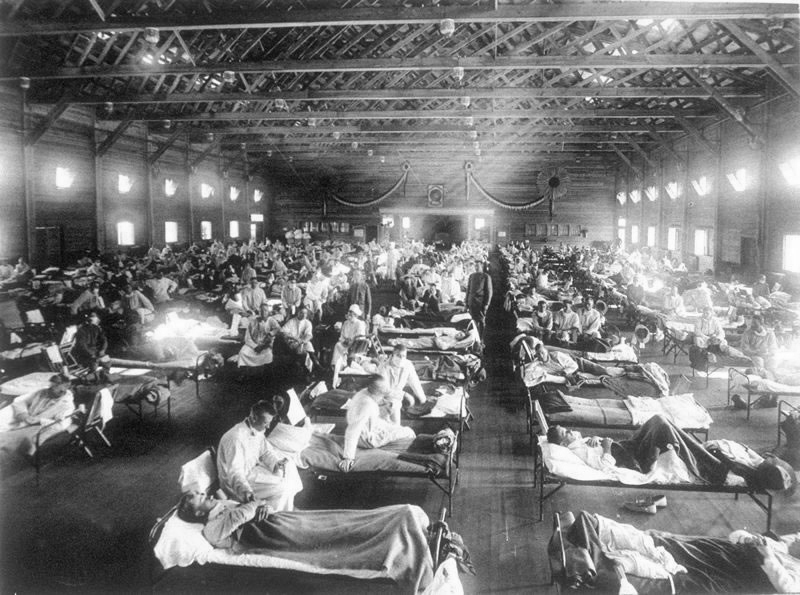
Some of the earliest victims of the flu were the American soldiers stationed here in the United States. As the epidemic spread the disease wasn't partial to US soil and quickly spread to military hospitals not only here but abroad. By November of 1918 the whole world was affected by the growing pandemic. - public domain wiki
The rail systems being so popular became an easy channel for the spread of the influenza virus. During the epidemic, cities became concerned about how easily the virus spread, causing some cities to limit and even close their transportation systems. Many cities that remained opened had people wearing masks to reduce the risk of infection.
Between nine and sixteen million people died during the war. But the influenza pandemic would take a staggering fifty million lives, which at the time
was approximately one fifth of the world's population. These high
mortality rates made this one of the deadliest natural disasters in
history. The 1918 flu killed more people than all the wars of the 20th century combined.
So who died in this epidemic? You might think the young and old. If you guessed that you'd be wrong. The 1918 disproportionately killed the healthy young adults. The reason wasn't known why them, but in modern research, researchers have discovered the virus killed through an overreaction of it's immune system. The stronger the immune system, the stronger the reaction. So the young adult body was ravaged, where a child or middle-aged adult had a milder reaction.
Death came quickly. Victims had such a violent immune response that there are stories where people died within hours of showing symptoms of the flu. Their lungs would fill with fluid and they would suffocate. Doctors were helpless to stop the toll that the influenza took on the young adults.
 |
| Basha Bay Veatch Davis |
On a personal note, my grandmother was one year old in 1918. Her Aunt Icey (her mother's sister) died of influenza. Ten days later my grandmother's mother, Basha Bay Veatch Davis contacted the flu and died, leaving my grandmother an orphan.
 |
| Sisters: Icey May, Basha Bay, and Rachel who was deaf |
 |
| Mass Graves being dug |
My husband's father was a young man in 1918. He told us about the flu epidemic. The memory embedded in his mind was looking out the window and seeing them stack bodies like cords of wood because the morgues couldn't keep up with them.
So how, you might ask, is my great-grandmother ten years younger than my husband's father? That my friend is food for another blog post. =o)
Leave a comment to be entered in drawing. Your choice of 1 of 6 books. Don't forget to leave your email address.
A Little Bit of Charm by Mary Ellis
Before the Season Ends by Linore Rose Burkard
A home for my Heart by Anne Mateer
When Mockingbirds Sing by Billy Coffey
Echoes of Titanic by Mindy and John Clark
Whispers from the Shadows by Roseanna M. White

Debbie Lynne Costello is represented by Tamela Hancock Murray of the Steve Laube
Agency. She attended Heritage University, where she studied Journalism and
worked in the editing department.
She has completed five full length
novels set in the Charleston, SC and Savannah, GA area in the late 19th century
and is now seeking homes for them.
She and her husband have four
children. They live in upstate South Carolina with their family. She spent
thirteen years coaching cheerleading and trying to make a difference in young
girls’ lives. Debbie Lynne has raised Shetland sheepdogs for eighteen years
and occasionally shows them. In her spare time, she sews, paints, makes jewelry, camps
(in a fifth wheel) and enjoys the grandbabies.
WEBSITE: www.debbielynnecostello.com BLOG: www.theswordandspirit.blogspot.com BLOG: www.fictionaddictionfix.blogspot.com
WEBSITE: www.debbielynnecostello.com BLOG: www.theswordandspirit.blogspot.com BLOG: www.fictionaddictionfix.blogspot.com
