Showing posts with label Heroines of World War II. Show all posts

Sunday, May 29, 2022

Poor Man's Honey and the Return of Frugal Living


Frugal living isn't what it used to be, but thrift might be making a comeback in ways we haven't experienced since WWI, the Great Depression, and WWII. Not even since the "energy crisis" of the 1970s or the recession of the early '80s--those years when my hubby and I lived on venison roasts and rabbit in the crockpot.

It's no secret that America is looking at economic crisis, and the world at large isn't doing much better. With inflation jogging steadily upward, the summer looks grim. Of course, those of us who've been watching events with a long view want to do whatever we can to prepare, so many of us are returning to basics.

I'm reminded of some of the things my grandparents taught me about harvesting and putting by as a child. One of them I included in my WWII novel Season of My Enemy is to harvest dandelion greens for the table. They're an unlimited springtime vegetable as healthy as spinach! You can eat them cooked or fresh, stems or leaves. The roots, leaves, or flowers can all be used to brew a healthy tea too. I haven't tried dandelion tea, either home-picked or store bought, but I plan to pull some roots and do that. (Dandelions just started blooming about a week ago in northern Wisconsin.)  

In that same spirit, a couple of my granddaughters and I decided it was time for a project. I told them how we could make dandelion jelly, or as some folk call it "Poor Man's Honey", and they wanted to do it right away. I'm not sure that it's a big money saver, although in terms of using honey to sweeten our tea, it's a nice substitute. But let's face it, it's mostly sugar water--with the added benefits of what dandelions have to offer.

Dandelions contain natural antioxidants that can:
  • reduce inflammation.
  • manage blood pressure.
  • control blood sugar.
  • lower cholesterol.
I'm not sure how much of that is negated by adding the sugar, but you can use real honey to make the jelly instead, and you might even try a sugar-free pectin. For our project, we used no pectin at all. I rarely use pectin these days when making jams and jellies. (Which is definitely a money saver!) I just cook it a lot longer--like reducing down sap for maple syrup. If I'm really desperate for a thickener, I throw in a cup of mashed blueberries. They contain a ton of natural pectin. Apple peel is another option.

Back to our dandelion jelly. The girls headed out with a big mixing bowl and began plucking fully-opened dandelion flower heads. Not-yet-full heads produce a more bitter taste, so I'm told. These they then painstakingly pulled the yellow petals from while watching princess movies. It took a couple of hours to fill a quart jar.


I covered the dandelion petals with four cups of boiling water in a two-quart jar, capped it with a coffee filter and rubber band, and let it brew overnight. Some folks just boil the petals for a bit, others brew it for about four hours or more (like I did). The more green you leave (stem or leaves), the more bitter or strong your results could become. We pulled only the petals. 

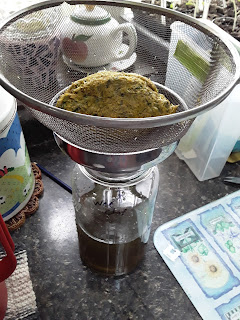
Then we strained the juice. It looked hideous at first! See how brownish-green it looks in the jar? I strained it with just a strainer, and then did it again using a coffee filter in a strainer. But as we began to simmer it, the golden color returned.


The girls helped me add sugar at an almost 1:1 ratio, and we also added a couple tablespoons of lemon juice. Fresh lemon would be lovely, but I didn't have any. A squeeze of orange would add a nice flavor too. Next time!


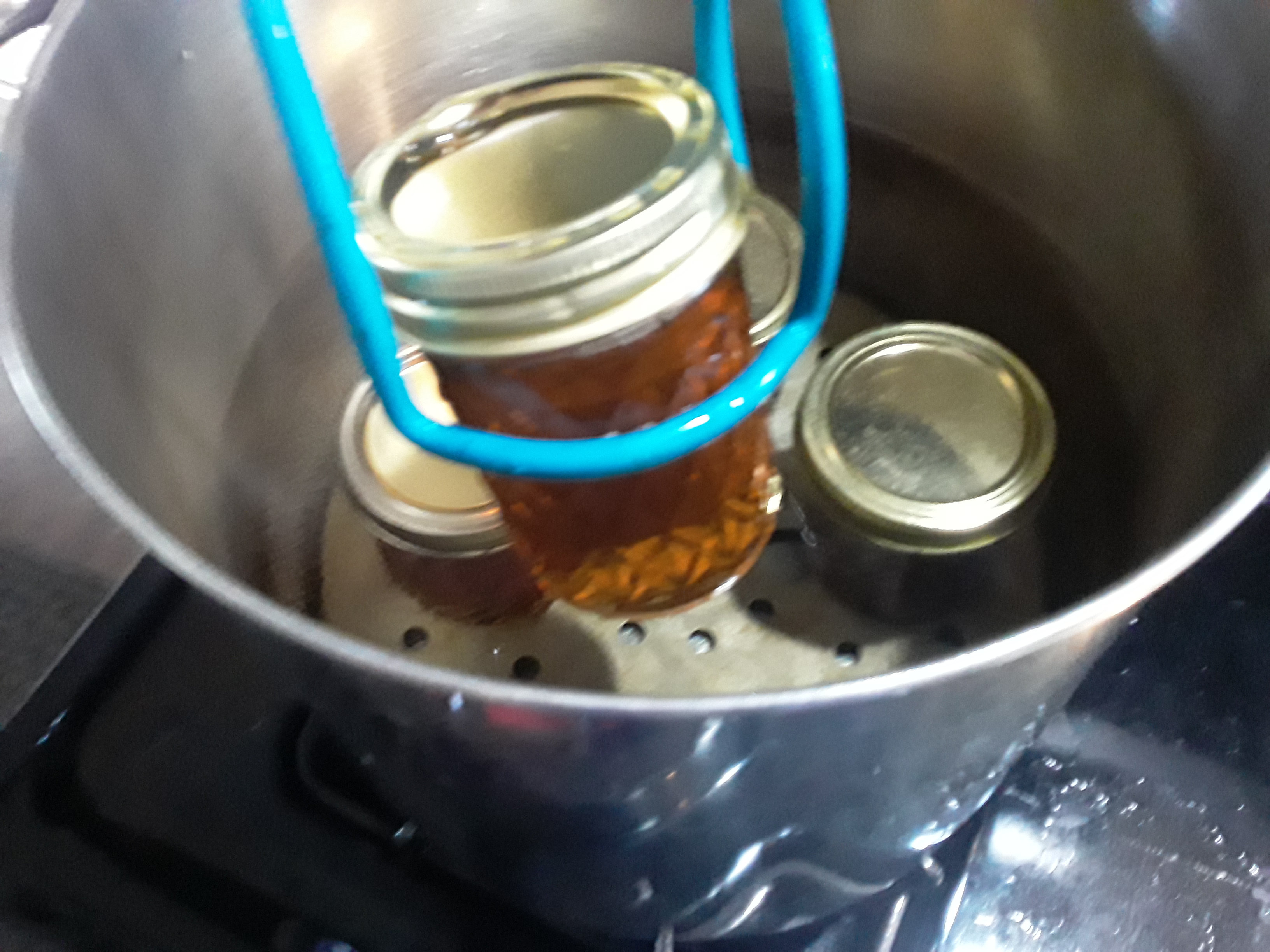
Our jelly bubbled for about 1/2 hour, until it seemed to be getting a little thicker. Then grandma ladled it into hot jars and water-bathed them for a few minutes.


There are a ton of recipes on the web for making dandelion jelly, so I'll let you search those out. Ours was a mostly-guesswork version, and it turned out well. Our jelly didn't set great this time. It's a little loose, but very honey-like. We'll probably use it as a sweetener for other tea. It's very tasty and not bitter at all! 


And these two little dandelions are very sweet too!


Straining the Brew

What are some ways you plan to return to frugal living, if any?
Any thrifty ideas you want to share?


Releasing June 1st, 2022!


Season of My Enemy (Heroines of WWII series)

Only last year, Fannie O’Brien’s future shine bright, despite the war pounding Europe. Now with her father’s sudden death and her brothers overseas, Fannie must now do the work of three men on their 200-acre Wisconsin farm—until eight German prisoners arrive as laborers and, just as Fannie feared, trouble comes too.

Captain Wolfgang Kloninger is relieved that his boys are off the warfront, keeping busy working the O’Brien farm, until they can go home again and he can return to his teaching position in Germany.

Crops take precedence, even as “accidents” happen around the farm. Could a saboteur be among them? Fannie is especially leery of the handsome German captain who seems intent on cracking her defenses. Can she manage the farm and hold her family together through these turbulent times, all while keeping the prisoners—and her heart—in line?

Grab Season of My Enemy!


Naomi is a multi-published author whose heart beats hardest for fiction set in America’s by-gone days. Her novel Mist O’er the Voyageur was a 2019 Selah Awards finalist, Book of the Year finalist, and NE Minnesota Book Awards finalist. It’s sequel Song for the Hunter released in early 2022. Also in 2022 come Lumberjacks and Ladies: Four Stories of Romance Among the Pines, and Season of My Enemy (Heroines of WWII). Naomi believes a perfect day is spent working on a story, roaming about her family’s northern Wisconsin farm, snacking out of the garden, relaxing in her vintage camper, and loving on her passel of grandchildren. Find her online at the usual reader hideouts.

Website & Newsletter

Bookbub

Goodreads

Amazon Author Page


Saturday, April 23, 2022

WEDDING GOWNS FROM THE SKY: Even War Can’t Stop Love

By Mary Davis

Parachute chic. / Christopher Sessums, Flickr // CC BY-SA 2.0
WWII and post-WWII brides had to be resourceful if they wanted a special dress for their wedding day because of rationing and shortages. Fabrics of any kind were designated as military and war essential—especially silk. This luxury fabric had it all—strong, lightweight, fire resistant, and easy to pack. Perfect for parachutes. But that meant those on the home front went without. So what was a bride to do for her special day? Use whatever was available. Some wore their Sunday-best dress, others borrowed someone else’s wedding dress, or they refashioned a family member’s outdated one. Orrrrrr . . .

. . . make a dress from a parachute with its yards and yards and yards and yards of beautiful white silk (or nylon late in the war). The best wedding gowns were made from their sweetheart’s parachute that brought them to safety. Ruth, Rosalie, Janet, and countless others all around the world did just that.

Violette de Courcy is licensed under a Creative Commons Attribution-NonCommercial-ShareAlike 3.0 Unported License // CC BY-NC-ND 3.0

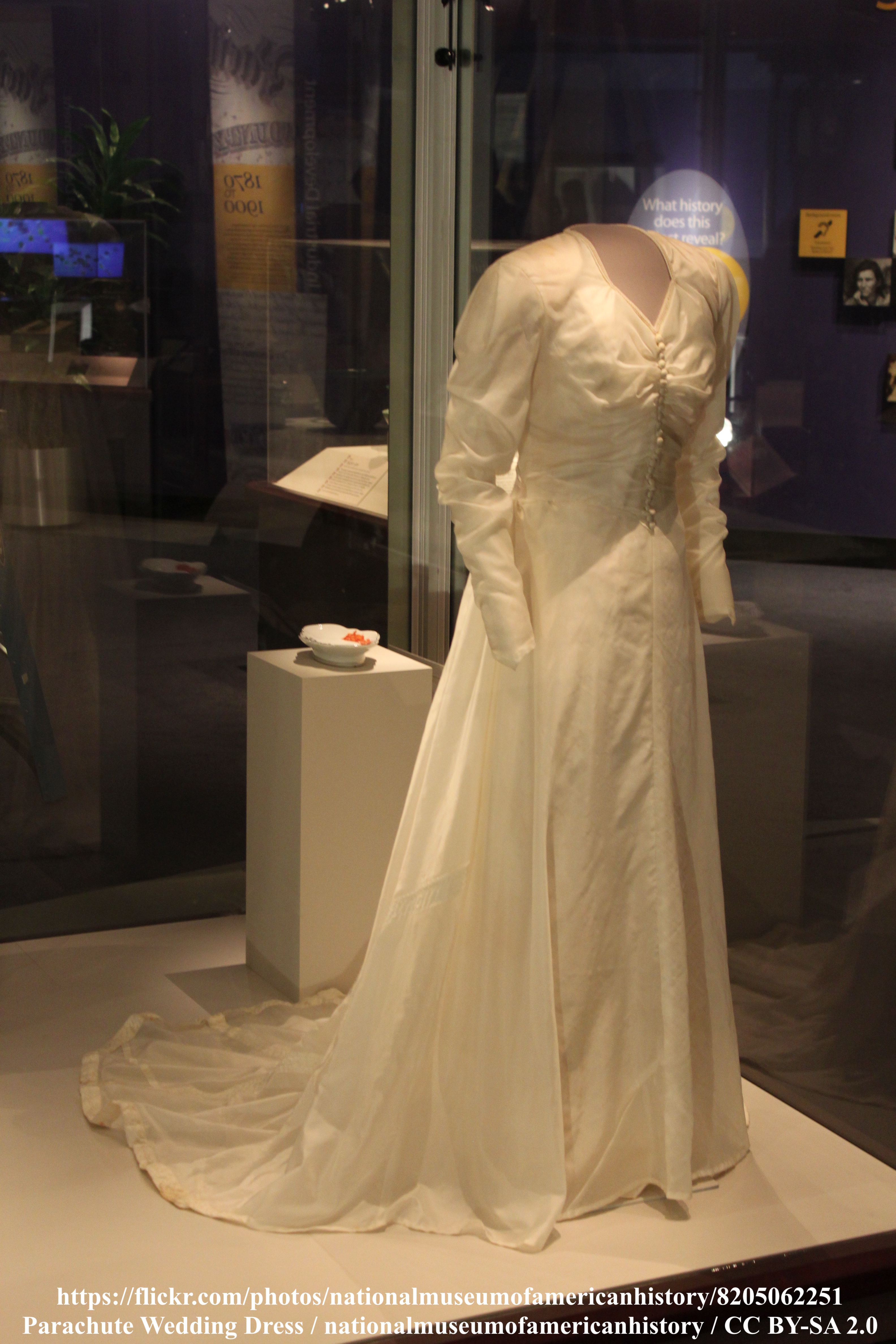
While returning from a bombing raid over Japan in August of 1944, B-29 pilot Maj Claude Hensinger and his crew were forced to bail out when their aircraft caught fire. After it saved his life, Claude used his parachute as a pillow and blanket until he was rescued. When he returned to the States, he used his life-saving parachute in lieu of a ring to propose to Ruth, asking her to make her wedding dress out of it. Claude and Ruth wed on July 19, 1947. The couple’s daughter as well as their son’s bride wore this dress before it was donated to the Smithsonian.

Parachute Wedding Dress / nationalmuseumofamericanhistory / CC BY-SA 2.0

On November 15, 1945, Rosalie Hierholzer walked down the aisle in a wedding gown fashioned out of her sweetheart’s bullet-hole riddled parachute. While flying over Germany, radio operator Temple Leslie Bourland and his crew had to bail out when their aircraft was hit by enemy fire. As Bourland floated toward the ground, he was shot in the hip, and his parachute received several bullet holes. When Bourland showed his fiancee his war mementos, Rosalie’s aunt offered to make her niece’s wedding gown from the silk, bullet holes included. With up to forty yards, there was plenty.

Reo Arland Casper, a native of Idaho, enlisted in the US Marines at age nineteen. Janet Gleason of Massachusetts signed up for the Navy WAVES (Women Accepted Volunteer Emergency Service) at age twenty-one. Their paths crossed at Fort Dix in New Jersey, where they struck up a friendship that evolved into a romance, and they fell in love. Janet packed Reo’s parachute for his final jump before graduation Paramarine training. Before he shipped out for his first duty, he proposed, and the pair planned to wed after the war was over. Knowing she couldn’t afford a wedding dress, Janet’s commanding officer gave her a Japanese silk parachute. With it, she fashioned the gown she would marry Reo in and packed it away until the end of the war. And the war did end, but Reo’s mother objected to the marriage because of religious differences. So, the couple went to Montana and eloped. They were married for fifty-eight years. You can learn more about Reo and his bride HERE as well as see Janet’s dress. 

Here are a few others.

“Wedding dress made from parachute silk which American soldier Tom Worthington acquired while serving in Japan during World War II.” Ben P L from Provo, USA, Wikimedia.org

“Wedding dress made in Normandie, France in the summer of 1944 from fabric from a parachute. This wedding dress was made from a silk American reserve parachute. Fabric had been scarce under the German occupation and parachutes were much sought after items for their potential to make new clothes. Photo taken in 2015 showing items from the former International Museum of World War II in Natick, Massachusetts, a few miles west of Boston.” Lee Wright, Wikimedia.org

“Dress, bordeaux red, 1945 from the white parachute material from a Second World War, military parachute which has been painted; the upper part has small shiny pearls. Photographed in the collection of the National Liberation Museum 1944-1945, the Netherlands, archive number 3.2.53.” KingaNBM
, Wikimedia.org
 
My guess is this one was either never worn as a “wedding dress” or after the wedding it was dyed red to get more use out of it. No wasting good fabric.
 
I love stumbling across little gems like this while researching. For my WWII novel, Mrs. Witherspoon Goes To War, I needed to know a thing or two about parachutes: the type, weight, steering capability, and such, when a wedding dress made from a parachute popped up. That’s way cool! I wanted to know more, and I WANTED to use it, but sadly, it wouldn’t fit into my story. Perhaps, someday I’ll have the perfect story to include this wonderful bit of history in.


MRS. WITHERSPOON GOES TO WAR (Heroines of WWII series)

A WASP (Women Airforce Service Pilots) flies a secret mission to rescue three soldiers held captive in Cuba.

Margaret “Peggy” Witherspoon is a thirty-four-year-old widow, mother of two daughters, an excellent pilot, and very patriotic. She joins the WASP. As she performs various tasks like ferry aircraft, transporting cargo, and being an airplane mechanic, she meets and develops feelings for her supervisor Army Air Corp Major Howie Berg. When Peggy learns of U.S. soldiers being held captive in Cuba, she, Major Berg, and two fellow WASPs devise an unsanctioned mission to rescue them. With Cuba being an ally in the war, they must be careful not to ignite an international incident.

Get it HERE!


MARY DAVIS, bestselling, award-winning novelist, has over thirty titles in both historical and contemporary themes. Her latest Quilting Circle release is THE DÉBUTANTE'S SECRET (The Quilting Circle  4), THE DAMSEL’S INTENT (The Quilting Circle  3) is a Selah Award Winner. Some of her other recent titles include; THE WIDOW'S PLIGHT (The Quilting Circle  1), THE DAUGHTER'S PREDICAMENT (The Quilting Circle  2),Zola’s Cross-Country Adventure” in The MISSAdventure Brides Collection , Prodigal Daughters Amish series, and "Bygones" in Thimbles and Threads. COMING IN OCTOBER 2022 THE LADY'S MISSION (The Quilting Circle  5).
Mary lives in the Pacific Northwest with her husband of thirty-seven years and one cat. She has three adult children and three incredibly adorable grandchildren.

Saturday, August 14, 2021

America’s First Female Cryptanalyst


By Johnnie Alexander


A few weeks ago, I got a fun tweet from a gal whose Twitter name is MelissasLibraryLife. She was reading a pre-pub copy of The Cryptographer’s Dilemma and asked me this question:


“Only a few pages in and I wonder if it was based on Elizebeth Friedman’s doll collection case? Her collection is here at the #MarshallFoundationLibrary.”


My heroine’s backstory resembles that of many of the young women who were recruited by either the Navy or the Army to break codes. My main source for their stories was Code Girls: The True Story of the American Women Who Secretly Broke Codes in World War II by Liza Mundy.

These women often attended college on scholarships because their families were financially ruined during the Great Crash of 1929. They majored in such fields as astronomy, music, mathematics, and languages, and they often became teachers. As the young men went off to war, however, more job opportunities opened up for these talented and intelligent women.


I also read about Elizebeth Smith Friedman, first in Velvalee Dickinson: The “Doll Woman” Spy by Barbara Casey and in an until-then-unread book I found on my own WWII bookshelf, The Woman Who Smashed Codes: A True Story of Love, Spies, and the Unlikely Heroine Who Outwitted America's Enemies by Jason Fagone.


Melissa, who is the director of library and archives at the George C. Marshall Foundation, told me that Elizebeth and her husband had donated more than 800 photos, their personal papers and library, and even their desk to the Marshall Foundation located in Lexington, Virginia. She even “had the privilege of supplying information” for an episode of PBS’s American Experience called “The Codebreaker” (Season 33, Episode 1). I purchased the episode on Amazon Prime (only $4.99!) and highly recommend it. 

Elizebeth was the youngest of ten children born to John and Sopha Smith, Quakers who lived on an Indiana farm. She graduated from Hillsdale College (Michigan) in 1915. Though she majored in English literature, she also studied Latin, German, and Greek.

In a strange turn of events, Elizebeth was hired by George Fabyan, a wealthy textile merchant, to search for enciphered messages he believed were hidden in Shakespeare’s works. Though she never found these messages, her work led her to decode messages for the government during World War I, during Prohibition, and during World War II. 


After Velvalee’s arrest for sending coded messages to the Japanese, J. Edgar Hoover asked Elizebeth to review the letters to help the FBI build their case. Though she wasn’t the first to break Velvalee’s jargon code, she did perform [check this].

Unfortunately, Hoover made sure the FBI was credited with much of Elizebeth’s work—particularly for the codes she broke during WWII. Her contributions were mostly lost to history until documents from the era were eventually declassified.


This photo of Elizebeth and her husband, William, on their wedding day in May 1917. William was also a cryptographer with the U.S. Army. In the 1930s, he ran the Army's Signal Intelligence Service research division. [Photo Credit: George C. Marshall Foundation, Lexington, VA. (Thanks, Melissa!)]


Elizebeth died on October 31, 1980 at the age of 88. After her death, she received the following honors:

  • The NSA inducted her into the NSA Hall of Honor in 1999.
  • The NSA dedicated their OPS1 building as the William and Elizebeth Friedman Building in 2002.
  • The U.S. Senate passed a resolution honoring Elizebeth's "life and legacy" in 2019.
  • The U.S. Coast Guard named a Legend-Class National Security Cutter the USCGC Friedman in Elizebeth's honor in 2020.

Here are the links to my previous posts about "The Doll Woman" investigation:  


The Doll Woman ~ A World War II Traitor


World War II's "Number One Woman Spy”


FBI Field Offices ~ A Brief History of a Select Few


Johnnie Alexander imagines stories you won’t forget in multiple genres. A fan of classic movies, stacks of books, and road trips, she shares a life of quiet adventure with Griff, her happy-go-lucky collie, and Rugby, her raccoon-treeing papillon. 

Purchase The Cryptographer's Dilemma at http://bit.ly/ja-TCD.


Connect with Johnnie at johnnie-alexander.com.