Showing posts with label Inventors. Show all posts

Monday, October 2, 2023

How Clumsiness and Boy Scouts made the Band-Aid


Amber Lemus Christian Author
Blogger: Amber Lemus


Earle Dickson as a young man
Johnson & Johnson Archives
Used under Fair Use

I love reading about inventions because the stories are always entertaining. Either it was a funny accident, an inspirational story of perseverance, or an ingenious solution to a problem most people skim over. For example, did you know the Band-Aid was invented for a woman who was clumsy, especially in the kitchen?

Earle Dickson was born October 10, 1892 in Grandview, Tennessee. In 1917, Earle married Josephine Frances Knight. He was working at the Johnson and Johnson company as a cotton buyer, while his wife stayed at home keeping house. However, he quickly discovered that dear Josephine was constantly burning her fingers, nicking them with knives, or having some type of mishap around the house. She must have complained to him about the difficulty of bandaging up those minor wounds by herself while she was at home alone everyday, because he quickly came up with a solution.

Earle took a patch of gauze and affixed it to the center of surgical tape. He then used a band of crinoline to keep the tape from sticking to itself. What resulted was an easy-to-use bandage that his wife could easily use by herself to cover those injuries and prevent infection or further tearing of the skin. It worked wonderfully.

When Earle went back to work at Johnson and Johnson, he mentioned his solution to a coworker, who thought it was genius. The coworker encouraged him to take the idea to management and see if they would be interested in it. Initially, the managers at J&J were not impressed, but when Earle demonstrated that he could apply the bandage by himself to his own wounds, they saw that as a great feature. His supervisor told one of the Johnson brothers about the idea, who decided to adopt it and released the product to the public in 1921 under the brand of the Band-Aid. 

Band-Aid ad 1921
Early Ad for the Band-Aid
Johnson & Johnson Archives
Used under Fair Use


During this time, Johnson and Johnson were already successful producers of gauze and bandages for hospitals as well as military installations, so they had a built in market for this new product. Still, the first launch of the product was mostly a flop. Only $3,000 worth of the product was sold during the first year of production. Some believe that the reason it didn't initially take off was because the first versions of the Band-Aid were 2.5 inches wide by 18 inches long. The idea was that you could cut off whatever length of bandage you required for your injury.

Sales remained low, until someone came up with the idea of providing free, unlimited Band-Aids to the Boy Scout troops across the country. With the Boy Scouts using them, they became widely known and the demand for the Band-Aid soared.

In 1924, the Johnson and Johnson company started pre-cutting the Band-Aids into select sizes. Then in 1939, they began producing them as fully-sterilized bandages, just in time for WWII.

As for Earle Dickson, he was promoted for his invention and climbed to the rank of Vice President of the Johnson and Johnson company. He also became a member of the board, where he remained until his death in 1961, at which time the company was producing more than 30 million dollars worth of Band-Aids per year.

Today, more than 100 Billion Band-Aides have been produced and they have become one of the worlds most iconic and innovative products.

In recognition of his invention, Earle Dickson was inducted into the Inventor's Hall of Fame in 2017.

*****


Two-time winner of the Christian Indie Award for historical fiction, Amber Lemus inspires hearts through enthralling tales She has a passion for travel, history, books and her Savior. This combination results in what her readers call "historical fiction at its finest".

She lives near the Ozarks in her "casita" with her prince charming. Between enjoying life as a boy mom, and spinning stories out of soap bubbles, Amber loves to connect with readers and hang out on Goodreads with other bookish peoples.

Amber is a proud member of the American Christian Fiction Writers Association. Visit her online at http://www.amberlemus.com/ and download a FREE story by subscribing to her Newsletter!

Saturday, September 2, 2023

Doctor Charles R. Drew, Inventor of the Blood Bank

Amber Lemus Christian Historical Author
Blogger: Amber Lemus

By Associated Photographic Services, Inc
- National Library of Medicine

Continuing our series on lesser-known inventors, today we learn about Dr. Charles R. Drew, the American surgeon who pioneered the techniques for blood storage, which is why he is known as the "Father of the Blood Bank."


Charles Drew was born June 3, 1904 in Washington D.C. He was the son of a carpet layer and a teacher, the oldest of four children. They grew up in the Foggy Bottom neighborhood and from a young age, Drew began working as a newspaper delivery boy.

Charles was able to attend Dunbar High School, which was an advantage for him because the school was known for its equality and opportunities for all students, regardless of the racial issues of the time. Although he still experienced hostility from opposing teams, and was passed over for the position of Captain of the team, even though he was the best player. After high school, Drew won an athletics scholarship, but a biology professor ignited his interest in medical science. Further education would be expensive, so Charles became a biology and chemistry professor to earn money to pursue his next goal, medical school. He also served as an athletics coach.
Charles's High School Yearbook Entry
Public Domain


When he was ready to pursue his medical career, circumstances led Charles to McGill's medical school in Montreal, Canada. He excelled in his class, winning multiple honors and scholarships. It was here that he met Dr. John Beattie, a doctor at Montreal Hospital who was studying the correlations between shock therapy and blood transfusions. Charles interned with Doctor Beattie while earning his surgical residency at the hospital.

Still, Charles career path was fraught with difficulty and racial discrimination. He intended to further his research on blood transfusions at Mayo Clinic, but was barred from going so because their practices didn't allow black scholars. So instead, he went to Columbia University, where he won a fellowship to train with eminent surgeon, Allen Whipple. However, he was still assigned to a non-traditional path which deprived him of some of the assets afforded to his white peers, such as direct access to patients. He was, however, able to continue his study of blood storage and transfusions. He eventually managed to prove himself and his intellect, and his superiors began to respect his brilliance.


In 1940, Charles wrote a doctoral thesis on "Banked Blood: A Study on Blood Preservation". It was through this research that Charles discovered that blood could be preserved two months longer by de-liquefying it. This paper earned him the honor of becoming the first African American to earn the Doctor of Science in Medicines degree at Columbia University.
Illustration of Charles Drew from the National Archives
Public Domain


This quote from the American Chemical Society article explains how important this breakthrough was.

"Dr. Charles Richard Drew broke barriers in a racially divided America to become one of the most important scientists of the 20th century. His pioneering research and systematic developments in the use and preservation of blood plasma during World War II not only saved thousands of lives, but innovated the nation’s blood banking process and standardized procedures for long-term blood preservation and storage techniques adapted by the American Red Cross." ~ACS biography of Charles R. Drew


In February of 1941, Charles was appointed as Director of the first American Red Cross blood bank. He also invented mobile blood donation centers, which greatly increased prospective blood donation. However, this appointment was short lived. The two greatest buyers of the blood were the US Navy and US Army, who refused African-American blood. They later decided to accept it, but only if it was stored separately from blood from white donors. Charles objected to this exclusion, stating that it had absolutely no scientific foundation. He resigned his post in 1942 in protest.

“While one must grant at once that extraordinary talent, great intellectual strength and unusual opportunity are necessary to break out of this prison of the Negro problem, we believe that the Negro in the field of physical sciences has not only opened a small passageway to the outside world, but is carving a road in many untrod areas, along which later generations will find it more easy to travel. The breaching of these walls and the laying of this road has not been, and is not easy.” — Charles Drew


Charles stated that his greatest mission in life, and what he considered to be his greatest accomplishment, was training young African-American surgeons who would meet the most rigorous standards in any surgical field, and in turn place them in strategic positions throughout the country where they could nurture the tradition of excellence.


Charles career was full of honors both in academics and research. He was granted the Springard Medal by the NAACP for his work on British-American projects in 1944. He also received honorary doctorate degrees in the sciences from Virginia State College in 1945, followed by Amherst in 1947. However he died without being accepted as a member of the American Medical Association, since African-American physicians were still excluded.

Doctor Charles Drew was still campaigning against such exclusions when he tragically died in 1950 after sustaining fatal injuries in a car accident. He was only 46 years old, but he left a life-saving legacy behind.

*****
Two-time winner of the Christian Indie Award for historical fiction, Amber Lemus inspires hearts through enthralling tales She has a passion for travel, history, books and her Savior. This combination results in what her readers call "historical fiction at its finest".

She lives near the Ozarks in her "casita" with her prince charming. Between enjoying life as a boy mom, and spinning stories out of soap bubbles, Amber loves to connect with readers and hang out on Goodreads with other bookish peoples.

Amber is a proud member of the American Christian Fiction Writers Association. Visit her online at http://www.amberlemus.com/ and download a FREE story by subscribing to her Newsletter!

Wednesday, August 2, 2023

The Invention of Gas Masks

Blogger: Amber Lemus


Garrett A. Morgan
Public Domain

In April, we learned about a man who helped invent the stoplights that we know today. ( You can read that post here.) His name is Garrett A. Morgan, and we are revisiting this amazing inventor today because another of his inventions bears a story worth telling.

Our story begins in Cleveland during the post civil-war era. The industrial boom led to pollution of the Cuyahoga River, which had been the city's primary source of drinking water. In response to the issue of tainted water, the city began construction of water tunnels that would draw water from old riverbeds further away, where hopefully the water was untainted. The city ended up constructing multiple tunnels, each one longer, and larger in diameter than the last. The construction on the fourth tunnel began in March of 1914.

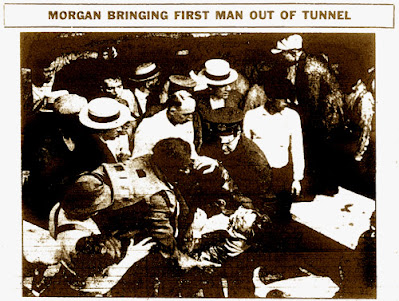
Tunnel construction was dangerous business. While building the third tunnel, more than thirty three workers had lost their lives in four separate accidents. The fourth tunnel, however, started off great. Initially, safety standards were lauded, and two years passed without major incident. However, on the evening of July 24, 1916, a foreman led his crew of eight men down into crib number five. A natural gas leak somehow ignited, causing a massive explosion and trapping the crew hundreds of feet below the surface, buried in debris and mud.

Rescue crews were formed and sent down, but that didn't go well. The first two attempts ended with 10 additional deaths due to the inhalation of gas inside the tunnel. Several additional efforts were made, but they were only able to rescue one of two members of the second rescue team that had fallen unconscious in the tunnel.

Garrett Morgan demonstrates his invention.
Source: Cleveland State University, Michael Schwartz Library, Special Collections

Someone remembered Garrett Morgan, an inventor and entrepreneur there in Cleveland, who had designed a device he called a safety hood and smoke protector. They called for Garrett, and he and his brother Frank bravely volunteered to go down in the tunnel, equipped with his invention which later became known as the gas mask. Garrett, his brother, and their crew were able to rescue two men, and recover four bodies. However, they were prevented from further rescue missions because the US Bureau of Mines put a stop to the efforts.

Eventually, all the bodies were recovered, but it was a tragedy that overshadowed the city of Cleveland for decades. Investigations were launched, with fingers pointing in every direction. When fault was directed at city officials, suddenly the investigations came to a halt, and it was concluded that it was no one's fault, but every man did what they thought was best. 

Public Domain

Garrett had personally made four trips into the tunnel, which affected his health for years to come, despite the use of the mask. Garrett's mask design was simple; a cotton hood with two hoses that hung down to the floor. Moist sponges would then filter the less-toxic air closer to the ground. It did not, however, filter out all of the fumes.

Despite Morgan's essential role in the rescue, Harry L. Davis, who was the mayor at the time, failed to put his name, or his brother's, on the list of men recognized as heroes. Many of the men who participated in the rescue efforts received the Carnegie medal for their bravery, but he and his brother were excluded from that honor by city officials. Garrett believed his race was the reason for this, which was confirmed by Victor M. Sincere of the Bailey Company in his statement to the committee.


"Your deed should serve to help break down the shafts of prejudice with which you struggle. And is sure to be the beacon of light for those that follow you in the battles of life."
-Victor M. Sincere in a statement to the Citizens Award Committee.


 Later on, in 1917, citizens of Cleveland awarded Garrett a diamond-studded gold medal in an effort to correct this omission. 

The one good thing that came out of the incident was the publicity for Morgan's gas mask. His company received orders from all over the country for the hoods. However, the national news that covered the story included a photo of Garrett. When the officials in a number of southern cities saw his photo, they cancelled their orders. Nevertheless, Garrett Morgan went on to become a successful entrepreneur and an advocate of civil rights. Many have recognized and honored him and his accomplishments by placing his name on schools, and granting awards and honorary memberships. He was inducted into the Inventor's Hall of Fame in 2005.


As for his life-saving invention, gas masks were further developed to be much safer. They now have the ability to protect the wearer for many types of toxins, including pesticides, fumes from paint or other materials, and even chemical weapons. To try to number the lives saved by this apparatus (derivatives were used in both World Wars) would be impossible.

*****

Two-time winner of the Christian Indie Award for historical fiction, Amber Lemus inspires hearts through enthralling tales She has a passion for travel, history, books and her Savior. This combination results in what her readers call "historical fiction at its finest".

She lives near the Ozarks in her "casita" with her prince charming. Between enjoying life as a boy mom, and spinning stories out of soap bubbles, Amber loves to connect with readers and hang out on Goodreads with other bookish peoples.

Amber is a proud member of the American Christian Fiction Writers Association. Visit her online at http://www.amberlemus.com/ and download a FREE story by subscribing to her Newsletter!

Friday, June 2, 2023

The Life of Lewis Latimer, American Inventor and Patent Draftsman

Blogger: Amber Lemus

While researching inventions, I came across a biography for an American inventor by the name of Lewis Latimer. His story is astounding, and he is almost never heard of, so I wanted to share his story with you all today.

Lewis' story really starts with his parents, Rebecca and George Latimer. The couple escaped slavery in Virginia by fleeing to Chelsea Massachusetts in 1842. Since George was the son of a white man and an enslaved African American mother, his skin was light, and he had many of the white features. His wife posed as a servant of his, and they escaped safely, but George's former owner put out a reward for his capture. When he and his wife reached Boston, he was immediately recognized by a colleague of his former slave owner. A few days later, he was arrested.
Lewis' Father, George Latimer
Public Domain


The news of his detention sparked a great conflict in the State of Massachusetts. Latimer was represented by Samuel Sewall, who organized meetings that came to be known as the "Latimer Meetings." According to some sources, Fredrick Douglass was also involved in George's defense. The trial ended with George purchasing his own freedom from his former owner for the price of four hundred dollars. However, the case led to fundraising, petitions, and even the 1843 Liberty Act which is sometimes called the "Latimer Law."

After that case was settled, George and Rebecca settled in Chelsea to raise their family. On September 4, 1848, Lewis was born, the youngest of four children. During his younger years, Lewis spent time in his father's barbershop. But the happiness was not to last.

When Lewis was 10 years old, his family had to be split up. With the ruling of the Dred Scott case, slaves who had escaped to freedom had to prove that they had the consent of their former owners to become free. Lewis's father had no such proof, so he fled, leaving his family behind and hoping that his absence would make the family less of a target. Lewis's mother decided it would be best to further split up the family, so she sent Lewis and his brothers to a farm school.

At the age of 16, Lewis joined the United States Navy, and served aboard the USS Massasoit during the Civil War. He received an honorable discharge on July 3, 1865 and gained employment as an office boy in a patent office. This is where he began to show his true potential.

Lewis Latimer
Public Domain


Lewis quickly learned how to use the tools of drafting and sketching, and his boss started noticing his talent. He was promoted to draftsman, and then head draftsman, his earnings increasing with each promotion. Lewis's creativity was sparked by drafting sketches of other's inventions, and he began to tinker with some of his own.

In 1873, Lewis wed Mary Wilson Lewis, but it would be ten years before they were blessed with children. They did end up having two daughters, Emma Jeanette in 1883, and Louise Rebecca in 1890.


In 1874, Lewis registered his first patent, along with his coworker Charles M. Brown. Together, they had developed a system for water closets in rail cars. A couple years after that, Lewis was hired by Alexander Graham Bell to draft the drawings that would be needed to register the patent for Bell's telephone.

In 1879, Lewis moved to Bridgeport, Connecticut and started working for a competitor of Thomas Edison, the US Electric Lighting Company owned by Hiram Maxim. It was here that he made his most well-known innovation. He was working on improving the filaments inside the light bulbs so they could last longer and be more cost-effective. Lewis successfully invented a modification to the filament process that made it more durable, and therefore more affordable to the public. These filaments were substantially safer than gas lamps, but also less harsh than some of the prior inventions such as arc lights. His invention transformed the average American home after nightfall.


Lewis was an incredibly intelligent man, who could speak and translate into German and French, and could teach workers how to create a light bulb from beginning to end, including the glass blowing formation of the bulb. He registered several patents during his lifetime, including a fore-runner to our modern day Air Conditioner.


After leaving the US Electric Lighting Company, Lewis went on to work with Thomas Edison, became a patent inspector, an expert witness, an author of several books, a teacher, and a member of the Board of Patent Control.

Despite many societal challenges, Lewis was able to become a successful inventor and was respected in his field. He was accepted into the Edison Pioneers, an exclusive group of 100 innovative minds, and he was the first person of color to attain that honor. He was also an early advocate of Civil Rights


Lewis Latimer passed away on December 11, 1928 at the age of 80, but his legacy remained. There is a museum in New York with his family's home dedicated to the inventor, the invention program at MIT is named after him, as well as several schools also being named in his memory. Finally, Lewis was inducted into the National Inventor's Hall of Fame in 2006. 


Light Bulb by Lewis Latimer
Daderot, CC0, via Wikimedia Commons


*****
 
 
Two-time winner of the Christian Indie Award for historical fiction, Amber Lemus inspires hearts through enthralling tales She has a passion for travel, history, books and her Savior. This combination results in what her readers call "historical fiction at its finest".

She lives near the Ozarks in her "casita" with her prince charming. Between enjoying life as a boy mom, and spinning stories out of soap bubbles, Amber loves to connect with readers and hang out on Goodreads with other bookish peoples.

Amber is a proud member of the American Christian Fiction Writers Association. Visit her online at http://www.amberlemus.com/ and download a FREE story by subscribing to her Newsletter!


Tuesday, May 2, 2023

Inventor Alexander Miles and the Automated Elevator Door

Amber Lemus Christian Author
Blogger: Amber Lemus


Photo of inventor and businessman Alexander Miles, public domain
Alexander Miles
Public Domain

Alexander Miles was an American inventor who was both born and passed away in the month of May, so I figured this would be a fitting month to learn about this incredible man.

Alexander was born May 18, 1838 to Michael Miles and Mary Pompy in Ohio. Since he was born in a free state, and was never recorded as enslaved, historians believe that he was a freeman.

After Alexander became of age, he moved to Wisconsin where he made a living as a barber. His innovative talents were already emerging as he created and marketed hair products. While in Wisconsin, he met Candace Dunlap, who was a widow with two children. Though she was four years older than him, they fell in love and married. Together they had one daughter whom they named Grace.

Shortly after the birth of their daughter, they moved to Duluth, Minnesota. Alexander and his wife decided to take a risk and invested their life savings into a real estate office. This proved to be a smart investment for them, and they lived in prosperity in Duluth, even getting a whole block named after them because of his real estate developments. He had also opened a barber shop at the upscale four-story Saint Louis hotel, and his business achievements paved the way for him to become the first African-American member of the Duluth Chamber of Commerce.


It was most likely at the aforementioned hotel that Alexander's innovative mind was exposed to the elevator problem. As the story goes, Alexander was riding in an elevator with his daughter when he realized the dangers of the current door operating system. At this time, the doors could only be operated by either the people inside the elevator, or a dedicated elevator operator. However, people often forgot, or didn't go through the hassle to manually close the doors, which created a danger of people falling into the elevator shaft. In the early days of elevators, it could be quite dangerous and usually resulted in serious injury or death. Alexander thought that if the elevator doors would open and close automatically when leaving and arriving at the various floors, it would create a safer environment. 

Diagram of Alexander Mile's invention


He set to work on a design and came up with a system that utilized a flexible belt attached to the elevator cage, drums to indicate the elevator's position, and various levers and rollers. He was granted a patent for his design on October 11, 1887. It's interesting, because thirteen years prior, an inventor was granted a patent on an automatic elevator door system, however his design never took hold. It was Alexander's design that was used and is even influential in our modern-day elevators. Needless to say, his invention earned a lot of income for him and his family.

Second diagram of his invention
Public Domain


In 1899, at the age of sixty-one, Alexander founded yet another business, The United Brotherhood. It was a life-insurance company specifically formed for African-American customers who were being turned down for coverage from white-owned firms.

By the time of his death on May 7, 1918, Alexander Miles was considered the wealthiest African-American in the Pacific Northwest area. He was inducted into the National Inventors Hall of Fame in 2007.

*****

Two-time winner of the Christian Indie Award for historical fiction, Amber Lemus inspires hearts through enthralling tales She has a passion for travel, history, books and her Savior. This combination results in what her readers call "historical fiction at its finest".

She lives near the Ozarks in her "casita" with her prince charming. Between enjoying life as a boy mom, and spinning stories out of soap bubbles, Amber loves to connect with readers and hang out on Goodreads with other bookish peoples.

Amber is a proud member of the American Christian Fiction Writers Association. Visit her online at http://www.amberlemus.com/ and download a FREE story by subscribing to her Newsletter!

Thursday, February 2, 2023

Margaret Knight: The Most Famous 19th Century Woman Inventor

Blogger: Amber Lemus


Newspaper article about Margaret Knight
Public Domain.

Continuing from our post on shopping bags last month, today we explore the fascinating and inspiring life of female inventor, Margaret Knight. February happens to be her birth month also!

Young girl working in a cotton mill
Public Domain


"Mattie" was born to Hannah Teal and James Knight on February 14, 1838 in York, Maine. She was known as a very odd little girl, because instead of dolls she preferred woodworking tools. Her father died when she was very young, so she and her two brothers were raised by her widowed mother. Life was very hard for them, and she didn't receive much education, since she had to leave school as soon as she was old enough to start working in the cotton mill with her brothers.


Mattie's first invention was spurred by yet another traumatic event. At age twelve, she was working in the cotton mill when a nearby machine malfunctioned, and sent a steel-tipped shuttle shooting out of the machine and into a young boy. Terrorized by the event, she immediately set to work and conceived a safety device to shut off the machine if something went wrong. Her device was developed and put into use, supposedly by mills all over the country. However she would never see a dime from that invention.

Before long, Mattie developed health conditions that prevented her from continuing to work in the cotton mill. She tried many different things to earn a living, including home repair, engraving and furniture upholstery. In 1867, near age thirty, Mattie moved to Springfield, Massachusetts and began working in a paper bag factory. The bags they made were envelope style, but they had several issues that made them less functional. However, flat-bottomed bags were more expensive to produce, since they had to be made by hand. Mattie's mind set to work on that problem.

About a year later, in 1868, Mattie invented a machine that cut, folded, and glued paper to form flat-bottomed brown paper bags, much like the ones we know today. This machine would greatly increase the speed of production for these bags, allowing a mass manufacturing of the more efficient design.
Another of Knight's Patents for a rotary engine.
Public Domain


This time, Mattie knew the value of what she had, and she intended to go about it in a way that would allow her to patent the machine and reap the rewards of her labor. She made her own wooden prototype, but she needed a working iron model in order to apply for a patent. So she went to a machine shop to get it built. But when Mattie went to patent her design, she discovered that someone else had already done so.

Charles Annan was either working at the shop to build the prototype, or was near enough to see the design as it was in the making, and he stole the design and filed his own patent. During this point in history, patents hadn't been awarded to women, at least not openly. Women would disguise their names by only using initials so their names were not perceived as female. But this was something Mattie was willing to fight for. She took Annan to court, shelling out over $100/day in legal fees (something around $2,143 today) to win back her patent. Annan argued that his invention was different than Mattie's, and that she never developed a fully functional machine. He even went so far as to state that "she could not possibly understand the mechanical complexities of the machine". Most consider this comment to stem from his prejudice against women, although some debate that point. Either way, Mattie had to bring witnesses, and copious amounts of evidence to prove the invention was actually hers. After a sixteen day hearing, which would have cost her over $1600 (over $34,000 in today's market.) she won the case and her patent was awarded in 1871.


From there, Mattie was able to sustain herself from the royalties of her patents. She continued to invent and registered more than 80 patents during her lifetime. Later in life, as she reflected on her accomplishments she said, "I'm only sorry I couldn't have had as good a chance as a boy, and have been put to my trade regularly." She is one of the most saluted women in the suffrage movement, because she demonstrated women's cognitive abilities and succeeded in a predominately male field.

Some articles have claimed that she was the first woman to receive a U.S. Patent, however that doesn't seem to hold up to fact checking.

Regardless, Margaret E. Knight is an inspiring person who despite countless trials, setbacks, and even having to fight for a place in the world, rose above it all to succeed at what she loved.

Today, I'd love to know what that would be for you. If you could rise above it all and succeed in a field, what field would that be? Leave me a comment below the blog post and let me know.


****
Two-time winner of the Christian Indie Award for historical fiction, Amber Lemus inspires hearts through enthralling tales She has a passion for travel, history, books and her Savior. This combination results in what her readers call "historical fiction at its finest".

She lives near the Ozarks in her "casita" with her prince charming. Between enjoying life as a boy mom, and spinning stories out of soap bubbles, Amber loves to connect with readers and hang out on Goodreads with other bookish peoples.

Amber is a proud member of the American Christian Fiction Writers Association. Visit her online at http://www.amberlemus.com/ and download a FREE story by subscribing to her Newsletter!