Showing posts with label Civil Rights. Show all posts

Tuesday, July 2, 2024

On This Day: Civil Rights Act of 1964 Signed Into Law

Amber Lemus Christian Author
Blogger: Amber Lemus


On this day, July 2, 1964, a very important change came to the United States of America. The Civil Rights Act was signed by President Johnson, which made segregation illegal and went a long way in promoting equality over racism in the workplace and public spaces.

Lyndon B. Johnson signing the Civil Rights Act of 1964
Public Domain


But did you know this wasn't the first effort to legislate Civil Rights? The 1964 law was actually the culmination of years of activism and protest by civil rights leaders, including Martin Luther King Jr., who had advocated for an end to segregation and discrimination since the emancipation proclamation.

The first civil rights law in the United States was the Civil Rights Act of 1866, which was enacted on April 9. This pivotal legislation was the first to define citizenship and affirm that all citizens are equally protected by the law. Since this was the first law to be passed in the aftermath of the Civil War, it was primarily aimed at protecting the civil rights of persons of African descent born in or brought to the United States. Congress passed the law twice; however it was vetoed twice by President Andrew Johnson. Congress then voted to override his veto, which made it the first major law to be passed without Presidential signature.

While the 1866 law granted all citizens, regardless of color or previous enslavement, the right to make and enforce contracts, sue and be sued, give evidence in court, and inherit, purchase, lease, sell, hold, and convey real and personal property, many argued that Congress didn't yet have the authority to enforce such a law on individual states. It wasn't until the passage of the 14th amendment two years later, which officially gave Congress the power to prevent discrimination by states and bestow certain protections equally under the law. Still, this first legislation fell short. Efficacy of the law was continually undermined by the activities of groups such as the KKK, and while it was "technically" illegal to discriminate for housing and employment based on race, the law failed to provide federal penalties for doing so, which basically meant it was left up to individuals or states where people who couldn't afford or acquire legal representation suffered.
President Grant Portrait 1875
Public Domain


In 1871, President Ulysses S. Grant requested legislation prohibiting race-based violence against African Americans. It was passed within a month of his request and is also known as the Ku Klux Klan Act. President Grant utilized the authority granted to him under this law many times during his presidency, and as a result he successfully disbanded the Ku Klux Klan, or at least the first era of it.

In 1875, Congress took yet another step toward racial equality and added legislation prohibiting discrimination in "public accommodations and transportation", and also stating that no one could be excluded from jury service because of race. It was also signed into law by President Ulysses S. Grant but this was later overturned by the Supreme Court in 1883 who ruled it as unconstitutional, stating Congress could not regulate conduct of individuals. It would be a hundred and thirty years before the repeal of this law was rectified.

Amos T. Akerman, appointed Attorney General by Grant,
who vigorously prosecuted the Ku Klux Klan
Public Domain

From 1875 until 1957, no more Civil Rights laws were passed. Our African American population suffered with few laws to protect them from mistreatment, and authorities who hesitated to enforce the laws that were on the books. Activists and protests increased until what is known as the "Civil Rights Movement" was born.

The Civil Rights Acts of 1957 and 1960, although limited, marked the first attempts since Reconstruction to deal with civil rights. The 1957 Act established a Civil Rights Division in the Justice Department and a Commission on Civil Rights to investigate discriminatory conditions. The 1960 Act provided for federal voting referees to assist in voter registration. These acts laid the groundwork for the comprehensive 1964 Act, which would decisively outlaw segregation and discrimination based on race, color, religion, sex, or national origin.
President Kennedy Addressing the Nation regarding Civil Rights
Public Domain


The passage of the act was a battle. It was introduced by President Kennedy in 1963, but met with fierce opposition from some lawmakers, who argued that it was an overreach of federal power. They stifled the bill within committees, and proponents of the bill struggled to get it brought to the Senate floor for a vote. Even when they did, it was killed by a filibuster more than once. After the assassination of President Kennedy, Lyndon B. Johnson pushed the bill forward and was finally the one to sign it into law.

The Civil Rights Act of 1964 was a major milestone in the struggle for equality and justice in the United States. It paved the way for further legislation, such as the Voting Rights Act of 1965, and continues to be an important tool for combating discrimination and promoting equality today.


*****

Two-time winner of the Christian Indie Award for historical fiction, Amber Lemus inspires hearts through enthralling tales She has a passion for travel, history, books and her Savior. This combination results in what her readers call "historical fiction at its finest".

She lives near the Ozarks in her "casita" with her prince charming. Between enjoying life as a boy mom, and spinning stories out of soap bubbles, Amber loves to connect with readers and hang out on Goodreads with other bookish peoples.

Amber is a proud member of the American Christian Fiction Writers Association. Visit her online at http://www.amberlemus.com/ and download a FREE story by subscribing to her Newsletter!


Wednesday, August 2, 2023

The Invention of Gas Masks

Blogger: Amber Lemus


Garrett A. Morgan
Public Domain

In April, we learned about a man who helped invent the stoplights that we know today. ( You can read that post here.) His name is Garrett A. Morgan, and we are revisiting this amazing inventor today because another of his inventions bears a story worth telling.

Our story begins in Cleveland during the post civil-war era. The industrial boom led to pollution of the Cuyahoga River, which had been the city's primary source of drinking water. In response to the issue of tainted water, the city began construction of water tunnels that would draw water from old riverbeds further away, where hopefully the water was untainted. The city ended up constructing multiple tunnels, each one longer, and larger in diameter than the last. The construction on the fourth tunnel began in March of 1914.

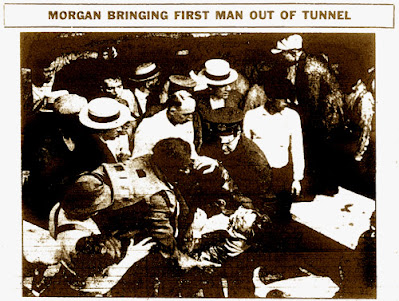
Tunnel construction was dangerous business. While building the third tunnel, more than thirty three workers had lost their lives in four separate accidents. The fourth tunnel, however, started off great. Initially, safety standards were lauded, and two years passed without major incident. However, on the evening of July 24, 1916, a foreman led his crew of eight men down into crib number five. A natural gas leak somehow ignited, causing a massive explosion and trapping the crew hundreds of feet below the surface, buried in debris and mud.

Rescue crews were formed and sent down, but that didn't go well. The first two attempts ended with 10 additional deaths due to the inhalation of gas inside the tunnel. Several additional efforts were made, but they were only able to rescue one of two members of the second rescue team that had fallen unconscious in the tunnel.

Garrett Morgan demonstrates his invention.
Source: Cleveland State University, Michael Schwartz Library, Special Collections

Someone remembered Garrett Morgan, an inventor and entrepreneur there in Cleveland, who had designed a device he called a safety hood and smoke protector. They called for Garrett, and he and his brother Frank bravely volunteered to go down in the tunnel, equipped with his invention which later became known as the gas mask. Garrett, his brother, and their crew were able to rescue two men, and recover four bodies. However, they were prevented from further rescue missions because the US Bureau of Mines put a stop to the efforts.

Eventually, all the bodies were recovered, but it was a tragedy that overshadowed the city of Cleveland for decades. Investigations were launched, with fingers pointing in every direction. When fault was directed at city officials, suddenly the investigations came to a halt, and it was concluded that it was no one's fault, but every man did what they thought was best. 

Public Domain

Garrett had personally made four trips into the tunnel, which affected his health for years to come, despite the use of the mask. Garrett's mask design was simple; a cotton hood with two hoses that hung down to the floor. Moist sponges would then filter the less-toxic air closer to the ground. It did not, however, filter out all of the fumes.

Despite Morgan's essential role in the rescue, Harry L. Davis, who was the mayor at the time, failed to put his name, or his brother's, on the list of men recognized as heroes. Many of the men who participated in the rescue efforts received the Carnegie medal for their bravery, but he and his brother were excluded from that honor by city officials. Garrett believed his race was the reason for this, which was confirmed by Victor M. Sincere of the Bailey Company in his statement to the committee.


"Your deed should serve to help break down the shafts of prejudice with which you struggle. And is sure to be the beacon of light for those that follow you in the battles of life."
-Victor M. Sincere in a statement to the Citizens Award Committee.


 Later on, in 1917, citizens of Cleveland awarded Garrett a diamond-studded gold medal in an effort to correct this omission. 

The one good thing that came out of the incident was the publicity for Morgan's gas mask. His company received orders from all over the country for the hoods. However, the national news that covered the story included a photo of Garrett. When the officials in a number of southern cities saw his photo, they cancelled their orders. Nevertheless, Garrett Morgan went on to become a successful entrepreneur and an advocate of civil rights. Many have recognized and honored him and his accomplishments by placing his name on schools, and granting awards and honorary memberships. He was inducted into the Inventor's Hall of Fame in 2005.


As for his life-saving invention, gas masks were further developed to be much safer. They now have the ability to protect the wearer for many types of toxins, including pesticides, fumes from paint or other materials, and even chemical weapons. To try to number the lives saved by this apparatus (derivatives were used in both World Wars) would be impossible.

*****

Two-time winner of the Christian Indie Award for historical fiction, Amber Lemus inspires hearts through enthralling tales She has a passion for travel, history, books and her Savior. This combination results in what her readers call "historical fiction at its finest".

She lives near the Ozarks in her "casita" with her prince charming. Between enjoying life as a boy mom, and spinning stories out of soap bubbles, Amber loves to connect with readers and hang out on Goodreads with other bookish peoples.

Amber is a proud member of the American Christian Fiction Writers Association. Visit her online at http://www.amberlemus.com/ and download a FREE story by subscribing to her Newsletter!

Sunday, May 7, 2023

Z. Alexander Looby: Civil Rights Attorney

By Michelle Shocklee

An explosion rocked a Nashville neighborhood in the early morning hours of April 19, 1960. The target: the home of NAACP leader, city council member, and famed civil rights attorney Z. Alexander Looby. Nashville would never be the same afterwards.

I wasn't born yet when this terrible event happened, but it has touched my world as an author of historical fiction. If you've read my novel Count the Nights by Stars, you know I make reference to it. Tragically, the reason this horrific event happened is as relevant today as it was in the 60s.

 
Z. Alexander Looby; 
Tennessee Portrait Project

Z. Alexander Looby was born in Antigua, British West Indies, on April 8, 1899. He was barely five years old when his mother died in childbirth, and he was a teenager when his father died. Orphaned, 15-year old Looby somehow managed to find passage on a ship bound for America and began a new life in the United States. 

Looby was a fast learner with a sharp mind. He worked hard to earn a B.A. degree from Howard University, followed by a law degree from Columbia University. He moved to Nashville, Tennessee in 1926 to work as an assistant professor of economics at Fisk University, an all-black school. Three years later he was admitted to the Tennessee bar and practiced in Memphis for three years. There he met Grafta Mosby, a Memphis schoolteacher, and they married in 1934. The next year, the couple relocated to Nashville where Alexander helped found the Kent College for Law for African Americans.

In the 1940s, Looby was president of the James C. Napier Bar Association, an organization of African American attorneys named for the prominent Nashville political activist. He also began working with the NAACP, specifically on a case involving twenty-three African Americans who had been charged with murder following race riots in Columbia, Tennessee. All of the defendants were acquitted.

Looby's work earned him the reputation as someone who would stand up for civil rights no matter what, but it was his work involving the desegregation of schools that earned him the most enemies. 

Hattie Cotton Elementary School after an explosion on
 Sept. 10, 1957 one day after a black first grader attended school here.  
 Photo: Bill Preston, The Tennessean
Shortly after the historic 1954 Brown v. Board of Education ruling that allowed black children to attend formerly all-white schools, Looby filed the first desegregation suit against the Nashville public schools. On September 9, 1957, nineteen black 6-year olds attempted to attend school. Hattie Cotton Elementary school admitted one black student, a brave 6-year-old girl. That night, the school was damaged when a bundle of dynamite exploded. It reopened nine days later and repairs followed in 1958.


When the sit-ins began in Nashville in 1960 at lunch counters throughout the city, many students were arrested on various trumped up charges. Looby became their first attorney. It was during this period that his enemies--white segregationists--wanted him silenced. On the night of April 19, 1960, Looby and his wife were asleep in their bedroom at the back of their home. An unknown person or persons threw a bundle of dynamite toward the house, aiming for a picture window. Thankfully their aim was off, and the dynamite exploded without causing Mr. Looby and his wife harm. However, the blast was so powerful, it destroyed the house and shattered windows throughout the neighborhood and at nearby Meharry Medical College.

Civil rights leader Z. Alexander Looby’s house after being bombed in April 1960

Photo: Nashville Public Library, Special Collections

The attempt on Looby's life had the exact opposite effect from what the bombers hoped to achieve. Instead of silencing Looby and those fighting for civil rights, it fired them up. Students from Fisk University led 2500 protesters on a silent walk to city hall, where they confronted Mayor Ben West. One of them, a young woman named Diane Nash, asked him, "Do you feel it is wrong to discriminate against a person solely on the basis of their race or color?" West said "yes," later explaining, "It was a moral question – one that a man had to answer, not a politician." By May of that year, lunch counters in Nashville were desegregated. And by October, Looby and his team gained dismissal of the charges against 91 students arrested for conspiracy to disrupt trade and commerce.

Z. Alexander Looby continued to practice law and fight for civil rights for the remainder of his life. He died in 1972, but his legacy continues today. 


(PLEASE VISIT THE BLOG TO COMMENT ON THIS POST.)


Michelle Shocklee
 is the author of several historical novels, including Count the Nights by Stars, winner of the 2023 Christianity Today Book Award, and Under the Tulip Tree, a Christy Awards and Selah Awards finalist. Her work has been included in numerous Chicken Soup for the Soul books, magazines, and blogs. Married to her college sweetheart and the mother of two grown sons, she makes her home in Tennessee, not far from the historical sites she writes about. Visit her online at www.MichelleShocklee.com


               COUNT THE NIGHTS BY STARS

*2023 Christianity Today Book Award Winner*

1961. After a longtime resident at Nashville’s historic Maxwell House Hotel suffers a debilitating stroke, Audrey Whitfield is tasked with cleaning out the reclusive woman’s room. There, she discovers an elaborate scrapbook filled with memorabilia from the Tennessee Centennial Exposition. Love notes on the backs of unmailed postcards inside capture Audrey’s imagination with hints of a forbidden romance . . . and troubling revelations about the disappearance of young women at the exposition. Audrey enlists the help of a handsome hotel guest as she tracks down clues and information about the mysterious “Peaches” and her regrets over one fateful day, nearly sixty-five years earlier.
https://www.tyndale.com/p/count-the-nights-by-stars/9781496459930


Friday, March 6, 2020

Nashville and the Lunch Counter Sit-Ins of 1960

By Michelle Shocklee


Nashville; photo from https://www.thevisionsite.com/


Nashville, Tennessee is known for a lot of things. Music, entertainment, food. It also has a rich history that dates back to the 1500s when various Native American tribes roamed the land. But like most southern cities, Nashville also has a checkered past when it comes to racial issues and civil rights.

Prior to the Civil War, Tennessee experienced a 15% increase in the slave population between 1850 and 1860. By the latter year there were over 275,000 slaves in the state. When it came time to decide on secession, the majority of the population voted to secede from the Union, with the issue of slavery at the heart of the vote. 

Fast forward one hundred years and things haven't improved all that much. Although slavery was abolished in 1865, segregation continues in schools, public transportation, hotels, and in many places of business, including lunch counters found in stores like Woolworth's, Walgreens, and major departments stores. It's difficult to imagine being denied service based on ones race, but it was a common practice back then.

However, on February 1, 1960, four brave, black college students sat down at the lunch counter at the Woolworth’s in downtown Greensboro, North Carolina, where the official policy was to refuse service to anyone but whites. Denied service, the four young men refused to give up their seats. Police arrived on the scene but were unable to take action due to the lack of provocation. The Greensboro Four, as they were dubbed, stayed put until the store closed, then returned the next day with more students from local colleges.

Sit-in, Nashville lunch counter, 1960
Courtesy U.S. Library of Congress (00651469)
By February 5, some 300 students had joined the protest at Woolworth’s, paralyzing the lunch counter and other local businesses. Heavy television coverage of the Greensboro sit-ins sparked a sit-in movement that spread quickly to college towns throughout the South and into the North, as young blacks and whites joined in various forms of peaceful protest against segregation in libraries, beaches, hotels and other establishments.

By the end of March, the movement had spread to 13 states and 55 cities, including Nashville. Though many were arrested for trespassing, disorderly conduct or disturbing the peace, national media coverage of the sit-ins brought increasing attention to the civil rights movement.

Nashville's sit-in campaign targeted downtown lunch counters such 
as this one at Walgreens drugstore.
On February 13, 1960, twelve days after the Greensboro sit-ins occurred, college students entered S.H. Kress, Woolworth’s, and McClellan stores at 12:40 p.m. in downtown Nashville. After making their purchases at the stores, the students sat-in at the lunch counters. Store owners initially refused to serve the students and closed the counters, claiming it was their “moral right” to determine whom they would or would not serve. The students continued the sit-ins over the next three months, expanding their targets to include lunch counters at the Greyhound and Trailways bus terminals, Grant’s Variety Store, Walgreens, and major Nashville department stores, Cain-Sloan and Harvey.

The Nashville sit-ins lasted from February 13 to May 10, 1960. The campaign, coordinated by the Nashville Student Movement and the Nashville Christian Leadership Council, was notable for its early success and its emphasis on disciplined nonviolence. Over the course of the Nashville sit-in campaign, sit-ins were staged at numerous stores in the central business district. Sit-in participants, who mainly consisted of black college students, were often verbally or physically attacked by white onlookers. Despite their refusal to retaliate, over 150 students were eventually arrested for refusing to vacate store lunch counters when ordered to do so by police.

The first violent response to the protests came on February 27. The protesters that day were attacked by a group of white people opposing desegregation. The police arrested eighty-one protesters, but none of the attackers was arrested. Those arrested were found guilty of disorderly conduct. They all decided to serve time in jail rather than pay fines. On April 19, a bomb destroyed the home of Z. Alexander Lobby, the defense attorney representing many of the protesters. The bombing of Lobby’s home triggered a mass march to city hall where 2500 protesters demanded answers from Mayor West.

After weeks of secret negotiations between merchants and protest leaders, an agreement was finally reached. On May 10, six downtown stores opened their lunch counters to black customers for the first time. The customers arrived in groups of two or three during the afternoon and were served without incident. With that agreement, Nashville became the first major southern city to begin desegregating public facilities. The Nashville campaign became a model for other civil rights protests in the 1960s and 1970s.

Lunch counter in 2018 in the new Woolworth's on 5th
Photo from Google


Today, history, food, and entertainment have all come together in the form of a restaurant in the same location as the original store. Woolworth's on 5th offers a "welcome table" to everyone. Hubby and I haven't had a chance to eat there yet, but when we do, we'll remember the brave men and women who demanded respect and made it possible for all to be served.


Michelle Shocklee is the author of several historical novels including The Planter's Daughter and The Widow of Rose Hill. Her new historical time-slip novel, Under the Tulip Tree, will release in September 2020.  Married to her college sweetheart and the mother of two grown sons, she makes her home in Tennessee, not far from the historical sites she writes about. Visit her online at www.MichelleShocklee.com.

THE WIDOW OF ROSE HILL

Widowed during the war, Natalie Ellis finds herself solely responsible for Rose Hill plantation. When Union troops arrive with a proclamation freeing the slaves, all seems lost. In order to save her son’s inheritance she strikes a deal with the arrogant, albeit handsome, Colonel Maish. In exchange for use of her family’s property, the army will provide workers to bring in her cotton crop. But as her admiration for the colonel grows, a shocking secret is uncovered. Can she trust him with her heart and her young, fatherless son?

Monday, January 15, 2018

Culinary Arts, Part IV - Civil Rights Era


Hello everybody. Welcome to Part IV and my final post from the Culinary Arts Luncheon I attended last fall. Parts I, II, and III focused on the Muskogean Era, the Colonial Era, and the Civil War Era.

Today's post moves us into the 20th Century and the Civil Rights Era. The Civil Rights Era from the 1960s, some fifty years ago, but the foods chosen to highlight that era at the luncheon are still foods that Southerners enjoy today.

I'll admit that I didn't sample much of these dishes as we had SO much food to taste, choosing to focus on those dishes I'd never heard of.

The Menu for the Civil Rights Era. Deep Fried Okra, Fresh Tomato Pickles, Catfish Po-Boy, Fried Chicken, and Banana Pudding


Culinary Arts Students Serving Their Guests. And there was Ham, too! :)


Banana Pudding! This a favorite dessert on Mississippi dinner tables even today. This one was very good, but I'll be honest, my mother-in-law makes the best Banana Pudding I've ever tasted. It is aMAZing. And, yes, we use Vanilla Wafers. I read somewhere that different parts of the country don't eat banana pudding and certainly don't make it with vanilla wafers.


What????

Next to anything chocolate, banana pudding is one of my most favorite desserts with LOTS of vanilla wafers.


More of the students dressed in period garb from the 18th, 19th, 20th, and 21st centuries
Everyone Sampling the Food


Who Wouldn't Love This? Homemade Southern-style Banana Pudding
I'm getting hungry!!


And Sweet Tea, y'all!

Most of these dishes can be found on many menus in the south and any potluck or church social wouldn't be complete without fried chicken, fried okra, butter beans, cornbread, field peas, and the aforementioned banana pudding.

But, just as all banana puddings aren't the same, neither are all fried chicken, okra, or even cornbread. I won't pretend to be a great cook, but I know some great cooks.

My mother, my mother-in-law, all the grandmothers had their specialties. I've already mentioned my mother-in-law's banana pudding. My mother makes an amazing chocolate pie with "calf slobber" on top. What's that, you say? That's egg-white meringue beat to peaks, then very lightly browned. Sorry, didn't mean to gross anybody out! lol

My husband's grandmother passed away this past year and she was an amazing cook. But I especially loved her cornbread. She'd preheat the oven, then heat an iron skillet on the stovetop with an unhealthy dollop of lard, mix up a batch of cornbread, then drop the cornbread mixture by spoonfuls into the hot grease. Once it was all in the skillet, she'd put it in the oven to finish baking. Best cornbread ever!

But here's something on the Civil Rights Era menu that I wasn't familiar with. Tomato Pickles. There are as many recipes for tomato pickles as there are varieties of pickles. The simplest is just tomatoes, apple cider vinegar, and spices.

So, there you go. A list of Southern foods that were served with abandon 50 years ago, but are still solid savory fare found on tables today.


CBA Bestselling author PAM HILLMAN was born and raised on a dairy farm in Mississippi and spent her teenage years perched on the seat of a tractor raking hay. In those days, her daddy couldn't afford two cab tractors with air conditioning and a radio, so Pam drove an Allis Chalmers 110. Even when her daddy asked her if she wanted to bale hay, she told him she didn't mind raking. Raking hay doesn't take much thought so Pam spent her time working on her tan and making up stories in her head. Now, that's the kind of life every girl should dream of. www.pamhillman.com


Monday, March 28, 2016

Sojourner Truth - Champion of Rights for All


by Tamera Lynn Kraft
 
Sojourner Truth was born a slave who lived a life of purpose as an abolitionist and women’s rights activist. She was the first black woman to successfully petition the courts to free her son from slavery. She is most famous for her speech, “Ain’t I a Woman” at an Ohio woman’s rights convention in 1851 and devoted her life to serve God, end slavery, and gain rights for African Americans and women.

She was born Isabella Baumfree, the slave of a Dutch man, Colonel Hardenbergh, in Swartkill, New York in 1797. Her father, James Baumfree, was a slave captured in Guinea. Her mother, Elizabeth, was the daughter of Guinea slaves. She was one of 12 children. That area of New York was control by the Dutch at the time of her birth, and everyone in the household spoke Dutch, including Isabella.

After Colonel Hardenbergh’s death, ownership of the Baumfrees went to his son Charles. Charles died in 1806, and the family was separated at a slave auction. Nine-year-old Isabella was sold with a flock of sheep for $100. Her new owner, John Neely, was a violent man. She was sold two more times within two years and finally ended up as the property of John Dumont in West Park, New York. Isabella learned to speak English during this time.

In 1815, Isabella entered a relationship with a slave named Robert from a neighboring farm. They had a daughter, Diana, but Robert’s owner forbade the him from seeing Isabella, and they never saw each other again. In 1817, Dumont forced Isabella to marry an older slave on the farm named Thomas. Together they had a son, Peter, and two daughters, Elizabeth and Sophia.

In late 1826, Isabella escaped to freedom with her infant daughter, Sophia. Her other children stayed behind. She made her way to the home of Issac and Maria Van Wagener, a Quaker couple who bought her from Dumont and freed her. It was during this time, Isabella gave her life to Christ stating God showed her in a vision.

In 1827, all slaves in New York were emancipated. At this point, Isabella found out that her son Peter had been illegally sold to a man in Alabama. She petitioned the court and won, the first time a black woman successfully challenged a white man in court. Peter was returned to her from the South.

Isabella moved to New York City with her son Peter in 1829. She worked as a housekeeper for Christian evangelist Elijah Pierson. During this time, her doctrine became confused, and she became a housekeeper of a cult leader known as Prophet Matthias. Shortly later, Elijah Pierson died, Matthias was accused of poisoning him. She also joined the Millerites who predicted Christ would return in 1843.

In 1939, Isabella’s son Peter took a job on a whaling ship called the Zone of Nantucket. She received three letters for Peter in 1840 and 1841. When the ship returned in 1842, Peter wasn’t on board. She never heard from him again.
Isabella was devastated by her son’s loss and the Millerite prediction that didn’t come true. In 1843, she sought God. Wanting to make a fresh start, she asked God for a new name. In a vision, God gave her the name Sojourner . She later said it was "because I was to travel up an' down the land, showin' the people their sins, an' bein' a sign unto them." She asked God for a second name "'cause everybody else had two names; and the Lord gave me Truth, because I was to declare the truth to the people." She became a Methodist and declared her new name on June 1, 1843 saying, "The Spirit calls me, and I must go." At this point she began to travel and preached about the abolition of slavery.

She joined the Northampton Association of Education and Industry, an organization the supported women’s rights, abolition, and pacifism. During this time she met famous abolitionists William Lloyd Garrison, Frederick Douglass and David Ruggles. In 1850, Sojourner dictated her memoirs to Olive Gilbert and they were published by William Lloyd Garrison as The Narrative of Sojourner Truth: A Northern Slave. The notoriety left her open to attacks. She was once told the building she was to speak in would be burned if she preached, and she replied, "Then I will speak to the ashes." Another time, she was physically assaulted by a mob and had to walk with a cane for the rest of her life.

Sojourner began touring regularly with abolitionist George Thompson speaking to large crowds on the subjects of slavery and human rights. She was one of several escaped slaves, along with Frederick Douglass and Harriet Tubman, to rise to prominence as an abolitionist leader and a testament to the humanity of enslaved people.

In May of 1851, Sojourner delivered her most famous speech to the Ohio Women's Rights Convention in Akron. She continued to tour Ohio with Robinson to publicize the antislavery movement in the state. She also brought controversy by preaching about women’s rights.

During the Civil War, Sojourner Truth helped recruit black troops for the Union Army. She encouraged her grandson, James Caldwell, to enlist in the 54th Massachusetts Regiment. In 1864, Sojourner was also called to Washington, D.C., to contribute to the National Freedman's Relief Association. Sojourner met more than once with President Abraham Lincoln about her experiences. In 1865, she tried to force desegregation on Washington streetcars by riding in the cars designated for whites. After the war, she tried unsuccessfully to secure land grants from the government for former slaves arguing the property ownership would free them from servitude of wealthy landowners.

Sojourner continued to speak about women’s rights, universal suffrage, and prison reform until the day she died. She died at her home in Battle Creek, Michigan, on November 26, 1883. She is buried alongside her family at Battle Creek's Oak Hill Cemetery. She is known as one of the greatest abolitionists and champion of right for all in the 19th century. Her unwavering faith in God is what fueled her passion despite the obstacles.


Tamera Lynn Kraft has always loved adventures and writes Christian historical fiction set in America because there are so many adventures in American history. She has received 2nd place in the NOCW contest, 3rd place TARA writer’s contest, and is a finalist in the Frasier Writing Contest. 

Her novellas Soldier’s Heart and A Christmas Promise are available on Amazon. Her novella Resurrection of Hope will be released in July.

Wednesday, May 21, 2014

Voice of the Century


By Rebecca Price Janney

In 1955, Rosa Parks’ refusal to give up her bus seat to a white man sparked the modern Civil Rights movement. Several years earlier, however, Marian Anderson laid the foundation for change by virtue of her talent. When many people think of her today, it’s in the context of a transformative concert she gave 75 years ago, on Easter Sunday, 1939.

 Marian was born in 1902 and grew up in an integrated Philadelphia neighborhood to hard working parents. Her father sold ice and coal at Reading Terminal Market, and her mother, who had taught school in Virginia, now cleaned houses and took in laundry. When their daughter was just six years old, Marian began singing in the choir of their Union Baptist Church, stunning her elders by performing bass, alto, tenor, and soprano parts. It didn’t take long before other congregations invited her to perform for them.


When she was seventeen, Marian tried to enter a Philadelphia voice academy, but the school wouldn’t admit a Negro. Mrs. Anderson encouraged her daughter not to become bitter, or to focus on her skin color, but rather to rise above ignorance. Eventually, Marian took lessons with Mary Patterson, a black teacher in the city. When Ms. Patterson had taught Marian all she knew, she sent the young woman to the famed Giuseppe Boghetti. Although the maestro had more students than he could handle, when he heard Marian sing “Deep River,” the crusty teacher said, “I will make room for you at once.”


Boghetti knew that Marian had operatic talent, but he discouraged her from going in that direction because he believed a black person wouldn’t be accepted. Instead, he trained her for the concert stage. In 1925 at the age of twenty-three, Marian was selected from over 300 candidates at a major New York competition. Although newspaper reviewers praised her talents, the consensus was, “Too bad she’s a Negro.”


Maestro Boghetti advised her to leave for Europe, where he believed opportunities for her to succeed were far greater. After making her continental debut in Berlin, Marian sang throughout Europe in the 1930s, including performances for the royal families of England, Sweden, Norway, and Denmark. She was so popular that many European women copied her clothes, makeup, and hair. In spite of Marion’s successes and sophistication, her accompanist, Kosti Vehanen, one said, “She would always remain the same religious girl who had sung in the choir at church.” When Marian was about to perform in the Soviet Union, officials warned her not to sing anything religious. That night, with the atheistic Premier Josef Stalin in attendance, she nevertheless sang proudly about God. At the end of the concert, people rushed to the stage and pounded on it for an encore, shouting, “’Deep River!’ ‘Heaven, Heaven!’”


Back in the U.S., Howard University in Washington, D.C. invited Miss Anderson to sing, and the only place large enough to accommodate the expected crowds was Constitution Hall. When her agent, Sol Hurok, tried to reserve the venue, he was told it had already been booked. He submitted other dates, but he always received the same message. When he asked another concert master to try for those same times, Hurok learned that each of them actually was available. It became painfully obvious that a black woman was not welcome at Constitution Hall. Because the city was segregated, African-Americans couldn’t perform anywhere in Washington for mixed race audiences.

Because the Daughters of the American Revolution owned Constitution Hall, First Lady Eleanor Roosevelt publicly withdrew her membership in the organization. Other prominent DARs also quit, and several local chapters lodged protests. The United States Department of the Interior stepped forward, offering to let Marian sing outdoors, at the Lincoln Memorial in front of the Great Emancipator’s statue. The incident had upset her, but she knew that like it or not, she had become a symbol of her race. Interior Secretary Harold Ickes introduced her to a crowd of 75,000 on Easter Sunday, April 9, 1939. At the end of the concert, Marian told the throng, “I am overwhelmed. I can’t tell you what you have done for me today. I thank you from the bottom of my heart again and again.” Secretary Ickes later commented, “Marian Anderson’s voice and personality have come to be a symbol of the willing acceptance of the immortal truth that ‘all men are created equal.’”


Four years later, she did sing at Constitution Hall, for a war benefit; over the years she performed there many more times. On the 75th anniversary of the historic event, the DAR held a special concert in her honor. “The country and the DAR have grown very much in these past 75 years,” a DAR press release said. “Our organization is proud that Marian Anderson performed in DAR Constitution Hall numerous times after 1939. . . While this anniversary reflects on a sad time for racial equality in the DAR as well as our nation’s history . . .we are celebrating a beautiful event and a brave woman who sparked much needed change in our country. The Daughters of the American Revolution is proud to honor Marian Anderson and the historic concert that was a transformative moment in making America a better place for us all 75 years later.”

Hers was, indeed, the voice of the century in which she lived, which God used to bring about liberty and justice for all.


Dr. Rebecca Price Janney is a
theologically trained historian and the author of 18 books, including Great Women in American History and Then Comes Marriage? A Cultural History of the American Family. She’s also written an upcoming fiction series about revivals in American history. She began writing professionally at the age of 14 and the following year, she started covering the Philadelphia Phillies for her local paper. Rebecca is a member of the Daughters of the American Revolution, Valley Forge Chapter, a wife, and the mother of one son. When she’s not writing or speaking, she loves watching baseball games with her family. www.rebeccapricejanney.com