Showing posts with label American Heroes. Show all posts

Tuesday, May 20, 2025

Heroes of the Wild West: Trail Guides


There’s something timeless about the Wild West. Maybe it’s the echo of hoofbeats on prairie ground or the image of a wagon cresting a ridge at sunset. For Christian readers of western historical romance, these wide-open landscapes offer more than scenic beauty—they provide stories of courage, faith, and the kind of love that thrives in hard places.

Imagine such a story with the hero as a trail guide. You know the type—quiet, rugged, full of knowledge and secrets. He’s the one helping settlers cross rivers, scale mountain passes, and make it to the other side of danger. He might not wear a tin star or ride into town with a posse, but he’s brave in ways that count. He leads others through the wilderness—sometimes even when he’s lost inside himself.

And what’s more romantic and evocative--not to mention literary--than a hero on a journey?


Real-Life Trailblazers


While fictional guides have captured our hearts, the history behind them is just as compelling—and even more inspiring. Let's look at three trail guides who truly walked the path, each with a story worth remembering.

1. Thomas “Broken Hand” Fitzpatrick

Thomas Fitzpatrick (1799-1854) trapper and Indian Agent; public domain image
Known as one of the most respected mountain men and trail guides of the 19th century, Thomas Fitzpatrick earned his nickname after a hunting accident, but his legacy runs far deeper. He led countless wagon trains west, including pioneers on the Oregon Trail, and helped guide military expeditions. Later in life, he served as an Indian agent and peacemaker, respected by both settlers and Native American tribes. Fitzpatrick was known for his integrity, fairness, and moral compass—traits that fit beautifully with the Christian ideal of servant leadership. His dedication to justice and peace makes him an excellent model for a trail guide hero grounded in faith and conviction.

2. Sacajawea’s Son: Jean Baptiste Charbonneau

Sacajawea and Jean-Baptiste sculpture in Washington Park, Portland; public domain image

Born during the Lewis and Clark expedition, Jean Baptiste Charbonneau was the son of Sacajawea, a Shoshone woman who was one of the most famous Native American guides in history. Jean Baptiste grew up multilingual and deeply skilled in frontier life. As an adult, he became a scout, guide, and interpreter. What makes his story unique is how he navigated two worlds—Native and European—just like many mixed-heritage trail guides in western fiction. His life reminds us of the deep contributions Native Americans made to westward expansion—and how God works through all people, across all cultures.

3. Medicine Calf (also known as George Bent)

George Bent in wedding attire for the camera in 1867. A survivor of the Sand Creek Massacre, Bent continued to translate for peace chiefs and Indian Agents of the Cheyenne; public domain image

Now here’s a story tailor-made for historical romance readers. George Bent, or Medicine Calf, was the son of a prominent Cheyenne woman and a white trader from Bent’s Fort in Colorado. Educated in both white and Cheyenne traditions, he later fought in the Civil War, then returned west to serve as a mediator, scout, and interpreter during a time of immense cultural upheaval. His mixed heritage gave him a unique perspective that helped him guide others—not just across physical terrain, but between two worlds at war. Imagine the kind of quiet strength and identity struggle he must have lived with. A character based on George Bent could easily step off the pages of a novel: scarred, spiritual, and steady in the storm.

These men, and others like them, weren’t just skilled at reading landscapes—they were navigating history, culture, and faith in incredibly complex times. And that’s part of what makes trail guides such captivating heroes in our favorite stories.

Why We Love Them

Trail guides often aren’t the loudest or flashiest characters. They’re the ones who’ve seen too much, said too little, and carry maps in their heads and burdens in their hearts. But in Christian romance, they often become the protectors, the steady hands, and sometimes the prodigals finding their way back to the Father.

They also have a habit of falling in love with strong, stubborn heroines who challenge them—ladies who are just as determined to survive the journey west and make a life out of the wilderness. These relationships aren’t built on ballrooms and pretty words—they’re forged in hardship, patience, and prayer.

And really, what better soil is there for love?

Final Thoughts

Maybe one of the reasons we love trail guides so much is because we’re all on a journey of our own. We might not be dodging rattlesnakes or crossing rivers on horseback, but we are trying to find our way. And just like in the stories, we need guides—mentors, pastors, friends—who’ve walked the path before us and can point us to truth when the trail gets hard to see.

Ultimately, the best trail guide in any story—and in life—is the One who promises to never leave us or forsake us. As Psalm 32:8 says, “I will instruct you and teach you in the way you should go; I will counsel you with my loving eye on you.” Whether we’re walking the Oregon Trail or facing a personal wilderness, God goes before us.

So the next time you open a western romance and meet a brooding, Bible-carrying hero with trail dust on his boots and a mysterious past—pause and remember: you’re meeting someone with roots in real history. Someone who reflects the human longing for purpose, belonging, and the faithful God who guides us every step of the way.

Over to You


Which historical trail guide would you love to see as the inspiration for a romance hero?


About Janalyn Voigt

Janalyn Voigt fell in love with literature at an early age when her father read chapters from classics as bedtime stories. When Janalyn grew older, she put herself to sleep with tales "written" in her head. Today Janalyn is a storyteller who writes in several genres. Romance, mystery, adventure, history, and whimsy appear in all her novels in proportions dictated by their genre.

Learn more about Janalyn, read the first chapters of her books, subscribe to her e-letter, and join her reader clubs at http://janalynvoigt.com.

Fall in Love with the Wild West!


Wednesday, August 2, 2023

The Invention of Gas Masks

Blogger: Amber Lemus


Garrett A. Morgan
Public Domain

In April, we learned about a man who helped invent the stoplights that we know today. ( You can read that post here.) His name is Garrett A. Morgan, and we are revisiting this amazing inventor today because another of his inventions bears a story worth telling.

Our story begins in Cleveland during the post civil-war era. The industrial boom led to pollution of the Cuyahoga River, which had been the city's primary source of drinking water. In response to the issue of tainted water, the city began construction of water tunnels that would draw water from old riverbeds further away, where hopefully the water was untainted. The city ended up constructing multiple tunnels, each one longer, and larger in diameter than the last. The construction on the fourth tunnel began in March of 1914.

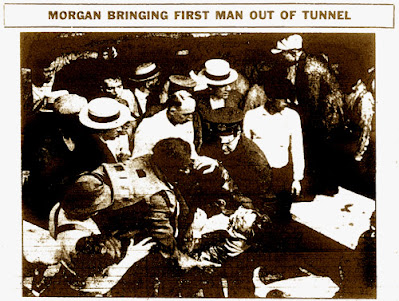
Tunnel construction was dangerous business. While building the third tunnel, more than thirty three workers had lost their lives in four separate accidents. The fourth tunnel, however, started off great. Initially, safety standards were lauded, and two years passed without major incident. However, on the evening of July 24, 1916, a foreman led his crew of eight men down into crib number five. A natural gas leak somehow ignited, causing a massive explosion and trapping the crew hundreds of feet below the surface, buried in debris and mud.

Rescue crews were formed and sent down, but that didn't go well. The first two attempts ended with 10 additional deaths due to the inhalation of gas inside the tunnel. Several additional efforts were made, but they were only able to rescue one of two members of the second rescue team that had fallen unconscious in the tunnel.

Garrett Morgan demonstrates his invention.
Source: Cleveland State University, Michael Schwartz Library, Special Collections

Someone remembered Garrett Morgan, an inventor and entrepreneur there in Cleveland, who had designed a device he called a safety hood and smoke protector. They called for Garrett, and he and his brother Frank bravely volunteered to go down in the tunnel, equipped with his invention which later became known as the gas mask. Garrett, his brother, and their crew were able to rescue two men, and recover four bodies. However, they were prevented from further rescue missions because the US Bureau of Mines put a stop to the efforts.

Eventually, all the bodies were recovered, but it was a tragedy that overshadowed the city of Cleveland for decades. Investigations were launched, with fingers pointing in every direction. When fault was directed at city officials, suddenly the investigations came to a halt, and it was concluded that it was no one's fault, but every man did what they thought was best. 

Public Domain

Garrett had personally made four trips into the tunnel, which affected his health for years to come, despite the use of the mask. Garrett's mask design was simple; a cotton hood with two hoses that hung down to the floor. Moist sponges would then filter the less-toxic air closer to the ground. It did not, however, filter out all of the fumes.

Despite Morgan's essential role in the rescue, Harry L. Davis, who was the mayor at the time, failed to put his name, or his brother's, on the list of men recognized as heroes. Many of the men who participated in the rescue efforts received the Carnegie medal for their bravery, but he and his brother were excluded from that honor by city officials. Garrett believed his race was the reason for this, which was confirmed by Victor M. Sincere of the Bailey Company in his statement to the committee.


"Your deed should serve to help break down the shafts of prejudice with which you struggle. And is sure to be the beacon of light for those that follow you in the battles of life."
-Victor M. Sincere in a statement to the Citizens Award Committee.


 Later on, in 1917, citizens of Cleveland awarded Garrett a diamond-studded gold medal in an effort to correct this omission. 

The one good thing that came out of the incident was the publicity for Morgan's gas mask. His company received orders from all over the country for the hoods. However, the national news that covered the story included a photo of Garrett. When the officials in a number of southern cities saw his photo, they cancelled their orders. Nevertheless, Garrett Morgan went on to become a successful entrepreneur and an advocate of civil rights. Many have recognized and honored him and his accomplishments by placing his name on schools, and granting awards and honorary memberships. He was inducted into the Inventor's Hall of Fame in 2005.


As for his life-saving invention, gas masks were further developed to be much safer. They now have the ability to protect the wearer for many types of toxins, including pesticides, fumes from paint or other materials, and even chemical weapons. To try to number the lives saved by this apparatus (derivatives were used in both World Wars) would be impossible.

*****

Two-time winner of the Christian Indie Award for historical fiction, Amber Lemus inspires hearts through enthralling tales She has a passion for travel, history, books and her Savior. This combination results in what her readers call "historical fiction at its finest".

She lives near the Ozarks in her "casita" with her prince charming. Between enjoying life as a boy mom, and spinning stories out of soap bubbles, Amber loves to connect with readers and hang out on Goodreads with other bookish peoples.

Amber is a proud member of the American Christian Fiction Writers Association. Visit her online at http://www.amberlemus.com/ and download a FREE story by subscribing to her Newsletter!

Sunday, January 26, 2020

Reach for the stars to change the world…


I recently watched the motion picture, Harriet. The movie was excellent. The writing, actors, and settings are some of the best I’ve seen as far as historical movies go. While I watched this emotional story unfold, I questioned what was real and what was contrived by Hollywood for my viewing pleasure. So, let’s take a look at this remarkable woman’s life.

The truth about Harriet Tubman is as amazing as the movie portrays.

Born sometime between 1820 and 1825 in Dorchester County Maryland, Araminta Harriet Ross (nicknamed Minty) had a clear sense of justice from a young age. Maybe because she carried scars from a whipping she received when she was five or six years old. Or maybe because of the daily violence she was subjected to on the plantation where she lived. Whatever the reason, the most severe injury Harriet received in slavery, happened while she was defending a fellow slave who had left the fields without permission. An overseer was threatening the man and threw a two-pound weight at him. Harriet moved in front of the slave and consequently the weight struck her in the head. For the remainder of her life, Tubman suffered severe headaches, bouts of narcolepsy, and vivid dreams she called visions from God.
 
Harriet Tubman
Stipulations in the will of the man who owned Harriet and her family stated that her family should have been freed after his death, but his son and wife chose not to carry out his wishes. Though Harriet’s father had been freed before their owner’s death.

Fear of being sold further south, Harriet escaped without a plan and then made the trip almost solely on foot from Maryland to Philadelphia, Pennsylvania completely alone. Her main focus…follow the North star. She crossed into the free state of Pennsylvania with liberation and reverence and later recollected: “When I found I had crossed that line, I looked at my hands to see if I was the same person. There was such a glory over everything; the sun came like gold through the trees, and over the fields, and I felt like I was in Heaven.” (Harriet Tubman, Scenes in the Life of Harriet Tubman By Sarah Hopkins Bradford.)

Harriet couldn’t live with the thought of her family still in bondage, so she made her first trip back into slave country about a year after her escape. It’s estimated she made a total of 19 trips and led many others to their freedom in the North. She was never caught and stated, “I was the conductor of the Underground Railroad for eight years, and I can say what most conductors can’t say — I never ran my train off the track and I never lost a passenger.” (Harriet Tubman at a suffrage convention, NY, 1896.)

The beginning of the Civil War gave Harriet another means to rescue more people. She first worked as a cook, then a nurse, then she began to scout and eventually spy for the Union. Harriet Tubman was the first woman—black or white—to lead an armed expedition in the war. The South Carolina, Combahee River Raid, liberated more than 750 people.
 
Harriet, her 2nd husband and family
                       
Harriet Tubman continued to serve others even after the war. She and her second husband, Nelson Davis (who was at least twenty years her younger) lived on a small farm in Auburn, NY where they ran a brick-making business and cared for Harriet’s family and aging former slaves.
 
Harriet Tubman
At the age of approximately 93, Harriet passed away from complications due to pneumonia. She was buried with full military honors at Fort Hill Cemetery in Auburn, New York.


Harriet Tubman was a woman from whom we can all learn.

______________________________________________________________


Multi-award-winning author, Michele K. Morris’s love for historical fiction began
when she first read Laura Ingalls Wilder’s Little House book series. She grew up riding horses and spending her free time in the woods of mid-Michigan. Michele now lives with her six children, three in-loves and ten grandchildren in the great Sunshine State. Michele loves to hear from readers on Facebook, Twitter, and here through the group blog, Heroes, Heroines, and History at HHHistory.com.

Michele is represented by Tamela Hancock Murray of the Steve Laube Agency.


Friday, November 1, 2019

Happy Birthday Daniel Boone


Blogger: Amber Schamel
Daniel Boone Age 84
Today marks what would have been the birthday of one of America's greatest heroes, Daniel Boone. A dedicated frontiersman and explorer, Daniel Boone became one of the most celebrated men in American literature and inspired boys and girls around the nation long after his death. 

Daniel Boone was born on November 2, 1734 to Sarah Morgan and Squire Boone in a log cabin in Pennsylvania. He was the sixth born of eleven children. He had a love of the outdoors and even as a young adult, he supplemented his family's income by hunting and trapping. 

Daniel's father, Squire Boone, had emigrated to Pennsylvania because he was persecuted in England for his Quaker faith. However, this faith benefited Daniel and his pursuit of hunting and exploration. The area where Daniel was raised was, at the time, the edge of the frontier. The Lenape Indian tribes resided nearby, and because the Quakers were pacifists, they enjoyed good relations with the tribe. The Lenape contributed to Daniel's knowledge of the wilderness. At the age of twelve, Daniel received his first rifle. 


Since Daniel's education was informal, at best, many expressed concern over his illiteracy. Boone's spelling was....unconventional. However his father defended him by saying, "Let the girls do the spelling. Dan will do the shooting." However, Daniel did possess enough education to accomplish his calling in life. While the majority of his time was spent as an outdoors man and frontiersman, he also went on to become a politician. Daniel Boone was an avid reader. He often took reading material with him on hunts and excursions, and he would often entertain his companions by reading to them. His favorites were the Holy Bible and Gulliver's Travels. 

Since Boone grew up as a Quaker, it is interesting that he volunteered for the French and Indian war, and also served during the Revolutionary War. However, his family was expelled from the Quaker fellowship when he was a young man, and he identified as a Christian, but not as a Quaker. It could be that the experience of excommunication caused him to renounce his family's Quaker beliefs. 

Despite the obstacles that Daniel Boone faced throughout his life, he is an inspiring example of courage and what one person can accomplish in a lifetime. These qualities make him an outstanding man and icon in American history and literature. It is men like him that make us proud to be Americans.

Happy Birthday, Mr. Daniel Boone! 


*****
Two-time winner of the Christian Indie Award for historical fiction, Amber Schamel writes riveting stories that bring HIStory to life. She has a passion for travel, history, books and her Savior. This combination results in what her readers call "historical fiction at its finest". She lives in Colorado and spends half her time volunteering in the Ozarks. Amber is a proud member of the American Christian Fiction Writers Association. Visit her online at www.AmberSchamel.com/ and download a FREE story by subscribing to her Newsletter!