Showing posts with label Kansas history. Show all posts

Monday, February 20, 2023

Western Cattle Queens: Hattie Cluck

The Wild West had a way of producing tough women, and none grittier than the cattle queens who rode, roped, and endured the privations of the trail as well as any man. Facing challenges, hardships, and perils—sometimes with children at their side—they garnered grudging respect in an era of shifting cultural roles. Some accrued wealth, while others paid with their lives. These women overcame cultural expectations to live on their terms. The halls of history must ring with applause.

This blog series celebrates the cattle queens mentioned in The Whispering Wind, the final installment in the Montana Gold western historical romance series.

"Pioneer Woman" and "Pioneer Boy" (statues of Hattie and Emmett Cluck) published courtesy of Another Believer, CC BY-SA 4.0, via Wikimedia Commons

Western Cattle Queens: Hattie Standefer Cluck

Harriet Louise Standefer entered this world on April 14, 1846 in Alabama. Her parents, James Stuart and Caroline (Randall) Standefer soon left for Williamson County, Texas, taking their young daughter with them. Her father did quite well at cattle ranching.

In 1860, Hattie started her studies at Salado College. She met George Washington Cluck at a dance. Hattie was seventeen when they married on June 25, 1863. The Civil War had begun, several of their brothers enlisted in the Confederate Army. George remained behind, most likely to run the ranch. Hattie gave birth to two daughters and a son over the next six years.

Up the Chisholm Trail


Following the War, the eastern states were in short supply of beef. Cattle that sold for $4 each in Texas fetched $40 a head when sold in Abilene. A supply route opened up in 1867 when the railway connected to Abilene Kansas. Texas ranchers could drive their cattle up the Chisholm Trail to newly-built stockyards and send their beef to eastern buyers by rail. In the spring of 1871, George Cluck decided to join forces with another rancher to drive their herds to Abilene.

Hattie accompanied George on the arduous journey. Hattie later said that George “took all he had in the world with him, and we wanted to be together no matter what happened.” However, her granddaughter stated that Hattie was the one who insisted on going along. The truth is probably lost in time. Either way, Hattie is celebrated as the first female to travel the Chisholm Trail. She accomplished this feat with her three children (ages six, four, and two) in tow and while pregnant with her fourth child.

Along the way, Hattie and her family dealt with several harrowing experiences. She and her children had to cross the swiftly-running Red River on horseback to lighten the wagon. Robbers assailed their party and had to be fended off at gunpoint.

Despite the hardships and dangers, the Clucks made it to Abilene with their herd and their family intact. Hattie was so close to her due date that she and her husband opted to remain in Kansas. This didn’t go particularly well, since Kansas farmers resented the tendency of Texas ranchers to drive their cattle through their crops. 

The Clucks returned to Texas two years later, and George registered a second cattle brand under Hattie’s name. George closed several good land deals, enjoyed success as a cattle rancher, and sold water rights to the railroad. He donated land and money for a local school. Hattie and George added six more children to their family. They also took in their nephew.

After George died in August of 1920, Hattie spent her days in simple living. She continued to run her farm, and in spare moments might be found quilting, reading popular fiction, writing poetry, daydreaming, or collecting arrowheads on her property.

The Hattie Cluck Legend

She was 84 when reporters began making much of her journey up the Chisholm Trail. They were guilty of embroidering its perils. The bandits became Indians in some accounts, and Hattie helped loade guns for the men who resisted them. One legend has it that Hattie declared herself ready to take the place of any coward who refused to fight. Whatever the truth may be, the bandits left without any cattle.

Hattie died on March 2, 1938, at the venerable age of 92, but her fame lives on. The Chisholm Trail Crossing Park in Round Rock, Texas includes a statue of Hattie Cluck with her young son, Emmet.

Hattie is much admired by Phoebe Walsh, heroine of The Whispering Wind (Montana Gold, book six). Phoebe cites Hattie Cluck as an example while trying to talk her uncle into training her to become a ranch hand. Like Hattie, Phoebe challenges limits imposed on women. Regardless of her impending spinsterhood, Phoebe determines to live a meaningful life. It would take a strong man to change her mind--someone like Will Canfield. Despite the kiss he'd stolen along with her peace of mind, Will doesn't want her. 
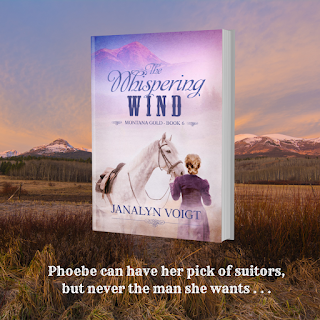
The Whispering Wind

The Whispering Wind by Janalyn Voigt
Fancy parties and embroidered fans hold little appeal for Phoebe Walsh. She would rather gallop across the open range or help her father with a wounded calf. Of her many admirers, none spark her interest. Ma seems determined to save her from becoming a spinster, but how can Phoebe accept her mother's choice of suitors when her heart belongs elsewhere?

Several years have passed since Will Canfield stole a kiss and her heart. Remembering her passionate response still curls her insides, but how she feels doesn't matter. Will's interest in her isn't serious, as he's made clear. She needs to get over the man. If Uncle Con will stop throwing them together, that could be a whole lot easier.

Will feels guilty about Phoebe, but he can't risk another heartbreak. Being left at the altar certainly changed his mind about romance. Phoebe is better off marrying someone else, even if the idea sets his teeth on edge.

Phoebe and Will must both, with God's help, conquer an old fear before they can move ahead with their lives. 

Set during a troubled time in America, the Montana Gold series explores faith, courage, and love in the Wild West.


What's New with Janalyn Voigt

Hello friends. I hope all is well with you. Have you planned any challenges for yourself lately? I'm working to improve my daily life. Recently, I came across an image of types of coffee drinks. Some I've tried and others I've thought about making. It surprised me, though, to learn how many I'd never heard of before. There were 30 pictured, meant to encourage a month of experimenting. Now, as an author, I have an affinity for coffee. 

Last Christmas, a family member gave me a tongue-in-cheek sign for my office: "I turn coffee into books. What's your superpower?" Hmmm... I wonder if consuming various coffee drinks produces different books. What do you think?  

Biography 

Janalyn Voigt's unique blend of adventure, romance, suspense, and fantasy creates worlds of beauty and danger for readers. Writing in the historical romance and medieval epic fantasy genres, Janalyn is represented by Wordserve Literary. When not writing, she loves to discover worlds of adventure in the great outdoors.
Learn more about Janalyn Voigt and her books.

Thursday, May 9, 2019

Ghost towns of Kansas

By Tiffany Amber Stockton


Last month, I shared about higher education and the dawn of the very first Bible College established by D. L. Moody. If you missed that post, you can read it here: https://www.hhhistory.com/2019/04/dawn-of-first-bible-college.html.

After I moved to Colorado and realized I now truly lived in "The West," I've spent time exploring this general region and have become increasingly fascinated with its culture, history, and people who made this area what it is today. A lot of that history includes what have now become "ghost towns," pale existences of their former glory.

* * * * *

From Thriving to Abandoned 

I don't know about you, but as a historical author, I am always fascinated by the existence and ability to visit the ghost towns of America. Like stepping into a house that was built hundreds of years ago, there's a story to be discovered.

Although every state has its share of ghost towns, I'm going to start with Kansas this month, then move around to other states in the coming months. I know I won't cover all 50 states, but I will highlight a few of my favorites.

Hundreds of towns in Kansas flourished for a few years then died for a variety of reasons or causes. It could have been something as simple as bad weather or depletion of minerals, or the lack of railroad construction and the unpredictability of local politics. This resulted in a lot of historic ghost towns spread throughout the state. Some still stand to this day.


Empire City, Kansas

The site for Empire City is located on 120 acres of land along Short Creek just north of Galena. The town was established in 1877 when the West Joplin Lead & Zinc Company bought the land for mining operations. The discovery of lead brought in more people looking for mineral wealth, and the town almost instantly erupted with saloons, a post office, restaurants, general stores, gambling houses, a school, hardware stores, churches, and company offices.

The city was officially incorporated in June of 1877 and by the end of that summer, it had a population of over 3,000 people. Being close to Galena create a fuse of sorts, with each mining city trying to outshine the other. However, more lead deposits were soon discovered on the side of Galena than those found near Empire City.

By the mid-1880s, lead deposit around Empire City began to diminish and so did its population. The town’s population had reduced to a little over 1000 people in just a few years.

In the early 1900s, the mining around the city was almost gone and the people began to leave. In 1907, Empire City was made a suburb of Galena, and in 1913 the post office was closed down. Today, you can see a number of historic buildings still standing at the original site of Empire City.


Treece, Kansas

Treece is another important boomtown, and unfortunately, it's been deemed environmentally unsafe in recent years. The town is located in Cherokee County in the Southeast corner of Kansas on its border with the state of Oklahoma and about 12 miles from the Missouri border. The town grew as a result of the discovery of lead and zinc in mining explorations.

By 1917, the town had a post office, many businesses, and was producing the highest quality lead, zinc, and iron in the county. At its peak, the town had over 1000 people.

By 1970, lead and zinc mining began to decline and so did the town's population. The post office was closed in 2004, and in 2011 the town was closed down by the government due to environmental impacts of lead poisoning. All the remaining people were evacuated in 2012, and today the site of the original town is now waiting for the environmental cleanup.


Peterton, Kansas

This mining town was established in the 1860s as an important coal mining center in those early days. It was bought by T. J. Peter of the Atchison, Topeka & Santa Fe RR.

Does anyone else have that song from the movie, Harvey Girls starring Judy Garland, playing through their mind right now? (grins) But I digress.

Peter named the town Centennial City before the town borrowed his name. At its peak, the town had over 600 people, 4 churches, general stores, hotels, bars, brothels, a doctor, a judge, and many other small businesses.

The town was kept afloat by 2 strip mines nearby that provided resources to run the town. With no police, the town was rather chaotic, especially at night. The town began to decline in the early 1900s when cheaper coal was discovered in other places within the state, and finally the school was closed down in 1964.

With the end of coal mining, the town was taken over by farmers and ranchers, but tornados that ran through the town destroyed it. Today, it's a ghost town with little to show for its once vibrant life. Only a church, the original schoolmaster’s house, an old coal weighing foundation, and a few houses remain.


Elk Falls, Kansas

Elk Falls currently has a population of slightly over 100 people, so it's not quite abandoned, and it's a rather unique assortment of folks who live here. Some love to tout the tourist attraction of The Outhouse Tour. (winks) Of course, the primary reason people visit is to see the Elk Falls. Nestled in a wooded area along the Elk River, these falls are some of the prettiest in all of Kansas.

The town was established in 1870 by R. H. Nichols and named Elk Falls in 1871. That same year, the town became a temporary county seat for Howard County. In 1875, the town got its own flour mill built by L. J. Johnston and E. A. Hall. By 1880, the town had both Baptist and Methodist churches, a school house, general stores, saloons, a post office, and a population of over 500 people.

The town is also home to the National Register of Historic places’ Pratt Truss Bridge, which was constructed across the Elk River at a significant cost. Although less than 20% of its population remains, Elk Falls receives enough tourism and business to keep it running. It's considered one of the largest existing "ghost towns" because of how many residents still call it home.


Pawnee, Kansas

Most likely won't know this, but Pawnee was the first capital in the Kansas Territory in 1855, and only for 5 days, before legislators suggested moving to Shawnee Mission, which was closer to Kansas City. Pawnee was 150 miles from the Missouri border and the proslavery legislators felt threatened by the distance from another proslavery state.

The first legislature of the territory took place at the capital building, and the session lasted from July 2nd-6th. The majority of legislators were Missourians, fraudulently elected in an effort to make Kansas a slave state. They came in wagons, on horseback, well-armed, and camped out on the prairie. They were determined to legislate closer to home, so they voted in favor of Shawnee Mission.

When the state capital was moved, Pawnee's decline began almost immediately. Sadly, the town was destroyed by order of Secretary of War Jefferson Davis. Today, only the old capital building still stands, and that is now the Fort Riley Museum. It stood in ruin until 1928, when it was restored by the Union Pacific Railroad, which runs directly in front of it.


Mildred, Kansas

Mildred is one of the more important ghost towns in Kansas because it was a key cement processing location in Allan County during the first half of the 20th century. It was established in 1907 and borrowed its name from the daughter of local industrialist J.W. Wagner.

The city flourished during the heyday of cement production, and thanks to the Missouri-Kansas-Texas Railroad, it got a passenger depot and spur lines.

Unfortunately, the town faced a great decline in the 1950s, and now only a handful of people remain. Most of the old structures in the city still remain, although they are unoccupied, as the majority of the businesses closed down when people began moving away. Sadly, they were never revived.

* * * * *

NOW IT'S YOUR TURN:

* Have you ever visited a "ghost town" anywhere in the US? If so, where is it?

* If you had lived in a town that showed signs of decreasing due to a significant exit of the population, what would make you stay?

* What was your favorite part about today's post?


BIO

Tiffany Amber Stockton has been crafting and embellishing stories since childhood, when she was accused of having a very active imagination and cited with talking entirely too much. Today, she has honed those childhood skills to become an award-winning and best-selling author and speaker who is also an advocate for literacy as an educational consultant with Usborne Books. On the side, she dabbles in the health & wellness and personal development industry, helping others become their best from the inside out.

She lives with her husband and fellow author, Stuart Vaughn Stockton, along with their two children and two dogs in Colorado. She has sold twenty (21) books so far and is represented by Tamela Hancock Murray of the Steve Laube Agency. You can find her on FacebookTwitterGoodReads, and LinkedIn

Thursday, May 12, 2016

Pony Express Women--Sophia Hollenberg and Hollenberg Station


A footnote from history by Stephanie Grace Whitson www.stephaniewhitson.com

The challenge of learning about the women who were an important part of the "supporting cast" of the Pony Express led me to nineteen-year-old Sophia Brockmeyer (pictured later in life at right),
a German immigrant who settled in Kansas with her family, married the neighbor (the only neighbor at the time) and joined her husband of only one year in establishing Hollenberg Station. Sophia's first home at this location was a one-room log cabin with a dirt floor. That one room served as kitchen, living room, bedroom, and store. 

If I had to feed a family using only a box stove like the one pictured below, we'd all be in big trouble, but box stoves were a great improvement over fireplaces. They provided even heat and helped eliminate the threat of long skirts and petticoats catching fire from the open flames in a fireplace. The lack of an oven would have made fine wheat bread impossible, but Sophia could have prepared corn bread and soda bread in iron pans atop the stove. Fueled by the abundant firewood available nearby, this little stove would have kept the log cabin warm all through the long Kansas winters.


A box stove
While the image of a one-room log cabin is often thought of as a synonym for "loneliness," because their business was located on the California-Oregon Trail, the Hollenbergs probably saw as many as 15,000 people a year pass by. Yes. Thousand.

Two years after settling into the log cabin, the Hollenbergs added a post and beam room to one side of the log cabin and a lean-to kitchen on the other. Imagine Sophia's joy at having a dedicated kitchen! Hopefully that included a bigger and better stove, too. A root cellar beneath the kitchen (see the trap door in the photo below) and more expansion continued until the station became what it is today, still located on its original site and cared for by the State of Kansas as a historic site.

Hollenberg Station in the distance
Kitchen showing trap door
Today, visitors cross the Oregon trail when they walk from the visitor's center to the station itself. Hollenberg Station was the 1800s equivalent of convenience store, motel, and restaurant/tavern. Customers would have included immigrants headed west, freighters, Pony Express riders, stagecoach drivers, and stagecoach passengers. Hollenberg offered Sophia's hot meals (billed at 26 1/2 cents each), supplies, postal service (letters could be left for the stagecoach to transport to various destinations), and even a bed for the night, the latter accessed by steep stairs leading to an unfinished attic above the main rooms. 


The Hollenbergs would have worked long hours to keep their station running, with Sophia cooking, cleaning, gardening, and doing laundry while Gerat ran the store located just behind this
counter in the station's main room--and the tavern. Together--and with the help of Louisa, their niece and a young man Gerat helped immigrate from Germany--the Hollenbergs produced much of the food served at their station. Travelers in the late 1800s mentioned a large garden and even an orchard at Hollenberg. Every fall, meat was preserved by drying, smoking, or salting. Garden produce was dried and stored in the root cellar beneath the kitchen. Canning would have also been possible by the late 1800s. 

After the telegraph put the Pony Express out of business, the Hollenbergs continued to operate their store, post office, and stage station until 1872, when they moved into Hanover, a town Gerat had helped lay out--a town named for his home in Germany. Gerat encouraged other Germans to immigrate to the area and began to deal in real estate. He also served three terms in the Kansas Territorial Legislature.

Sophia was widowed in 1874 when Gerat died on a trip to Germany. He was buried at sea. She remarried Judge William Kalhoefer in 1875. The couple had one son who died in infancy. Her tombstone is gray granite and it bears only the name Sophia Kalhoefer, her birth date, and her death date (1914--one year after my own mother was born). No one seeing Sophia's gravestone would imagine the history behind the name or that this woman was witness to the Oregon Trail and the Pony Express.  

See more photos of Hollenberg Station and plan your visit at http://www.kansastravel.org/hollenbergstation.htm.

What's your favorite historic site? Why? Answer to enter a drawing for a free copy of Stephanie's newest book. Keep reading to learn more about it.

_________________________________

Stephanie's new release, Messenger by Moonlight,
features young Annie Paxton who's been "hornswoggled" into working as a cook at a Pony Express Station near Fort Kearney, Nebraska. Sophia Hollenberg has a cameo appearance ... and even shares a recipe.

In celebration of Stephanie's third book with them, FaithWords is featuring all three of her FaithWords ebooks for only $3.99 each. Here's the link for the newest:

http://amzn.to/1Wo3iwr


Monday, December 1, 2014

The Holliday Tour ~ Cyrus K. Holliday

December brings fond memories of holidays past. Today, I want to share with a different Holliday. ;)  I hope you enjoy.

A few years ago, back in 2009, the girls wanted to go to the museum. I love the museum but after you’ve seen it many, many time, the thrill kind of wears off. I couldn’t resist the pouty faces and the bouncing begs? I mean this was history after all, right?

Besides, they were advertising the Cyrus K. Holliday!

Now, I knew the museum had a train, I just hadn't realized it was my train. All right, so it wasn't my train since the two I use in one of my manuscripts are Locomotive No. 1 and Locomotive No. 2. The one at the museum is Locomotive No. 132, but since I haven't been able to find pictures of No. 1, No. 132 will have to do.

I believe the red photo below is No. 1, the trains look exactly alike, except for the No. (Just look at that lock ;)


The bright 132 was painted around the dome. I'm not positive what this was used for, but it seems to be where the whistle is located.


No. 1 didn't consist of private cars, but this one had one.


It's a bit dark, but this is a picture of the smokestack.

The lantern. Not only was the lantern used for the conductor to see further down the track, but also to warn people of a coming train.


Interesting, do you know what this is called? A cowcatcher.


Coal. ;)


A look at the passenger car. When No. 1 first began to roll toward Wakarusa and Carbondale, Kansas, it carried one passenger car. The afternoon excursions were so popular they added a second. Stories tell folks exited the train, had themselves a picnic while the rail workers turned the train around, and then got back on for the return trip.


As you can see there are four seats. I can't imagine putting any more than sixteen passengers in this car.


Not sure I'd enjoy sitting in the first row. The heat radiating off the stove would have been intense.

I'm taking a wild guess, water?


These are compartments above the seats. They weren't very big, my laptop would fit in there but not much else.


I loved these baskets. And do you see the etching on the glass? I didn't notice it until I was going through the pictures.


They thought of everything. I wonder if a train caught on fire and that is why they have the vent holes above the lamps.


Does she look sinister, or what?

She's been daydreaming about robbing a train in the old west ever since. ;) Five years later and her favorite show is still Gunsmoke and Rifle Man.


Did you know that the smaller wheels in front of the driving wheels were called bogie wheels? They were invented by U.S. engineers so the trains could maneuver the sharp curves on the rugged terrain.


Christina writes historical romance set in ancient Judah and Kansas. She's published with Love Inspired Historicals. You can find more about her at threefoldstrand.com


Saturday, November 1, 2014

Jesse Chisholm

Since we've been without cable we've had the neat experience of being able to watch Gunsmoke, Bonanza, and The Rifleman. Watching these shows has really renewed my love for all things Old West, and it brought to remembrance a research trip to Abilene, KS and my discovery of a man who was a pioneer as well as a true hero.

One look at Jesse Chisholm and you can see he's not your ordinary white man. Born around 1805 in Tennessee to a Scottish father and a Cherokee mother, it's no surprise Jesse was a good business man. When the Cherokees began moving themselves to Arkansas, Jesse and his mother went. Later, and I can only imagine the circumstances, they moved into what is now known as Oklahoma.
Jesse set up a trading post in Council Grove, OK (near Oklahoma City). From all accounts, Jesse was a friendly man, and very diplomatic. One of the things I found very interesting about Jesse is that he spoke many languages. Somewhere there is an account that he spoke over fourteen of the tribal languages, making him an ideal man, not only for trading, but for diplomacy when it came to negotiations among the various tribes.
One thing of note here, when we think of Indian tribes and treaties we tend to think of those treaties in terms of the white man. But sometimes issues arose between the tribes. Jesse was known for listening to both sides, really listening, before seeking out a solution.

Although Jesse had left TN well before the Trail of Tears began, you should understand that it still could not have been easy for him. There was a distrust of the white man, as well there should have been, and there was a lot of prejudice against mixed breeds (sounds harsh, but it was the reality). I'm pretty sure Jesse's friendliness and willingness to listen gained him a lot of trust with those he encountered.

Jesse wasn't only a trader and a negotiator, he was also a trail guide. It was during one of his trail guiding trips in 1836 that led him to Wichita, KS where he set up another trading post. It is this trail he used between Council Grove and Wichita that would become known as the Chisholm Trail.

Some believe the Chisholm Trail had begun and ended as a cattle drive to Abilene, but that isn't the case. When the Civil War threatened to tear apart the United States, it also divided many of the Indian tribes. The greatest division seemed to be amongst the Cherokees themselves (this topic deserves a blog of its own). The result of the division was a mass exodus of Indians to the north, settling into Kansas. Jesse used his trail to Wichita to bring those who wished to flee the south.

I hadn't a second thought about the Chisholm Trail, until the conductor of our train ride mentioned Jesse. My attention grew as the conductor spoke about Jess and his death. It was during my research of his death that I discovered what a wonderful man Jesse Chisholm was. During a time when kidnappings and ransoms were common place amongst the tribal nations, Jesse often ransomed hostages himself, especially when children were involved. His actions spoke his heart. He cared for people, no matter who they were.

Jesse died in 1868, only a year after the Chisholm Trail was used to drive cattle all the way to Abilene, KS, the first real 'cow town'.

As for Jesse's death, he died of accidental food poisoning. Supposedly, Jesse's favorite meal was bear grease and honey. I've searched around to find exactly what this was, but no luck. From what I gather it was bear meat, honey, and possibly nuts. Jesse's wife, of Cherokee blood, often made this for him in a brass pot. It was after one of their travels where she had bought a copper pot that she made Jesse's favorite meal. Something in the food had a chemical reaction with the copper pot and poisoned him.
Jesse Chisholm was one of a kind. 

And very hero worthy.

Friday, September 6, 2013

Kansas Territory ~ After the Sack of Lawrence

Monday's winner of the Amazon gift card is Jackie Smith,
congratulations, Jackie. Please contact me with your email at christinainspirationals at gmail dot com.

In January 1865, before Lawrence, Kansas was sacked, Charles Robinson was elected governor by the free-staters. If you recall there had been a Topeka convention in which a constitution was adopted and sent to Congress for approval. Unfortunately, the Senate rejected the constitution after the House of Representatives had passed it.

Remember that whole thing about 'high treason'? Old Judge Lecompte decided that anyone who was even slightly connected to the abolitionists would be consider guilty and the pro-slavery activists went on a rampage. A grand jury was set up and they began indicting people left and right. The first indictment was for ex-territorial governor Andrew Reeder. Reeder refused to appear before the grand jury, and when a marshal attempted to arrest him Reeder took off. Story goes that Reeder disguised himself as a woodchooper until he made it to the free-states.

The current governor, Charles Robinson, wasn't as lucky.

The grand jury set up by Lecompte conducted all of their activities in private. They had hoped to act quickly and send all free-staters packing from Kansas, either that or arrest them. Fortunately for the free-staters, they had a sympathizer among the jurors who informed them of the jury's intentions.

Robinson met with several officials and decided he would go east to appeal to the Eastern governors. Charles Robinson and his wife Sara were captured at Lexington, Missouri when a group of men boarded the boat they were on. Even though there was no indictment against Robinson at this time, the men were ordered to hold him until one could be drawn up.

 Mr. Robinson was taken to Leavenworth where a group of pro-slavery men threatened to hang him. The attempt was halted and Robinson was then moved to Lecompton where he remained a prisoner with many free-staters.


The following excerpts come from Kansas: Its Interior and Exterior by Sara T. L. Robinson.

My husband and myself left Lawrence, on his way to Washington, in the public hack for Kansas city. We reached that point about six o'clock. The Star of the West, Capt. Dix commanding, soon after came down the river; and the doctor immediately went on to the boat, entered his name on the clerk's book, and procured a state-room. We remained at the hotel over night and took passage on the boat the next morning about six and a half o'clock. There were very few passengers; everything was quiet; and we were making a quick trip. In the afternoon we procured some books, and went into our state-room. From reading we soon fell asleep. At Lexington I was awakened by a noise as of many coming on to the boat.
I love her sense of sarcastic humor in the following paragraph.
Gen. Shields stated that "they had been talking to the mob fifteen minutes, endeavoring to persuade them to leave the boat; but none would be satisfied unless the governor was retained in Lexington," while others said, "Drag him out." His own manner was sufficient to show that, had the mob acted upon the advice as reported, there would have been at least one of "the first citizens" wofully disappointed. He said, moreover, "Had it not been reported that your lady was on board, violence would at once have been offered; and no restraint could have been held over the crowd." The Yankee spirit of the lady rose at this, and a mental review was made upon such chivalry, such gallantry, of men who hesitate not to steal and invade the rights of others on the public thoroughfares. Such gallantry is the index, in all nations where it prevails, of the real want of morality and principle -- a false glitter, where the whole under-current of the body politic is corrupt.
Seeing there is no other option, she seems to resign herself.
My counsels were to decline going with them. This was an unexpected phase of the matter; but the clerk of the boat stepped into our state-room at this juncture of affairs, and advised me, for the sake of my husband's safety, to consent to his going with them. The gentlemen gathered about the door pledged themselves to protect him from all violence. The exact value of such pledges I was unable to estimate, not knowing why men who would invade all the rights of American citizens on the public thoroughfares, would not as easily, without compunction of conscience, break their plighted word, if policy whispered a different course. My only hope at that moment was in this matter of policy, and I at last consented to go off the boat at Lexington.
Mrs. Robinson chose to continue her journey the next morning.She took with her all the documentation her husband was to share with the Eastern governors.

The following excerpt tells us a few things. One, Governor Robinson seemed to be some sort of freak show the way the crowds wanted to visit with him. And two, it didn't matter how willing the free-staters were to negotiate, the pro-slavery advocates were determined to have there way. Take note of the bold type.
Many of the citizens called to see him, and were acquainted with all the plans of the new invasion. They said, "There would be a fight." He told them "he did not think so; there would be no occasion for a fight. No one intended to resist the arrests of the United States Marshal." They said, 'it would make no difference whether they resisted the marshal or not, -- they were determined to have a fight. They would attack and destroy Lawrence, then the other towns generally, and drive the free-state men from the territory." A few of them said, "they did not care for Kansas particularly, or the laws, but were determined to get up a fight; then the North would be aroused, a general war ensue, and the dissolution of the Union would be the result." Others said, "it was to be a war of extermination; if the free-state men could sustain themselves against the pro-slavery men, they would acquiesce and give it up."
I hope you join me next month where I plan to wrap up my Kansas Territory posts and share a bunch of photos from Fort Scott.

 Born and raised in Kansas, where she currently lives with her husband and children, Christina loves to read stories with happily ever afters, research,  take photos, knit scarves, dig into her ancestry, fish, visit the ocean, write stories with happily ever afters and talk about her family and Jesus.
 

A semi-finalist in the Genesis, she just recently signed two contracts with Love Inspired Historical for a Biblical romance. You can find her at http://christinarich.wordpress.com/

Sunday, September 1, 2013

Kansas Territory ~ Sack of Lawrence

Public domain in U.S. publish prior to 1923
I sure do hope y'all aren't getting tired of my Kansas posts. I know they seem to be going on forever and ever, but there was a lot going on in this territory in 1856, which eventually led up to the War between the States.

If you remember from my last post, Thomas Barber, an abolitionist, was killed on December 5, 1855. Three short days later winter hit this part of Kansas, and hit it hard. Many of the residents hadn't quite finished building more permanent lodgings. Many were still living in what was known as hay tents, shanties and poorly built log cabins.

 A letter written by Captain Sam Walker during this winter may be taken as illustrating the common condition:
     "I failed to complete my log house before the winter of 1855-56 set in. The sides were up, roofed, and partly plastered when the Wakarusa war interrupted work. On my return home, on the conclusion of peace, the cold was so severe that nothing more could be done, and we had to shift the best we could till warmer weather. Our cabin had no floor, but we were as well off in this particular as most of our neighbors. Chinks and fissures abounded in roof and gable, as the green slabs with which they were covered warped badly. Seven of us made up the family, five children mostly small. At times when the winds were bleakest we actually went to bed as the only escape from freezing. More than once we woke in the morning to find six inches of snow in the cabin. To get up and make one’s toilet under such circumstances was not a very comfortable performance. The wolf was never very far from our door during that hard winter of 1855-56."
History of Lawrence by Rev. Richard Cordley

Although the winter was harsh, and one of the most difficult in Kansas history as of the year 1895, the free-staters were able to live in peace for a short time. However, it was to be short lived. While many settlers shivered in their beds, Missourians and the Southerners were making their plan of attack.

 All over Missouri and the south preparations were going on to push the controversy to a successful issue for slavery. The shrewdest men in the land were planning together for the summer campaign. The general idea was to make it so uncomfortable for the free-state men that they would flee the country, and so that others would not come.
History of Lawrence by Rev. Richard Cordley
Before we go onto the sacking of Lawrence, I guess I should tell you that in the fall of 1855 the free-staters held a constitutional convention and adopted the Topeka constitution. It was sent to Congress with the request of being admitted into the union. The House of Representatives passed the bill, the Senate rejected it. Now, there is a bunch of stuff that I don't quite understand that went on during all this time, but from the sound of it the pro-slavery people had a judiciary ally. The Douglas County grand jury met in Lecompton, Kansas where Judge Samuel Lecompte (guess he was pretty powerful had a town named after him) set the line for treason, which specifically pointed fingers at free-staters.
  "This territory was organized by an act of congress, and so far its authority is from the United States. It has a legislature elected in pursuance of that organic act. This legislature being an instrument of congress by which it governs the territory, has passed laws. Those laws, therefore, are of. United States authority and making, and all who resist those laws resist the power and authority of the United States, and are therefore guilty of high treason. Now, gentlemen, if you find that any persons have resisted these laws, then you must under your oath, find bills against them for high treason. If you find that no such resistance has been made, but that combinations have been formed for the purpose of resisting them, and individuals of notoriety have been aiding and abetting in such combinations, then must you find bills for constructive treason."
History of Lawrence by Rev. Richard Cordley

 After a few incidences, all of which seemed to be provoked by 'Bogus' Sheriff Jones, 800 men, led by Jones himself, rode into Lawrence, Ks, all bearing arms and cannons. Most of these men were Southerners and very few, if any, intended on staying in Kansas. They were there for one reason only, to strong arm Kansas into the Union as a slave state.

It's said once they 'sacked' Lawrence, which included destroying two abolitionist newspapers and the Free State Hotel (which by the way took over fifty cannon shots and several kegs of powder with little damage) the Southerners hoisted a 'blood red' flag with the words 'Southern Rights' on it. It flew right beside the 'stars and stripes' flag. Homes, churches and schools were taken over. Many free-staters were taken prisoner and charged with high treason.

It wasn't looking good for the free-staters.

Prize day! One commenter will receive a $10 GC to Amazon.

 Born and raised in Kansas, where she currently lives with her husband and children,
Christina loves to read stories with happily ever afters, research,  take photos, knit scarves, dig into her ancestry, fish, visit the ocean, write stories with happily ever afters and talk about her family and Jesus.
 

A semi-finalist in the Genesis, she just recently signed two contracts with Love Inspired Historical for a Biblical romance. You can find her at http://christinarich.wordpress.com/


Monday, August 19, 2013

GOIN’ TO THE POOR FARM


by Kim Vogel Sawyer

When one of my critique partners was a little girl, her mother would bemoan, “If we aren’t careful, we’ll all end up at the poor farm.” She didn’t know what a poor farm was, but the thought of going there scared her and she hoped she wouldn’t have to go. 

My mother tells the story of being instructed to drive my great-grandfather to the poor farm in Marion County when he ran out of money and my grandfather didn’t have room for him in his house. She said she’ll never forget him looking at her as they drove up and lane and asking, “Why’re you leaving me here?” It nearly broke her heart.

1913 plat from Soldier Township, Shawnee County, showing County Poor Farm
Although a lot of people have never heard of “poor farms,” they were once common across the nation. Various terms have been used to describe the “house for the poor,” and often the titles were unique to the part of the country where the house was located. For example, in New England, they were called “almshouses,” in Maryland “county home,” in Indiana “county asylum,” and throughout most of the middle Midwest they were known as “poor farms” or “county farms.” Owned and operated by local government, they provided a place of refuge for those who otherwise would be homeless. The residents were referred to as inmates--a word with a completely different connotation today!


In addition to state- or county-run homes, private institutions sometimes operated asylums for the elderly, poor, or orphaned. In Kansas, more than a dozen existed, including the Hygiene Home for Friendless Persons (opened in 1890 in Hillsboro), which was financially supported and run by the Mennonite Brethren Church. Many poor farms closed their doors during the years of World War II. The last poor farm in Kansas, the Ingleside Home in Topeka, operated until 1974, closing permanently on March 1 of that year.

Limestone barn near Cottonwoods Fall, Kansas
In June of 2011, two other historical writers and I traveled to the Cottonwood Falls area of Kansas for a little get-away. While driving through the countryside, we came upon a huge rock barn and couldn’t resist stopping to investigate. A sign indicated the barn was all that remained of what had once been the county poor farm. Through further exploration at a later time, I learned that the house had been destroyed by a fire in 1945. The information got my writer-thinker going: Who had lived here? What brought them to that place? Where did they go when the house was destroyed? Those questions collided with my previous knowledge of the Mennonite Church sponsoring poor farms in Kansas, and a story seed sprouted into full bloom.

Historical sign--near Cottonwoods Fall, Kansas

On September 17th, What Once Was Lost will find its way to bookstore shelves. Christina Willems was raised by missionary parents who taught her to serve, and she feels very accountable for the residents of the Brambleville Asylum for the Poor where she lives as manager. When a fire breaks out, leaving the house uninhabitable, she faces the difficult task of providing care for those who have come to depend upon her leadership. As Christina’s world crumbles around her, she will learn the true meaning of home and belonging. 

Reading about the poor farms and learning some of the difficulties that brought people to those places of refuge made me very grateful not only for the home I have here on earth, but for the one waiting for me in heaven. That one will never be destroyed by a fire or flood or close its doors for lack of funding! The mansion waiting for me will be mine for eternity--a comforting thought.

If you’d like to learn more about poor farms in Kansas, please visit the Kansas Historical Society website (http://www.kshs.org/p/poor-farms-in-kansas-1855-1974-a-bibliography/13587)

May God bless you muchly as you journey with Him! ~Kim Vogel Sawyer


Highly acclaimed for her gentle stories of hope, Kim Vogel Sawyer is a bestselling author of thirty titles with more than a million copies of her books in print. A Kansas girl at heart, Kim enjoys writing stories set on the plains of her home state. She and her retired military husband operate a bed-and-breakfast inn with the help of their four feline companions and relish time with their three adults daughters and ten grandchildren. Learn more about Kim at: www.KimVogelSawyer.com.