
Showing posts with label Kovach. Show all posts

Saturday, March 12, 2022

Top O’ The Mornin’ To You!

By Kathy Kovach


I’ve always embraced my Celtic roots, from the auburn in my hair to my Irish smile. Movies about Ireland are among my favorites. The Quiet Man with John Wayne and Maureen O’Hara, and Leap Year, a contemporary love story. Yes, Ireland has always been deep in my soul, until my sister took a DNA test and found we’d spent more time in other European countries than the Emerald Isle.

Maybe I was adopted.


At any rate, here's the craic on some misunderstood Irish facts. (Craic is a common word for fun going's on, gossip, or story.)
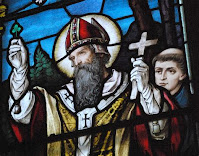

First off, let’s talk about Saint Patrick, the patron saint of Ireland. He wasn’t Irish. He was but a lad of about sixteen and a Roman citizen of Britain, when he was captured by pirates and sold into slavery in Ireland. He escaped to his homeland, became an ordained Bishop, and returned to the land of his captivity as a missionary. Some say he drove the snakes (the pagans) out of Ireland, but more accurately, Saint Patrick brought Christianity into the country. As a result, he was instrumental in changing laws and culture, advocating for women, the poor, and the enslaved. 
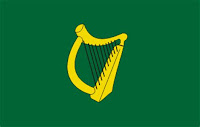

Do you know what the national symbol is? The shamrock, you say. Indeed, ‘tis not! Well, not the only one, anyway. A 14th century harp is the official national emblem of Ireland, but not without its controversy. As respected as poets, harpers were held in high esteem. In 1431, Henry the VIII of England declared the musical instrument as the national symbol. He even ordered the image to be used on coins. Eventually, however, harp music fell out of favor. By 1912, the harp was resurrected as a representation of resistance to the United Kingdom, and the image was flown on a green flag. After gaining their independence, the Irish government wished to make it their national symbol once more. But not so fast! Guinness, as in the beer, had already registered the figure in 1862, long before the revolution. Not to be deterred, the government simply flipped the harp from left to right, effectively distinguishing the harp’s image for posterity.

Picture is of my husband and our granddaughter, Sophia.

If you ask an Irishman a direct question, they will not answer with a simple “yes” or “no.” This is because these words are not in their original Gaelic vocabulary that dates back to the 4th century. When you inquire if they want to join you at the pub, they will answer with “I would” or “I would not.” More than likely the former as many of them love their beer—the one with the harp on it.
The term, boycott, has been bandied about lately, along with the word, cancel. But where did it originate? If you look at the word itself, it gives no clue to its meaning, unlike cancel, which, in part, comes from the Latin cancellare, meaning “to make like a lattice” or in short, “cross out.” Rather, the word started in Ireland. In 1880, Captain Charles Boycott, a land agent from Ulster, refused to reduce the rents of his employer’s tenants. As a result, he was ostracized by the entire community. The Times of London coined the expression, to boycott, as a term of organized isolation.


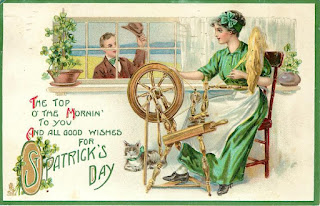
“Top o’ the mornin’ to you.” The phrase that kicked off this article was once used in the British Isles during the Victorian era, gaining popularity in Ireland. However, if you said it to an Irishman today, you’d be laughed at. Hollywood resurrected the archaic term and joined a long list of Irish stereotypes. Notably, Clancy, the red-haired hot head with an ale in one hand and a shillelagh (walking stick) in the other, searching for a Leprechaun and his pot of gold at the end of a rainbow.

The drop of Irish blood in me wishes to bestow a blessing before we part:



MissAdventure Brides Collection
Seven daring damsels don’t let the norms of their eras hold them back. Along the way these women attract the attention of men who admire their bravery and determination, but will they let love grow out of the adventures? Includes:
"Riders of the Painted Star" by Kathleen E. Kovach

1936 Arizona
Zadie Fitzpatrick, an artist from New York, is commissioned to go on location in Arizona to paint illustrations for an author of western novels and falls for the male model.

Kathleen E. Kovach is a Christian romance author published traditionally through Barbour Publishing, Inc. as well as indie. Kathleen and her husband, Jim, raised two sons while living the nomadic lifestyle for over twenty years in the Air Force. Now planted in northeast Colorado, she's a grandmother, though much too young for that. Kathleen is a longstanding member of American Christian Fiction Writers. An award-winning author, she presents spiritual truths with a giggle, proving herself as one of God's peculiar people.


Wednesday, May 12, 2021

The Salem Tomato Trial

By Kathy Kovach


When I hear Salem and trial, I’m immediately transported to a time of torches, pitchforks, and ignorance. The Tomato Trial didn’t involve tiny fruit tied to their stalks with screaming villagers accusing them of all manners of infractions.

But it might as well have. 


Other than the fact that the Tomato Trial was held in Salem, New Jersey rather than Salem, Massachusetts—and there was no fire involved—the bulbous fruit suffered from the same ignorance, falsely accused and condemned. 

The plant, as far as the origin of using it as food, dates back to the Aztecs in 700 AD. Known as a berry in the nightshade family, they can also be considered a vegetable as they lack high levels of sweet fructose. The poor tomato. No wonder people were confused. 


It made its way around the world, eventually landing in the United States. However, it was shunned from American tables due in large part to a book published in 1597 by barber/surgeon and English botanist John Gerard. He claimed the tomato to be poisonous due to low levels of the toxin tomatine. True, those toxins are present, but not enough to be dangerous. Some say his sloppy research condemned the tomato to a life of decoration, pretty to look at but never to consume.

A long-standing belief that tomatoes were sinful due to their aphrodisiac properties didn't help. Besides, they were red, a color associated with danger. 


Centuries later, Thomas Jefferson, our third president and known food connoisseur, took a liking to the vegetable/fruit, which helped to shine light on the misunderstood plant. However, it was slow to take off as a culinary delight. Because of the nightshade stigma, of which the mandrake, a hallucinogenic poisonous plant, is one, the tomato was shunned as table fare. The plant was merely ornamental, but nary a piece touched the lips of the savvy public. 


A myth surfaced that the plant had been known to kill, but later it was surmised to be pewter dishes which had leached lead due to the tomato's acid. However, some say the acid isn't strong enough to pull off such a task.

Finally, by 1820, a hero stepped up to save the day. Colonel Robert Gibbon Johnson was fed up with the smear campaign of his favorite side dish. He sponsored competitions for those who could grow the largest tomatoes to dispel the stigma.

Court was held to condemn the tomato once and for all. Johnson, serving as the defense, walked into the courthouse, carrying a basket of tomatoes and proceeded to eat every single one in front of the stunned crowd. Much to their dismay, he did not die, or even become violently ill. 

And thus, the tomato, in all of its round, shiny yumminess, escaped the pitch forks and burning at the stake. Declared innocent. And gracing my dinner table to this day.

I love tomatoes. My favorite way to eat them is Tomato Basil Soup. Mm, mm, good! Do you like tomatoes? What's your favorite way to eat them?


A secret. A key. Much was buried on the Titanic, but now it's time for resurrection.


Follow two intertwining stories a century apart. 1912 - Matriarch Olive Stanford protects a secret after boarding the Titanic that must go to her grave. 2012 - Portland real estate agent Ember Keaton-Jones receives the key that will unlock the mystery of her past... and her distrusting heart.
To buy: Amazon


Kathleen E. Kovach is a Christian romance author published traditionally through Barbour Publishing, Inc. as well as indie. Kathleen and her husband, Jim, raised two sons while living the nomadic lifestyle for over twenty years in the Air Force. Now planted in northeast Colorado, she's a grandmother, though much too young for that. Kathleen is a longstanding member of American Christian Fiction Writers. An award-winning author, she presents spiritual truths with a giggle, proving herself as one of God's peculiar people.