

Hello, everyone! I thought it would be fun, since I shared about becoming a lawyer in the Old West last month, to share about a larger-than-life Western judge this month. Many of us have probably heard of Judge Roy Bean, the only “Law West of the Pecos.” But beyond the interesting moniker for which he was known, who was he and how did he become a judge?
 |
| Judge Roy Bean |
Roy Bean was born in Mason County, Kentucky
somewhere around 1823. His parents were poor, uneducated hill folk, and they
had a hard time providing for Roy and his two older brothers, Sam and Josh.
Both of the elder Beans left home, Sam heading to Mexico, Josh to California.
When Roy became a teenager, he pulled up stakes and headed to Mexico to find
his brother, Sam. The pair ended up in Chihuahua in 1848, but Roy’s time there
was short. Soon after arriving, young Roy got in a barroom brawl and another
man pulled a knife on him. He shot the man in the head. The witnesses disagreed
on whether it was self-defense or murder, and Roy ended up having to flee
Mexico.
He next went to his brother, Josh, in California, where
he held a variety of jobs, from working for his brother (who was mayor of San
Diego), to running a saloon, and working as a California Ranger. When Josh was
murdered in 1852, Roy left there, headed for New Mexico. One account I read
said that he killed a man here in a duel on horseback, and that was why he
fled. Another account says that was a tale Roy told in his later years. He is
also fabled to have gone to Los Angeles, where he was reported to have stolen a
Spanish girl away from her Mexican boyfriend. As the story goes, Roy was caught
by the Mexican man and his cohorts, who lynched Bean. However, as the story
goes, the rope stretched, allowing Roy to stay alive until his girlfriend
arrived and cut him down. It’s been said that he carried scars of the rope
around his neck for the rest of his days.
During the Civil War, Bean and his friends created
a guerilla band who stole cattle and other valuables from wealthy landowners in
order to help the Confederate cause. They were little more than a nuisance, but
little real help to the cause.
After the war, Bean went to San Antonio, and for
the next eighteen years, he led a fairly uneventful life. Always looking for
the next “get rich quick” scheme, Bean tried his hand at lots of things.
Butcher, freighter, saloon-keeper, and dairy operator among them. During this
time, he was in and out of the San Antonio courts, pressing claims, which he
mostly lost. But he spent so much time in and around the courthouse that this
man with no formal education learned quite a bit about the law. It was during
this span of time that he married a child bride, had four children, and was
left by his bride when she saw what a washed-up nobody he was.
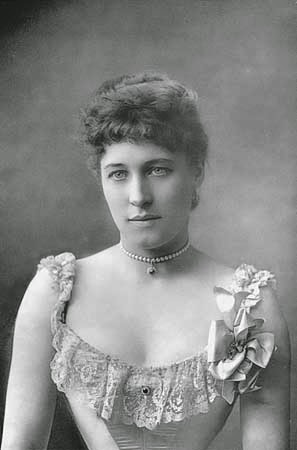 |
| Lily Langtry |
Bean moved on with the railroad once his wife
left, and as he worked his way across the great state of Texas, his friends
recommended he become a Justice of the Peace and Notary Public, due to his
seemingly extensive knowledge of the law. Eventually Bean landed in Langtry,
Texas. Some accounts say he founded and named the town. Others say it existed
before he arrived, and he made up the account. According to Bean, he named the
place after actress Lily Langtry, whom he developed an infatuation for after seeing
a beautiful drawing of her in a magazine. He was so smitten with her that he
kept the article and picture of her until the day he died.
 |
| The Jersey Lilly. Judge Bean sits on the front porch wearing a sombrero as he presides over court. |
In Langtry, Bean opened his own saloon called the
Jersey Lillie, named after the famed actress.
However, the sign outside the
establishment was misspelled by a drunken, illiterate sign painter. Other signs
that hung outside the saloon read, “Judge, Roy Bean, Notary Public,” “Justice
of the Peace,” and “Law West of the Pecos.” He also had one which advertised
his establishment’s ice beer. Inside the establishment, he had half the room
set up as a saloon, and half as a courtroom.
As a judge, Roy Bean relied heavily on his own common
sense, though many of his judgments were outrageous and, in some cases, outright
objectionable. Before big cases, he would recommend everyone buy a drink to “liven
up the proceedings.” Once, he found a corpse with gold and a pistol in the
pants pocket. He fined the deceased $40 for carrying a concealed weapon, and pocketed
the money. In another case where a white railroad worker was accused of killing
a Chinese worker, Bean thumbed through the only law book he owned, then tossed
the tome aside, stating that there was a single law in it that said it was
illegal to shoot a Chinaman. He dismissed the defendant without further ado. He
was also known to fine any drunken patron who fell asleep on the courtroom side
of his establishment, rather than on the saloon side.
By the turn of the century, Bean’s reputation had
grown to the point that easterners would board the train just to come to
Langtry to see Judge Bean sit on the porch of his saloon. If they could witness
him presiding over some matter of law, even better.
Bean passed away on March 16, 1903, after a trip
to San Antonio the previous day. He’d witnessed a cockfight while there, and
the bloodsport had gotten him so stirred up that he drank himself into a coma
and died the next day. The dream of his life, to meet Lily Langtry was nearly
realized. Just months after his death, Miss Langtry came to town to meet Bean
and tour the establishment named in her honor. She was saddened to learn of his
death, but the townsfolk gave her Bean’s pistol, which she took back to England
with her, to remember the “strange little man in America.”

It’s your turn. Had you heard of Judge Roy Bean?
Was he a hero or a villain? Leave me a comment, including your email address,
to be entered in a drawing for my first published novella, which is including
in the Oregon Trail Romance Collection.

Jennifer Uhlarik
discovered the western genre as a pre-teen, when she swiped the only “horse”
book she found on her older brother’s bookshelf. A new love was born. Across
the next ten years, she devoured Louis L’Amour westerns and fell in love with
the genre. In college at the University of Tampa, she began penning her own
story of the Old West. Armed with a B.A. in writing, she has won five writing
competitions and finaled in two other competitions. In addition to writing, she
has held jobs as a private business owner, a schoolteacher, a marketing
director, and her favorite—a full-time homemaker. Jennifer is active in
American Christian Fiction Writers and lifetime member of the Florida Writers
Association. She lives near Tampa, Florida, with her husband, teenaged son, and
four fur children.
