Showing posts with label Mid 20th Century history. Show all posts

Monday, November 20, 2017

Faith, the Brave Little Church Cat of WWII


In September, when I shared stories of some cats from World War II, 
I promised to share the story of a special cat who deserved a post of her own! Her touching story brought a tear to my eye.

On Watling Street in London at St. Augustine's and St. Faith's rectory, Fr. Henry Ross had an unexpected visitor. A thin little cat had followed the aroma of breakfast to the second floor. Ther verger (one who takes care of the sanctuary and order of service) tried to throw the persistent feline out for the third time. Henry was concerned the cat looked thin and cold. The verger's wife liked cats and Henry asked if she would bring a box for the little feline along with some bowls for feeding her.


Used with permission from
http://www.purr-n-fur.org.uk/famous/faith.html
article: "Faith, the Church Cat"
After no one in the congregation answered Henry’s message in the church bulletin, attempting to find the cat’s true home, he happily made her the church cat and thought that the name “Faith” would fit, since she hadn’t given up on finding a home in the church. Faith enjoyed the full range of the church and mice to catch. She grew fatter and even attended services. She curled up at Fr. Ross’ feet as he preached. When he wasn’t the celebrant, she sat on the front pew. The little cat became a well-loved fixture in the church.

In 1940 she’d grown plumper than usual and it was discovered she was expecting. One August morning, Henry found she’d given birth to a male kitten. Due to his black and white markings he was named “Panda.”

On September 6, Faith somehow communicated to Henry to follow her all the way from the second floor down to the basement door. She persisted until he opened it for her. Faith made her way down to the basement and Henry left the door open for her. Later, she transported her kitten, Panda, down to the cold, musty basement.

When Faith's basket stayed empty. Henry found them in the basement both between two piles of retired sheet music. He brought Panda back upstairs to where the two cats would be warmer while Faith followed. 


Lucka97, 2011,(CC) from Wikimedia Commons.
Perhaps, with his black ears and tail, and
white body, Panda looked a little like this kitten.
Henry went to lead a church service, but Faith didn’t attend that time. Instead, he later found she had taken Panda back to the basement. He brought the kitten up again. This happened a few times before he decided to consult the verger’s wife and some of the other church ladies. They seemed to believe that Faith felt her kitten was in some sort of danger.

On September 9, Henry rode his bike to Westminster for business. When he was returning later that day, the air raid sirens had begun. He was forced to spend the night in a shelter. The next day, amidst the destruction he made his way back to Watling Street. Though the church tower still stood, most of the church was a twisted mess.

A fireman warned Henry that what was left of the roof could collapse at any moment. Still, Father Ross searched determinedly through the rubble for his beloved feline companions. He called to Faith until he heard a faint mew. He finally found her under the old singed sheet music, nursing her kitten, while surrounded by the smoking rubble.

St. Augustine's, Watling Street
London, by ChrisO, current photo,
from Wikipedia.org (CC)

Henry, overjoyed, moved them to safety before the roof collapsed. The verger and his wife invited him and the cats to stay with them until the rectory would again be inhabitable.

In 1945, Faith was given an honorary Dickin medal and citation for her bravery, even though she wasn’t a military cat. The Archbishop of Canterbury even attended the ceremony at St. Augustine’s! Even across the pond, the Greenwich Village Humane League in New York had gotten wind of her story and made sure her story was printed and shared.

Panda grew up into a handsome tom and eventually went to become the in-residence cat at a nursing home, where I’m guessing he brought joy to many of the residents. Then one morning in 1948, after Henry gave Faith her breakfast, she laid down in front of the fireplace for a nap and peacefully passed away.

She was buried near the churchyard gate and was remembered by the congregation in a service. After her act of bravery to protect her kitten during the Luftwaffe bombing, her photograph was placed on a chapel wall with this tribute below it:


Photo from Popular Social Science article "The Cats that
Fought WWII: The Allies"
"Faith"
Our dear little church cat of St. Augustine and St. Faith.
The bravest cat in the world. On Monday, September 9th, 1940, 
she endured horrors and perils beyond the power of words to tell.
Shielding her kitten in a sort of recess in the house (a spot
she selected three days before the tragedy occurred), she
sat the whole frightful night of bombing and fire, guarding her
little kitten. The roofs and masonry exploded. The whole house
blazed. Four floors fell through in front of her. Fire and water
and ruin all round her.Yet she stayed calm and steadfast and 
waited for help.We rescued her in the early morning while the
place was still burning, and By the mercy of Almighty God, she and
her kitten were not only saved, but unhurt. God be praised and
thanked for His goodness and mercy to our dear little pet.
(Used with permission from: 
http://www.purr-n-fur.org.uk/famous/faith.html)

For a more complete story of Faith, go to: Purr-n-Fur UK for the article "Faith, the Church Cat", by Patrick Roberts, where much of this information was found and you can find more delightful stories about famous felines!

Kathleen Rouser is the award-winning author of Rumors and Promises, her first novel about the people of fictional Stone Creek, Michigan. She is a longtime member of American Christian Fiction Writers. Kathleen longs to create characters who resonate with readers and realize the need for a transforming Savior in their everyday lives. She lives in Michigan with her hero and husband, and the sassy tail-less cat who found a home in their empty nest. Connect with Kathleen on her website at kathleenrouser.com, on Facebook at https://www.facebook.com/kathleenerouser/, and on Twitter @KathleenRouser


Tuesday, May 5, 2015

WONDER BREAD TURNS 94!


by Ramona K. Cecil
                                                                                                                                                   
I’m of the Howdy Doody generation. If you’re too young to remember Howdy Doody, it was a TV puppet show for children in the 1950s. One of the main sponsors of the show was Wonder Bread with it’s iconic package sporting colorful red, yellow, and blue balloons. I remember those ads very well. What I didn’t know as a kid watching them was that the bread being touted by Howdy Doody and his pal Buffalo Bob Smith, actually got its start in my home state of Indiana.

This month, Wonder Bread turn 94 years old! It was introduced by the Taggart Baking Company of Indianapolis, Indiana, on May 21st, 1921. Leading up to the bread’s launch, the baking company enticed the public with a promotional ad campaign arguably as intriguing as any Apple Computer has put forth in recent years with the tantalizing promise, “Wonder is coming May 21st!”   

Are you “wondering” how the bread got the name “Wonder,” I wonder, with tongue placed firmly in cheek? The brand name was the brain child of Elmer Cline, the baking company’s vice president charged with naming the new product. Cline had witnessed the International Balloon Race at the Indianapolis Motor Speedway and was filled with “wonder” at the sight of the many colorful balloons rising skyward. The red, yellow, and blue balloon logo on the bread’s packaging pays homage to the event that inspired the product’s name.
 

Balloon Race at Indianapolis Speedway 1909


When the bread hit the stores, Cline and his marketing department continued their genius ad promotion. They sent out company trucks filled with colorful helium-filled balloons and handed the balloons out to kids with a note advertising Wonder Bread to take to their mothers. It worked. Soon, Wonder Bread outsold all other bread brands in Indianapolis. Over the years the company continued to target their youngest customers through promotions like games and magic tricks on the bread’s package as well as sponsoring radio and TV programs for kids like Howdy Doody and personalities like sports heroes and cartoon characters.


In 1925, Continental Baking Company bought Taggart and Wonder Bread went national.

In 1928, a bread-slicing machine invented by an Iowan named Otto Frederick Rohwedder completely revolutionized commercial bread baking. Wonder Bread was one of the first to adopt the technology and began selling pre-sliced bread nationwide in 1930. At first the public was skeptical, wary that pre-slicing would cause the bread to be stale. Ultimately, however, fears about less than fresh-tasting bread proved unfounded and the public went wild for the uniformly pre-sliced product. Wonder Bread rode the wave of  public enthusiasm over the new technology and helped to coin the phrase “The best thing since sliced bread.”

Wonder Bread had a bakery pavilion at the 1939 New York World's Fair, advertising Wonder as the only bread baked at the world's fair.

 With the outbreak of WWII metals required to produce bread slicing machines were needed for the war effort, so, for much of the 1940s, Wonder Bread returned to selling their product unsliced. Despite what might have been viewed as a step backwards, Wonder Bread was quietly making new leaps forward. It was during this time that Wonder Bread was on the forefront of a government supported initiative to eliminate diseases like beriberi and pellagra by enriching commercially sold white bread with vitamins and minerals. Known as the “quiet miracle,” this innovation helped to improve the health of millions of people nationwide and was touted in Wonder Bread’s slogan, “Helps build strong bodies 12 ways.”  It was also during this period that Wonder Bread revolutionized commercial bread-baking with a new process that eliminated holes in the bread.


Continuing to innovate, Wonder introduced nutritional information and open-dating to their packaging in the 1970s and, in the mid 1980s, brought a reduced-calorie Wonder Bread to a more health-conscious public.


In 1995 Interstate Brands bought the Continental Baking Company and the Wonder Bread brand. Six years later, in 2001, the company honored Wonder Bread’s 80th birthday with a hot air balloon tour of the country, reminding folks about how the famous bread got its name.


Today, Wonder Bread is part of Flowers Foods.
Flowers Foods markets baked foods under such brands as Nature's Own and Whitewheat.


Back in the 1950s as I sat cross-legged on the floor in front of the TV set, singing along with the Howdy Doody theme song between bites of a peanut butter sandwich, would I have cared if I knew that the bread I was eating got its start in Indiana? I doubt it. But today, I say “Happy birthday, Wonder Bread! One of Indiana’s own.

Do you have a special childhood memory of Wonder Bread? I’d love to hear it!


Ramona K. Cecil is a poet and award-winning author of historical fiction for the Christian market. A proud Hoosier, she often sets her stories in her home state of Indiana.


Check out her website at www.ramonakcecil.com


Wednesday, September 3, 2014

I'm The Omar Man Knocking at Your Door...and other Deliverymen from the Past


by Pamela S. Meyers

For years most towns in the U.S. had their milk delivered daily. But how many of you have heard of the Omar Man or the Jewel-Tea Man?

When I was growing up in the fifties and sixties we often traveled from Wisconsin to Ohio to visit my grandparents and cousins. When we did, I experienced the Omar Man who came to households on regular routes, delivering bread and pastries. Bread was bread as far as I was concerned, but to have pastries delivered to your door to satisfy your sweet tooth?  To me that was heaven. Oh how I wished we had an Omar Man in my small Wisconsin town.


I haven’t thought about the Omar Man in many years, but last week something prompted me to Google him. I learned that the company started in 1923 in Omaha, Nebraska. It’s home office building has now been restored and repurposed into office and event space, but at one time the entire operation included bakery operations in Milwaukee, WI, Columbus, OH, Indianapolis IN, and Omaha. The Omar Man trucks fanned out across the countryside and called on millions of homes, including those in Springfield, Ohio where my extended family lived.


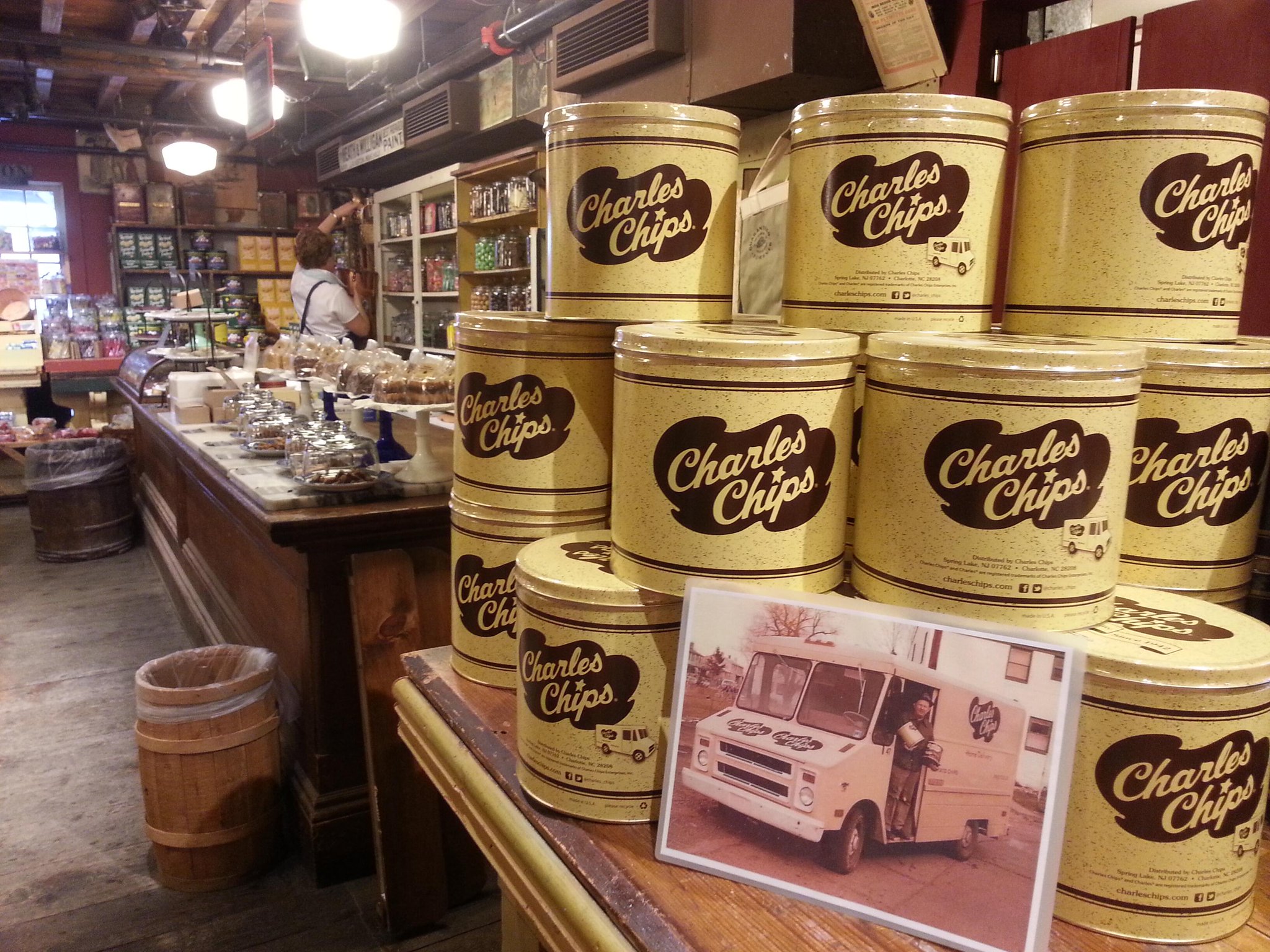
While researching the Omar Man, I came across other similar deliverymen. One of these was the Charles Chips Man, another deliveryman that I encountered on visits to Ohio.

Charles Chips is a regional brand that is still around, but they stopped home delivery in the 70s. I don’t know about current times, but back in the day they came in a tin like the ones shown in the picture and never in a bag. Note the photo in the picture of one of the delivery trucks.


The Two Franks


One deliveryman who was popular around the Chicago area, as well as in other parts of the country, was the Jewel Tea Man. The business started in 1899 when Frank Skiff started selling teas, coffee, spices, and extracts door to door. In 1901, Skiff’s brother-in-law, Frank Ross, joined in, and they started the Jewel Tea Company on Chicago’s south side. Until 1916, the delivery routes were local, but after 1916, they spread nationwide. The Jewel man would call on his customers every two weeks. Over time their inventory expanded, even to include housewares in addition to food items.


 In 1932, the company acquired a chain of self-service stores and changed their name to Jewel Food Stores. The number of grocery stores expanded and in 1981, the home shopping
Jewel Grocery store circa 1940s
service was sold. It now operates under the name “J.T.’s General Store.”


When I first moved to the Chicago area back in the seventies, I sometimes heard people refer to the Jewel grocery stores as Jewel-Tea and I never got the connection until now. 


Jewel Store Today

Locals in the Chicago area now have a large selection of grocery stores to shop in, but Jewel still holds a large portion of the market share. You will often hear people saying something like, “I went to the Jewel today.” Where the addition of "the" to the sentence came from I have no idea, but I wonder if it isn't a throwback to the day Jewel's wares arrived in a delivery wagon.


What deliverymen do you remember?


A native of Lake Geneva, Wisconsin, author Pamela S. Meyers lives in suburban Chicago with her two rescue cats, an hour's drive away from her Wisconsin hometown which she visits often to dig into its historical legacy. Her novels include Thyme for Love, and Love Will Find a Way, contemporary romantic mysteries, and her 1933 historical romance, Love Finds You in Lake Geneva, Wisconsin. She can often be found speaking at events around Lake Geneva or nosing in microfilms and historical records about Wisconsin and other Midwestern spots for new story ideas