Showing posts with label Montana Cattle Ranches. Show all posts

Sunday, February 20, 2022

Shake Idioms (Wild West Sayings We Use Today)

Welcome to an all-new exploration of words and their history. Do you find it fascinating to learn about people from a bygone era? Words connect us to those who lived before us. Today we’ll discover slang expressions that use ‘shake' or 'shakes.’ Ready to climb into our literary time machine? It’s time for another word adventure.


Wild West Sayings We Use Today, Part 31


No Great Shakes

This idiom, which means ‘nothing to brag about,’ has been around since the early 1800s, and possibly before. Several theories exist on the origin of 'no great shakes.' Some believe it derived from gambling with dice. Others suspect the phrase evolved from an obsolete sense of ‘shake,’ which once signified ‘swagger.’

Historical Reference: The first known print citation came from Sir John Cam Hobhouse, the first Baron Broughton, a politician and friend to Lord Byron. In Recollections of a Long Life, his 6-volume memoir, Lord Broughton referred to an art show held in 1816: “W. said that a piece of sculpture there was 'nullae magnae quassationes,' and the others laughed heartily.” (Note: The others were proficient linguists, who understood the Latin for ‘no great shakes’ at once.

Example: I’ve tasted her meatloaf. She’s no great shakes at cooking.

Shake a Leg



The use of ‘shake a leg’ for ‘hurry up and get started’ appears to have come from an old nautical saying with a colorful backstory.

Historical Reference: In the 1700s through the 1800s, many men were kidnapped and forced into service on sailing vessels. To keep them from deserting, sailors were restricted from going ashore in port. However, the wives of married sailors could join their husbands onboard. In the bunk area in the mornings, the petty officer would shout, ‘show a leg,’ or ‘show a leg and put a stocking on it.’ Feminine ones could remain under the covers. Hairy legs betrayed their owners, who had to get up and work.

Example: Shake a leg, will you? We don’t have all day.

More Than You Can Shake a Stick At



This delightfully picturesque expression for ‘too many to count’ inspires interesting mental pictures. Shaking a stick can be considered threatening, so some people suggest this phrase came from warfare. Others picture children at play. No one knows the exact origin. I vote for children at play.

Historical Reference: The first print citation for this phrase appeared in “The Lancaster Journal” (Pennsylvania; 1818): "We have in Lancaster as many Taverns as you can shake a stick at."

Example: My mother has more yarn than you can shake a stick at.

Thanks for traveling into another installment of Wild West Sayings We Use Today. Don't rush off. I'd love to know your thoughts.
  • Were you aware of these phrases and meanings or did they surprise you?

What's New with Janalyn Voigt

The deadline for The Whispering Wind (Montana Gold, book 6) was the worst I’ve ever faced. To make a long story short, I hurt my back last fall by lifting a heavy canner. My injury had nearly healed when I decided it would be a good idea to carry a 50-lb. bag of sugar. (What could go wrong?) This reactivated the earlier injury. To alleviate the pain, I applied a muscle rub. This gave me a chemical burn, complete with nerve damage. Constant pain, sleep disruptions, and the inability to type without muscle spasms made meeting my deadline seem impossible at times.

Thankfully, my publisher was gracious. I could use dictation to type and voice-edit. And my dear husband stepped in to help with the dishes. He even cooked dinner one night. It turned out well, which is saying something. My husband’s informal nickname around here is ‘Mr. Burny Man.’ If you’ve read Hills of Nevermore (Montana Gold, book 1), Nate is modeled after my husband. Enough said.

I’m grateful to report that I turned in The Whispering Wind on Thursday. The story never stopped coming, which boosted my faith to continue working. The plot involves two people, ironically enough, in pain. I could relate, although my characters suffered emotional pain, whereas mine was quite physical. I’ve sustained no permanent damage, and the book is finished. God is good.

Learn more about Janalyn Voigt and her books.

Hills of Nevermore
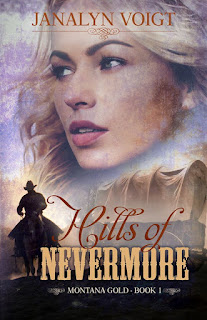
Can a young widow hide her secret shame from the Irish preacher bent on helping her survive?

In an Idaho Territory boom town, America Liberty Reed overhears circuit preacher Shane Hayes try to persuade a hotel owner to close his saloon on Sunday. Shane lands face-down in the mud for his trouble, and there’s talk of shooting him. America intervenes and finds herself in an unexpectedly personal conversation with the blue-eyed preacher. Certain she has angered God in the past, she shies away from Shane.

Addie Martin, another widow, invites America to help in her cook tent in Virginia City, the new mining town. Even with Addie’s teenage son helping with America’s baby, life is hard. Shane urges America to depart for a more civilized location. Neither Shane’s persuasions nor road agents, murder, sickness, or vigilante violence can sway America. Loyalty and ambition hold her fast until dire circumstances force her to confront everything she believes about herself, Shane, and God. Available in print, digital, and audiobook formats. Purchase Hills of Nevermore.

Based on actual historical events during a time of unrest in America, Hills of Nevermore explores faith, love, and courage in the wild west.


Monday, March 12, 2018

MONTANA CATTLE BARON CONRAD KOHRS


"They were a rugged set of men, these pioneers, well qualified for their self-assumed task. In the pursuit of wealth a few succeeded and the majority failed,...the range cattle industry has seen its inception, zenith, and partial extinction all within a half-century. The changes of the past have been many; those of the future may be of even more revolutionary character." —Conrad Kohrs, 1913

Conrad Kohrs and his friends in the parlor of the main ranch house.

Once a sprawling 10-million-acre cattle ranch, the Grant-Kohrs Ranch National Historical Site is now open to the public to explore. It is not a petting zoo for cows and horses, nor is it a dude ranch. Nope, it’s a working cattle ranch where cowboys still have chores and work hard every season of the year. The ranch is a unique opportunity to take a glimpse into an important period in taming the Old West.

The Montana gold rush of the 1860s lured many a man to stake his claim, but few realized the lucrative potential of selling beef to the miners in butcher shops at the camps. Miners would pay in gold for a nice, juicy steak after eating beans morning, noon, and night.

Carsten Conrad Kohrs, an immigrant from Germany, may have followed his gold fever from California, to Canada, and finally to Montana in 1862, but he soon discovered the motherload of gold on the hoof and became one of the first Montana cattle barons. He had learned the butcher trade from relatives in New York and Iowa and set up a butcher shop, at first taking advantage of the herds of longhorns driven up from Texas.


The main ranch house was built in 1862 by Johnny Grant
and known as the most beautiful home in Montana Territory.
Conrad Kohrs bought the property in 1866 and added a brick addition in 1890. 

Starting small, Kohrs purchased his first ranch in 1866 from Johnny Grant near Deer Lodge in Montana Territory. At first, he only grazed the cattle sold in his butcher shops, but then his business grew until he was shipping 10,000 head of cattle every year to the Chicago stockyards that supplied beef to most of the country. Eventually, he amassed a cattle empire that ranged over four states and two Canadian provinces.

The range was unfenced, and by the 1870s, the bison had almost been wiped out, and the Native Americans couldn’t fight the onslaught of settlers and cattle ranchers. Cattlemen bred the longhorns that came from a Spanish strain with English shorthorns and helped multiply Kohrs herds.

Cowboys herding cattle on the Kohrs Ranch in 1910

The open grasslands of Montana Territory offered unlimited grazing land. Once a herd overgrazed an area, the cowboys simply moved the herd to new pasture. Feed was plentiful.

By the mid-1880s, raising cattle was so lucrative that foreign investors and Eastern opportunists rushed to Montana to make their fortunes. Raising cattle was big business. Ranches multiplied and herds grew larger until there was not enough grazing land to feed them all.

Then came the deep snows and bitter-cold winter of 1886-87 that wiped out almost half the cattle in Montana. When homesteaders started fencing their 160-acre plots of land with barbwire, it was the beginning of the end for the cattle barons.

Even though the cattle “gold” rush only lasted less than half a century, the pioneering spirit of the cattle ranchers changed the industry forever. Much like small farms, there are still cattle ranchers in Montana who take the risk of making money off the range, but there are none who can rival the cattle barons, especially Conrad Kohrs.

All photos in this post are courtesy of the 
National Park Service and are public domain.


***

Will my hero Buck McKean in Dreams of My Heart become a cattle baron in The Reluctant Brides series? Stay tuned for book 2, Love of My Heart, that releases February 1, 2019.


My feisty Irish bride Kate O'Brien McKean asks her Texas cattleman husband Buck for an annulment in Dreams of My Heart, book 1 of The Reluctant Brides series, setting off a chain reaction of events that endangers them both. The historical romance set in 1875 Montana Territory releases April 1 from Mountain Brook Ink. The e-book is available for preorder on Amazon.


After a career spent acquiring and editing books by numerous bestselling Christian authors, Barbara J. Scott has returned to her true love—writing. Barbara and her husband Mike live in the Nashville area, with their two Chihuahuas, Riley and Sissy, both rescued from puppy mills. Reading, writing, and research are her passions. Want to know more? Connect with Barbara at www.BarbaraJScott.com.