Showing posts with label Montana Territory. Show all posts

Sunday, February 20, 2022

Shake Idioms (Wild West Sayings We Use Today)

Welcome to an all-new exploration of words and their history. Do you find it fascinating to learn about people from a bygone era? Words connect us to those who lived before us. Today we’ll discover slang expressions that use ‘shake' or 'shakes.’ Ready to climb into our literary time machine? It’s time for another word adventure.


Wild West Sayings We Use Today, Part 31


No Great Shakes

This idiom, which means ‘nothing to brag about,’ has been around since the early 1800s, and possibly before. Several theories exist on the origin of 'no great shakes.' Some believe it derived from gambling with dice. Others suspect the phrase evolved from an obsolete sense of ‘shake,’ which once signified ‘swagger.’

Historical Reference: The first known print citation came from Sir John Cam Hobhouse, the first Baron Broughton, a politician and friend to Lord Byron. In Recollections of a Long Life, his 6-volume memoir, Lord Broughton referred to an art show held in 1816: “W. said that a piece of sculpture there was 'nullae magnae quassationes,' and the others laughed heartily.” (Note: The others were proficient linguists, who understood the Latin for ‘no great shakes’ at once.

Example: I’ve tasted her meatloaf. She’s no great shakes at cooking.

Shake a Leg



The use of ‘shake a leg’ for ‘hurry up and get started’ appears to have come from an old nautical saying with a colorful backstory.

Historical Reference: In the 1700s through the 1800s, many men were kidnapped and forced into service on sailing vessels. To keep them from deserting, sailors were restricted from going ashore in port. However, the wives of married sailors could join their husbands onboard. In the bunk area in the mornings, the petty officer would shout, ‘show a leg,’ or ‘show a leg and put a stocking on it.’ Feminine ones could remain under the covers. Hairy legs betrayed their owners, who had to get up and work.

Example: Shake a leg, will you? We don’t have all day.

More Than You Can Shake a Stick At



This delightfully picturesque expression for ‘too many to count’ inspires interesting mental pictures. Shaking a stick can be considered threatening, so some people suggest this phrase came from warfare. Others picture children at play. No one knows the exact origin. I vote for children at play.

Historical Reference: The first print citation for this phrase appeared in “The Lancaster Journal” (Pennsylvania; 1818): "We have in Lancaster as many Taverns as you can shake a stick at."

Example: My mother has more yarn than you can shake a stick at.

Thanks for traveling into another installment of Wild West Sayings We Use Today. Don't rush off. I'd love to know your thoughts.
  • Were you aware of these phrases and meanings or did they surprise you?

What's New with Janalyn Voigt

The deadline for The Whispering Wind (Montana Gold, book 6) was the worst I’ve ever faced. To make a long story short, I hurt my back last fall by lifting a heavy canner. My injury had nearly healed when I decided it would be a good idea to carry a 50-lb. bag of sugar. (What could go wrong?) This reactivated the earlier injury. To alleviate the pain, I applied a muscle rub. This gave me a chemical burn, complete with nerve damage. Constant pain, sleep disruptions, and the inability to type without muscle spasms made meeting my deadline seem impossible at times.

Thankfully, my publisher was gracious. I could use dictation to type and voice-edit. And my dear husband stepped in to help with the dishes. He even cooked dinner one night. It turned out well, which is saying something. My husband’s informal nickname around here is ‘Mr. Burny Man.’ If you’ve read Hills of Nevermore (Montana Gold, book 1), Nate is modeled after my husband. Enough said.

I’m grateful to report that I turned in The Whispering Wind on Thursday. The story never stopped coming, which boosted my faith to continue working. The plot involves two people, ironically enough, in pain. I could relate, although my characters suffered emotional pain, whereas mine was quite physical. I’ve sustained no permanent damage, and the book is finished. God is good.

Learn more about Janalyn Voigt and her books.

Hills of Nevermore
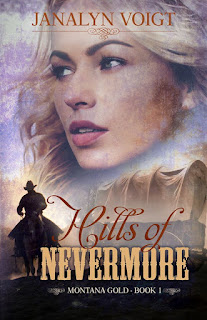
Can a young widow hide her secret shame from the Irish preacher bent on helping her survive?

In an Idaho Territory boom town, America Liberty Reed overhears circuit preacher Shane Hayes try to persuade a hotel owner to close his saloon on Sunday. Shane lands face-down in the mud for his trouble, and there’s talk of shooting him. America intervenes and finds herself in an unexpectedly personal conversation with the blue-eyed preacher. Certain she has angered God in the past, she shies away from Shane.

Addie Martin, another widow, invites America to help in her cook tent in Virginia City, the new mining town. Even with Addie’s teenage son helping with America’s baby, life is hard. Shane urges America to depart for a more civilized location. Neither Shane’s persuasions nor road agents, murder, sickness, or vigilante violence can sway America. Loyalty and ambition hold her fast until dire circumstances force her to confront everything she believes about herself, Shane, and God. Available in print, digital, and audiobook formats. Purchase Hills of Nevermore.

Based on actual historical events during a time of unrest in America, Hills of Nevermore explores faith, love, and courage in the wild west.


Sunday, August 19, 2018

Quirky Montana Historical Facts


I came across my share of quirky historical trivia while researching the Montana Gold series, set during Montana’s goldrush, a wild and wooly time in the Old Wild West. Many colorful stories attach to place names in particular. Here, for your entertainment are some of the gems I mined in my historical research. 


Quirky Montana Historical Facts 

Montana was Idaho


You read that right. Idaho Territory formed March 4 1863 and covered some of the, er, territory that would become part of southwestern Montana in the present day. Prior to that date, the land was part of Washington Territory.

Image: Idaho Territory Coat of Arms
 The borders shifted again on March 26 1864, at the birth of Montana Territory. One family living in Hell Gate (south of what is now Missoula) held an unusual claim to fame. Their three children had been born in a single house but three different territories.

Image: Montana Territory Coat of Arms


The Ruby River contained no rubies

The Upper Ruby River; image by Mike Cline [CC BY-SA 3.0] from Wikimedia Commons
Early settlers mistook the pretty red gemstones they found in the riverbed and along its banks for rubies. These were in fact garnets. The name stuck, regardless.

Hell Gate Canyon earned its name.

Hell Gate Canyon from Heaven's Gate overlook, Idaho. Image by Dsdugan [Public domain], from Wikimedia Commons
French trappers named Hell Gate Canyon for the piles of human bones they found within it. The Flathead tribe had to pass through the canyon to reach hunting grounds on the other side. Unfortunately, the narrow canyon entrances made ideal locations for members of the Blackfoot tribe to ambush the hunting parties.

Deer Lodge wasn’t a building.

Hot spring mound in the "Deer Lodge" prairie of the Rocky Mountains.
Color lithograph after G. Sohon. [CC BY 4.0] via Wikimedia Commons
Well, okay. There are buildings in the town of Deer Lodge, and Deer Lodge Valley has its share of buildings. However, both the town and the valley were named after a mound. A remarkable landmark in its day, Deer Lodge Mound has less status in modern times. A warm spring (now capped) steamed at the top of the 40-foot-high geologic formation and deposited minerals down its side. This made the mound into a salt lick for multitudes of local deer. The spring steamed in the cold winter air, reminding the local tribe of a lodge with smoke curling above it.

Tell it to the judge.

Varina Davis, wife of Jefferson Davis in a portrait miniature by John Wood Dodge (1807-1893)
 (www.civilwar.si.edu) [Public domain], via Wikimedia Commons
Virginia City, Montana was almost named after Jefferson Davis’s beautiful wife, Varina. However, Judge Bissell, a devout Unionist, refused to approve the town charter until the name was changed. The framers of the town opted for the judge’s suggestion of Virginia City, and the charter went through.

The fort that wasn’t.

Fort Owen in Montana's Bitterroot Valley; image by Forest Service Northern Region from Missoula, MT, USA
[CC BY 2.0 or Public domain], via Wikimedia Commons
Major John Owen, a retired army sutler (supply manager), settled in 1850 with his beloved Native American wife in the Bitterroot Valley and there established a ‘fort.’ Really just a trading post, Fort Owen never housed soldiers or heard a shot fired. Major Owen was trusted by the local tribe and settlers alike. He served as Indian Agent to the Flathead tribe between 1856 and 1862.

Uncovering very human stories while researching my books makes history come alive for me. I hope I have given you a small window into the past.

About Janalyn Voigt


Janalyn Voigt's unique blend of adventure, romance, suspense, and whimsy creates breathtaking fictional worlds for readers. Known for her vivid writing, this multi-faceted author writes in the western historical romance, medieval epic fantasy, and romantic suspense genres. 

Janalyn is represented by Wordserve Literary Agency. Her memberships include ACFW and NCWA. When she's not writing, she loves to garden and explore the great outdoors with her family.


Cheyenne Sunrise (Montana Gold 2)

Can a woman with no faith in men learn to trust the half-Cheyenne trail guide determined to protect her?
Young Irish widow Bry Brennan doesn’t want another husband to break her spirit. When she and her brother Con join a wagon train headed to Montana Territory, Bry ignores her fascination with Nick Laramie, the handsome trail guide.
Nick lives in an uneasy truce between the settlers and his mother’s tribe without fully fitting in among either. With no intention of dragging a woman into his troubles, he stifles his yearning for Bry.
The perilous journey throws the two together, leaving Bry no choice but to trust Nick with her life. Can she also trust him with her heart? Answering that riddle forces Bry to confront her unresolved questions about God’s love.

Based on actual historical events during a time of unrest in America, Cheyenne Sunrise explores faith, love, and courage in the wild west. Learn more.

Tuesday, June 19, 2018

The Vigilantes of Montana


Boot Hill, Virginia City, Montana. Outlaws were buried separately from the town's decent folk. By Basenjik [CC BY-SA 4.0], from Wikimedia Commons

Men came to Bannack, site of the first discovery of gold in present-day Montana, in 1863 for a number of reasons. Many hoped to make their fortunes in gold, find adventure, and enjoy the freedom of the American West. Others were fleeing justice or on the take. Greed sparked crimes.


The Civil War focused the government’s attention away from the settlers’ pleas to tame the West. Those living in the Wild West felt justifiably abandoned. The dearth of law-and-order was never more keenly felt than in the gold camps, where gold dust, prostitutes, and rot-gut whiskey combined to lead men astray. Bannack was one of the most notorious. The first-hand accounts I read while researching the Montana Gold series confirm this. Lucia Darling, who established a school for the town’s children in 1863, gave a scathing report in her diary. “Bannack was tumultuous and rough. It was the headquarters of a band of highwaymen. Lawlessness and misrule seemed to be the prevailing spirit of the place.”

Word-of-mouth held that a gang of road agents known as “The Innocents” had murdered one hundred men. Some believed that the leader was none other than Bannack’s Sheriff Henry Plummer and that several of his deputies were among the outlaws. This naturally did not instill in them feelings of security. The gang was said to operate out of the Rattlesnake Ranch, twelve miles from Virginia City, another boomtown that in 1865 would steal the title of territorial capital from Bannack.

People were fed up with the scourge of road agents who held up stagecoaches carrying gold between Bannack and Virginia City and robbed riders who dared to venture onto the roads. After the brutal murder of a well-liked Dutch miner named Nicholas Tbalt, matters came to a head. Nicholas had ridden off with a bag of gold and simply vanished. On December 21, four days after the discovery of the unfortunate man’s body, a group of vigilantes tried and hanged George Ives for the crime. Two days later, prominent citizens of Bannack and Virginia City formed the Vigilance Committee of Alder Gulch, headquarted in Virginia City.

A slew of lynchings followed as the vigilantes hunted down at least 20 suspected road agents. They left a scrap of paper with the numbers “3-7-77” on each hanged man. Many theories have been ventured as to what these numbers meant. Some claim it gave the dimensions of a grave. Whatever their meaning, the warning these numbers gave was well understood by anyone who found them painted on their tents or cabins. Today, members of the Montana Highway Patrol still wear these numbers.

On January 10, 1863, vigilantes hanged Sheriff Henry Plummer alongside two of his deputies. I used first-hand accounts to paint this scene in Hills of Nevermore (Montana Gold, book 1). Some feel that justice was served; others that the vigilantes hung the innocent. Today, historians disagree over Sheriff Plummer’s guilt or innocence. On May 7, 1993, Montana’s Twin Bridges Public Schools initiated a posthumous trial for Henry Plummer. It ended in a hung jury and the declaration of a mistrial.

The lynching of Jack Slade on March 10, 1864 in Virginia City raised eyebrows. Jack hadn’t actually murdered anyone, although he’d terrorized the entire town by riding his horse down the main street with his guns blazing while drunk. Not long after Jack’s death, government-sanctioned law and order came to Montana. Vigilante violence continued sporadically until 1867, but it became an increasing cause for concern. Miners in Bannack asked the vigilantes to desist, promising to return any judgment they meted out five-fold. 

About Janalyn Voigt

Janalyn Voigt's unique blend of adventure, romance, suspense, and whimsy creates breathtaking fictional worlds for readers. Known for her vivid writing, this multi-faceted author writes in the western historical romance, medieval epic fantasy, and romantic suspense genres.

Janalyn is represented by Wordserve Literary Agency. Her memberships include ACFW and NCWA. When she's not writing, she loves to garden and explore the great outdoors with her family.


Monday, March 12, 2018

MONTANA CATTLE BARON CONRAD KOHRS


"They were a rugged set of men, these pioneers, well qualified for their self-assumed task. In the pursuit of wealth a few succeeded and the majority failed,...the range cattle industry has seen its inception, zenith, and partial extinction all within a half-century. The changes of the past have been many; those of the future may be of even more revolutionary character." —Conrad Kohrs, 1913

Conrad Kohrs and his friends in the parlor of the main ranch house.

Once a sprawling 10-million-acre cattle ranch, the Grant-Kohrs Ranch National Historical Site is now open to the public to explore. It is not a petting zoo for cows and horses, nor is it a dude ranch. Nope, it’s a working cattle ranch where cowboys still have chores and work hard every season of the year. The ranch is a unique opportunity to take a glimpse into an important period in taming the Old West.

The Montana gold rush of the 1860s lured many a man to stake his claim, but few realized the lucrative potential of selling beef to the miners in butcher shops at the camps. Miners would pay in gold for a nice, juicy steak after eating beans morning, noon, and night.

Carsten Conrad Kohrs, an immigrant from Germany, may have followed his gold fever from California, to Canada, and finally to Montana in 1862, but he soon discovered the motherload of gold on the hoof and became one of the first Montana cattle barons. He had learned the butcher trade from relatives in New York and Iowa and set up a butcher shop, at first taking advantage of the herds of longhorns driven up from Texas.


The main ranch house was built in 1862 by Johnny Grant
and known as the most beautiful home in Montana Territory.
Conrad Kohrs bought the property in 1866 and added a brick addition in 1890. 

Starting small, Kohrs purchased his first ranch in 1866 from Johnny Grant near Deer Lodge in Montana Territory. At first, he only grazed the cattle sold in his butcher shops, but then his business grew until he was shipping 10,000 head of cattle every year to the Chicago stockyards that supplied beef to most of the country. Eventually, he amassed a cattle empire that ranged over four states and two Canadian provinces.

The range was unfenced, and by the 1870s, the bison had almost been wiped out, and the Native Americans couldn’t fight the onslaught of settlers and cattle ranchers. Cattlemen bred the longhorns that came from a Spanish strain with English shorthorns and helped multiply Kohrs herds.

Cowboys herding cattle on the Kohrs Ranch in 1910

The open grasslands of Montana Territory offered unlimited grazing land. Once a herd overgrazed an area, the cowboys simply moved the herd to new pasture. Feed was plentiful.

By the mid-1880s, raising cattle was so lucrative that foreign investors and Eastern opportunists rushed to Montana to make their fortunes. Raising cattle was big business. Ranches multiplied and herds grew larger until there was not enough grazing land to feed them all.

Then came the deep snows and bitter-cold winter of 1886-87 that wiped out almost half the cattle in Montana. When homesteaders started fencing their 160-acre plots of land with barbwire, it was the beginning of the end for the cattle barons.

Even though the cattle “gold” rush only lasted less than half a century, the pioneering spirit of the cattle ranchers changed the industry forever. Much like small farms, there are still cattle ranchers in Montana who take the risk of making money off the range, but there are none who can rival the cattle barons, especially Conrad Kohrs.

All photos in this post are courtesy of the 
National Park Service and are public domain.


***

Will my hero Buck McKean in Dreams of My Heart become a cattle baron in The Reluctant Brides series? Stay tuned for book 2, Love of My Heart, that releases February 1, 2019.


My feisty Irish bride Kate O'Brien McKean asks her Texas cattleman husband Buck for an annulment in Dreams of My Heart, book 1 of The Reluctant Brides series, setting off a chain reaction of events that endangers them both. The historical romance set in 1875 Montana Territory releases April 1 from Mountain Brook Ink. The e-book is available for preorder on Amazon.


After a career spent acquiring and editing books by numerous bestselling Christian authors, Barbara J. Scott has returned to her true love—writing. Barbara and her husband Mike live in the Nashville area, with their two Chihuahuas, Riley and Sissy, both rescued from puppy mills. Reading, writing, and research are her passions. Want to know more? Connect with Barbara at www.BarbaraJScott.com.

Monday, February 19, 2018

The Ordeal of Fanny Kelly, Captive of the Sioux

The plight of American pioneer women captured by local tribes has long sparked my imagination. The struggle to survive in a foreign culture amid trials of endurance whisper stories to me. I finally gave into the temptation to write one of them in Cheyenne Sunrise, a western historical romance set in a time of unrest in the Wild West. My research for this story led me to an account by Fanny Kelly of her capture and imprisonment by the Sioux. Since the Cheyenne and Sioux were allied tribes, I based many of the events in Cheyenne Sunrise on Fanny’s experiences.

Fanny Kelly in 1871

Born Fanny Wiggins in 1845, she lived in present-day Canada until her father, James Wiggins, relocated his family to Kansas in 1856. Unfortunately, Fanny’s father died of cholera during the journey. Fanny and the rest of her family settled in Geneva, Kansas. When she came of age, Fanny married Josiah S. Kelly, a man who hoped to bolster his poor health with a change in climate. He set out for Montana Territory in the spring of 1864 with Fanny, Mary Hurley, their seven-year-old adopted daughter and Fanny’s niece, plus two ‘colored’ servants, Franklin and Andy. A Methodist preacher named Mr. Sharp soon joined their party. Another couple, William and Sarah Larimer with their eight-year-old son, Frank, left a larger wagon train to travel with them. Two other men, Gardner Wakefied and Noah Taylor, fell in with the Kellys also. The company preferred the faster speed a smaller party could make. They paid a tragic price for this decision.

After reaching Wyoming’s Little Box Elder Creek on July 12th, they were approached by a large band of perhaps 250 Oglala Sioux warriors led by the war chief, Ottawa. Terrified, they did their best to appease the warriors, doling out their supplies on request and even preparing a meal for the warriors. The Sioux engaged in increasingly rowdy behavior, then attacked the party while several of the men, including Mr. Kelly, were away from the wagons. They killed Mr. Sharp, Noah Taylor, and Franklin outright and wounded Gardner Wakefield and William Larimer. The other men escaped. Another wagon train that happened on the scene raced away, but warriors pursued them and killed one their number. The remaining Sioux looted the five wagons, then forced Fanny, Sarah, and the two children.to ride off with them.

Fearful of what their captors planned, Fanny explained to little Mary that she would drop her to the ground, and that she must run back along the trail until she found someone to help her. With the volume of travelers on the Oregon Trail at the time, this seemed a logical plan to her. Mary agreed, and Fanny dropped her, then was immediately seized by the desire to join her. She attempted to follow but was recaptured while several warriors rode off after Mary.

Josiah Kelly and the servant, Andy, along with the wagon party that had chanced upon the site of the massacre, sought the protection of a large wagon train miles distant. They later returned to the scene and found William Larimer with an arrow in his arm and Wakefield pierced by three arrows but alive. They found Mary Hurley’s scalped and mutilated body several days later. After burying her, the party traveled to Deer Creek Station to inform the army garrison of the incident.

Sarah Larimer managed to escape with her son. She and Frank reunited with William at Deer Creek Station. After William’s recovery, the family returned to Kansas.

Sarah’s escape had a profound impact on Fanny, for it served to isolate her all the more. She fell under the protection of the old chief, but angered him by losing his pipe. Overloaded with things to carry and unaware of its importance, she had dropped and broken the pipe. The old chief announced her punishment. She would be tied to the back of an unbroken horse and used for target practice by the warriors. Certain she would die, she opened her pouch and distributed banknotes to her captors. This charmed them so much that she escaped her planned fate. Divine intervention, as Fanny freely acknowledges, appears to have saved her.

I based an incident in Cheyenne Sunrise on this story and borrowed details of scenery from Fanny’s journey to the Sioux village for my book.

Efforts to free Fanny were finally successful, and she rejoined her husband, who never tired in his pursuit of a way to free her. The Kellys returned to Kansas, where an outbreak of cholera claimed Josiah’s life in July 1867, shortly before Fanny gave birth to their child.

Researching a historical novel can be heartbreaking. I found Fanny’s account of her captivity among the Sioux hard to read, especially the parts about little Mary. Despite everything, Fanny’s abiding faith in the Lord inspired my own.

About Janalyn Voigt

My father instilled a love of literature in me at an early age by reading chapters from The Wonderful Wizard of Oz, Robinson Crusoe and other classics. When I grew older, and he stopped reading bedtime stories, I put myself to sleep with tales I 'wrote' in my head. My sixth-grade teacher noticed my interest in storytelling and influenced me to become a writer.

I'm what is known as a multi-genre author, but I like to think of myself as a storyteller. The same elements appear in all my novels in proportions dictated by their genre: romance, mystery, adventure, history, and whimsy.

Visit http://janalynvoigt.com

Cheyenne Sunrise (Montana Gold, book 2)


Romantic Times: "Janalyn Voigt is a talented writer and brings to life the long-ago wild west with vivid descriptions of the landscape."
Young Irish widow Bry Brennan doesn’t want another husband to break her spirit. She ignores her fascination with Nick Laramie, her wagon train's handsome trail guide. Nick lives in an uneasy truce between the settlers and his mother’s tribe without fully fitting in among either. With no intention of dragging a woman into his troubles, he stifles his yearning for Bry.

The perilous journey throws the two together, leaving Bry no choice but to trust Nick with her life. Can she also trust him with her heart?

Purchase Cheyenne Sunrise

Monday, February 12, 2018

Marriage Annulment Laws of the Old West


Countless novels and movies have made it seem so simple to rip up a marriage by its roots by filing for an annulment. The reason given is that the couple was underage, or the marriage was never consummated.

When I decided to use the device in my latest historical romance, Dreams of My Heart, I never “dreamed” the statues of Montana Territory in the nineteenth century regarding annulment were so complicated. But my research revealed that the legal proceedings could prove to be quite humiliating and embarrassing for the couple.

To complete the paperwork for an annulment, the precise reason for granting the voidance of the marriage had to be listed. That would seem simple enough for a couple over the age of consent. The aggrieved party could say that the marriage was never consummated. Unfortunately, the court wanted to know why the marriage was never consummated.

An annulment or divorce was quite a public affair in those days. Not only would the filing become public record, it would most likely be published in the local newspaper or spread by word of mouth. The couple would be required to testify before a judge in open court. In fact, any member of the community could attend the legal proceedings. The annulment of a marriage or divorce was rare, and neighbors often wanted to know all the details of a split.

Other grounds acceptable for an annulment included an incestuous relationship, or fraud perpetrated on one of the parties in some way such as by committing bigamy. An annulment could also be sought if it was revealed that one of the parties was a felon and wanted for arrest when the couple exchanged their vows.

If none of those reasons applied, the court would want to know whether the husband or wife was either mentally or physically incapacitated, which would include feeblemindedness or impotence.

An annulment hearing was an intrusive and intimate proceeding. The judge could discuss any of these reasons in open court before a packed house. And worse yet, if a reporter was present, the couple's testimony could be published in lurid detail for everyone to read.

***


My feisty Irish bride Kate O'Brien McKean asks her husband for an annullment in Dreams of My Heart, book 1 of The Reluctant Brides series, setting off a chain reaction of events that endangers them both. The historical romance set in 1875 Montana Territory releases April 1 from Mountain Brook Ink. The ebook is available for preorder on Amazon.


After a career spent acquiring and editing books by numerous bestselling Christian authors, Barbara J. Scott has returned to her true love—writing. Barbara and her husband Mike live in the Nashville area, with their two Chihuahuas, Riley and Sissy, both rescued from puppy mills. Reading, writing, and research are her passions. Want to know more? Connect with Barbara at www.BarbaraJScott.com.

Friday, January 12, 2018

Medical Treatment in the Old West


In the Old West, there were plenty of ways to die, including snake bites, bullet wounds, STDs, dysentery, rabies, childbirth, and Malaria (known as ague) along with a host of other diseases or accidental injuries.

Prior to the Civil War, poor people had a better chance of surviving sickness or injury than their ritzier neighbors. Doctors of that time, if they were trained at all, tended to bleed their patients to balance the humoral systems of the body, up to as much as a pint per day. Not only had they never heard of a germ, none of them even grasped the rudimentary basics of personal hygiene. Physicians would never think of washing their hands or sterilizing their instruments before working on a person. A pre-Civil War patient was better off using home remedies than making a trip to the doctor in town.


Battle of Spottsylvania in Virginia byThure de Thulstrup

The Civil War changed medical treatment forever and ushered in what we think of now as the modern era of medicine. More than 12,000 physicians treated millions of soldiers on the battlefield during the conflict between the North and South from 1861 to 1865. Bleeding a man with leeches while he was already bleeding from a ghastly bullet wound didn’t make much sense, so doctors veered off the track of traditional medicine and got creative. Amputation became the norm to stave off infection, but doctors also gained insight that would help save future patients and their limbs.

Before the Civil War, anyone could hang out a shingle as a doctor, and in the Old West, frontier medicine was often administered by quacks peddling snake-oil and unregulated opiate drugs. Many of them were unsavory characters hiding out in small towns. Native American medicine men knew more about healing the body than the average doctor.
When the War Between the States broke out, the qualifications for becoming an army doctor or surgeon were minimal. But in 1862, a revolution in medicine was set in motion by U.S. Surgeon General William Hammond. He made it a requirement that all military physicians receive training in public health, hygiene, and surgery.

Then he sent out an odd, yet revolutionary request to all field medical personnel in the Union Army to forward any notes or specimens of morbid anatomy that might add to the knowledge base in the practice of military medicine and surgery. Rather than basing medicine on accepted tradition, i.e. bloodletting, Hammond ushered in medical treatment based on evidence. The samples he collected provided case studies to train and prepare doctors during and after the war.

After the Civil War, rather than returning home, many of those battlefield-trained doctors headed west and set up offices along the way. They trained other physicians and medical assistants and practiced the new methods they had learned during the war.

Gunshot wounds, which often became infected and led to amputation or death, were treated post-Civil War by leaving the wound open and cleaning it regularly until new skin developed, rather than amputating or taking out the bullet and then sewing up the patient, which led to infection.

The knowledge gained on Civil War battlefields saved countless lives in the years to come in the Old West.


         ***


My hero Buck McKean suffers a gunshot wound in my upcoming historical romance novel Dreams of My Heart, book 1 of The Reluctant Brides series that releases April 1, 2018 from Mountain Brook Ink. Thankfully, the doctor who treats him in my story set in Deer Lodge, Montana Territory was a battlefield surgeon during the Civil War.


After more than twenty years spent acquiring and editing books by numerous bestselling Christian authors, Barbara J. Scott has returned to her true love—writing. Barbara and her husband Mike live in the Nashville area, where sweet tea is a food staple, with their two Chihuahuas, Riley and Sissy, both rescued from puppy mills. Reading, writing, and research are her passions. Want to know more? Connect with Barbara at www.BarbaraJScott.com.