Showing posts with label New Woman. Show all posts

Friday, March 27, 2026

The Bicycle and the New Woman

by Kimberly Keagan

When you think of a bicycle, you probably picture a leisurely ride through the park or a way to get exercise. (Or something you have to watch out for when you're driving!) But in the 1890s, bicycles were so much more than that. They weren’t just a mode of transportation—they were a cultural revolution on two wheels!


Bicycle Outfits, The Delineator, April 1894


Although the bicycle first appeared around 1818, the vehicle as we know it today with equal sized wheels and a chain drive, was invented in 1885. By the 1890s, bicycling was a craze in both Europe and the United States. Not only was the bicycle a form of exercise and leisure, it was a mode of transportation for many. More importantly, it played a crucial role in women's independence.

During the 1890s, a social phenomenon known as the "New Woman" emerged. Women were advocating for more rights, better education, and increased independence. One of the biggest symbols of this newfound freedom? The bicycle. Bicycles allowed women to move about without needing a chaperone or relying on a carriage. They could travel to work, school, or social gatherings on their own terms. This newfound mobility wasn’t just about convenience—it was about autonomy. Women were no longer bound by rigid social expectations that kept them dependent on others for transportation.


From the author's collection


The bicycle also changed fashion. Traditional women’s clothing—heavy skirts, corsets, and layers of petticoats—was impractical for riding. Enter the bicycle suit, a more practical outfit that included shorter skirts or bloomers, allowing for easier movement. While bloomers were controversial, they symbolized a shift toward practicality over strict social norms.
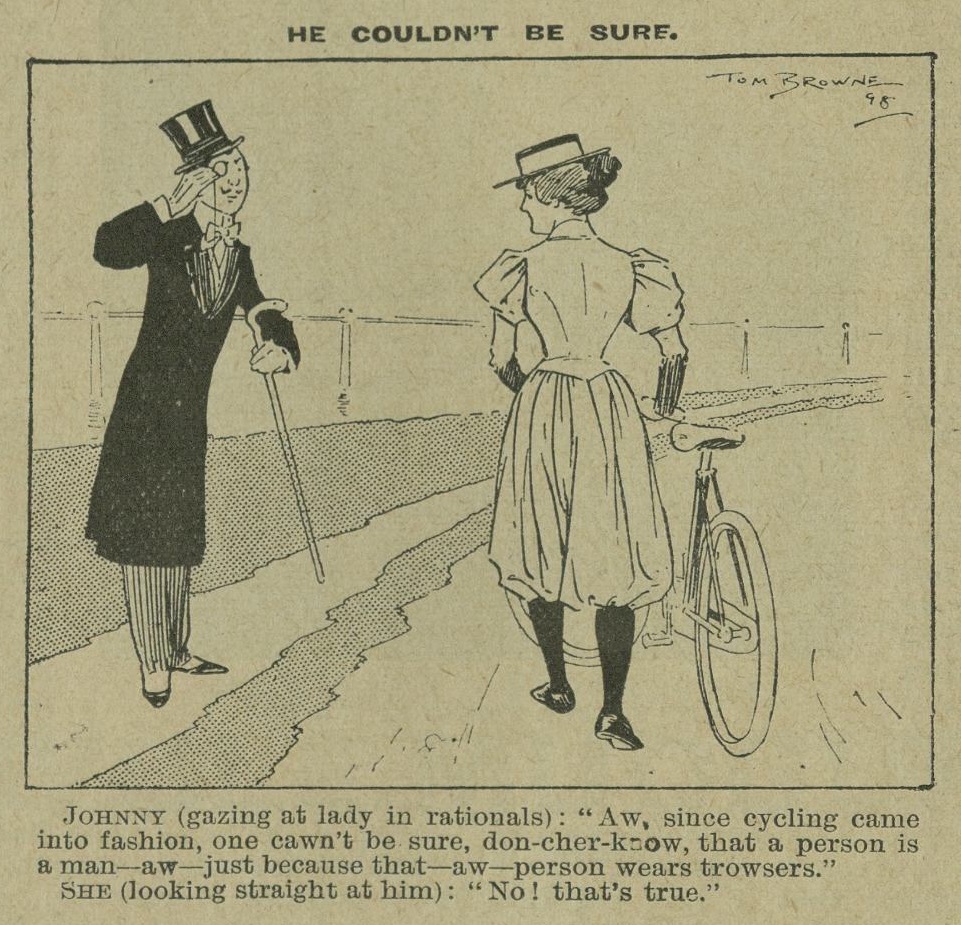


Photo courtesy of warwick.ac.uk.com


Of course, not everyone was thrilled about these changes. Many critics claimed that cycling was unladylike, dangerous, or even immoral. Some doctors warned that too much bicycling could cause “bicycle face,” a supposed condition where a woman’s features would become permanently strained from the exertion. (Thankfully, history has since debunked that one!)

Despite the naysayers, women kept riding. The bicycle wasn’t just a trend—it was a tool of progress. It gave women a taste of freedom, adventure, and control over their own lives. As Susan B. Anthony noted in 1896, "I think [the bicycle] has done more to emancipate women than anything else in the world. It gives a woman a feeling of freedom and self-reliance. The moment she takes her seat she knows she can't get into harm unless she gets off her bicycle, and away she goes, the picture of free, untrammeled womanhood."


Kimberly Keagan is a former investor relations consultant and corporate financial writer (not very romantic) who now crafts historical romances filled with strong heroines, swoon-worthy heroes, faith, and a touch of humor. Her latest novel, Risky Business, released in February of 2026 and is the third book in her Hearts on Display series. When not reading or writing, Kimberly enjoys baking, gardening, watching sports, and researching her family tree. Sign up for Kimberly's newsletter and receive a free Gilded Age Romance at www.kimberlykeagan.com.

Friday, June 27, 2025

America's First It-Girl

Before there were movie stars, fashionistas, and influencers, there was the Gibson Girl—a pen-and-ink phenomenon who captivated America at the turn of the 20th century. Tall, poised, stylish, and independent, she was the idealized image of modern womanhood created by illustrator Charles Dana Gibson.

But she was more than a drawing. She was a cultural icon who both reflected and shaped the aspirations of a generation of women.

A New Kind of Beauty


The Gibson Girl made her debut in the 1890s, gracing the pages of Life, Collier’s, and Harper’s Weekly. She reflected the era’s beauty ideal: a slim waist shaped by a swan-bill corset, an elegant S-curve silhouette, and voluminous updos like pompadours or chignons.

Unlike the fragile Victorian ideal of earlier decades, the Gibson Girl exuded self-assurance. She wasn’t a suffragist or a radical, but she was unmistakably modern. Often shown in fashionable outfits that signaled her upper-middle-class status, she embraced outdoor activities like cycling, valued education, and sometimes even entered the workforce.
 
AT THE OPERA     
He fails to take a friendly interest in the great composers

ADVICE TO BEGINNERS  


Keep close to nature.

Brains, Beauty, and a Bit of Attitude

Gibson’s illustrations captured women who were witty, spirited, and just a little aloof. They towered over bumbling suitors, debated politics with charm, and weren’t afraid to scoff at convention. These images suggested that beauty and brains could coexist—a bold notion at the time.

"The don't even know 'Tommy Atkins'"

Under the Microscope: The Weaker Sex

Fashion designers embraced the look. High collars, flowing skirts, and the famous Gibson hairstyle quickly became all the rage. As women stepped into new roles as students, workers, and athletes they carried her image with them. She was part fantasy, part aspiration, and very influential.

The Women Behind the Drawings

Many women served as inspiration for Gibson Girl illustrations, including Charles Dana Gibson’s own wife, Irene Langhorne (pictured below, far left), who is often considered one of the earliest muses. She was also the sister of Nancy Langhorne Astor, the first woman to take a seat in the British Parliament. Other notable models included actresses and performers such as Mabel Normand, Evelyn Nesbit (pictured middle), Minnie Clark, and Clara B. Fayette. The most iconic of them all was stage actress Camille Clifford (pictured far right), whose towering hairstyle, sweeping gowns, and tightly corseted figure came to embody the classic Gibson Girl look.


Enter the Christy Girl: Color, Energy, and Modern Appeal

Building on Gibson’s legacy, artist Howard Chandler Christy introduced the Christy Girl—a vibrant, athletic evolution of the Gibson Girl.


While Gibson’s pen-and-ink drawings were designed for the black-and-white printing of late 19th-century magazines, Christy rose to fame just as color printing technology improved. He embraced watercolor and oils, producing dazzling full-color posters and magazine covers that leapt off the page.

The public responded enthusiastically. His vivid use of color captivated the imagination even more, bringing his idealized heroines to life in a way that felt fresh, patriotic, and unforgettable.


Post cards from 1906-1910 featuring Christy's paintings


More Than a Pretty Face 

By the 1910s, with the rise of the suffrage movement and the looming shadow of World War I, the Gibson Girl began to fade. She was soon replaced by new icons like the flapper, who represented a bolder and more rebellious spirit.

In the end, the Gibson Girl wasn’t just a pretty face. She was a symbol of transition—a graceful bridge between the corseted constraints of the past and the freer spirit of the new century. She proved that a woman could be charming and clever, poised and opinionated.

And though she never spoke a word, she started a conversation that echoed long after the ink dried.

(Photo credits: All photos of Gibson and Christy works: ©KimberlyKeagan.com. All other photos courtesy of Wikipedia.)

About the Author:


Kimberly Keagan is a former corporate financial writer (not very romantic) who now crafts historical romances filled with strong heroines, swoon-worthy heroes, faith, and a touch of humor. Her Gilded Age romance, Perfect, is her debut novel.