Showing posts with label New Year's. Show all posts

Tuesday, December 30, 2014

Auld Lang Syne--Many Years Ago

By Naomi Rawlings

Auld Lang Syne is perhaps one of the most played tunes around the world on New Year's Eve. The lyrics come from a 200 year old poem written by Robert Burns (of "The best laid schemes o' mice and men" fame). Burns was the most famous of Scots poets, writing in the traditional Scots dialect, and has been hailed as a national hero by many Scotsmen and Scotswomen.


So what does the title Auld Lang Syne mean? Well, exact interpretations vary, though they all carry a similar meaning. "Old long since," "long, long ago," "days gone by" and "old times" are all possible meanings. The "cup of kindness" mentioned in the chorus refers to a drink shared between friends. Below you'll find an illustration of Auld Lang Syne by John Masey Wright and John Rogers.


Robert Burns claims to have written the "old, old song" down rather than created it himself. Indeed, some of his lyrics bear a striking resemblance to a ballad published at the beginning of the 18th Century, though some of them appear to be original. The tune comes from a traditional Scottish folk song, and the lyrics are as follows:

Should old acquaintance be forgot,
and never brought to mind?
Should old acquaintance be forgot,
and old lang syne?

CHORUS:
For auld lang syne, my dear,
for auld lang syne,
we'll take a cup of kindness yet,
for auld lang syne.

And surely you’ll buy your pint cup!
and surely I’ll buy mine!
And we'll take a cup o’ kindness yet,
for auld lang syne.

CHORUS

We two have run about the slopes,
and picked the daisies fine;
But we’ve wandered many a weary foot,
since auld lang syne.

CHORUS

We two have paddled in the stream,
from morning sun till dine†;
But seas between us broad have roared
since auld lang syne.

CHORUS

And there’s a hand my trusty friend!
And give me a hand o’ thine!
And we’ll take a right good-will draught,
for auld lang syne.

CHORUS

Here's Auld Lang Syne sung by Dougie Maclean, one of Scotland's most famous contemporary singers and songwriters. Some of the lyrics are in the original Scots dialect.


Do you sing Auld Lang Syne on New Year's Eve? When are some other times you think the song might be appropriate to sing? And did you have any idea the lyrics had been written by a famous poet?

From everyone here at Heroes, Heroines, and History, have a Happy New Year!

~.~.~.~.~

A mother of two young boys, Naomi Rawlings spends her days picking up, cleaning, playing and, of course, writing. Her husband pastors a small church in Michigan’s rugged Upper Peninsula, where her family shares its ten wooded acres with black bears, wolves, coyotes, deer and bald eagles. Naomi and her family live only three miles from Lake Superior, where the scenery is beautiful and they average 200 inches of snow per winter. She is looking forward to the release of her fourth novel, Falling for the Enemy, in January 2015. For more information about Naomi, please visit her website at www.naomirawlings.com.

Friday, January 3, 2014

NEW YEAR'S CELEBRATIONS By Cynthia Hickey

My family has long celebrated New Year's with a crowd who divides into teams, men against women to play a rousing game of Pictionary. We have more finger foods than we can possibly eat. We watch the ball drop in Times Square and hand out kisses for everyone when the clock strikes midnight.

The god Marduk and his snake dragon. From: J. Black & A. Green, Gods, demons and symbols of ancient Mesopotamia (1992)
Marduk and his snake dragon (from J. Black & A. Green, Gods, demons and symbols of ancient Mesopotamia,1992; ©!!!)
The earliest recorded festivities in honor of a new year’s arrival date back some 4,000 years to ancient Babylon. For the Babylonians, the first new moon following the vernal equinox—the day in late March with an equal amount of sunlight and darkness—heralded the start of a new year. They marked the occasion with a massive religious festival called Akitu (derived from the Sumerian word for barley, which was cut in the spring) that involved a different ritual on each of its 11 days. In addition to the new year, Atiku celebrated the mythical victory of the Babylonian sky god Marduk over the evil sea goddess Tiamat and served an important political purpose: It was during this time that a new king was crowned or that the current ruler’s divine mandate was symbolically renewed.

The early Roman calendar consisted of 10 months and 304 days, with each new year beginning at the vernal equinox; according to tradition, it was created by Romulus, the founder of Rome, in the eighth century B.C. A later king, Numa Pompilius, is credited with adding the months of Januarius and Februarius. Over the centuries, the calendar fell out of sync with the sun, and in 46 B.C. the emperor Julius Caesar decided to solve the problem by consulting with the most prominent astronomers and mathematicians of his time. He introduced the Julian calendar, which closely resembles the more modern Gregorian calendar that most countries around the world use today.

As part of his reform, Caesar instituted January 1 as the first day of the year, partly to honor the month’s namesake: Janus, the Roman god of beginnings, whose two faces allowed him to look back into the past and forward into the future. Romans celebrated by offering sacrifices to Janus, exchanging gifts with one another, decorating their homes with laurel branches and attending raucous parties. In medieval Europe, Christian leaders temporarily replaced January 1 as the first of the year with days carrying more religious significance, such as December 25 (the anniversary of Jesus’ birth) and March 25 (the Feast of the Annunciation); Pope Gregory XIII reestablished January 1 as New Year’s Day in 1582.

In many countries, New Year’s celebrations begin on the evening of December 31—New Year’s Eve—and continue into the early hours of January 1. Revelers often enjoy meals and snacks thought to bestow good luck for the coming year. In Spain and several other Spanish-speaking countries, people bolt down a dozen grapes-symbolizing their hopes for the months ahead-right before midnight. In many parts of the world, traditional New Year’s dishes feature legumes, which are thought to resemble coins and herald future financial success; examples include lentils in Italy and black-eyed peas in the southern United States. Because pigs represent progress and prosperity in some cultures, pork appears on the New Year’s Eve table in Cuba, Austria, Hungary, Portugal and other countries. Ring-shaped cakes and pastries, a sign that the year has come full circle, round out the feast in the Netherlands, Mexico, Greece and elsewhere. In Sweden and Norway, meanwhile, rice pudding with an almond hidden inside is served on New Year’s Eve; it is said that whoever finds the nut can expect 12 months of good fortune.
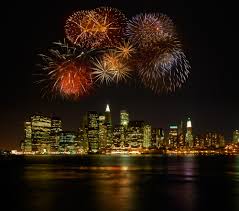
     Other customs that are common worldwide include watching fireworks and singing songs to welcome the new year, including the ever-popular "Auld Lang Syne" in many English-speaking countries. The practice of making resolutions for the new year is thought to have first caught on among the ancient Babylonians, who made promises in order to earn the favor of the gods and start the year off on the right foot. (They would reportedly vow to pay off debts and return borrowed farm equipment.)

In the United States, the most iconic New Year’s tradition is the dropping of a giant ball in New York City's Times Square at the stroke of midnight. Millions of people around the world watch the event, which has taken place almost every year since 1907. Over time, the ball itself has ballooned from a 700-pound iron-and-wood orb to a brightly patterned sphere 12 feet in diameter and weighing in at nearly 12,000 pounds.

Various towns and cities across America have developed their own versions of the Times Square ritual, organizing public drops of items ranging from pickles (Dillsburg, Pennsylvania) to possums (Tallapoosa, Georgia) at midnight on New Year’s Eve.

NEW Masthead NYE History
NYE HistoryNew York in 1904 was a city on the verge of tremendous changes - and, not surprisingly, many of those changes had their genesis in the bustling energy and thronged streets of Times Square. Two innovations that would completely transform the Crossroads of the World debuted in 1904: the opening of the city's first subway line, and the first-ever celebration of New Year's Eve in Times Square.               

Information courtesy of http://www.history.com/topics/new-years

How do you ring in the New Year?


Multi-published author Cynthia Hickey had three cozy mysteries and two novellas published through Barbour Publishing. Her first mystery, Fudge-Laced Felonies, won first place in the inspirational category of the Great Expectations contest in 2007. Her third cozy, Chocolate-Covered Crime, received a four-star review from Romantic Times. All three cozies have been re-released as ebooks through the MacGregor Literary Agency, along with a new cozy series, all of which stay in the top 50 of Amazon’s ebooks for their genre. She has several historical romances releasing in 2013 and 2014 through Harlequin’s Heartsong Presents. She is active on FB, twitter, and Goodreads. She lives in Arizona with her husband, one of their seven children, two dogs and two cats. She has five grandchildren who keep her busy and tell everyone they know that “Nana is a writer”. Visit her website at www.cynthiahickey.com

Thursday, December 26, 2013

New Year's Eve Traditions


What do you and your family do to celebrate the beginning of the new year? Do you raise a cup of kindness and sing Auld Lang Syne? Do you watch the one-minute decent of the ball in Times Square New York City at midnight? Maybe you use noisemakers, gongs, fireworks, or firecrackers. 


Do you have your New Year Resolutions in mind or already written out? What about last year’s promises to self? Are there kisses all around for loved ones?

Read about where new year’s resolutions got their start in Patty Smith Hall’s CFHS Blog post on December 30th.

Even now I can hear the big band sounds of Guy Lombardo and The Royal Canadians playing Auld Lang Syne


Courtesy of the blog.thecanadianencyclopedia.com

Poet Robert Burns first published this old Scottish song in Scots Musical Museum (1796 edition). Some historians believe he heard it sung by an old man from the Ayrshire area of Scotland. He transcribed the words and improved the lyrics. "Auld Lang Syne" literally translates as "old long since" and means "times gone by."

Lombardo's version of the song was played at the Waldorf Astoria every New Year's eve from the 1930s until 1976. It was broadcast first on radio, and then later on television. It became such a New Year's tradition that, according to infoplease.com,  "Life magazine wrote that if Lombardo failed to play 'Auld Lang Syne,' the American public would not believe that the new year had really arrived."

Hogmanay, Scotland, considered the birthplace of the song "Auld Lang Syne" observes the tradition of “first-footing.” After welcoming in the new year at home, neighbors visit each other and bring gifts of coal for the fire or shortbread.  Naturally, there's music.
Courtesy of Sarah Anne Lawless.com

If your first guest at First-Footing happens to be a tall, dark, and handsome man, or if that fails—a fair woman, you are considered lucky. A man is preferred over a woman. Redheads are considered especially unlucky. Hm-m-m, a good beginning for a new historical novel. If you are looking for an all-night street party, the Edinburgh Hogmanay (hog-mah-NAY) is ranked the largest in the country.

Some celebrations are held to bid farewell to the problems and tribulations of the past year and to prepare for new beginnings.
Japan’s Bonenkai or “forget the year” parties are a time where forgiveness for misunderstandings and grudges are put aside. Houses are scrubbed in preparation for the new year and gongs are struck 108 times to expel the multitude of human weaknesses. New Year cards are popular, children receive otoshidamas, small gifts with money inside, and adults do not work.

If you are in Spain, you will eat twelve grapes at midnight to secure happiness in the coming year. I'm getting green, red, and black grapes just in case it makes a difference!

The Dutch light bonfires of Christmas trees and launch fireworks as a means to purge the old and embrace the new year.

One of the traditional foods during the Festival of St. Basil in Greece is Vassilopitta cake. A gold or silver coin is baked inside – a promise of good luck for the one who finds the coin in their piece of St. Basil cake.

Many of us will party around the television and watch the Waterford Crystal ball drop at midnight in Midtown Times Square. Originally made from wood and iron, the sixth generation of the Ball is 12 ft. in diameter and weighs 11,875 lbs. The flagpole now rises 475 above the street. It remains in full view atop One Times Square year-round in anticipation of the coming biggest party night of the year.

Who can pass up the Tournament of Roses parade that precedes the Rose Bowl in Pasadena, California on New Year’s Day? Today's floats are elaborate and so creative. Did you know that the first parade was held in 1890? Carriages and horses were decorated with flowers to promote the "Mediterranean of the West." Writers, have you put this parade in any of your novels?

Tournament of Roses on New Year's Day 1893—Courtesy of WaterAndPower.org
 
 
The date refers to when the Pasadena settlement was first founded
Tournament of Roses on New Year's Day 1894—Courtesy of WaterAndPower.org

Whether you reflect on past mistakes and misfortunes, or resolve to improve oneself in the new year, resolutions are a standard part of the new year celebrations. This practice is believed to go back to the Babylonians. Read more about ancient practices on Cynthia Hickey's CFHS Blog post on January 3rd.

Saying “Happy New Year” in different languages is fun and a nice addition to your New Year’s card. Try your hand at pronouncing it the 35 languages presented at http://www.factmonster.com/ipka/A0923039.html. They also have "Saying Merry Christmas or Season's Greetings Around the World." You can practice up for next year.

January was not the original month chosen for the celebration of the calendar’s new year. In 1582, the Gregorian calendar reform restored January 1 as new year's day. Learn more about the history of the new year at http://www.infoplease.com/spot/newyearhistory.html

How ever you say it, sign it, or sing it, please have a very Happy and Blessed New Year. 


Make the CFHS Blog part of your 2014 resolutions.
Blessings, Lin


Lin and Jerry celebrate their holidays on their ranch P bar R Ranch-West, in Chimney Rock, Colorado. When she isn't researching the many historical sites in Southwest Colorado, she is working on her new series Voices in the Desert, which span the years 1928-1932. Book one about the Southwestern Indian Detour Couriers, Treasures Among the Ruins, is set in 1926 northwest New Mexico. Her heroine, Cornelia Miller, searches for self-identity and finds that love is as sure as the spring grass under the winter snowflakes.