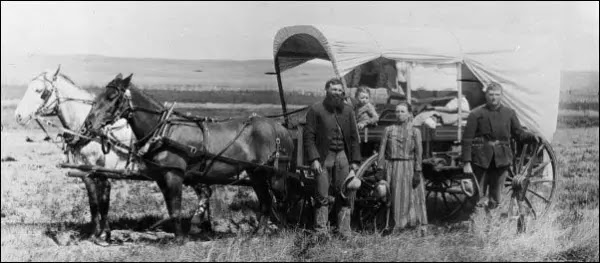
Showing posts with label Oregon Trail. Show all posts

Tuesday, February 17, 2026

Mrs. Amelia Stewart Wright Knight and her Oregan Trail Diary


enjoy reading true stories, especially diaries. I purchased the book, Lillian Schlissel's Women's Diaries of the Westward Journey. Inside are wonderful excerpts from pioneer women's diaries. Their words bring their overland journeys across America to life.

Amelia Stewart knight was born in 1817 in Boston, Massachusetts. She married Dr. Joel Knight (b.1808) an English immigrant, in September,1834. They moved to Iowa after their first child was born. Dr. Knight hated the climate in Iowa. He took his family (now seven children) to Oregon Territory, where the climate was milder. They left Iowa April 18,1853 and arrived near Milwaukie, Oregon Territory, on September 17,1853. Six months on the trail. Can you imagine primitive camping with seven children for six months?

Amelia's diary shared a mother's view of their trip. Her diary focused on her children, the weather, and the rough terrain. She had an entry at least once a week. The Wrights had three covered wagons for their supplies and their seven children. Dr. Knight hired men to tend the wagons and their livestock. She had the daunting task of feeding everyone on their journey.

The Knights had more resources than other travelers because they had paid help. Also, like many who traveled the Oregon Trail successfully, they had uprooted and relocated before. Their trip by wagon from Massachusetts to Iowa years before gave the experience they needed to be prepared for the undertaking.

Primitive camping in all kinds of weather

Can you imagine walking in the rain, sleeping in a tent on muddy ground? (Tents didn't have flooring at this time.) Sounds miserable, especially with children. Walking over a variety of terrains, usually taking the miles on foot. One day it's freezing cold in the higher altitudes; within a week the dry desert heat is unbearable. Amelia had to feed her family, their hired help and her children, no matter the weather.

Traveling with seven children

She carried her youngest child when the ground was rough. Add to this: sickness. She doesn't dwell on her children's sicknesses, only mentioning which child had the mumps, scarlet fever, or was covered in poison ivy. And she noted the youngest had fallen out of the wagon twice because he was so active. All the other children had daily responsibilities on the journey. She related one fear-induced moment. When they lost their daughter, Lucy. She was watching wagons cross the river while waiting the Knight's turn. These crossings could take days depending on the size of the wagon train. Amelia assumed Lucy was in the wagon with her sister as normal, and the sister thought she was with her mother getting her hair combed. After they crossed the river, they discovered her missing. Lucy had been found by another family. They'd made sure she crossed the river and was reunited with her parents.

The seven Knight children
Indians- not what she expected

Her view of Indians changed as she traveled. Most information regarding the Indian tribes along the trail were based on half-truths and racism. Amelia found the tribes were very helpful. They assisted with their livestock while the wagons forded rivers. Some would swim and guide the horses and livestock for a fee or goods. She writes of a time the wagon train traded with the Indians. She was very impressed with their beadwork. Indians often requested gifts of their supplies or cash in order to pass through their land safely. Most of their requests were reasonable.

Whites took advantage of the travelers

 While the cost the white men charged to ferry them over rivers reached three dollars a wagon near the end of the trip. (Equal to $126.28 in 2026) Remember they had three wagons. These unexpected costs forced Dr. Knight to sell a prized horse in order to have the funds needed to cover the remaining river crossings. The average cost of a horse was one hundred dollars—at least those purchased to pull a wagon. His horse must have sold for far more to secure the rest of their passage to Oregan Territory.

Interesting Trivia

An interesting fact I'd never read before was what they fed their cattle when there was no grazing or hay available. A mash consisting mostly of flour. She was very worried about their oxen and did what she could to help care for them.

 This strong woman wept when one of their oxen died and had to be left by the side of the road with many other. The carnage along the more desolate areas also brought tears. But she remained steadfast and determined.

Cost of living in 1853

To give some context for the diary entry below, let me share a few facts regarding the cost of living in 1853. The average income was between $300 and $500 a year. ($8,418.75-21,046.88 in 2026). The cost of their trip included wagons, supplies, oxen and or mules and horses. A family of four would need $1000 to supply their wagon for the six-month journey. (This doesn't include any additional fees.) The Knights had three wagons pulled by at least two oxen, a family of nine plus an undisclosed number to men to drive the additional wagons and livestock. Oxen valued $25 each ($1,052.34) while mules or horses at around $100 each ($4,229.38). Dr. Joel Knight, we can assume, probably made a bit more money than the average traveler. But still, things got tight. All numbers in bold were added by me to compare to 2026.

She shared the cost of items at a trading post near the end of their journey.  (Tuesday, September 13th… Drove over some muddy miry ground, and through mud holes and just halted at the first farm to noon and rest awhile and buy feed for the stock, Pay 1.50 per hundred for hay.($61.18) Price of fresh beef 16 to 18 cts a pound,(6.79-7.58) butter ditto one dollar, eggs, one dollar a dozen,($42.09)  onion 4 or 5 dollars per bushel,($149-210.47) all too dear for poor folks, so we have treated ourselves to some small turnips at the rate of 25 cents per dozen,) ($10.53)

Constant wagon upkeep

Amelia did what needed to be done and accepted every difficulty as part of the journey. Often after rains they had to empty their wagons to dry out supplies and make wagon repairs before continuing. Amelia seemed to accept emptying her goods along the road to lighten the load as they travel a part of the price needed to get her family safely to Oregon Territory.

Reading between the lines

It is shocking, yet appropriate for the era, to discover Amelia was pregnant with her eighth child when they left Iowa. She makes no reference to her condition directly until the day her child is born. She mentions stopping on the trail to give birth and then walking with a newborn to their new home.

Think about all the difficulties along the trail and multiply that by ten as her girth grows. She mentions smells bothering her, she gets very emotional over the death of their oxen, and headaches and backache plague her. But speaking about being with child was taboo in 1853, and I suppose writing that in her diary was too. Her husband was a doctor, so that may have given her a bit of peace traveling pregnant. And she'd already traveled from Massachusetts to Iowa years earlier, so she had some idea what to expect. Still, pregnant with eight children to keep safe. Not to mention feeding the hired help. Place her family with a community of at least forty wagons and stress and anxiety abound.

Why I love diaries

Her diary gave me a better picture of life on the Oregon Trail. The bravery and stamina it took to reach their destination. Modern day travelers complain about flight delays, or traffic congestion. If our vehicle breaks down, help is a phone call away. And usually at the end of our journey, we're sleeping in a warm home or hotel with easy access to food and medical facilities.


As you can imagine, they didn't move into a house when they staked their claim. It took time to build a cabin and plant a garden and do what needed to be done.

    Do you think you'd be willing to relocate across country enduring the             same travel conditions as the Knights?

Cindy Ervin Huff, is a multi-published award-winning author in Historical and Contemporary Romance.  She’s a 2018 Selah Finalist. Cindy has a passion to encourage other writers on their journey. When she isn’t writing, she feeds her addiction to reading and enjoys her retirement with her husband of 50 plus years, Charles. Visit her at www.cindyervinhuff.com.


Saturday, April 20, 2024

History of the Great American Road Trip


Historic Route 66 - Snow Covered Peaks; public domain image

History of The Great American Road Trip

Not so long ago in America, taking a vacation meant packing up luggage, an ice chest, possibly the dog, and of course the family and setting off on a road trip. The rise of air travel changed this scenario for some, but definitely not for everyone. Pulbished in 2021, the 2019–2020 Portrait of American Travelers® survey by MMGY Global revealed a resurgence in road travel. Since 2015, the survey recorded a 64% yearly increase in road trips. The trend is far from over, with 50% of Americans planning to travel more in 2024. Of those, 63% will hit the road.

I am writing this in a remote cabin on a river in California, one of many stops on my own road trip adventure. The April 8th total eclipse of the sun sent my husband and me across six states in our SUV to Texas. We were not alone. Millions traveled to the path of totality, which included parts of Texas, Oklahoma, Arkansas, Missouri, Kentucky, Tennessee, Illinois, Indiana, Ohio, Michigan, Pennsylvania, New York, Vermont, New Hampshire, and Maine. On the way home, I keep running into eclipse travelers. While waiting for tables at restaurants or for admittance to tourist attractions, we swap impressions of totality. Restaurant and service staff confirm that the recent crush of new business is due to eclipse travelers.

The great American road trip seems here to stay. After driving paved-over stretches of the Old Oregon Trail and Route 66, it makes me smile that essential slice of American history lives on. Most people take the interstate nowadays, but for those who seek roads less traveled, the rewards are substantial.

The opportunities for safe road travel abound today, but this wasn’t always the case. At the turn of the 20th century, wretched roads and the limited capabilities of horses, wagons and coaches hampered travel. Most covered long distances by steam locomotive. However, a few hardy souls set off on horseless carriage excursions. These intrepid individuals began the tradition of adventuring by private motorized vehicle that we enjoy today.


1899 Quinby Electric Carriage; public domain image

When recalling his 1903 trip from Colorado Springs to Santa Fe, attorney Phillip Delany declared: “and so the machine is conquering the old frontier, carrying the thudding of modern mechanics into the land of romance. . . .” Much taken with the idea, he went on to note: “The trails of Kit Carson and Boone and Crockett, and the rest of the early frontiersmen stretch out before the adventurous automobilist.”

While exploration appealed to adventurers like Delany, others wanted to escape the rigors of city life into a romanticized dream of nomadic travel. These tourists belonged to the upper-middle class. The cost of an automobile (between $650 and $1,300) placed owning one beyond the reach of most households. Besides this constraint, gas stations and garages were not largely available outside city limits. While a wealthy person might overcome such limitations, the average American could not.

Bad roads increased the likelihood of breakdowns and misadventures. One motorist in the Wyoming of 1909 described the roads he traveled as “deep ruts, high centers, rocks, loose and solid; steep grades, washouts, or gullies…” He also described “unbridged streams, sand, alkali dust, gumbo, and plain mud” as “common abominations.” Venturing off the beaten path for long distances demanded a great deal of self reliance. Mishaps could and did happen.

The first successful transcontinental journey was undertaken on a whim and a $50 bet in the spring of 1903. Dr. Horatio Nelson Jackson, his friend, Sewall K. Crocker, and a bulldog named Bud set off from San Francisco in a 20-horsepower Winton touring car. 
This feat inspired others. 

Horatio Nelson Jackson, public domain image

Between 1901 and 1908, transcontinental drivers loaded their vehicles with numerous tools, sleeping bags, water carriers, camp stoves, navigational instruments, first aid supplies, rain-proof ponchos, pith helmets, tire chains, spare parts, firearms, and more. Mary C. Bedell published her gear list in Modern Gypsies, her 1924 account of auto touring: “tent, duffle bags, gasoline stove, Adirondack grate and a kit of aluminum kettles, with coffee pot and enamel cups and saucers inside.” This equipment increased the weight of her fully loaded automobile by “four or five hundred pounds” and gave the automobile a striking resemblance “to a hermit crab staggering across the ocean floor burdened with its house on its back.”

In time, wages rose and prices for used cars fell. Henry Ford introduced the Model T in 1908, improving the availability and affordability of automobiles. The increasing number of automobile travelers sparked the interest of merchants across America. Gas stations, garages, roadside diners, and hotels sprang up along more traveled routes. 


Eventually, interconnected roads became highways like Route 66. 
The great American road trip was born.

About Janalyn Voigt

Janalyn Voigt fell in love with literature at an early age when her father read chapters from classics as bedtime stories. When Janalyn grew older, she put herself to sleep with tales "written" in her head. Today Janalyn is a storyteller who writes western historical romance and medieval epic fantasy. Romance, mystery, adventure, history, and whimsy appear in all her novels in proportions dictated by their genre.

Wednesday, February 28, 2024

The History of Midway Station By Donna Schlachter—with Giveaway


Midway Station pre-1959


If you look on a map of Nebraska, you won’t find Midway Station. That’s because it is not, and has never been, a hamlet, village, town, or city. Midway Station was one of the stops along the Pony Express route, which ran—and still exists in many areas—from St. Joseph, Missouri to San Francisco, California.

However, if you’ve ever passed near or through Gothenburg, Nebraska, you might well have seen the cabin called Midway Station. It is one of the few original stations that remains at its original location. Much more famous, perhaps, is the Sam Machette station in the city of Gothenburg, which was moved in 1931 and turned into a museum in the mid 1950s which attracts more than thirty thousand visitors each year.
Midway Station with Pony Express plaque


Midway Station was built in 1859 just south of modern-day Gothenburg and expanded in 1860 to its current size when it was contracted by the Pony Express. Originally it was used by the Leavenworth City and Pikes Peak Express Company, then adopted as a stop where riders could get a fresh horse, use the privy, and perhaps get a crust of bread or a quick meal to keep them going to the next home station.

Midway was used by wagon trains along the Oregon Trail to water or rest their animals and emigrants, and sometimes the trains would send hunters to replenish fresh meat supplies. Large and small game was plentiful, as were wild berries in season and plenty of prairie grasses to feed their horses, cattle, and oxen.


By the late 1870s, when wagon trains were replaced in large part by trains, the station wasn’t used as much. In 1879, Henry Williams bought the building and turned it into a bunkhouse or cabin on his Lower 96 Ranch.

The Midway Station has gone by several names over the years, including Cold Water Ranch, Heavy Timber, Smith’s East Ranch, and Pat Mullaly’s Home Station. It is a long, low, one-story cabin, constructed of heavy, squared, hand-hewn cedar logs. When the Pony Express contracted to rent the location for its riders, two additional sections were added to the east. Originally, the log walls sat on a bare earth floor, but a concrete foundation was added later. Wall spaces were originally packed with mud, and the low pitched, split cedar roof was supported by cedar log ridge beams, and then covered with a heavy layer of sod, on which the split cedar shingles now rest.

Many stations used by wagon trains and express services in Nebraska were destroyed during Indian raids, and many more fell into ruins once the railroad was completed. Rumors abound that Midway Station was one that was burned, however, it seems a larger frame house built nearby was destroyed, with minor damage to the station.

In recent years, the family that owns the station has created a museum-like experience including furnishings and artifacts. If you’d like to visit, contact the Gothenburg Pony Express Museum at 308-537-9876.


Leave a comment to enter a random drawing for an ebook copy of Hearts of Hollenberg, the first in my Hearts of the Pony Express series. And stay tuned for Book 4 in the series, Hearts of Midway, which releases in August.


About Donna:
A hybrid author, Donna writes squeaky clean historical and contemporary suspense. She has been published more than 60 times in books; is a member of several writers groups; facilitates a critique group; teaches writing classes; and judges in writing contests. She loves history and research, traveling extensively for both, and is an avid oil painter. She is taking all the information she’s learned along the way about the writing and publishing process, and is coaching committed career writers. Learn more at https://www.donnaschlachter.com/the-purpose-full-writer-coaching-programs Check out her coaching group on FB: https://www.facebook.com/groups/604220861766651


Connecting Online:
www.DonnaSchlachter.com Stay connected so you learn about new releases, preorders, and presales, as well as check out featured authors, book reviews, and a little corner of peace. Plus: Receive 2 free ebooks simply for signing up for our free newsletter!

www.DonnaSchlachter.com/blog

Facebook: www.Facebook.com/DonnaschlachterAuthor

Bookbub: https://www.bookbub.com/authors/donna-schlachter


Resources:

https://en.wikipedia.org/wiki/Gothenburg,_Nebraska

https://en.wikipedia.org/wiki/Midway_Stage_Station

https://www.ponyexpressstation.org/

https://www.youtube.com/watch?v=cX1x3KUuGP4 Video tour

https://www.nps.gov/parkhistory/online_books/poex/hrs/hrs5a.htm

https://npgallery.nps.gov/GetAsset/81ae5996-bb27-4bbe-8229-d5c66bfb8748

Friday, October 20, 2023

The Scourge of the West?


Blackfoot Indian by Karl Bodmer
Blackfoot Indian, painting by Karl Bodmer ca. 1840-1843
Public domain via Wikimedia Commons

Have you ever wondered how folks from the Wild West would react to the western myths we believe today? What? Wasn’t the landscape filled with marauding Indians, brave lawmen, settlers packing heat, desperate outlaws, and bawdy dancehall girls? Well, yes—but also no. When it comes to understanding the American West, those of us who live in the modern day are at a disadvantage. The Old West is gone.

Echoes remain. We might attend a rodeo, employ western slang, ride a steam train, or gather to “swing your partner.” It’s possible to read diaries, newspapers, and official records from back in the day. Visiting a museum exposes us to fading artifacts in a historical building alive with forgotten footsteps. 

Rodeo image from cjuneau, CC BY 2.0
 via Wikimedia Commons

From remnants, we piece together a blurred picture. For some, imagining what should have been is more fun than ferreting out information. 

Take those marauding Indians, for example. Old western movies and popular literature would have you believe that Indians were just waiting to murder settlers at the drop of a cowboy hat. These “red devils” set up ambushes for their hapless victims Any sight of Indians signaled the immediate need to prepare for battle. (Fun fact: we still use “circle the wagons” to mean “hunker down and get ready to fight.”) The facts don’t really support this. 

Plenty of wagons were lashed together, but usually not for defence. They formed a makeshift corral so the livestock wouldn't stray at night. Also, skirmishes between settlers and Indians were rare. According to historical studies referenced by the Oregon Trail Center, during the main emigration years (1840-1860), Indians killed 362 emigrants. With all respect to the deceased, that’s a drop in the bucket compared to the estimated 350,000 pioneers who traveled the trails. The number of Indians killed by settlers comes to 426, which is greater. 

Let’s take the long view of what happened to America’s indigenous population following Christopher Columbus’s arrival in 1492. At that time, North America boasted nearly 55 million people. By 1900, the native population had declined by 80% overall and 98.8 percent in some areas. How did they die? The answer isn’t an easy one.

A painting by Alejo Fernández between 1531 and 1536. It is the only state sponsored portrait of the First Admiral of the Indias called Don Cristoval Colon known today as Christopher Columbus in English.(1475-1545), Public domain, via Wikimedia Commons

In the days following the Civil War, soldiers crowded into western forts, many with the express intention of subduing Indians. Bored after the excitement of the war, they were chafing for a fight. By this time, Indians were wising up about the land grab going on. The last straw was when the railroads started laying track through their ancient hunting grounds. None of this, as you can imagine, encouraged thoughts of happy co-existence. Bury My Heart at Wounded Knee, a book written by Dee Brown, describes not how the West was won, but how it was lost. Its pages recount the tragic fate of tribe after tribe of Native Americans. Violence played a part, but it wasn't the worst culprit.

When colonists came to the New World, they introduced diseases to which native tribes had no immunity. The most deadly, according to the Oregon Encyclopedia were smallpox, malaria, viral influenza, yellow fever, measles, typhus, bubonic plague, typhoid fever, cholera, and pertussis (whooping cough). Millions died in what was termed the "greatest demographic disaster in human history."

Painting of "Indian Burial Ground" by Seth Eastman, 1849–1855; Dakota graveyard with elevated burial sites, located seven miles above Fort Snelling along the Minnesota River. This graveyard served three Dakota villages; public domain image via Wikimedia Commons

Indians weren’t the only ones to suffer. The number one killer on western trails, claiming the lives of nine out of ten pioneers, was infectious disease. The hardship and privation emigrants endured weakened them so much that epidemics spread like wildfire.

So, what was the scourge of the West? Suffice it to say that it looked nothing like an Indian in war paint.

What's New with Janalyn Voigt

In Sojourner, one of my Tales of Faeraven epic fantasy novels, the hero and heroine must cross a swamp where fresh and salty waters collide. At the heart of this fenland lies a ruined castle that both draws and repels them. The more they travel toward it, the further away it gets. 

This scenario best expresses how I feel when editing one of my novels. I slash words, but then add even more of them. I write spare, and then fill in layers of complexity through rounds of edits. The book's length increases as the end moves farther away. You can imagine the effect this has on my moral. Perhaps you will share my joy at closing in on the final pages of this project.

I can't be alone in this. Have you ever experienced an ever-retreating endpoint?

Discover Montana Gold


Saturday, May 28, 2022

Traveling in a Covered Wagon – by Donna Schlachter – with Giveaway


From www.homestead.org

Read all the way through for a chance to win a free book!


In last month’s post, we looked at the kinds of wagons that carried families and their goods west, as well as their designs. We saw that the famous Conestoga wagon wasn’t well-suited for the rough travel across the plains and through the mountains. Still, that didn’t stop some folks from trying.

In this post, we’ll slow down a little and take a glimpse inside the typical wagon that traveled west toward California and Oregon from the 1850s and on through even into the 1920s. Not every family could afford to travel by stagecoach or even the train, and so many wagons continued as their only source of transportation.

In planning a trip of this magnitude—thousands of miles, six months or more on the trail—families had to consider what they’d need along the way; what they’d need once they got where they were going; and what they couldn’t bear to leave behind. In many ways, their questions were similar to what we might ask ourselves today if we decided to move halfway across the country. The major difference was the length of time and the difficulty of travel for them as opposed to us.

Food, of course, was a primary concern. A barrel of flour was a must, since most meals included either bread, biscuits, flapjacks, or some other form of starch. Meat was scarce, as were ways to preserve it so it would last the heat and rain of the journey, so most meat was hunted along the way. Beef jerky was often prepared and stored in burlap sacks.

Coffee, sugar, and baking ingredients, such as baking powder, salt, soda, and spices, were carried in smaller leather or paper sacks, often stored in a chest. Honey might be hidden away. A sack of beans was a staple, and if somebody in the wagon knew about healing, ingredients such as mustard for plasters, milk thistle for fever, and other natural ingredients would be vital in case of illness.

Quilts were a common thing to bring, as they would serve as mattress, cover, a bed under the wagon, and even an extra layer of clothing should the weather turn cold. Oilskins were a treasure for driving in the rain.

Depending on the beasts used to draw the wagon, different foodstuffs might be carried, too. For horses, grain in addition to sweet grass grazed along the way helped keep up their stamina. For oxen or mules, they could survive on foraging.
From dustyoldthing.com 
 
An extra wheel, a spare axle, a set of leathers, and if using horses, spare horseshoes would be stowed in boxes attached to the outside of the wagon. A butter churn hung from a hook at the rear tailgate could make butter in a day. Cook pots, including a dutch oven, coffee pot, and a large boiler, aided the wife in preparing meals. Sometimes, though, if weather was rainy or the wagon train was forced to keep moving, the family ate cold leftovers.

Additional tools, such as shovels, hammers, axes, ropes, and grinding stones were carried in a tool box built under the front seat or attached to the outside of the wagon. A bucket holding lard or grease would hang from a peg on the rear axle, and the hubs would be greased to keep them moving easily and not wearing on the wood.

A water barrel hung from the side of the wagon, or perhaps was kept inside, depending on the size of the family and amount of space. Often it was the younger children’s responsibility to fill this barrel at every available stop. The stock was watered first, then the family. Often water had to be rationed, since sometimes days could pass without seeing a river or lake. Bathing and laundry was limited to local water sources.

Clothing was hung from pegs or hooks suspended from the ribs holding up the canvas cover. Some families included large furniture, such as a rolltop desk, parlor chairs, or even an organ. As you can imagine, many of these pieces were discarded along the way.

 
From dustyoldthing.com

Books were often seen in piles along the trail. Folks would pick up a book from one pile, read it along the way, and discard it a hundred miles along the trail. Mothers often used these books to teach their children, a form of homeschooling, as they traveled.

Stories are often told of a family falling ill with cholera, typhoid, measles, smallpox, and the like. In that case, they’d pull out of the wagon train they were currently in and wait by the side of the trail. Once recovered, they’d join the next train along. Sometimes, if they were found to be sick, they’d be abandoned at the muzzle of a rifle. With few remedies, nobody wanted to be around the sick.

Forts and towns along the way often sold goods and supplies to families, so carrying cash was a necessity. Unfortunately, many emigrants were robbed and killed by trail pirates.

As you can see, traveling west took a great deal of planning, strength, and mental acuity. It’s no wonder there are so many graves along the Oregon, Santa Fe, and California trails. Some estimates are as high as an average of one grave per mile.


Question: what would be one thing you would have to take with you if you traveled west in a covered wagon? Leave a comment, and I’ll draw randomly for a print (US only) or ebook copy of Calli.


About Calli:


Calli works as a nurse with the US Army at Fort Bridger, Wyoming in 1880. When a wagon train full of discouraged emigrants passes through on its way east, a pregnant widow delivers her baby then dies. Bradley Wilson, leading this train, has few options. He asks Calli to travel with them until they find a relative to take the child in St. Joe, Missouri. Calli, drawn to both this dark and quiet man and the child, resists. But when she disappears, he wonders if she’s run away or been kidnapped. Can these two put their pasts behind them and move into a new future together? Or will Calli insist on having things her own way?

https://www.amazon.com/Calli-Prairie-Roses-Collection-Book-ebook/dp/B09SD6XPRQ


About Donna:

A hybrid author, Donna writes squeaky clean historical and contemporary suspense. She has been published more than 50 times in books; is a member of several writers groups; facilitates a critique group; teaches writing classes; ghostwrites; edits; and judges in writing contests. She loves history and research, traveling extensively for both.

www.DonnaSchlachter.com Stay connected so you learn about new releases, preorders, and presales, as well as check out featured authors, book reviews, and a little corner of peace. Plus: Receive a free ebook simply for signing up for our free newsletter!

www.DonnaSchlachter.com/blog


Resources:

https://dustyoldthing.com/photos-covered-wagon/

https://www.homestead.org/homesteading-history/covered-wagons-heading-west-life-on-the-oregon-trail/