Showing posts with label 1870. Show all posts

Tuesday, July 14, 2026

Rogue's Gallery, The Next Round of the Wanted Poster by Denise M. Colby


The Original Wanted Poster

In the Old West (1700 to early 1800’s) the wanted poster communicated to local lawmen that a criminal was at large. They were issued by sheriffs, state officials, or the military. Possibly with a drawing or description, unless you knew details, it made it difficult to track them down.


These bulletins didn’t go out to the public or were posted publicly. There were a tool used by local law enforcement in all sizes of towns and cities. They shared this information by mail or stagecoach (pony express too), and later by telegraph or wire and would be reproduced locally (especially if it was urgent).


With the invention of the railroad (and with it railway robbers) they too would send out bulletins, or hire agencies such as the Pinkerton Detective Agency (because if they couldn’t keep their passengers safe, who would want to ride a train?).


Rogue's Gallery - A New Improved Version

In 1855, Allan Pinkerton saw a need and created the The Rogue’s Gallery. It incorporated an actual photograph of the person along with more specific details. A step up from the original wanted poster.


They images were made with cheap photography mounted on card stock to capture what the criminals looked like, making it easier to identify them. Many of these criminals were bank robbers, railroad bandits, and other more localized criminals. These images were distributed to sheriffs throughout the west in a booklet.


By 1870, the agency had built the largest collection of mugshots in the world. (Although the term mugshot wasn’t used until later). The Rogue’s Gallery included a card on the back of the photograph that had detailed information related to physical descriptions, methods of how the rogue operated, hiding places, and any associates of the criminals. It might list distinguishing marks on the person, aliasas, and much more.


It was the most extensive early database around. By 1895, the Rogue’s gallery had grown to over 1500 photographs.


Examples of Rogue's Gallery 

I found this picture online of a printed book that was up for auction. It shows how a book looked, and gave an idea of how it could be distributed.


I also found a photograph of a permanent fixture In New York City, where they mounted on large wooden boards all the cards, similar to how one would look through posters at a store to purchase.


The website page where I found it is called The Rogue’s Gallery.


Reference to the Rogue's Gallery

In my book, A Whole New Plan, the local sheriff of Washton has the cards from the Rogue’s Gallery up on the wall and Lydia points out one of the criminals listed there as the person who she is trying to capture. She then shares she’s a part of the Pinkerton Agency. It was a fun way to put in this tidbit of history.


Book 4 in the Best-laid Plans Series releases May 26, 2026


California, 1870. Pastor William Baker built his life on steady faith and safe choices, but the arrival of Lydia Spencer upends everything. Independent and outspoken Lydia is unlike any woman he’s ever known. Lydia is a Pinkerton detective, undercover as a schoolteacher while tracking a dangerous crime boss. She’s determined to protect her friends in Washton even if it means keeping her distance from the kind, steadfast pastor who sees too much. But when Will and Lydia are thrown together in a search for truth they find themselves fighting not only for justice, but for a future neither had planned.


Denise M. Colby writes historical romance sweetened with faith, hope, and love. She finds history fascinating and contemplates often how it was to live in the 1800's. Her debut novel, When Plans Go Awry, is a 2025 Carol Award finalist. Sign up for her newsletter at www.denisemcolby.com or follow Denise on Facebook, Instagram, Bookbub, Pinterest, or GoodReads.

Sunday, June 14, 2026

Cincinnati, Ohio in 1870 - Part 2 by Denise M. Colby


This is the PART TWO of my two-part post about Cincinnati, Ohio in 1870. I had gathered so much research for my recent book, A Whole New Plan, that I divided it into two parts. If you are interested in reading PART ONE, click on this link.


The Red Stockings


Image downloaded from of Detroit Public Library website


I love baseball and was e
xcited to learn that Cincinnati had the very first fully paid baseball team in 1869. The name was the Red Stockings. They traveled all over the country and played over 60 games that season, winning the 57 that were part of the league (the only perfect season for a team, ever). All other teams would mostly have volunteers and a few paid players, so this team was also a rarity and had a huge following because of it.


Nine of the original players stayed and played in 1870. They won many in the first half of the season, but had a losing streak later, which caused the team to disband. Some of the business men involved were hired by a man in Boston to form a team. A few of the Cincinnati players went to play for this newly formed team named the Boston Red Stockings in 1871 (that became the Boston Braves, which then moved to Atlanta in 1966). At first I thought it would be tied to the Boston Red Sox, but that team wasn’t formed until 1901.


The new Cincinnati Reds formed a few years later. As associations came and went, so did teams. The current Cincinnati Reds do consider the Cincinnati Red Stockings as part of their history, even though there was a few years gap in between organizations.


To continue on with the theme of baseball, the first baseball league, called The National Association of Base Ball Players, was formed in 1857. It changed after the 1870 season to the National Association of Professional Base Ball Players. This organization lasted until 1876 with the formation of the National League of Professional Base Ball Clubs, which was the foundation of the baseball leagues we have today.


Since my characters are in Cincinnati, I added a bit about the Cincinnati Red Stockings. Will, the hero in A Whole New Plan, is from California in a small ranching community that plays baseball in a field during the fall harvest celebration each year (I have a baseball game scene in my first book, When Plans Go Awry) but he’s never seen a professional team before, so when he comes across a promotion for the team, he makes note of it.


Crime and Crime Bosses


First let’s talk about Crime Bosses. Since I have one in A Whole New Plan, I needed to know what they could be focused on, where in the city they were located, and how they operated. In my research, I didn’t find any specific crime boss’s in 1870, but I did find some from the 1880’s, so I incorporated things I learned about “Boss Cox”.


George “Boss” Cox was a political boss who ruled in the 1880’s. He went from a barkeep to a city councilman. Then found his way onto the property tax board where he began cutting deals with business owners and pocketing the funds. He ruled the city for 25 years. And it was because of him that reforms were created about how much power one role could wield. In his eyes everything ran smooth, organized, and clean, even though he most likely traded favors for votes, and influenced candidates and policy. I read different reports, but I did find multiple sources calling his reign corrupt.

George "Boss" Cox (Photo from Wikipedia)


I sort of went with someone similar in A Whole New Plan. The bad guy (named Boss Man) owns a lot of establishments in town that could pay and influence city officials, including the police.


Besides Cox, there was a street gang called the Nuttle Gang and they supposedly terrorized the Dublin Street area. They would swarm victims (there were so many of them) so no one could really identify them. They claimed the abandoned railroad tunnels as their own, and when delivery wagons had to pass the area, a “tax” had to be paid. Since many of these were breweries, an extra keg was put in the delivery wagon’s to give to the gang.

Other Crimes


There was one other type of crime I learned about that was a little creepy, but part of Cincinnati history that I want to share. Body snatching was a popular type of felony committed in Cincinnati through 1871 (before a crackdown on the practice happened). Providing cadavers to medical schools was a lucrative trade. So grave robbers would dig them out of the ground and get paid for each body retrieved. I can only imagine how many families would not be happy to find the grave of a loved one dug apart and the body missing.


Eateries


In my story, my “Boss Man” owned eateries. So in my research I found that many were built in key areas.


Riverfront: with the Ohio river being a vital transportation route, the docks and surrounding areas would have had many establishments in 1870 to serve travelers, workers, and sailors.


Downtown: because this was close to the river, there was a lot of commercial activity downtown and there would be taverns, inns, and restaurants serving business travelers as well as residents.


High-traffic areas: areas with high foot traffic would have been prime locations for food vendors, simple eateries, and restaurants.


Neighborhood hubs: many neighborhoods featured a mix of businesses such as local taverns and food shops to serve the growing communities formed. These residential areas sometimes were grouped based on immigrant culture. They all had names including “Over-The-Rhine (OTR)” and “Columbia-Tusculum”.


Photo from the Cincinnati Library Collection 

In my book, I decided to have a restaurant called “The Fish Grotto” on the riverfront that served a well-known fish patty sandwich. I had found references to several different types of fish sandwiches that were served by restaurants including a Victorian era fish cake that combined flaked poached codfish with mashed potatoes, eggs, and seasonings. They would be formed into cakes and then sauteed in butter until crispy.


A fun-fact (not set in 1871) was that the owner of the Cincinnati McDonalds created the first filet-o-fish in 1962 that then became a menu staple in all McDonalds across the country.


Old Photos of Cincinnatti


I found a Facebook page specifically for old photos of Cincinnati


Cincinnati Overall

After the civil war, Cincinnati was by far Ohio’s largest city. The sheer number of people who lived in the city (one report says 200,000 and one said 300,000) made it the country’s most densest population. In comparison, Sacramento, California was the 10th largest city in the nation but only had 16,283 (in the city only). I tried to capture this through Will’s eyes. What would it be like to come from a city the size of Sacramento to the size of Cincinnati?


Photo from the Cincinnati Library Collection 


 Book 4 in the Best-laid Plans Series releases May 26, 2026


California, 1870. Pastor William Baker built his life on steady faith and safe choices, but the arrival of Lydia Spencer upends everything. Independent and outspoken Lydia is unlike any woman he’s ever known. Lydia is a Pinkerton detective, undercover as a schoolteacher while tracking a dangerous crime boss. She’s determined to protect her friends in Washton even if it means keeping her distance from the kind, steadfast pastor who sees too much. But when Will and Lydia are thrown together in a search for truth they find themselves fighting not only for justice, but for a future neither had planned.


Denise M. Colby writes historical romance sweetened with faith, hope, and love. She finds history fascinating and contemplates often how it was to live in the 1800's. Her debut novel, When Plans Go Awry, is a 2025 Carol Award finalist. Sign up for her newsletter at www.denisemcolby.com or follow Denise on FacebookInstagramBookbubPinterest, or GoodReads.


Thursday, May 14, 2026

Cincinatti, Ohio in 1870 - Part 1 by Denise M. Colby

 
Since my next book release has part of the story in Cincinnati during 1870, I found myself doing a lot of research of this city and wanted to share some of the amazing little tidbits I found:


map of Cincinnati, 1870


Public Transportation:


In 1870, Cincinnati had a horse-bus, otherwise called a horse-drawn omnibus for public transportation. One would pay a fee and be carried from one stop to another. When the first horse-bus started (before 1850), they were not too reliable and it was still faster to walk, but by the late 1850s, steel rails were installed throughout the city, so if a carriage had steel wheels it could be pulled by a team of horses or mules easier.


In one article I found there were six different companies managing separate lines all around Cincinnati in 1870.


Sometimes the buses were built as double deckers (I can only imagine!)


This picture I found looks similar to an early design of a cable car (the very first successful cable car was invented and operated in San Francisco in 1873, but Cincinnati had some shortly after that too).


What a small omnibus looked like in Cincinnati, 1870


I have my characters using this omnibus transportation in my most recent release.


The Cincinnati Conservatory:


The Cincinnati Observatory was built in a neighborhood high on a hill called Mount Ida. The location was renamed to Mount Adams when President John Quincy Adams presided over the dedication.


This observatory was unique for many reasons. The original 1845 telescope was the largest refractor in the western hemisphere, and the third largest in the world (the lens was found in Germany and shipped to Ohio). It also was called the people’s telescope because it was the first one open to the public (see photo below).


Known as ‘The Birthplace of American Astronomy’, the Cincinnati Observatory and first director MacKnight Mitchel published the first astronomical publication, The Sidereal Messenger. Cleveland Abbe, the second director, published the nations’s first weather forecasts and assisted in the creation of the National Weather Service.


But wait, there’s more.


Most people relied on church bells, jeweler clocks, and pocket watches to keep time. And most communities in different cities had their own time zone. But the invention of the railroads called for some sort of standard time (which they had their own system to build a consistent time). Imagine if the time your city kept was different than the train? I’m sure many people missed their train due to no standard time.


At the time most observatories used a sundial or a shadow clock, including the observatory in Cincinnati. But the city was so large that the these means meant time could be off if you were situated on the west side versus the east side. So the observatory received a transit telescope from the United States Coast Survey which allowed them to observe the crossing of the sun at its highest point in the day more precisely (called solar time). Professor Abbe coordinated with local jewelry shops to help regulate time around the city, thus keeping everyone on the same time. Thus making the Cincinnati Observatory the official time keeper in all of Cincinnati (I estimated the population to be about 215,000 people in 1870 - ranked the 9th largest in the US).


Later (1873) when the observatory was moved five miles east of the city to a place called Mt. Lookout, and they needed a new way to communicate the time around the city (not everyone could see it now), so with the help of the Army Signal Service, it built a time ball (think New York’s New Year’s Eve ball). At noon, every day, a five-foot canvas ball was hoisted up a 60-foot pole in three stages - halfway (11:45am), top (11:55am), dropping at exactly noon, signaling the correct time. The Time Ball was used through the mid-1880s.


 All of this is to say that the Cincinnati atronomical observatory was the only source for exact time in Cincinnati. If you check out the website to the observatory, it states that it has been recently restored and is still fully functioning. To learn even more about time balls, you can check out this website document which is full of details.


One of my characters uses the time-ball in my story (not exactly the right year - but since it’s fiction, I wanted to incorporate this fascinating historical tidbit).


Women’s College:


The Western Female Institute (1832-1837) operated in the neighborhood of Walnut Hills. It was founded by Catharine Beecher (yes, older sister to Harriot Beecher Stowe). The school was intended to train teachers for the western frontier. Due to several reasons, it closed after five years. But it was the early foundation for future schools including the American Woman’s Educational Association.


Catharine Beecher (1800-1878) advocated for women’s roles as teachers and mothers. She believed providing professional training to women would allow them to become independent professionals. Schools before this mostly focused on fine arts and languages, but Catherine’s schools offered a full range of subjects. She also introduced calisthenics to her students to improve women’s health (and to negate the idea of women fragility).


She established the American Woman’s Educational Association in 1852 and although it did not have a location in Cincinnati, from what I understand, she ran it from the area. As an association it provided funding to help establish other women’s colleges in Iowa, Illinois, and Wisconsin that taught with this focus. Its sole purpose was to recruit and train teachers for frontier schools (sending women West to civilize the young - a direct quote).


In my fictional story world, I established a school in Cincinnati supported by this association that sent my teachers west to California. I had Catherine Beecher teaching these teachers directly.


There's more - but I save the rest to share in next month’s post. In the meantime here is more about my next release (that I gathered all this research for).


 Book 4 in the Best-laid Plans Series releases May 26, 2026


 California, 1870. Pastor William Baker built his life on steady faith and safe choices, but the arrival of Lydia Spencer upends everything. Independent and outspoken Lydia is unlike any woman he’s ever known. Lydia is a Pinkerton detective, undercover as a schoolteacher while tracking a dangerous crime boss. She’s determined to protect her friends in Washton even if it means keeping her distance from the kind, steadfast pastor who sees too much. But when Will and Lydia are thrown together in a search for truth they find themselves fighting not only for justice, but for a future neither had planned.


Denise M. Colby writes historical romance sweetened with faith, hope, and love. She finds history fascinating and contemplates often how it was to live in the 1800's. Her debut novel, When Plans Go Awry, is a 2025 Carol Award finalist. Sign up for her newsletter at www.denisemcolby.com or follow Denise on FacebookInstagramBookbubPinterest, or GoodReads.

Saturday, May 28, 2022

Traveling in a Covered Wagon – by Donna Schlachter – with Giveaway


From www.homestead.org

Read all the way through for a chance to win a free book!


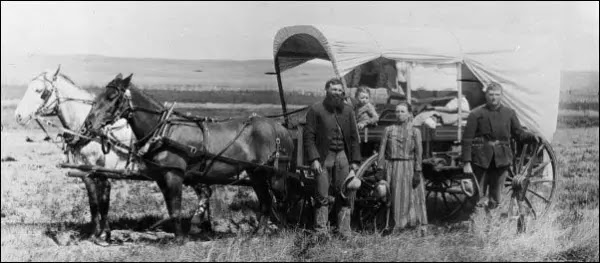
In last month’s post, we looked at the kinds of wagons that carried families and their goods west, as well as their designs. We saw that the famous Conestoga wagon wasn’t well-suited for the rough travel across the plains and through the mountains. Still, that didn’t stop some folks from trying.

In this post, we’ll slow down a little and take a glimpse inside the typical wagon that traveled west toward California and Oregon from the 1850s and on through even into the 1920s. Not every family could afford to travel by stagecoach or even the train, and so many wagons continued as their only source of transportation.

In planning a trip of this magnitude—thousands of miles, six months or more on the trail—families had to consider what they’d need along the way; what they’d need once they got where they were going; and what they couldn’t bear to leave behind. In many ways, their questions were similar to what we might ask ourselves today if we decided to move halfway across the country. The major difference was the length of time and the difficulty of travel for them as opposed to us.

Food, of course, was a primary concern. A barrel of flour was a must, since most meals included either bread, biscuits, flapjacks, or some other form of starch. Meat was scarce, as were ways to preserve it so it would last the heat and rain of the journey, so most meat was hunted along the way. Beef jerky was often prepared and stored in burlap sacks.

Coffee, sugar, and baking ingredients, such as baking powder, salt, soda, and spices, were carried in smaller leather or paper sacks, often stored in a chest. Honey might be hidden away. A sack of beans was a staple, and if somebody in the wagon knew about healing, ingredients such as mustard for plasters, milk thistle for fever, and other natural ingredients would be vital in case of illness.

Quilts were a common thing to bring, as they would serve as mattress, cover, a bed under the wagon, and even an extra layer of clothing should the weather turn cold. Oilskins were a treasure for driving in the rain.

Depending on the beasts used to draw the wagon, different foodstuffs might be carried, too. For horses, grain in addition to sweet grass grazed along the way helped keep up their stamina. For oxen or mules, they could survive on foraging.
From dustyoldthing.com 
 
An extra wheel, a spare axle, a set of leathers, and if using horses, spare horseshoes would be stowed in boxes attached to the outside of the wagon. A butter churn hung from a hook at the rear tailgate could make butter in a day. Cook pots, including a dutch oven, coffee pot, and a large boiler, aided the wife in preparing meals. Sometimes, though, if weather was rainy or the wagon train was forced to keep moving, the family ate cold leftovers.

Additional tools, such as shovels, hammers, axes, ropes, and grinding stones were carried in a tool box built under the front seat or attached to the outside of the wagon. A bucket holding lard or grease would hang from a peg on the rear axle, and the hubs would be greased to keep them moving easily and not wearing on the wood.

A water barrel hung from the side of the wagon, or perhaps was kept inside, depending on the size of the family and amount of space. Often it was the younger children’s responsibility to fill this barrel at every available stop. The stock was watered first, then the family. Often water had to be rationed, since sometimes days could pass without seeing a river or lake. Bathing and laundry was limited to local water sources.

Clothing was hung from pegs or hooks suspended from the ribs holding up the canvas cover. Some families included large furniture, such as a rolltop desk, parlor chairs, or even an organ. As you can imagine, many of these pieces were discarded along the way.

 
From dustyoldthing.com

Books were often seen in piles along the trail. Folks would pick up a book from one pile, read it along the way, and discard it a hundred miles along the trail. Mothers often used these books to teach their children, a form of homeschooling, as they traveled.

Stories are often told of a family falling ill with cholera, typhoid, measles, smallpox, and the like. In that case, they’d pull out of the wagon train they were currently in and wait by the side of the trail. Once recovered, they’d join the next train along. Sometimes, if they were found to be sick, they’d be abandoned at the muzzle of a rifle. With few remedies, nobody wanted to be around the sick.

Forts and towns along the way often sold goods and supplies to families, so carrying cash was a necessity. Unfortunately, many emigrants were robbed and killed by trail pirates.

As you can see, traveling west took a great deal of planning, strength, and mental acuity. It’s no wonder there are so many graves along the Oregon, Santa Fe, and California trails. Some estimates are as high as an average of one grave per mile.


Question: what would be one thing you would have to take with you if you traveled west in a covered wagon? Leave a comment, and I’ll draw randomly for a print (US only) or ebook copy of Calli.


About Calli:


Calli works as a nurse with the US Army at Fort Bridger, Wyoming in 1880. When a wagon train full of discouraged emigrants passes through on its way east, a pregnant widow delivers her baby then dies. Bradley Wilson, leading this train, has few options. He asks Calli to travel with them until they find a relative to take the child in St. Joe, Missouri. Calli, drawn to both this dark and quiet man and the child, resists. But when she disappears, he wonders if she’s run away or been kidnapped. Can these two put their pasts behind them and move into a new future together? Or will Calli insist on having things her own way?

https://www.amazon.com/Calli-Prairie-Roses-Collection-Book-ebook/dp/B09SD6XPRQ


About Donna:

A hybrid author, Donna writes squeaky clean historical and contemporary suspense. She has been published more than 50 times in books; is a member of several writers groups; facilitates a critique group; teaches writing classes; ghostwrites; edits; and judges in writing contests. She loves history and research, traveling extensively for both.

www.DonnaSchlachter.com Stay connected so you learn about new releases, preorders, and presales, as well as check out featured authors, book reviews, and a little corner of peace. Plus: Receive a free ebook simply for signing up for our free newsletter!

www.DonnaSchlachter.com/blog


Resources:

https://dustyoldthing.com/photos-covered-wagon/

https://www.homestead.org/homesteading-history/covered-wagons-heading-west-life-on-the-oregon-trail/