By Jennifer Uhlarik
I happened to scrolling through Facebook recently, and I saw a picture of two men in 1940s-era garb standing near several rough-looking pinball machines. One of the men held a sledge hammer. The caption read: Taken during the pinball prohibition of the 1940s through the 1970s. I’d never heard of a pinball prohibition, so I went searching for details. Here’s what I found.
INCEPTION OF PINBALL MACHINES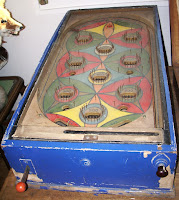 |
Early Pinball Machine
circa 1932 |
The game of Pinball began far earlier than most might imagine. All the way back to the 1600s and 1700s, people enjoyed outdoor lawn games like croquet or bocce, but eventually looked for ways to bring such games indoors, where they could be played on a table or pub floor. Thus, games like billiards and bowling were created. Over more than a hundred years, these games were changed and made smaller still, until they became tabletop varieties with boards where nails (a.k.a pins) surrounded holes that small marbles were shot or ricocheted into. In 1869, Montague Redgrave, a British inventor, moved to the United States and began manufacturing these “Bagatelle” tables, as they were known at the time. Just two years later, he created the spring launcher for the games, and the modern pinball machine was birthed.
These bagatelle games continued, fairly unchanged, until 1931, when they became coin-operated. Players would head to the local drugstore or tavern where, for one penny, he would be given five to seven balls, which would be launched by Redgrave’s spring-loaded plunger. However, the player was at the mercy of the bouncing marble. The game’s board was simply a wooden base under glass, with various pins and holes. There was no way, except by tipping the table, to control where the ball went. In 1933, electrification was added to the first pinball machine in the form of flashing lights, active bumpers, and a solenoid which would propel the ball up and out of a hole in the center of the board if it landed there during a turn. It wasn’t until 1947 when the flippers were added to the board to keep the ball in play longer.
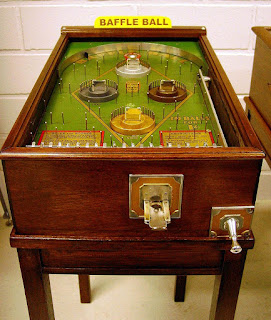 |
Gotleib Baffle Ball Machine
circa 1930s. |
SO WHY A PINBALL PROHIBITION?
As most everyone knows, the Great Depression started in 1929 and lasted for a decade. It was during this time that the pinball machines came into the modern era. As mentioned above, they were also turned into a coin-operated form of entertainment in 1931, right in the midst of one of the greatest economic disasters our country has faced. During a time when there weren’t many forms of cheap entertainment, here was the pinball machine, where players could dump in a penny and have several chances to win. Win what, you ask? Well, the machine operators—those drugstore, candy store, and tavern owners—would give away prizes to entice people to play. Prizes ranged from free games or gum all the way to jewelry and china dishes. Grown adults began spending their hard earned pennies for chances to win big prizes worth more than the meager pennies they were dumping in. And amongst the players, they gambled on which direction the balls would bounce, among other things.
In addition, children began skipping school in order to play pinball. Teachers, churches, civic groups, and law enforcement became alarmed when those same children would spend their nickels and dimes—given to them as lunch money—to feed the machines rather than feeding themselves. And many went further, turning to theft in order to support their pinball habits. Proper society saw these machines as a blight on our society, leading to corrupt children and adults.
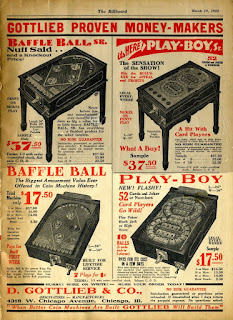 |
Catalog ad for various
early pinball machines |
Even worse, many of the main manufacturers of these games were located in Chicago, Illinois. Chicago was, at the time, a haven for organized crime and gangs—and many of those entities had their fingers in the pockets of the pinball manufacturers.
New York City Mayor Fiorello LaGuardia had already declared war on illegal slot machines, and once he’d cleaned up that area of his city, he set his sights on pinball machines. He gained help in that crusade when, on December 7, 1941, the Japanese attacked Pearl Harbor, and the United States subsequently entered World War II. Claiming that the metal from the pinball machines would be better used for the war effort, he was able to get his city council to ban pinball machines in public spaces on January 21, 1942. Over 2000 pinball machines were forcibly taken from various establishments. Taking a page from LaGuardia’s book, other U.S. cities such as Los Angeles, New Orleans, and Chicago also banned the machines, and still others set rules that children could not play the games until after school hours were done for the day.
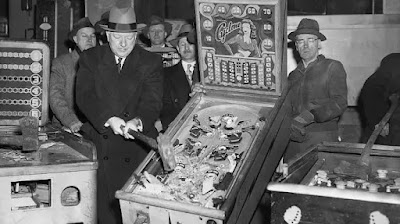 |
Authorities destroying a pinball machine,
circa 1949 |
This prohibition on pinball games lasted into the mid-1970s, when the California Supreme Court finally ruled that the games were not a game of chance, but had become one of reflexes and skill since the addition of the flippers. Many of the places that had instituted similar bans lifted them once California led the way, but it took New York City several years to come to the same conclusion. In getting there, the City Council actually allowed a pinball machine to be brought into their chambers and a skilled player to give a demonstration on just how adroit the players needed to be in order to keep the ball in play. The said player predicted that, by pulling back the spring-loaded plunger just the right amount to launch the ball, it would travel down a certain channel. He then deployed the plunger, and the ball went precisely where he predicted it to go. After the demonstration, the councilmen lifted the ban and immediately instituted a $50 license fee on each pinball machine, earning the city of New York some $1.5 million—a great boon, since the city was in the throes of a bankruptcy crisis.
Once the last of the bans was lifted, pinball experienced a revival, although it was short-lived since, after a brief few years, the video game era began. Today, only one manufacturer of these machines is still in operation.
It’s Your Turn: Did you know there was once a ban on pinball machines? How do you feel about the government stepping into such matters—is it their place, or should they have remained neutral on the topic?
Award-winning, best-selling novelist Jennifer Uhlarik has loved the western genre since she read her first Louis L’Amour novel. She penned her first western while earning a writing degree from University of Tampa. Jennifer lives near Tampa with her husband, son, and furbabies. www.jenniferuhlarik.com
AVAILABLE NOW
Love’s Fortress by Jennifer Uhlarik
A Friendship From the Past Brings Closure to Dani’s Fractured Family
When Dani Sango’s art forger father passes away, Dani inherits his home. There, she finds a book of Native American drawings, which leads her to seek museum curator Brad Osgood’s help to decipher the ledger art. Why would her father have this book? Is it another forgery?
Brad Osgood longs to provide his four-year-old niece, Brynn, the safe home she desperately deserves. The last thing he needs is more drama, especially from a forger’s daughter. But when the two meet “accidentally” at St. Augustine’s 350-year-old Spanish fort, he can’t refuse the intriguing woman.
Broken Bow is among seventy-three Plains Indians transported to Florida in 1875 for incarceration at ancient Fort Marion. Sally Jo Harris and Luke Worthing dream of serving on a foreign mission field, but when the Indians reach St. Augustine, God changes their plans. However, when Sally Jo’s friendship with Broken Bow leads to false accusations, it could cost them their lives.
Can Dani discover how Broken Bow and Sally Jo’s story ends and how it impacted her father’s life?