Showing posts with label St. Francis of Assisi. Show all posts

Friday, April 14, 2023

Italy Tour ~ Convent de Le Celle


I traveled to the Tuscany region of Italy last month for the Serious Writers Italy Tour, a combination writing retreat and sightseeing trip.

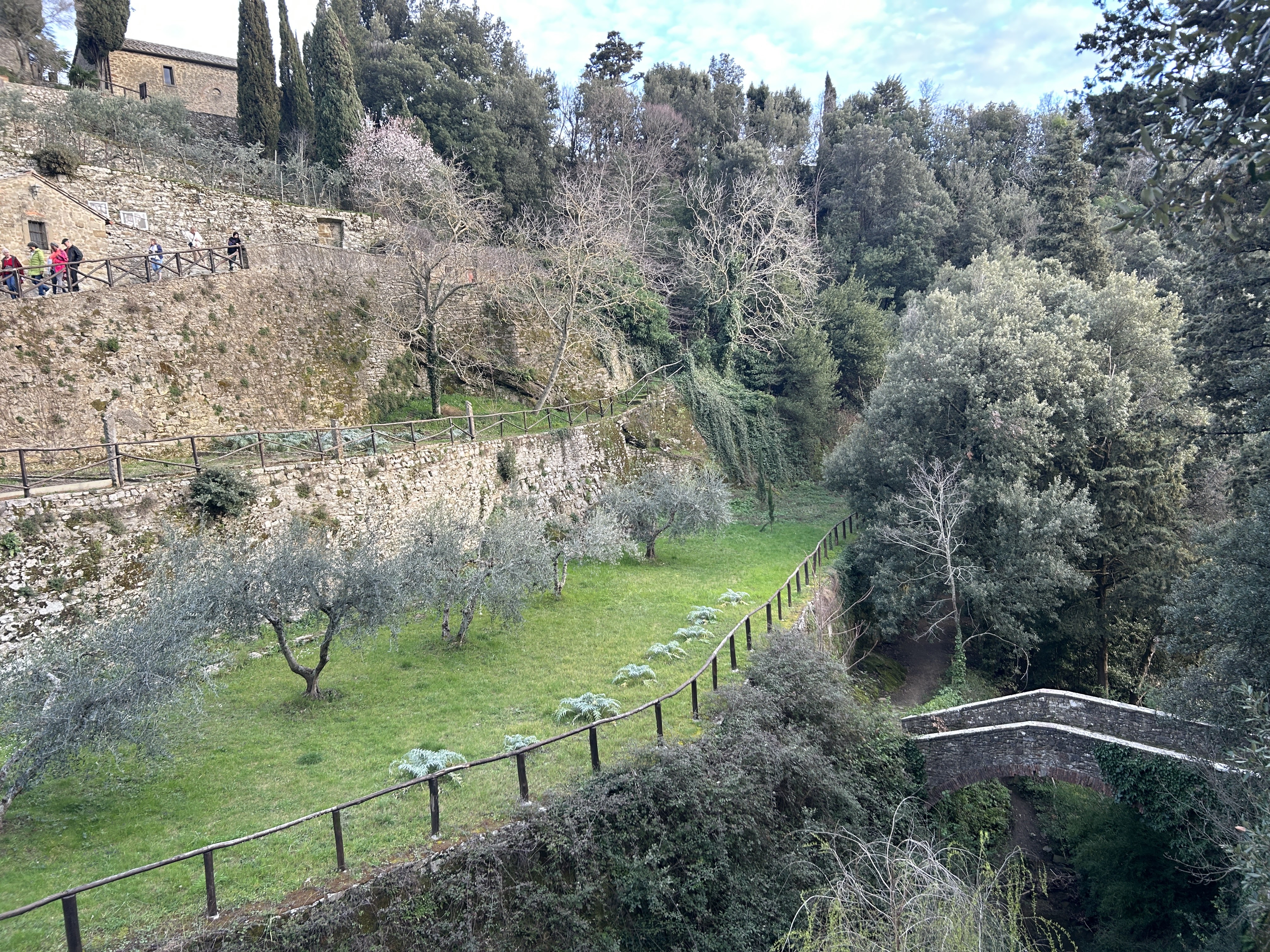
One unexpected highlight was our visit to a 13th-century Franciscan convent, located near the medieval town of Cortona in the province of Arezzo. The convent, also known as Convento delle Celle or Eremo Le Celle, is nestled in the side of a mountain and surrounded by woods.

The monastery is important because Francis of Assisi, the founder of the Franciscan order, dwelt in a small cell there for a time. 


Francis of Assisi was born Giovanni di Pietro di Bernardone, the son of a wealthy cloth merchant and landowner. He was a rebellious young man who was captured in a battle and imprisoned for almost a year while his father negotiated his ransom.

During that time, he claimed to receive visions from God. Eventually, various circumstances led him to live as the poor. He ministered to lepers, gained followers, and is venerated for his love of animals.

He was only forty-four when he died on October 3, 1226. Pope Gregory IX canonized him about two years later on July 16, 1228. He is known as the patron saint of animals.

When Francis stayed at the Convent de Le Celle, he lived in the small room shown below.

A few years after Francis’s death, a sanctuary, refectory and five monk cells were added to the original structure. In 1537, the Order of Friars Minor Capuchin dedicated the monastery to St. Michael Archangel. Almost a hundred years later, another dedication took place—this time to St. Antony of Padua.

Napoleon expelled the monks in the early 1800s but they returned before the end of the century.

Today, the site is managed as a rustic retreat by the Capuchin Order.

As you can see by the photos I’ve included in this post, the monastery is, indeed, a tranquil and restful place.


Johnnie writes award-winning stories in multiple genres. A fan of classic movies, stacks of books, and road trips, she shares a life of quiet adventure with Griff, her happy-go-lucky collie, and Rugby, her raccoon-treeing papillon. Visit her at 
johnnie-alexander.com.


Photos ~ © Johnnie Alexander 2023

Sources ~ 


Saturday, December 7, 2013

The Origin of the Nativity Scene By Debbie Lynne Costello PLUS GIVEAWAY! Ends 12/13

Debbie Lynne here today. Wow can you believe that there are only eighteen days until Christmas? Yikes! Where did the summer go? Well with Christmas right around the corner, have you ever wondered where and when the origin of the Nativity came from? I sure have. So I decided to do a little digging and here is what I found out. 

But first we will take a commercial break. :o)

I'm giving away a copy of A Home for my Heart and a Madam Alexander Christmas ornament.
Be sure to leave a comment and tell me what you learned new, if you knew this information, or just ask me a question to be entered to win.


PUBLIC DOMAIN sconosciuto

 St. Francis of Assisi is credited with the very first nativity scene.


There seems to be two different stories why St. Francis devised the first Christmas crib (Nativity scene). One says St Francis, concerned that people were losing the real meaning of Christmas and were more interested in all the gift giving (sounds familiar doesn't it?), gained permission from the sovereign Pontiff to hold a live nativity in the town of Greccio, Italy.


The second story tells that St. Francis worried for all the would-be pilgrims that wanted to take a pilgrimage to Bethlehem. The trip was dangerous because the Holy Land was under the control of the Turks. So St. Francis, remembering his trip to Bethlehem, decided to recreate what he saw there. 

Regardless of his reason, St. Francis chose a cave on the mountainside in Greccio and gathered his crib, hay, ox and ass. There he gave a sermon. It is said he stood before the manger overwhelmed with love and filled with happiness. 


There are references to presepe ('Nativity scene' in Italian) in Rome in 1272 and in Naples in 1343. The practice spread to other parts of Europe throughout the later Middle Ages. The presepe consisted of three figures up to the sixteenth century – the babe in the crib and two animals who kept him warm. Mass was celebrated and these three figures were placed next to the altar. 


By the end of the Middle Ages the figures of Mary and Joseph were added, and gradually the nativity scene became more complex by adding shepherds, some moveable figures, and music. As the years passed the nativity evolved until it is what we have today. It's sad that our government wants to take the nativity scene from all public areas. Our country would do well to take from the nativity what St. Francis had originally planned.


A few fun Christmas facts:


The first use of the word Christmas was recorded in a book  from Saxon England in 1038. The words used were Cristes Maesses. However, it wasn't until the fourteenth century that it became one word, Christesmaesse (Christmas).

In A.D. 350, Pope Julius I, bishop of Rome, proclaimed December 25 the official celebration date for the birthday of Christ.


William the Conqueror was crowned on Christmas Day 1066 in Westminster Abbey.

And one non-historical fact:
All the gifts in the Twelve Days of Christmas would equal 364 gifts.


My Christmas gift to a lucky winner. Ends 12/13