Saturday, April 19, 2025
Toys of the 1900s - From Wooden Tops to Whirligigs
At the turn of the 20th century, children's playtime was filled with the simple joys of handmade toys. In 1900, an array of charming and timeless playthings captivated the imagination of youngsters across the globe. From the humble wooden tops to the whimsical jumping jack man, these toys were not just sources of entertainment but also treasured artifacts of a bygone era.
Wooden tops were a ubiquitous sight in the hands of children during the early 1900s. Crafted from wood and often hand-painted with vibrant colors, these spinning marvels were propelled into action with the help of a string and a quick twist of the fingers.
Games of chance and skill were prevalent in the 1900s, with dice and teetotum being popular choices. Wooden dice were used in various games that tested luck and strategy. The teetotum, a spinning top with numbered sides, added an element of unpredictability to games, making them both entertaining and educational.
The yo-yo, with its timeless appeal, quickly became a sensation. The whirligig, a delightful and whimsical toy consisting of a spinning propeller mounted on a stick, the whirligig was set in motion by the wind or a twirling motion from the child.
The bilbo catcher, a skill-based toy, challenged children to improve their hand-eye coordination. Consisting of a wooden cup attached to a handle by a string, players aimed to catch a small wooden ball in the cup as it swung back and forth. The bilbo catcher not only entertained but also honed motor skills, making it a valuable plaything for development.
The jumping jack man added a touch of theatricality to playtime. Comprising a jointed figure attached to strings, pulling a cord caused the limbs to move, creating a whimsical dance. The jumping jack man brought a sense of animation to the toy box, allowing children to bring their imaginations to life. In A Summer at Thousand Island House, the children play with these toys.
What’s your favorite childhood toy? Leave your answer or comments on the post below and join me on February 19th for my next post.
ABOUT A SUMMER AT THOUSAND ISLAND HOUSE
Addison Bell serves children of the Thousand Island House guests on Staple’s Island. While thriving in her work, Addi’s vivacity attracts the attention of the recreation pavilion’s manager, Liam Donovan, as well as the handsome Navy Officer Lt. Worthington, a lighthouse inspector, hotel patron, and single father of mischievous little Jimmy. When Jimmy goes missing while in Addi’s care and former President Chester Arthur finds the child a stowaway on his fishing boat, her job and reputation are endangered. How can she calm the churning waters of Liam, Lt. Worthington, and the President, clear her name, and avoid becoming the scorn of the community?
ABOUT SUSAN
Susan G Mathis is an international award-winning, multi-published author of stories set in the beautiful Thousand Islands in upstate NY. Susan has been published more than thirty times in full-length novels, novellas, and non-fiction books. She has fourteen in her fiction line. Susan is also a published author of two premarital books, stories in a dozen compilations, and hundreds of published articles. Susan lives in Colorado Springs and enjoys traveling the world. Visit www.SusanGMathis.com/fiction for more.
Wednesday, March 19, 2025
A Day in the Life of a Lightkeeper
By Susan G Mathis
Lighthouse keepers had many duties including maintaining the lighthouse, ensuring the light was operational, and assisting with navigation. Their job was 24/7, but they also had many perks including a peaceful existence in nature’s bountiful beauty. Here’s a look at a day in the life of a lightkeeper.
Early MorningAs the sun rises over the St. Lawrence River, the first rays of light illuminate the lighthouse, signaling the keeper to snuff out the light and head to bed for a few hours of precious sleep… unless there’s a storm brewing, family needing him (or her), or another emergency.
Midday Tasks
After a few hours of sleep, the keeper’s duties might include a hearty lunch before turning to maintenance tasks. This could involve repairing the lighthouse’s exterior, tending to the garden, or clearing pathways for visitors. The keeper also needs to be vigilant about the weather, documenting changes that could affect navigation. On days with good weather, the keeper may even take the opportunity to explore the island, appreciating its natural beauty and solitude.
Later in the afternoon, the keeper might host visitors, sharing the lighthouse’s history and its significance in the region’s maritime safety. Engaging with visitors is a rewarding aspect of the job, allowing the keeper to share stories of life on the island and the challenges faced over the years.As the sun sets, the lighthouse keeper prepares for the night shift. This includes cleaning the lens again, checking the oil, and ensuring everything is in order for the night ahead. The keeper often watches the sunset over the river, a breathtaking sight that never gets old.
Have you ever had a nightshift job? Leave your answer or comments on the post below and join me on February 19th for my next post.
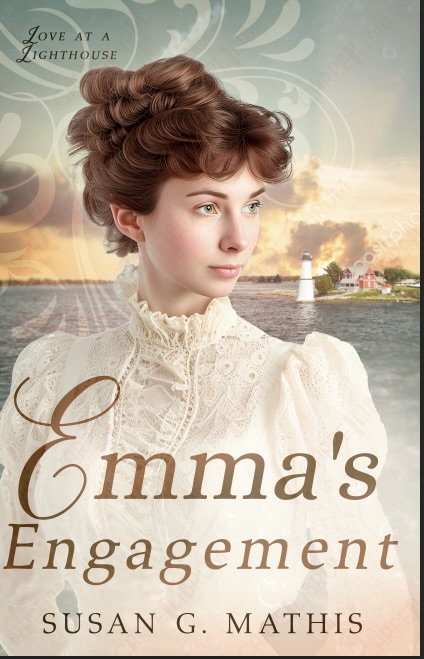
ABOUT EMMA’S ENGAGEMENT
Book 3 of the Love in a Lighthouse series:
Emma Row yearns to build a loving family. But becoming the Rock Island Lightkeeper's wife brings treacherous waters of isolation and the bitter rejection of her new stepdaughter, Ada. Michael Diepolder, the widowed lightkeeper, had hoped marriage would simplify life but realizes that the path to happiness is far more turbulent than he ever anticipated. Emma and Michael must confront the tempestuous waves of doubt, jealousy, and isolation that threaten to extinguish the light of their love. Can they weather the storm and find the strength to keep their family together, or will the darkness consume them all?
ABOUT SUSAN:
Susan G Mathis is an international award-winning, multi-published author of stories set in the beautiful Thousand Islands in upstate NY. Susan has been published more than thirty times in full-length novels, novellas, and non-fiction books. She has fourteen in her fiction line. Susan is also a published author of two premarital books, stories in a dozen compilations, and hundreds of published articles. Susan lives in Colorado Springs and enjoys traveling the world. Visit www.SusanGMathis.com/fiction for more.
Sunday, January 19, 2025
New Years Weddings in the 1890s
By Susan G Mathis
As the clock struck midnight to usher in a new year in the 1890s, couples embraced the idea of starting their lives together amidst the promises and resolutions that came with the dawning of a fresh chapter. New Year's weddings during this era were characterized by a sense of hope, optimism, and a touch of Victorian charm.
Venues adorned with winter florals, twinkling gas lamps, and the warm glow of candlelight created an enchanting atmosphere. The color palette reflected the season, with rich burgundies, deep greens, and touches of gold and silver adding a regal touch to the celebrations. The typical bridal silhouette featured high necklines, long sleeves, and voluminous skirts, epitomizing the grace and modesty of the time. Grooms complemented their brides with dark-colored suits, often accented with silk lapels and vests. Crisp white shirts, bow ties, and top hats completed the groom's ensemble, exuding a sense of formality and sophistication.
New Year's weddings were imbued with symbolism and a sense of renewal. The exchange of vows took on added significance, as couples pledged their commitment to one another on the threshold of a new year. Traditional wedding ceremonies were accompanied by the melodies of hymns and classical music, creating a harmonious backdrop to the sacred vows.
The stroke of midnight played a central role in the festivities, with couples often timing their nuptials to coincide with the turning of the year. As the clock struck twelve, the newlyweds would share their first kiss as husband and wife, surrounded by the cheers and well-wishes of family and friends.
New Year's weddings in the 1890s were celebrated with sumptuous feasts, featuring seasonal delicacies and festive treats. Champagne flowed freely, adding a touch of effervescence to the celebrations. The dining tables were adorned with crystal, silverware, and fine china, reflecting the opulence of the Victorian era.
New Year's weddings in the 1890s combined the richness of Victorian tradition with the optimism and hope associated with the turn of a new year. In Julia’s Joy, readers get to enjoy a New Year’s Eve wedding.
Have you been to a New Year’s wedding? Leave your answer or comments on the post below and join me on February 19th for my next post.
ABOUT JULIA’S JOY
Book 2 of the Love in a Lighthouse series:
When Julia Collins reluctantly sets foot on Sister Island, compelled by her grandmother’s will, she is intent on claiming her inheritance and moving on. But when she experiences the faith-filled island life and connects with the handsome lightkeeper, William, Julia finds herself confronting her open wounds from her parents’ deaths. Between a past betrayal and his chronic pleurisy, William Dodge, lightkeeper of Sister Island, wants nothing to do with love. But Julia turns his world upside down. But just as love begins to blossom between them, Julia is faced with a tempting proposal from a prominent Brockville family. Will she succumb to societal expectations or choose the richness of her island life and the love of the steadfast lightkeeper?
ABOUT SUSAN
Susan G Mathis is an international award-winning, multi-published author of stories set in the beautiful Thousand Islands in upstate NY. Susan has been published more than thirty times in full-length novels, novellas, and non-fiction books. She has thirteen in her fiction line. Susan is also a published author of two premarital books, stories in a dozen compilations, and hundreds of published articles. Susan lives in Colorado Springs and enjoys traveling the world. Visit www.SusanGMathis.com/fiction for more.
Wednesday, June 19, 2024
Summer Galas in the 1900 Thousand Islands
The turn of the twentieth century witnessed an era of opulence and grandeur, especially in the scenic splendor of the Thousand Islands. Nestled between the United States and Canada, this area became a haven for the elite seeking respite from the bustling cities. Among the many extravagant events that defined the social calendar, the Summer Galas of the 1900s emerged as glittering spectacles that combined luxury, leisure, and the charm of the Thousand Islands.
Affluent families and socialites from both sides of the border would sail on luxurious yachts to reach the enchanting islands. Hosted in sprawling mansions or elegant resorts, these galas were a celebration of the natural beauty surrounding the guests. The allure of the Thousand Islands Summer Galas was not just the picturesque setting but also the high-profile attendees. Industrial tycoons, politicians, and celebrities of the time would grace these events with their presence. The social elite would converge on the islands, showcasing their latest fashion trends and engaging in lively conversations against the backdrop of the shimmering St. Lawrence River.
Women adorned themselves in elegant evening gowns with high necklines, delicate lace, and elaborate accessories. Men, on the other hand, sported impeccably tailored tuxedos and top hats, reflecting the refined tastes of the Gilded Age.
Live orchestras would serenade the guests as they danced under the starlit sky, the gentle rustle of the leaves and the lapping of the river creating a symphony of nature. Fireworks displays over the water added a magical touch to the evenings, making the Summer Galas unforgettable affairs.
Lavish feasts were prepared, featuring the finest ingredients of the time. Fresh seafood from the surrounding waters, exotic fruits, and delectable desserts graced the tables, tantalizing the taste buds of the privileged attendees.
These events became a symbol of the luxurious lifestyle enjoyed by the elite during the Gilded Age. Today, remnants of that opulent era can still be seen in the grand mansions that once hosted these galas, standing as silent witnesses to a bygone era of elegance and extravagance.
As we reflect on this era, the remnants of the opulent gatherings continue to captivate our imagination, reminding us of a time when the Thousand Islands truly lived up to its name as a paradise for the privileged.
Have you ever been to a ball? Leave your answer or comments on the post below and join me on February 19th for my next post.
ABOUT PEYTON’S PROMISE:
Peyton Quinn is tasked with preparing the grand Calumet Castle ballroom for a summer gala. As she works in a male-dominated position of upholsterer and fights for women’s equality, she’s persecuted for her unorthodox ways. But when her pyrotechnics-engineer father is seriously hurt, she takes over the plans for the fireworks display despite being socially ostracized. Patrick Taylor, Calumet’s carpenter and Peyton’s childhood chum, hopes to win her heart, but her unconventional undertakings cause a rift. Peyton has to ignore the prejudices and persevere or she could lose her job, forfeit Patrick’s love and respect, and become the talk of local gossips.
ABOUT SUSAN:
Susan G Mathis is an international award-winning, multi-published author of stories set in the beautiful Thousand Islands in upstate NY. Susan has been published more than thirty times in full-length novels, novellas, and non-fiction books. She has eleven in her fiction line. Susan is also a published author of two premarital books, stories in a dozen compilations, and hundreds of published articles. Susan lives in Colorado Springs and enjoys traveling the world. Visit www.SusanGMathis.com/fiction for more.
Monday, June 19, 2023
The First Texting System—the Telegraph
Telegraphs were the first telecommunications texting system in the world. In its early days, it was used mainly in railway, government, and post offices. Samuel Morse invented the armature telegraph in 1838. Telegraph offices were connected by wires and could spread information quicker and more efficiently than mail.
The telegraph used a system of dots and dashes to communicate a message to the telegrapher who would get it to the receiver. By 1865, the Morse Code system became the standard for international communication.
At first, railroad companies mainly used it to control train routes and prevent crashes. Before long, governments, the military, banks, and businesses began using the telegraph more and more. In the second half of the 1800s, commercial telegraphs allowed the public to send urgent messages for a fee. A person paid by-the-word to have a message telegraphed to another office and delivered to the addressee in paper form. By the mid-to-late 1800s, most developed nations provided this benefit to their people, thanks to underwater telegraph cables that allowed communication between continents.
Telegraph operators had to learn the Morse system well and had to be able to translate the dots and dashes flawlessly. Long hours in front of the telegraph machine gave them hours of reading and dreaming. Telegraph operators often chatted with other operators and got to know each other’s style. Dots had to be uniform and short. Dashes uniform and long. Each letter had a distinctive beat. For example, SOS is three quick dots, three long dashes, and three quick dots.
During both World Wars, radio telegraphy was an essential way to communicate diplomatically and militarily. Telegraphers could be stationed anywhere alerting the their country’s military to the enemies’ movements, plans, and dangers.
With the increase of the use of the telephone in the early 1900s, the telegraph slowly became outdated. By the early 1990s, with the rise of the top the Internet and email the demise of the telegraph certain. In Mary’s Moment, Mary enjoyed being not only a telephone switchboard operator but also a telegrapher.
About Mary’s Moment:
Mathis’s attention to detail and rich history is classic Mathis, and no one does it better.—Margaret Brownley, N.Y. Times bestselling author
Summer 1912
Thousand Island Park’s switchboard operator Mary Flynn is christened the community heroine for her quick action that saves dozens of homes from a terrible fire. Less than a month later, when another disastrous fire rages through the Park, Mary loses her memory as she risks her life in a neighbor's burning cottage. Will she remember the truth of who she is or be deceived by a treacherous scoundrel?
Widowed fireman George Flannigan is enamored by the brave raven-haired lass and takes every opportunity to connect with Mary. But he has hidden griefs of his own that cause him great heartache. When George can’t stop the destructive Columbian Hotel fire from eradicating more than a hundred businesses and homes, he is distraught. Yet George’s greater concern is Mary. Will she remember their budding relationship or be forever lost to him?
About Susan:
Susan G Mathis is an international award-winning, multi-published author of stories set in the beautiful Thousand Islands in upstate NY. Susan has been published more than twenty-five times in full-length novels, novellas, and non-fiction books. She has ten in her fiction line including Mary’s Moment. Susan is also a published author of two premarital books, stories in a dozen compilations, and hundreds of published articles. Susan lives in Colorado Springs and enjoys traveling the world. Visit www.SusanGMathis.com/fiction for more.
Friday, May 19, 2023
Early 1900s Fire extinguishers
The lack of easy communication didn’t help either. Fire victims often had to wait—too long—for a message for help and volunteer firefighters to come to their aid. So, in-home fire protection became a must, even as early as the late 1600s.
Laws required fire buckets, often made of leather, to be in every home and business, and most owners painted their names on them. Pubs, bakers, and other fire-hazardous businesses were required to have multiple buckets.
Businesses and wealthier homes also had fire extinguishers at the ready. Before 1910, soda-acid extinguishers were the go-to safety items. Two viles of sulfuric acid were broken and mixed with bicarbonate solution, causing a chemical reaction in a tank. Though not too effective, it was better than nothing.
Around 1905, a Russian inventor, Alexander Laurant, created a chemical foam extinguisher with licorice root and sodium bicarbonate. A step better, but not great.
Fire extinguisher bombs or glass grenade fire extinguisher were a favorite from 1870 to 1912. Shaped like a light bulb, filled with liquid, and stored on metal brackets on the wall near a stove or fireplace, if there was a fire, anyone could throw it on the fire. That would either put it out or give the person time to escape. Some were filled with salt water, while others contained carbon tetrachloride.
People in the early 1900s lived with the daily fear of fire’s smoke, heat, backdrafts, and toxic fumes. Very few lived long without knowing someone who was killed, maimed, or harmed by fire. In Mary’s Moment, the summer community of Thousand Island Park lost more than a hundred homes, businesses, and hotels. It’s a tale that will bring fire danger to life.
About Mary’s Moment:
Mathis’s attention to detail and rich history is classic Mathis, and no one does it better.—Margaret Brownley, N.Y. Times bestselling author
Summer 1912
Thousand Island Park’s switchboard operator Mary Flynn is christened the community heroine for her quick action that saves dozens of homes from a terrible fire. Less than a month later, when another disastrous fire rages through the Park, Mary loses her memory as she risks her life in a neighbor's burning cottage. Will she remember the truth of who she is or be deceived by a treacherous scoundrel?
Widowed fireman George Flannigan is enamored by the brave raven-haired lass and takes every opportunity to connect with Mary. But he has hidden griefs of his own that cause him great heartache. When George can’t stop the destructive Columbian Hotel fire from eradicating more than a hundred businesses and homes, he is distraught. Yet George’s greater concern is Mary. Will she remember their budding relationship or be forever lost to him?
About Susan:
Susan G Mathis is an international award-winning, multi-published author of stories set in the beautiful Thousand Islands in upstate NY. Susan has been published more than twenty-five times in full-length novels, novellas, and non-fiction books. She has ten in her fiction line including Mary’s Moment. Susan is also a published author of two premarital books, stories in a dozen compilations, and hundreds of published articles. Susan lives in Colorado Springs and enjoys traveling the world. Visit www.SusanGMathis.com/fiction for more.
Wednesday, April 19, 2023
The 1912 Telephone Switchboard Operator
The Telephone Switchboard Operator had no easy task, but many young women found it to be a gratifying job. In smaller communities, one small multiplex switchboard might be found in a post office, a hotel, or even in one’s home, and only one person would operate it, connecting a few hundred subscribers. In larger cities, there might be rooms full of switchboards and operators busily placing calls to thousands.
When a caller lifted the telephone receiver, a light lit up on the switchboard near the caller’s jack. The operator inserted the cord and answered the call. For a local call, the operator connected the call with a ringing cord. But for a long-distance call, she had to connect the call with a special trunk circuit, talk to another operator, and have her connect the call.
By 1910, nearly six million businesses and homes had Alexander Graham Bell’s telephones. But it was a shared convenience. There was always a half dozen businesses or homes on one line, and to make a call, you first had to get an open line. Then you had to turn the long crank of the handle on the side of the phone box and wait for the operator to answer. She’d ask who you wanted to call, and she’d connect them to you. If the line was busy, she might even chat with you while you waited.
The most popular phone was the candlestick telephone, also known as a stick phone, a desk stand, or an upright. Candlestick telephones had a mouth piece at the top of the stand, and a receiver that was held up to the users ear to hear the caller. The receiver rested on a fork at the side of the stand when not in use. When the receiver sat on the fork, it disconnected the telephone circuit.
In my latest novel, Mary’s Moment, Mary’s acumen as a telephone switchboard operator for the growing summer community of the Thousand Island Park made for a fun and interesting protagonist—and she saved lives in the process.
About Mary’s Moment:
Mathis’s attention to detail and rich history is classic Mathis, and no one does it better.—Margaret Brownley, N.Y. Times bestselling author
Summer 1912
Thousand Island Park’s switchboard operator Mary Flynn is christened the community heroine for her quick action that saves dozens of homes from a terrible fire. Less than a month later, when another disastrous fire rages through the Park, Mary loses her memory as she risks her life in a neighbor's burning cottage. Will she remember the truth of who she is or be deceived by a treacherous scoundrel?
Widowed fireman George Flannigan is enamored by the brave raven-haired lass and takes every opportunity to connect with Mary. But he has hidden griefs of his own that cause him great heartache. When George can’t stop the destructive Columbian Hotel fire from eradicating more than a hundred businesses and homes, he is distraught. Yet George’s greater concern is Mary. Will she remember their budding relationship or be forever lost to him?
About Susan:
Susan G Mathis is an international award-winning, multi-published author of stories set in the beautiful Thousand Islands in upstate NY. Susan has been published more than twenty-five times in full-length novels, novellas, and non-fiction books. She has ten in her fiction line including Mary’s Moment. Susan is also a published author of two premarital books, stories in a dozen compilations, and hundreds of published articles. Susan lives in Colorado Springs and enjoys traveling the world. Visit www.SusanGMathis.com/fiction for more.
Sunday, March 19, 2023
Firefighting in the Early 1900s
To protect their bodies, firemen wore bulky, black rubber-lined duck coats and rubber boots. Heavy helmets made of leather and metal protected their heads. Designed with a high dome to deflect falling objects, a wide brim to fend off debris, and a long duck tail to keep water and cinders from their backs made them invaluable.
Commonly used Bucket Brigades were almost universal until the mid-1900s. Two lines of volunteers stretched from the town well to the fire passing buckets of water to the firefighters. Once empty, the buckets were passed back to the well to be refilled. Once the hand pumper came into use, bucket brigades kept the pumper full of water. The fire foreman would use a “speaking trumpet” to give orders and keep his men and volunteers motivated.
Firemen also used hooks and chains to pull down walls of burning buildings to form a firebreak and keep the fire from spreading. Firemen and volunteers often used wet mops called Swabs to fight falling embers that would easily catch a roof on fire.
The early fire engines were horse-drawn. Firemen had to manually pump the water. In the late 1800s, fire engines with internal combustion engines slowly replaced horse-drawn steam engines, but only in the larger cities and wealthier districts. At first, the engines were self-propelled steam powered engines. Decades later did they became gasoline powered trucks.
Professional firefighters had to learn a lot about firefighting including a basic knowledge of fire dynamics, extinguishers, fire suppression, building construction, and how to use ropes and knots, ladders, hoses, and other equipment. They also needed to be fit and to know a little about safe search and rescue, smoke dangers, and so much more.
We cheer on today’s firefighters, and rightly so. But the men who fought fires back in the early 1900s were heroes indeed. In my latest novel, Mary’s Moment, we experience three major fires that nearly destroyed the Thousand Island Park community in 1912. It’s an exciting read.
About Mary’s Moment:
Mathis’s attention to detail and rich history is classic Mathis, and no one does it better.—Margaret Brownley, N.Y. Times bestselling author
Summer 1912
Thousand Island Park’s switchboard operator Mary Flynn is christened the community heroine for her quick action that saves dozens of homes from a terrible fire. Less than a month later, when another disastrous fire rages through the Park, Mary loses her memory as she risks her life in a neighbor's burning cottage. Will she remember the truth of who she is or be deceived by a treacherous scoundrel?
Widowed fireman George Flannigan is enamored by the brave raven-haired lass and takes every opportunity to connect with Mary. But he has hidden griefs of his own that cause him great heartache. When George can’t stop the destructive Columbian Hotel fire from eradicating more than a hundred businesses and homes, he is distraught. Yet George’s greater concern is Mary. Will she remember their budding relationship or be forever lost to him?
About Susan:
Susan G Mathis is an international award-winning, multi-published author of stories set in the beautiful Thousand Islands in upstate NY. Susan has been published more than twenty-five times in full-length novels, novellas, and non-fiction books. She has ten in her fiction line including Mary’s Moment. Susan is also a published author of two premarital books, stories in a dozen compilations, and hundreds of published articles. Susan lives in Colorado Springs and enjoys traveling the world. Visit www.SusanGMathis.com/fiction for more.
Thursday, May 19, 2022
Thousand Island's Calumet Castle
During the Gilded Age, majestic Calumet Castle once graced the entry point to the St. Lawrence River from Lake Ontario. It was one of the first castles that the ocean-going ships saw as they traveled downriver from Lake Ontario through the Thousand Islands to the sea. And its story is fascinating.
New York City tycoon Charles G. Emery was a friend of George and Louise Boldt, who built Boldt Castle, still a major Thousand Islands tourist attraction today. Emery attended the couple’s wedding and the two men were members of the New York City yacht club, along with George Pullman.
As one of the pioneer developers of the Thousand Islands area, Emery purchased Powder Horn Island in 1882. Since the island reflected the shape of a peace pipe, he changed the name of the island to Calumet, a French word for the Native American ceremonial peace pipe.
Emery was impressed with George Pullman’s Castle Rest, the seven-story castle built on Pullman Island in 1888, about ten miles downriver. So, Emery wanted to create an equally imposing castle. The castle on Calumet Island was among the first such grand structures in the Thousand Islands region, predating the still-standing Boldt Castle.
Construction of Calumet Castle began in 1893 and was finished the following year. The completed castle had thirty room, including the largest private ballroom in New York. Several out buildings included a water tower, the caretakers home, a guesthouse, a boathouse, a men’s dormitory, and an ice house. My latest novel, Peyton’s Promise is set here.
Emery had a lagoon dredged out deep enough for his steam yachts and dozens of other boats. When there was a storm, the islanders knew they were free to seek shelter in its harbor.
Guests to Calumet Island arrive at the main dock and ascend a long walkway through the woods rising to the castle. At the castle’s massive stone paved terrace, guests can view the expansive verandas leading to the main entrance. On the veranda high above the river and treetops, guests could see the elaborate gardens and manicured lawns below as well as the village of Clayton. To the Northeast, they could catch a glimpse of the massive white Frontenac Hotel downriver.
In 1956, the castle burned to the ground, leaving only rubble and the outbuildings intact. Today, the owners live in the caretaker’s cottage and host a multitude of guests, still leaving the harbor available for those who seek shelter from the summer storms.
About Peyton’s Promise:
book 3 of the Thousand Islands Gilded Age series
Summer 1902
Peyton Quinn is tasked with preparing the grand Calumet Castle ballroom for a spectacular two-hundred-guest summer gala. As she works in a male-dominated position of upholsterer and fights for women’s equality, she’s persecuted for her unorthodox ways. But when her pyrotechnics-engineer father is seriously hurt, she takes over the plans for the fireworks display despite being socially ostracized.
Patrick Taylor, Calumet’s carpenter and Peyton’s childhood chum, hopes to win her heart, but her unconventional undertakings cause a rift. Peyton has to ignore the prejudices and persevere or she could lose her job, forfeit Patrick’s love and respect, and forever become the talk of local gossips.
About Susan:
Susan G Mathis is an international award-winning, multi-published author of stories set in the beautiful Thousand Islands, her childhood stomping ground in upstate NY. Susan has been published more than twenty times in full-length novels, novellas, and non-fiction books.
Her first two books of The Thousand Islands Gilded Age series, Devyn’s Dilemma, and Katelyn’s Choice have each won multiple awards, and book three, Peyton’s Promise, comes out May 2022 with Rachel’s Reunion in November. The Fabric of Hope: An Irish Family Legacy, Christmas Charity, and Sara’s Surprise, and Reagan’s Reward, are also award winners.
Susan is also a published author of two premarital books, stories in a dozen compilations, and hundreds of published articles. Susan lives in Colorado Springs and enjoys traveling the world. Visit www.SusanGMathis.com for more.
Monday, April 19, 2021
Thousand Islands Dressing
by Susan G Mathis
Who likes Thousand Islands Dressing? I do.
You probably use Thousand Islands dressing on your Reuben sandwiches, your salads, even your burgers. I like it on other sandwiches and even as a dip for veggies, chips, and French fries. But how did this creation come to be?
It’s a great story, really. And it began in the Thousand Islands area of upstate New York where there are 1864 islands. During the Gilded Age, the rich and famous bought islands and shoreline, building castles, mansions, and amazing summer homes. Many came from New York City to flee the heat and humidity—and stench—of the metropolitan summers. George Boldt was one of them.
George Boldt built Boldt Castle on Heart Island—in the heart of the Thousand Islands. Boldt was the manager of the prestigious Waldorf-Astoria Hotel in New York City and was in the process of building an elegant stone castle for his wife—which is now a famous tourist stop.
Boldt’s friend and colleague, Oscar Tschirky, accompanied Mr. Boldt to the castle several times. As maitre d’hotel of the famous Waldorf-Astoria, he was always ready to create something special. Once, while on the Boldt’s yacht, Oscar realized that the crew left behind the salad dressing, so he concocted what’s now known as Thousand Island Dressing.
On the yacht, Oscar found the condiments mayonnaise, ketchup, pickle relish, and Worcestershire sauce. He chopped some vegetables such as green olives, onions, and bell-peppers as well as a hard-boiled egg, and voila! He created a brand, new dressing. Boldt liked it so well that he began serving it at his hotel, and it became quite popular. And because of this impromptu creation, Oscar’s fame as a famous chef grew as well. He created other innovative and improbable dishes such as Waldorf Salad and Veal Oscar.
At the time, the country was in the midst of a salad craze. Iceberg lettuce was easily grown in California, and it was the dawn of the refrigerated train car. Chefs combined local greens with iceberg, and because mayonnaise cut some of the bitterness from the greens, the dressing was for the culinary elite, the rich and famous, and high-class establishments.
There’s a second, less interesting story about the dressing’s creation that’s largely been debunked but still moseys around the islands. This tale gives an innkeeper and a fishing guide’s wife the credit. Sophia Lalonde lived in Clayton, NY. She’d make food for the tourists who went on her husband’s fishing trips. On one such trip, May Irwin, the popular silent movie actress who had the first on-screen kiss, was said to have tasted the dressing and asked for the recipe, passing it on to Boldt who made it famous by serving it at the Waldorf-Astoria.
Whatever the origin may be, Thousand Islands Dressing originated in the Thousand Islands. There are many variations of the dressing today, but the base is mayonnaise and tomato sauce or ketchup and whatever else the cook puts in it. Because my novels are based in the Thousand Islands Gilded Age, many readers ask for the story. And now you know!
Ingredients: 1 cup mayonnaise, 1/4 cup relish, 2 tbs vinegar, 2 tbs. Worcestershire sauce, 1 tsp sugar, ¼ cup diced red pepper, ¼ c diced green onion, 1 diced hardboiled egg.
Combine ingredients in a bowl, stir and refrigerate overnight.
Longing for love, can she escape the shadows that follow her to Dark Island?
1910, Thousand Islands, New York. Others may consider The Towers castle on Dark Island an enchanting summer retreat, but to Devyn McKenna, it’s a prison. Yet as she works as a maid for Frederick Bourne, former president of the Singer Sewing Machine Company, her life blossoms under the kindness of his family and fascinating entrepreneurs such as J.P. Morgan, Thomas Lipton, and Captain Vanderbilt. But more than anything, the growing friendship of Mr. Bourne’s valet, Brice McBride, begins to pry away the painful layers that conceal Devyn’s heart.
Brice is drawn to the mysterious Devyn even though he’s certain she’s hiding a secret, one far more dangerous than the clues they find in The Towers that hint of a treasure on the island. When Devyn is accused of stealing Bourne’s investment in Vanderbilt’s New York City subway expansion, he might not be able to protect her.
About Susan:
Susan G Mathis is an international award-winning, multi-published author of stories set in the beautiful Thousand Islands, her childhood stomping ground in upstate NY. Susan has been published more than 20 times in full-length novels, novellas, and non-fiction books.
Her first two books of The Thousand Islands Gilded Age series, Devyn’s Dilemma and Katelyn’s Choice are available now, and she’s working on book three. The Fabric of Hope: An Irish Family Legacy, Christmas Charity, and Sara’s Surprise, and her newest, Reagan’s Reward, are also available. Susan’s books have won numerous awards, including two Illumination Book Awards, the American Fiction Award, the Indie Excellence Book Award, and the Literary Titan Book Award. Visit www.SusanGMathis.com for more.