Showing posts with label Trail of Tears. Show all posts

Thursday, June 18, 2026

The Black Freedman Who Called a Native Nation to Jesus

   by Tom Goodman


One of the lazy assumptions of our age is that Christianity is a “white man’s religion.”


There are reasons people say this. Some of them are painful and undeniable:


White slaveholders quoted Scripture while holding men, women, and children in bondage.


White foreign missionaries sometimes confused the gospel with Western culture.


White churches too often blessed what Christ would have judged.

But history has a way of complicating our lazy slogans.

I doubt you’ve ever heard of Joseph “Jesse” Island, a formerly enslaved Black man in Indian Territory. His story begins in one of the most sorrowful chapters in American history. During the removal of the Five Tribes to Indian Territory in what is now Oklahoma, Native peoples brought with them the thousands of African slaves they owned. Roughly 5,000 to 7,500 enslaved people walked the Trail of Tears with their Native owners.

After the Civil War, Jesse Island was free from his Indian master. And what did he do with his freedom? He went around preaching Christ. Not only to other Black freedmen, but also to the Muscogee and other Native people.

This was no safe hobby. So many Native people were turning to Christianity that Muscogee leaders expanded their “lash laws”—punishments originally designed for cattle rustling and rape and murder—to include those who held or attended Christian meetings.

A first offense could bring fifty lashes. A second could bring one hundred. A third could mean death.

Five tribal police caught Jesse Island. They bared his back, roped him by the wrists, and hoisted him until his feet barely touched the ground. One asked where he had gotten this “new religion.”

Island answered, “In the Old Nation.”

In other words, the nation that had sold him to his Native owners in the first place.

The reply came back: “You have set half of our people to praying and this is what we are going to whip you for.” They lacerated his back fifty times—and then struck him five more times to make their point.

Here was a Black man, enslaved by a Native master, being whipped by Native police for preaching Christianity to responsive Native people.

Is your mind spinning? Are your assumptions upended?

Whatever the faults of white Christians, when those tribal police punished Jesse Island, Christianity was not functioning as the religion of white social control. It was the faith of a freedman who could not stop telling others about Jesus despite withering torture.

Jesse Island’s story does not erase the hypocritical use of Christianity by whites. It exposes it. But it also shows that Christ cannot be reduced to the worst people who exploited his name. The oppressed often saw something in Jesus that their oppressors had missed, buried, or betrayed.

Jesse Island understood that.

I found the story of Jesse Island while reading Donald Fixico’s excellent history of tribal law enforcement called The Lighthorse Police. I am a member of the Western Writers of Amercia, and I was given the book to write a review for Roundup magazine. His book is about the history of Native law enforcement, not Native attitudes to Christianity. But his account of how tribal police treated Jesse Island was compelling.

To read more about the spread of Christianity among Black and Native populations, I recommend the following articles:

Also, check out my sermon from 2020 called “Has Christianity Been Complicit in Injustice?

Tom

Today’s devotional is my own, but the illustration imagining Jesse Island preaching to Freedmen and Natives was generated by ChatGPT.


Free Book!


A deadly train stunt. A pistol-packing preacher. A UFO crash in 1897. A town that outlawed dancing. In Ten Texas Tales, you'll find stories like this from turn-of-the-century Texas. I mine that seam of history for my novels and for anecdotes to put in my monthly newsletter. Each month, I’ll give you nuggets of history, recommended books and films, and behind-the-scenes looks at my novels.


Sunday, January 5, 2025

Sequoyah - A Cherokee Who Risked His Life to Create a Written Form of the Cherokee Language

By Mary Dodge Allen

His Cherokee name was Sikwayi, but he is best known by the name Sequoyah. He was born in Tuskegee, a Cherokee town in present-day Tennessee, in 1774 or 1775. 

Sequoyah, Oil on canvas, 1988, Tennessee State Museum Collection

Early Years:

His mother, Wuh-teh, was a member of the Cherokee Nation’s Red Paint Clan and his father was a fur trader named Nathaniel Gist. Although Sequoyah was given an English name at birth, George Gist, he was raised solely by his mother, and he spoke only the Cherokee language, even though he knew some English. 

Sequoyah had a slight limp, due to a shrunken leg. Despite this, he maintained an active life, and he was a quick learner. He became a successful fur trader. And later on, he became a self-taught blacksmith and silversmith. He even created his own tools and forge.

War of 1812:

Sequoyah served in the Cherokee Regiment of the U.S. Army during the War of 1812. Historians speculate that during the war, he saw the value of papers containing the written form of the English language, which the Cherokees called “Talking Leaves.” 

Sequoyah probably observed the paper messages and troop orders that were relayed back and forth. He must have also seen American soldiers writing letters to loved ones, and he was probably touched to see the joy on the faces of the soldiers whenever they received letters from home. 

Developing the Written Symbols:

After the war, Sequoyah married and settled in a Cherokee settlement in present-day Alabama. He was convinced a system of writing would benefit his people, and he set out to develop a writing system for the Cherokee language in his spare time. Sequoyah began by experimenting with pictographs, devising an image for each word, but he found this system was too cumbersome to be practical. 

Black and White illustration of Sequoyah working on his syllabary, (Alamy Images)

He then switched to a phonetic system. Sequoyah listened carefully to the sound patterns of Cherokee words and matched symbols to these basic sounds. The work was tedious. And as the years passed, his determination to create a writing system became an obsession, causing him to neglect his family. It is said that his wife got so fed up, she even burned some of his work papers. 

The following is an excerpt from the Chronicles of Oklahoma, Volume 11, No. 1; “Captain John Stuart’s sketch of the Indians.”

“He [Sequoyah] was laughed at by all who knew him, and was earnestly besought by every member of his own family to abandon a project which was occupying and diverting so much of his time from the important and essential duties which he owed his family.” 

Finally... Success!

In 1821, after twelve years of work, Sequoyah succeeded in creating a written system known as a syllabary – a set of 86 symbols that represent every spoken syllable in in the Cherokee language. He was overjoyed when he saw how easily he could teach this system to his six-year-old daughter, A-yo-ka. 

An Example of Symbols from Sequoyah's Syballary, (Public Domain)

Life or Death - Witchcraft Trial:

As word spread about Sequoyah’s syllabary, Cherokee leaders accused Sequoyah and his daughter of witchcraft and put them on trial before the Chief. They believed this written system of communication was a form of magic or sorcery. If Sequoyah and his daughter were found guilty of witchcraft, they would be put to death.

During the trial, Sequoyah and A-yo-ka were separated. Sequoyah was then forced to write a specific message to his daughter, using the syllabary. When A-yo-ka appeared before the Chief and successfully read the message her father had written, everyone was astonished. 

Some still believed it was witchcraft. But in the end, the Chief decided Sequoyah had truly found a way to represent words on paper. Soon, tribal members began asking Sequoyah to teach them to read, including the leaders who had put him on trial! 

Literacy Spreads throughout the Nation:

Sequoyah had tailored his syllabary to the specific sounds of the Cherokee language, which made it relatively easy to learn. Over the next few years, a significant number of the Cherokee population became literate. 

Sequoyah even traveled west of the Mississippi River to teach his syllabary to Cherokees in present-day Arkansas. In 1825, the Cherokee Nation formally adopted his syllabary, and its use became even more widespread. 

The Cherokee Phoenix Newspaper:

Samuel Worcester, undated photo (Public Domain)

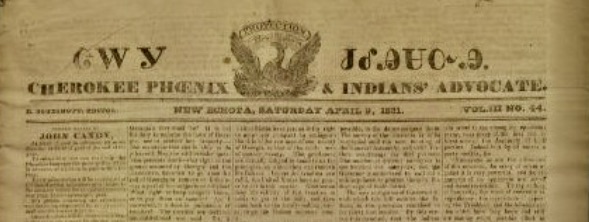
In 1828, a Christian missionary named Samuel Worcester obtained a printing press. He and a Cherokee named Oowatie established a newspaper called the Cherokee Phoenix. It was first published on February 21,1828 in New Echota, capital of the Cherokee Nation in present-day Georgia. This was the first bilingual newspaper in U.S. history. 

Front page of the Cherokee Phoenix newspaper, in English and Cherokee (Public Domain)

During his ministry, Samuel Worcester used the syllabary to translate the Bible. He became an active champion for Cherokee rights, and they honored him with the Cherokee name, A-tse-nu-tsi, which means “messenger.”

Trail of Tears:

The Trail of Tears, painted by Robert Lindneux, 1942

The Cherokee Phoenix, along with personal written messages, helped the Cherokee Nation to retain a measure of cultural solidarity during the forced migration caused by the Indian Removal Act of 1830. They lost their land, their homes, and many lost their lives as they migrated along the Arkansas River, on what became known as the Trail of Tears. But through the use of the syllabary, members of the Cherokee Nation were able to communicate with each other and keep informed, despite their tragic disbursement.  

Sequoyah's Later Life:

During his lifetime, Sequoyah remained faithful to Cherokee traditions and never adopted American clothing or customs. He always focused on what he could do to help the Cherokee Nation. 

In 1842, Sequoyah traveled to Mexico to find any tribal members who had migrated there, in hopes of persuading them to return to the Cherokee Nation. While there, he contracted a severe illness. Sequoyah died in August 1843, near San Fernando, Mexico.

His Legacy:

Sequoyah’s Cherokee syllabary, referred to in the Cherokee language as Tsalagi Gawonihisdi, remains in use to this day. It is seen on street signs and buildings across the Cherokee Nation (located in northeastern Oklahoma). The syllabary is also taught to students in schools and universities in Oklahoma and North Carolina.

The impact of Sequoyah’s syllabary spread to other cultures around the world, influencing them to develop their own syllabaries. This includes the Cree syllabary used by the First Nations people in Canada and syllabaries used in West Africa and China.

Sequoyah's Syllabary, Tennessee State Museum Collection


It is amazing that Sequoyah - a man who spoke only Cherokee and didn’t know how to read or write in any language - singlehandedly developed an effective written language for his people. He had an intuitive talent for understanding language, and he also persevered for twelve years, ignoring ridicule, until he completed this task. 

His syllabary is an accomplishment that greatly helped the Cherokee Nation. Sequoyah's life illustrates that one person’s vision, determination and hard work can make a positive difference in our world.

_________________


Mary Dodge Allen is currently finishing her sequel to Hunt for a Hometown Killer. She's won a Christian Indie Award, an Angel Book Award, and two Royal Palm Literary Awards (Florida Writer's Association). She and her husband live in Central Florida. She is a member of American Christian Fiction Writers and Faith Hope and Love Christian Writers. 


Recent release, anthology devotional: El Jireh, The God Who Provides


Mary's story, entitled: A Mother's Desperate Prayer, describes her struggle with guilt and despair after her young son is badly burned in a kitchen accident. When we are at the end of all we have, El Jireh provides what we need. 

Click the link below to purchase on Amazon:

https://www.amazon.com/El-Jireh-God-Who-Provides/dp/1963611608

Mary's novelHunt for a Hometown Killer won the 2022 Christian Indie Award, First Place - Mystery/Suspense; and the 2022 Angel Book Award - Mystery/Suspense.

Click the link below to buy Hunt for a Hometown Killer at Amazon.com:


Link to Mary's Spotlight Interview:   Mary Dodge Allen Author Spotlight EA Books


Friday, January 5, 2018

The Navajo Long Walk

Growing up in school, I read about the Cherokee Trail of Tears, part of the tragic Indian Removal Act enacted by President Andrew Jackson in the 1830s. But it wasn’t till more recent years that I’ve learned most Native American peoples have their own “Trail of Tears.”

For the Navajo, the largest First Nations people group in the Southwest, it was The Long Walk.

Edward S. Curtis: Navajo child, ca. 1904, Public Domain
My friend's grandfather was about this age on the Long Walk.
When I started researching my first novel, set at a Navajo mission boarding school in 1911, I had never heard of The Long Walk. The first Navajo friend I interviewed in my research told me about it. For another close friend and mentor of mine, his grandfather experienced it as a six-year-old boy. And the more I learned, the more this piece of history broke my heart.

In 1863, amid the crisis of the American Civil War, the U.S. government decided they were fed up with the Navajo. While the Navajo, or Dine ́, as they call themselves, were never a violent tribe, scattered raiding and disputes between New Mexican settlers and the Navajo were a thorn in the army’s side. And so they decided to put a stop to it once and for all.

Under the leadership of scout and army colonel Kit Carson—who till now had been a friend to Native peoples—the Navajo were systematically persecuted and rounded up. Their cornfields, orchards, homes, and livestock were destroyed, burned to the ground. In the winter of 1863-64, the last resistors were finally driven into Canyon de Chelly, to this day a sacred place to the Navajo and then a fertile valley full of peach orchards and family farms.

The Navajo held out long, bunkered in the canyon walls. But the soldiers destroyed their food sources and hogans and filled their water holes with stones. The Dine ́ were hungry, cold, and starving. At last, in January of 1864, various groups of Navajo began to surrender to Kit Carson in hopes of saving their families.
By Mario1952 - derived from [1], CC BY-SA 3.0,
Wikimedia Commons

In several groups, between 8,000 and 10,000 Navajo were marched up from Fort Defiance, Arizona, roughly 400 miles through bitter cold and snow to Fort Sumner in eastern New Mexico. Hundreds of people sickened and died along the way, from exposure, sickness, or improper food, since the Navajo were unfamiliar with the provisions given, like white flour and coffee. The flour they mixed with water and drank, the coffee beans they tried to cook like pinto beans, leading to caffeine poisoning.
Those who couldn’t keep up along the way were left to die or shot in the snow…the old, the young, the infirm, even pregnant mothers.

When they finally reached the camp at Fort Sumner, called Bosque Redondo—or Hweeldi by the Navajo—it was more a prison than a reservation. The water from the Pecos River was bad, and while the army hoped to turn the Navajo into Anglicized farmers, the corn they planted would not grow. Firewood was in short supply, and the land was arid. Up to 2,000 more Dine ́ died at the camp.

Navajo Prisoners from the Long Walk, Public Domain, Wikimedia Commons
Nearly five years after Carson’s campaign began, however, the few hundred Navajo who had managed to escape the Long Walk, under their leader Barboncito, managed to negotiate a treaty—according to one Navajo source, through a shooting contest betting that a skilled Navajo warrior could hit a tiny leather target placed high in a cottonwood tree.

The Treaty of 1868 at last released the Dine ́ people from Bosque Redondo and allowed them to go back to a portion of their original land, making them one of very few tribes ever allowed to return to their own land. When they came in sight of the first of their four sacred mountains, the Navajo wept. They had suffered much, but at last they could begin to rebuild, though the pain of The Long Walk left wounds that still remain today.

Have you ever heard of The Long Walk before? What about similar stories for other Native peoples? Which part of this story struck you most? I’d love to hear your thoughts!
 

Kiersti Giron holds a life-long passion for history and historical fiction. She loves to write stories that show the intersection of past and present, explore relationships that bridge cultural divides, and probe the healing Jesus can bring out of brokenness. Kiersti has been published in several magazines and won the 2013 ACFW Genesis Award - Historical for her novel manuscript Beneath a Turquoise Sky. A high school teacher and member of American Christian Fiction Writers, Kiersti loves learning and growing with other writers penning God's story into theirs, as well as blogging at www.kierstigiron.com. She lives in California with her wonderful husband, Anthony.

Saturday, October 19, 2013

THE TEXAS CHEROKEES


By Laurie Kingery


O si yo, as they say in the Cherokee language, or hello. Those at all familiar with Texas history in the 1800's know of the Comanches, that fierce band of Plains Indians who reacted to white encroachment on their hunting grounds by raiding the settlements and murdering or kidnapping white settlers. But I thought it would be interesting to do a series on some of the lesser-known Indian tribes in Texas. I will begin with the Cherokee, for whom I have a soft spot since I am part Cherokee myself, about one sixteenth, if I remember my Texas family history correctly.


      The Cherokees were one of the so-called "Five Civilized Tribes" who had begun to adopt white ways of dress and living, including the same types of houses whites lived in and the keeping of slaves. They had their own government, an 86-character alphabet (thanks to the famous Cherokee Sequoyah), and newspaper. The men dressed very colorfully with turbans and wide waist sashes over their American-style clothing, and Christianity was widely accepted.


White settlers wanted their land, however, and when gold was discovered at the edge of Cherokee land, their fate was sealed, with President Andrew Jackson's help, despite their having helped defeat the British and Creek Indians in the War of 1812. After they were moved off their lands, the graves of those Cherokees who had died previously were robbed, after they were rumored to contain treasure.
     The Cherokees who came to Texas, though, did so before the Indian Removal Act led to the forced migration of the Cherokees to Oklahoma via the infamous Trail of Tears. A quarter of the 16,000 removed died.
     The Cherokees that I'm most likely related to followed Chief John Bowles, a Chickamauga, to first Missouri, then Arkansas, and finally east Texas in about 1812-1819, where they displaced the Caddoan tribe which had decreased in population thanks to exposure to European diseases.


     But they were never left in peace for long in Texas, either. Segments of the Texas colonial population, when Texas was still part of Mexico, and Mexico itself, frequently tried to use the Cherokees against Stephen Austin and his settlers and later against the United States, after Texas became a state. It wasn't long before the white settlers decided they wanted the Texas land the Cherokees had settled on, too, and the Cherokees were pushed farther and farther toward the plains where the warlike Comanche lived. Chief Bowles was even sent to try to make peace with the Comanches.
      The Texas Cherokees' great ally was Sam Houston, the first president of independent Texas, because he had lived among them. The second president, Lamar, however, hated all Indians including the Cherokee. When Mexico tried to use the Cherokees against the Texans, the Cherokees refused, but Texans didn't believe they weren't allies and instituted an act to remove them from Texas. In a battle in 1839 Chief Bowles and many other Cherokees were killed. Others fled to Mexico, where they were persecuted to an even worse degree. They returned to Texas at Birds Fort, and signed their last treaty in 1843, and were removed to Oklahoma, to join the eastern band of the Cherokee who had been there since the Trail of Tears.
       Just as when the eastern band was removed from Georgia and Tennessee, however, some Cherokee hid in Texas, many of them marrying whites, as my ancestor did, or passing as white. There were several Cherokees who fought with the Confederate States of America, most notably Brigadier General Stand Watie. 


        I hope you've enjoyed this greatly condensed history of the Texas Cherokees. Until next month, Do na da' go hv i (goodbye)!
                        Blessings, Laurie Kingery