Showing posts with label Travel in the Late 1800s. Show all posts

Saturday, February 15, 2014

The Chunky Creek Train Wreck of 1863, Hickory, MS

The Chunky Creek Train Wreck of 1863 happened during the American Civil War near the town of Hickory, Mississippi on the Chunky River. On February 19, 1863 the Mississippi Southern train left the Meridian, MS depot at 3:00 am to transport Confederate soldiers to the Battle of Vicksburg. Several civilians were also on board bringing the total number of passengers to around 100.


The engineer was under strict orders to get to Vicksburg as quickly as possible, and the soldiers themselves were eager to get to the battlefield.
But they never made it.
Instead, they barreled toward the Chunky Creek, thirty-five miles west of Meridian, toward certain death.
In an article detailing the tragedy, Greg Boggan describes the scene, “The continued flooding caused by winter rains had weakened the bridges significantly. A train had crossed the west Chunky bridge the day before, but only after all passengers were removed from the train. Debris continued to build up from the flood, and the bridge trestle had shifted by several inches due to the weight of the debris.”
According to Mr. Boggan, the bridge had shifted as much as six inches out of alignment with the tracks. Workers had made a futile attempt to repair the damage, but didn’t have enough crew and resources to get it done before the next train was due.
An elderly man had been placed in the Chunky hills with a lantern to stop the train, and a pole had been erected about 100 feet from the bridge--a common warning system employed at the time. No one knows why the engineer failed to heed these warnings, but regardless of every effort, the train continued on through the night toward its tragic destination.
The engine ran off the track as it hit the bridge, plunging into the ice-cold flood waters. The boxcars, loaded with passengers and cargo, followed like a string of dominoes crashing against each other.
A reporter later described the scene, “The wreck presented a frightful experience. The engine is out of sight in deep water, with the box cars crushed to pieces, lying directly upon it, portions of which are now above water, while three more, laden with barrels and boxes, in the stream, are piled up in confusion. Confounded.”
Many of the passengers were trapped in the wreckage or killed on impact, while the icy waters of the flooded creek swept others up and away.
Help for the survivors came quickly, but even then it was too late for over 40 Confederate soldiers and civilians. The First Battalion of Choctaw Indians, under the command of Major S. G. Spann, was based at a Confederate military training camp near the crash scene. Led by Jack Amos and Elder Williams, these brave soldiers rushed to the scene and plunged into the flooded creek, rescuing many who would have perished had they not performed such heroic acts.

Jack Amos, Pvt of the First Choctaw Battalion
in MS,CSA in 1905 at age 77
As soon as it was day, rescuers began the gruesome task of recovering bodies and cargo from the swollen stream, and a first attempt at righting the engine was made. History says that over $80,000 was recovered from the baggage of W. P. Grayson, a paymaster for the Confederate government out of New Orleans. Mr. Grayson perished in the tragedy.

On April 28, 2003, the Sons of the Confederate Veterans placed a wreath at the site of the Chunky Creek Train Wreck in observance of Confederate Memorial Day. As part of the ceremony, the names of identified soldiers and civilians were read.


Claiming Mariah
released February 1st!

It's available in bookstores and from online retailers,
and has been seen roaming around at
Wal-Mart.

Too fun!! :)

If you spot a copy out in the wild, I'd love for you to shoot
me a message (via facebook or my website) with location and a picture.

Tyndale is giving away FIVE copies of
Claiming Mariah. Ends 2/28


---
Pam Hillman was born and raised on a dairy farm in Mississippi and spent her teenage years perched on the seat of a tractor raking hay. In those days, her daddy couldn’t afford two cab tractors with air conditioning and a radio, so Pam drove the Allis Chalmers 110. Even when her daddy asked her if she wanted to bale hay, she told him she didn’t mind raking. Raking hay doesn’t take much thought so Pam spent her time working on her tan and making up stories in her head. Now, that’s the kind of life every girl should dream of! Claiming Mariah is her second novel. 

Monday, August 26, 2013

Chapel Cars

Hi!  Winnie Griggs here.
As I was researching circuit preachers for a minor story thread in one of my books I came across an interesting little rabbit trail I couldn't resist pursuing.  The tidbit referenced a very unique tool utilized by clergy and other missionary-minded folk who were attempting to do their own brand of ‘taming the west’ - namely Chapel Cars.

These utilitarian traveling churches were constructed inside modified railroad cars.  They rode the rails from town to town, parking on sidings for as long as they were needed, then moving on to the next stop.  Space was set aside for very modest living quarters for the missionary and perhaps his wife.  The rest of the space was utilized for church services.

They were furnished with pews, a lectern, an altar table and in some cases an organ.  Depending on size and construction, they could accommodate 70+ people.  The Chapel Car served as a home, church, Sunday School, social hall, library and meeting place.  They carried bibles and tracts to be distributed all along the lines.  The missionary and his wife, in addition to their usual ministerial duties, were expected to function as singer, musician, janitor and cook.  They helped organize permanent churches, including raising the necessary funds and helping to construct the buildings.


The idea of the chapel card was not original to the U.S - they had existed in Europe for some time.  The first Chapel Car in the America was commissioned by Reverend William Walker, the Missionary Bishop of North Dakota.  The task of ministering to the people in such a vast and sparsely populated territory was a daunting one.  That, and the fact that many towns didn’t have the funds, or any certainty of permanence, to invest in a building, and it seemed a better solution had to be found.  Having knowledge of the chapel cars used in England, Bishop Walker decided that would be a workable solution to his challenge.

These Chapel Cars traveled throughout the West and Midwest.  They visited mining towns and logging camps, tent cities and fledgling towns, bringing their gospel message and the reminder of civilization to people who had seen neither for a long time - if ever. 


And their appearance was surprisingly well received in these wild and lawless places more often than not - especially by the ladies of the area.  The arrival of a Chapel Cars signaled not just the chance to attend Sunday services, but the arrival of someone to perform weddings, funerals, baptisms.  It also provided a welcome excuse for social gatherings.  In addition, many a rough and tough cowboy who would have balked at attending a traditional church, seemed to feel differently about these side rail services.  In fact, the very novelty of the Chapel Car brought folks from miles around just to have a look.

Of course, they didn’t always receive a warm welcome.  There were instances of Chapel Cars being pelted with eggs and refuse, defaced with graffiti and even set on fire.  But these were rare instances and the cars and their custodians survived to continue their mission.

In actuality, the peace-minded missionaries who rode the rails played a larger part in bringing peace to the lawless west than any gun-toting lawman or vigilante.  They traveled in their mobile churches to remote areas of the country, bringing spiritual direction and a civilizing influence to people who were starved for something to offset the violence and loneliness of their existence. 

Chapel cars remained in use on into the early twentieth century.  With the advent of World War I, however, the railroad tracks had to be kept clear for troop movement.  In addition, new regulations prohibited the railroad companies from giving ‘free rides’ to the Chapel Cars, something that had been common practice up until then.  And as paved roads and automobiles became more common it was easier for people to travel on their own to attend church.  Thus, the Chapel Cars that had brought their spiritual message and civilizing influence to the rough and tumble west faded into history.

So, where is the most memorable place where you have attended a church service and what was it about it that made it memorable?


Friday, June 28, 2013

Tidbits About Palatka, FL.

I live about 23 miles from Palatka, FL. in a small country town. I would drive to and from this town on many occasions, primarily because of the shopping available there that isn’t available in my town. Oddly enough I never gave Palatka much thought with regard to its history until I decided to set a story there. Here are some unique tidbits about the rich history of Palatka:
     •At one time Palatka was larger than Jacksonville, FL.
     •Founded in 1821 with a Spanish Treaty to James Marver and two companions, Hine & Woodruff. (I’m assuming these are last names but you can’t be too sure.)
     •A cypress lumberyard was the second largest sawmill producer
     •Major hub for supplies going in and out of Florida.
     •Known as an area for healing for northerners to come in winter months.
     •Had a major fire burn through a lot of the downtown area in 1884.

What made Palatka unique was the St. John’s River which runs from Jacksonville all the way down to the St. John’s Marsh west of Melbourne & Palm Bay, FL. The entire length of the river is 310 miles. At Palatka the deep water ends, and south of Palatka the steamboats could travel, although the large shipping schooners could not. This set Palatka apart as the perfect port for all commerce on the River. In 1880 people could travel from South Carolina or Savannah, GA to Palatka with a round trip ticket for $20. Others traveled from as far away as Boston and New York for their winter vacations. The northern schooners would bring Ice down to Palatka where it would be stored in one of the icehouses for use by the residents. In earlier days, similar to the early railroad days out west, travelers on the steamboats would shoot at the wildlife on shore. This soon became a problem when some passengers on other boats were accidentally shot. The practice was banned.
The railroad came through during the later part of the 19th century, forever changing the shipping industry. Other industries in Palatka were cattle, lumber, ship building, turpentine making, orange groves and tourism.


<--The Putnam House and other hotels provided the travelers with beds. However, in several of the publications I’ve read about the area you find complaints that there were not enough rooms. The streets were wide, and orange and lemon trees lined the major roadways.


Below are some pictures from various historical books of Palatka during the 19th Century.


The Arlinton Hotel 1880's


The Sarasota Inn 1911


Schooners at Palatka both of these are ships from New England


As a comparison of further down the St. John's you see the steamboat and how much narrower the river is.


Colonel Hart's Garden's Entrance: Showing the length of the dock as well as the palm trees and spanish moss hanging from the trees.


My give away for this month will be a copy of Key West as well as entering your name for a drawing in the fall for my next book, Courting Holly. Enter by leaving a comment and your email address for notification.

If you like historical tidbits you might like to visit my blog 19th Century Historical Tidbits. You can also follow me on twitter @LynnColeman or you can friend me on Facebook. "Courting Holly" is scheduled to be released in Oct. 2013.

In His grip,
Lynn

Friday, April 5, 2013

TRAVEL IN THE LATE 1800S - Lena Nelson Dooley

Last month I shared a lot of information with you about Oregon City and Portland, and when I did, I shared about the horse- and mule-drawn trolleys that connected the two cities before the electric trolleys did. As I researched for my three book series, I did research about various kinds of transportation to use in my books.

Since the heroines were born on one of the last wagon trains on the Oregon Trail, I did quite a bit of research about wagon trains. My wagon train was in 1867, near the last of the wagon trains across that trail. Since many trains had passed over the trail, experienced wagon masters knew they had options. Often the man might plan on going one way, but because of circumstances, he took his train on one of the other ways to get to the destination--Oregon Territory or State, according to the date.

The main route used by those on the Oregon Trail went by way of the Dalles. Fur trappers first used this term, which means gutter, for floating down the Columbia River on rafts. This part of the trip was treacherous because of the rocks and rapids they encountered. Later the Barlow Cutoff was a toll road that took the wagon around Mount Hood. Although it was much safer, it also took quite a bit longer.

In my McKenna's Daughters books, I had the wagon train use the Barlow Cutoff, because Lenora McKenna was bedridden in their wagon because of her pregnancy, and the wagon master didn't want to endanger her life more than it already was.

Most wagon trains on the Oregon Trail arrived in Ft. Vancouver, Oregon. However, those using the Barlow Cutoff arrived in Oregon City.

For book one of my series, I had to do a lot of research about railroads. My hero, heroine, and her aunt traveled from Seattle, Washington Territory, to Little Rock, Arkansas. They had to travel south to far northern California, then take another train east. That train took them through several states, over the Continental Divide with a stop in Denver, then on to St. Louis, Missouri. From St. Louis, they took another train southwest to arrive in Little Rock. Researching every stop along the way was interesting as was the way railroads were during that time. I used many tidbits I found to make the trip more interesting.

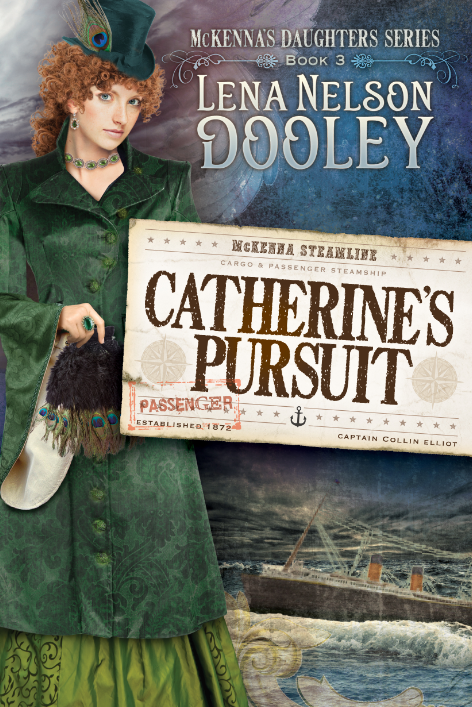
With book three of the series, the heroine's father owns a steamship line. Of course on land, they mostly traveled by train, but the trip back from Seattle to San Francisco was by steamship, and this trip was pivotal to the story. You can find out a lot about the steamships of the time in this book.

I was thrilled when my publisher's graphic department tied the covers together with pictures of modes of transportation: a train on Maggie's Journey


a trolley on Mary's Blessing,


and a steamship on Catherine's Pursuit.


What is your favorite form of long-distance transportation?