Showing posts with label Women Athletes. Show all posts

Thursday, June 13, 2024

Running for Gold: The “Babe” who made a great comeback

As the summer Olympics approach this year, it’s appropriate to remember “Babe” Didrikson Zaharias, who won 3 medals, the maximum for women, in the 1932 Los Angeles Olympics. She later went on to co-found the Ladies Professional Golf Association, and she never shied away from controversy.

Mildred Ella Didriksen was born in Port Arthur, Texas, in 1911. She later changed the ending of the family name to “son” and she embraced the nickname of “Babe” after she was compared to the great Babe Ruth.

Why is she considered such a great athlete?

Even as a young girl, Babe excelled in sports. The family had moved to Beaumont, Texas, where she played basketball, tennis, and golf while in high school. Her ability caught the attention of a Dallas insurance company’s basketball coach. In those days, businesses often fielded various semi-professional sports teams.

With five children, the family struggled financially and, since Babe struggled with math and was an average student, she left school early to do clerical work for the Employers Casualty Insurance Company. She competed on the company’s basketball, baseball, and track and field teams, which dominated the other 48 Texas company teams.

Photo: Colorado Women's Hall of Fame

Babe won five events and set several world records during the U.S. qualifying competition for the 1932 Olympics in Los Angeles. At that time, women could compete in no more than three Olympic events. She received a gold medal for her world-record javelin throw. The next day, she broke her own world record in the 80-meter hurdle, winning another gold medal. She tied for first in the high-jump, but the judges disqualified her technique and awarded her the silver medal instead.

Following the Olympics, Babe sought to earn a living as an athlete, and even pitched four innings for three different major league baseball teams during spring training of 1934.

But opportunities were limited for women in sports at that time. She decided on golf and began to play in men’s tournaments. She became popular for her long, powerful drives and off-color banter with the fans. Socialites, and sometimes even the media, frowned on her unorthodox behavior on the golf course. One biographer said, “She was criticized for her look; she was criticized for not being ladylike enough. There were comments made in the press, that she should be home sitting by the phone, waiting for a suitor to call her as opposed to being out competing. It was very harsh, negative, critical things. And they hurt her deeply.”

Photo: Associated Press

However, her friends said Babe cared more about winning than what people thought of her. She was known for arriving at the golf course and announcing, “The Babe is here! Who is going to finish second?”

She met George Zaharias, a professional wrestler, during the 1938 Los Angeles Open, and they married in December that year. He gave up wrestling and became Babe’s manager.

In 1949, she joined with several other women golfers to form the Ladies Professional Golf Association (LPGA). While Patty Berg served as president the first year, Zaharias became president the next year and held the position for the remainder of her life.

During her career, she won 82 tournaments, including 17 of 18 she entered in 1946-47. In 1950, the Associated Press voted her the Woman Athlete of the Half-Century. By that time, she reportedly was earning $100,000 (about $1 million in today’s dollars) annually from tournaments and endorsements.

Photos: Associated Press

She excelled in other sports, too, including swimming, football (at halfback), billiards, tumbling, boxing, wrestling, fencing, weight lifting, and adagio dancing, according to Time magazine, as well as tennis, diving, roller-skating, and bowling, according to other sources.

Undoubtedly, Zaharias played a major role in the acceptance and rise of women’s golf. But perhaps her greatest achievement was winning her third U.S. Women’s Open championship in Salem, Massachusetts in 1954, about 18 months after colon cancer surgery. She played 36 holes on the last day of the tournament while wearing a colostomy bag strapped to her leg, and won by 12 strokes. A Telenews announcer called it “one of the most inspiring comebacks in all of sports history.”

The cancer had already spread to her lymph nodes, though Babe did not know it at that time. She died less than 3 years later, on September 26, 1957. The following day, then-President Dwight D. Eisenhower opened a press conference by paying respects to “Mrs. Zaharias, Babe Didrikson. She was a woman who, in her athletic career, certainly won the admiration of every person in the United States, all sports people over the world, and in her gallant fight against cancer she put up the kind of fight that inspired us all. I think that every one of us feels sad that finally she had to lose this last one of all her battles.”

At the turn of the century, Associated Press and Sports Illustrated named Babe Zaharias the top female athlete of the entire 20th Century. Because she was so proficient in so many sports, some have called her the “greatest athlete, male or female, who ever lived.”

Her legacy lives on through the LPGA, through every woman who challenges accepted norms in sports or other pursuits, and through every person who faces cancer with courage and refuses to give up.

Sources:

The Triumph Of Her Life (usga.org)
Babe Didrikson Zaharias: The ‘greatest all-sport athlete’ who helped revolutionize women’s golf | CNN

Multi-award-winning author Marie Wells Coutu finds beauty in surprising places, like undiscovered treasures, old houses, and gnarly trees. After a career writing for newspapers, magazines, state and local governments, and the Billy Graham Evangelistic Association, she returned to her first love—writing fiction—in her fifties. All three books in her Mended Vessels series, contemporary stories based on the lives of biblical women, have won awards in multiple contests. She is currently working on historical romances set in her native western Kentucky in the 1930s and ‘40s. Her historical short story, “All That Glistens,” was included in the 2023 Saturday Evening Post Great American Fiction collection.

Another historical short story tells of a cafe waitress who waits for the love of her life to come back to her after the war. “A Song for Annie” is available free when you sign up for Marie's newsletter here. In her newsletter, she shares about her writing, historical tidbits, recommended books, and sometimes recipes.

Sunday, September 4, 2022

Gertrude Ederle - The First Woman to Swim the English Channel

 By Mary Dodge Allen


Gertrude Ederle (Public Domain)

In 1925, nobody believed a woman could swim the treacherous and stormy English Channel. At that time, only five men had accomplished this feat:

1875 – Matthew Webb; 21 hours, 45 minutes

1911 – Bill Burgess; 21 hours, 35 minutes

1923 – (August) Henry Sullivan, 26 hours, 50 minutes

1923 – (August) Enrique Tiraboschi, 16 hours, 33 minutes

1923 – (September) Charles Toth, 16 hours, 54 minutes


Enter... Gertrude Caroline Ederle:

She was born on October 23, 1905, the third of six children. Her parents Anna and Henry Ederle were German immigrants. Her father, a Manhattan butcher, purchased a summer cottage at the Jersey shore, where Gertrude learned to swim. When she became a member of the Women’s Swimming Association as a young teenager, she learned a streamlined, eight-beat version of freestyle swimming called the American crawl (based on the original Australian crawl). 

From 1921 to 1925, Gertrude set 29 U.S. and world amateur records for swimming. In 1922, she set seven records in a single day at Brighton Beach, New York.

Gertrude at swim practice (Public Domain)

In the 1924 Paris Olympics, Gertrude won a gold medal as part of the 400-meter freestyle relay team, and she won two bronze medals in the individual 100-meter and 400-meter freestyle events. She had been favored to win gold medals in these individual events, and the bronze medals were a disappointment. But Gertrude had won these medals while swimming with an injured knee, and she and the other U.S. women athletes were also suffering from fatigue, after traveling six hours each way to the Olympic event center for daily practice sessions and events. The U.S. officials had housed them in hotels far from the city because they didn’t want the women corrupted by the bohemian lifestyle in central Paris.

While at the Paris Olympics in 1924, Gertrude was inspired to swim the English Channel. She began an intensive training program with swim coach Jabez Wolffe, who had made 22 previous attempts to swim the channel. In June 1925 she was the first woman to swim from Manhattan’s Battery Park to Sandy Hook, New Jersey in 7 hours, 11 minutes, breaking the men’s record.


Gertrude practice swimming in the English Channel (Getty Images)


In August 1925 at the age of 19, Gertrude Ederle attempted to swim the English Channel. But after swimming 23 miles in 8 hours and 46 minutes, Gertrude was hastily retrieved from the water because her swim coach Wolffe, who was in the support boat accompanying her, was afraid she was drowning in the large swells. Gertrude was livid when her attempt was cut short. She insisted she had simply been resting while floating in the waves.

Gertrude was determined to try again. She began training with a new swim coach – Bill Burgess, who had successfully completed the channel swim in 1911.


Gertrude beginning her second English Channel swim (Getty Images)


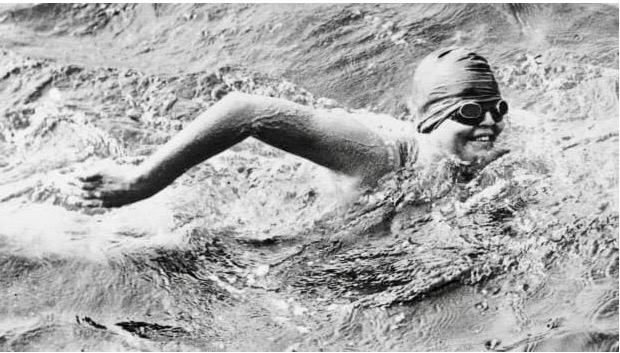
On August 6, 1926 at 7:08 a.m. Gertrude entered the English Channel at Cape Gris-Nez, France. She was now 20 years old, and much better prepared for the swim. In her first attempt, she had worn the traditional heavy wool one-piece bathing suit, which dragged in the water and rubbed against her skin. This time, she wore a lightweight, yet modest two-piece suit that she had designed with the help of her sister Meg. Gertrude donned motorcycle goggles to keep salt water out of her eyes and pulled a snug pink swim cap over her hair. She also slathered her body with sheep grease to insulate her body from the frigid water and protect her skin from jellyfish stings. Small craft warnings had been posted that morning, and the channel surface looked choppy. Gertrude prayed, “Please, God, help me.”

A number of family, friends and a few select reporters rode in the support boat alongside her, including her father Henry, her sister Meg and her coach Bill Burgess. The boat was stocked with soup, chicken legs and oranges to sustain her while swimming. A second boat also followed her, packed with other reporters.

Wireless machines on the boats allowed reporters to send frequent updates on her progress. It was an early ‘play-by-play’ athletic event.

As an incentive, Gertrude’s father had promised her a brand-new red roadster if she completed the swim. While she was swimming, people in her support boat held up encouraging signs like, “One wheel” or “Two wheels” to indicate how close she was getting to winning the roadster. Gertrude often sang, “Let Me Call You Sweetheart” with the beat of her swimming strokes, to maintain her pace.

During the twelfth hour of her swim, the channel’s unfavorable winds grew stronger, stirring up the waves. Bill Burgess feared for her safety. When he urged Gertrude to come out, she shouted back, “What for?” and kept on swimming.

By 9:00 p.m., lights from the boats accompanying her became visible from the English shoreline. As Gertrude swam toward Kingsdown, England, a huge crowd gathered on the beach and built bonfires to guide her. Loud cheers rang out as she finished her swim and walked ashore in the rough surf. She refused all offers of assistance from people who had waded out to meet her, even though she was exhausted, and her face was swollen and bruised from the battering of rough waves. As the crowd continued cheering, a British immigration officer met Gertrude on shore and requested her passport... with a grin.

Gertrude had completed the swim in 14 hours, 31 minutes! She was the first woman to swim the English Channel, and she’d also beaten the previous record by over two hours!

Gertrude was later quoted as saying, “I knew it could be done, it had to be done, and I did it.” Her accomplishment made a lasting contribution to women’s athletics. The next four swimmers who successfully completed the channel swim were all women. Gertrude’s record time wasn’t broken until twenty-five years later, when Winnie Roach-Leuszler beat her by an hour in 1951. 


Henry Ederle gave his daughter "Gertie" a new red roadster, as promised (Getty Images)


Gertrude Ederle's ticker-tape parade, New York City (Public Domain)


Gertrude was welcomed back to New York City, where she was given a huge ticker-tape parade on August 27, 1926. Calvin Coolidge later invited her to the White House and called her “America’s best girl.” The press treated her like a celebrity, and marriage proposals arrived in the mail every day.

But Gertrude’s fame was soon overshadowed by Charles Lindberg in May 1927, when he became the first person to fly an airplane across the Atlantic Ocean. 


Gertrude Ederle joined a touring vaudeville act and even made a short Hollywood movie about herself. But after a few years, she quit the vaudeville tour because she was going deaf. She had suffered a hearing loss at the age of five after contracting measles, and swimming in the salt water of the English Channel had worsened her hearing. Then in 1933, Gertrude was severely injured when she fell down a stairway in her apartment building. Her back was in a cast for four years. But by 1939, she had recovered enough to appear in Billy Rose’s Aquacade at the New York World’s Fair.

Despite receiving many marriage proposals, Gertrude remained single. She had one romance which almost resulted in an engagement, but the relationship fell apart because of her increasing deafness. For many years in her later life, she taught children’s swimming lessons at the Lexington School for the Deaf in New York. She died on November 30, 2003 at the age of 98.

Gertrude was regularly interviewed by the press on the anniversaries of her record-breaking channel swim. In one of her later interviews, she said, “I have no complaints. I am comfortable and satisfied. I am not a person who reaches for the moon as long as I have the stars.”


Gertrude Ederle's grave, Woodlawn Cemetery, New York City (Public Domain)

_____________

Mary Dodge Allen is the winner of the 2022 Christian Indie Award from the Christian Indie Publisher's Association, and two Royal Palm Literary Awards from the Florida Writer's Association. She and her husband live in Central Florida, where she has served as a volunteer with the local police department. Her childhood in Minnesota, land of 10,000 lakes, sparked her lifelong love of the outdoors. She has worked as a Teacher, Counselor and Social Worker. Her quirky sense of humor is energized by a passion for coffee and chocolate. She is a member of the Florida Writer's Association, American Christian Fiction Writers and Faith Hope and Love Christian Writers. 

Website: www.marydodgeallen.com

Mary's recent novel: Hunt for a Hometown Killer won the 2022 Christian Indie Awards, First Place - Mystery/Suspense.


Click to buy Hunt for a Hometown Killer at Amazon.com:

Link to Mary's Podcast on Sarah Hamaker's show: "The Romantic Side of Suspense"