Showing posts with label Women's Land Army. Show all posts

Tuesday, March 29, 2022

Who Will Raise the Food? ~Farming During WWII~


In the American Midwest, on a spring day in 1944, farmers’ regular concerns were in motion. Would the ground be too wet to till? When would be the best time to sow? How would the crops fare in the coming season? Those were no different than the questions farmers asked themselves every year. But in the spring of ‘44 there were new considerations. Would there be enough manpower to handle all the work needing to be done? With so many men away in service to the country (more than two million leaving their agricultural jobs between 1940-1942), who would run the equipment, do the planting, harvest the crops, man the canning factories? Could America supply enough food for her troops and their allies, not to mention everyone at home? How would those left behind manage it all with labor shortages at every level?

Well, our position isn’t too different now. Throughout my lifetime and probably yours too, we’ve seen the demise of thousands of small farms. Large farms also struggle with everything from governmental regulation to supply and mechanical issues. All this along with those age-old questions topped by how will the crops fare in the coming season? Will stock farmers have hay enough to feed their herds, or will drought or flood ruin the crop? Will fertilizer be available to raise crops? Will there be delays in transportation that could ruin a harvest?

Some things we just can’t predict. But in 1944, Americans learned ways to deal with the unknowns and changes brought on by international crisis. In large part, it began with the lady farmers. While women had long been working beside their husbands, sons, and fathers in fields and barns across America, now they took on the roles of total operation. There were even classes to help them learn how to take on their new line of work.

Women's Land Army School
Paus, Herbert Andrew, 1880-1946 artist
Image from Wikipedia
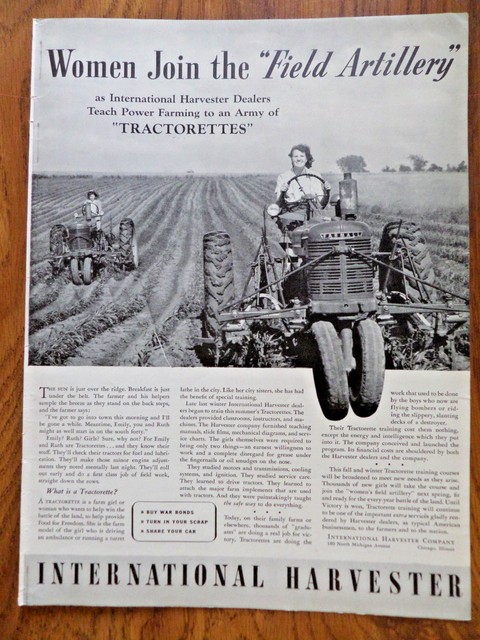
A 1942 article from LIFE magazine titled “Women Join the ‘Field Artillery’ as International Harvest Dealers Teach Power Farming to an Army of ‘Tractorettes’” explained how the Harvester equipment company was helping girls learn to run equipment and manage farm work for themselves. Through a supply of manuals, slide films, mechanical diagrams, and service charts, the ladies learned to drive tractors, service the internal working parts of just about any piece of farm machinery, attach implements, and farm with confidence toward victory.


A promotional advertisement from the International Harvester company on becoming a "tractorette" in the women's "field artillery".

In Iowa in 1944, 4-H clubs declared themselves a “Victory Army”. Youngsters aged 12 to 20 signed Victory Pledge cards with the slogan, “Feed a fighter or more in forty-four.” That year the largest 4-H exposition ever was held in the state, with a program entirely devoted to war production. One thousand boys and girls attended.

Women and youngsters took over other roles as well. We’ve all heard the "Rosie the Riveter" stories, but many farm wives and daughters took jobs in state canneries as well. In the meantime, they continued with regular housework and “putting by” for their own home consumption. These hardworking gals weren’t afraid to roll up their sleeves, get grime under their fingernails and grease smudges on their chins, and get the job done—whatever the work might entail.

One woman described her farm day as rising at 6:30 a.m. after burning the midnight oil. She always did her ironing, patching, and mending at night. Sometimes that was also when she’d accomplish her sewing—making the children’s clothing as well as her own house dresses and slacks. She canned vegetables in the morning when they were fresh (picking them first thing), but she put up fruit at night, which didn’t seem to make much difference. This woman said she planned to put up 500 quarts of food that summer.

Now, I am a canner and gardener. I’ve had years where I’ve done 200 quarts, and let me tell you—THAT was work. 500 quarts
along with milking the cows, sewing the clothes, plowing the field, hanging the wash, and everything else? I can’t even imagine.

Bear in mind that the farmers didn’t only have to till, sow, and reap their harvests. They also had to get them to market. In my novel coming out next June called Season of My Enemy, this involved hauling load after load of peas to the “viners”, all in a very timely fashion. Later it was corn to the canneries. For a dairy farmer it was getting their milk to the dairy.

Next month I’ll write more about labor during the war years. I’ll explain about one of the means Americans came by to accomplish this monumental task. Here’s a spoiler on that future post in this back cover copy for Season of My Enemy, which is available for pre-order:


The realities of WWII come to a Wisconsin farm bringing hope and danger.

Only last year, Fannie O'Brien's future shone bright, despite the war pounding Europe. With her father's sudden death and her brothers overseas, Fannie must now do the work of three men on their 200-acre Wisconsin farm—until eight German prisoners arrive as laborers and, just as Fannie feared, trouble comes too.

Captain Wolfgang Klonginger is relieved that his boys are off the warfront, keeping busy working the O'Brien farm, until they can all go home again and he can return to his teaching position in Berlin.

Crops take precedence, even as "accidents" happen around the farm. Could a saboteur be among them? Fannie is especially leery of the handsome German captain who seems intent on cracking her defenses. Can she manage the farm and hold her family together through these turbulent times, all while keeping the prisoners—and her heart—in line?


Naomi writes historical fiction from a deer farm and hunting preserve in the northern Wisconsin woods. In her free time, she "puts by" from a garden that she's never very successful at downsizing, and she also loves teaching her passel of grandchildren how to enjoy the bounty of the farm. Naomi invites readers to learn more about her books at naomimusch.com and subscribe to her monthly newsletter. Subscribers qualify each month for a giveaway drawing. 

Thursday, March 5, 2020

The Women's Land Army of WWII


Image: Kevsphotos from Pixabay
Shortly after World War II began, the U.S. government realized that in order to feed the country and its troops, rationing would be necessary in addition to promoting the concept of Victory Gardens. What they didn’t realize until nearly halfway through the war, was that food production and harvesting needed to be coordinated in a nation-wide effort.

In 1940, the population of the United States was approximately 132 million people. Across the country there were nearly six million farms that provided food for the nation. However, by 1942 over two million men had left agricultural jobs. By 1943 another four million men were gone from the farms, and the U.S. was now feeding other countries. Combined with gas and rubber rationing that put an end to the use of migrant workers, the agriculture industry was suffering. Badly.

Across the country, there were major concerns about widespread crop loss. As a result, many states and private organizations created programs that trained high schoolers, conscientious objectors, prisoners of war, and interned Japanese-Americans. But these workers were still not enough.

Florence Hall (archives.gov)
Finally, in November 1942 ranking officials in the Department of Agriculture began to move ahead with the creation of a Women’s Land Army. However, it would take another six months of committee meetings before congressional approval of the Emergency Farm Labor Program and the assignment of Senior Home Economist Florence L. Hall as its head, a “temporary” position she held until 1946!

Women were not expected to have farming experience, but applicants had to be physically fit and possess manual dexterity, patience, curiosity, and patriotism. They also had to be at least eighteen years old. Upon completion of their training, the women were assigned to a farm. Some recruits lived at home and participated in day-haul programs, referred to as the “Housewives Specials.” Recruits from distant cities lived in housing provided by the farmer, or in government camps if there were enough workers to qualify for defense housing to be built or requisitioned. In the late spring each year, posters, brochures, and radio advertisements encouraged teachers to work the farms during their summer vacations, and women in other industries to use their two week vacation time to work on the farms.

Photo: archives.gov
Accident and life insurance were also provided, and the women could purchase additional insurance as well as a uniform. The women supplied their own blankets, sheets, towels and clothes. They were also required to make their own beds and wash their own dishes.

When all was said and done, the Women’s Land Army program was considered a great success. Women with little or no agricultural experience saved countless crops from rotting in the fields and provided food to a world at war.


How are your gardening skills?


A Love Not Forgotten: Allison White should be thrilled about her upcoming wedding. The problem? She’s still in love with her fiancĂ©, Chaz, who was declared dead after being shot down over Germany in 1944. Can she put the past behind her and settle down to married life with the kindhearted man who loves her?


Linda Shenton Matchett writes about ordinary people who did extraordinary things in days gone by. A volunteer docent and archivist for the Wright Museum of WWII, Linda is also a trustee for her local public library. She is a native of Baltimore and was born a stone's throw fro Fort McHenry. Linda has lived in historic places all her life, and is now located in central New Hampshire where her favorite activities include exploring historic sites and immersing herself in the imaginary worlds created by other authors. Connect with her: WebsiteFacebookTwitterPinterestGoodreads, or BookBub.