Showing posts with label covered wagon. Show all posts

Tuesday, June 3, 2025

The Great Blue Army Wagon


Welcome back! A bit of a transportation theme threading here on the third of every month. In May, I shared some of the locations in America where private vehicles are not permitted. For this post, instead of discussing cars, trucks, and other fuel driven modes of getting from point A to point B, we travel back to a time with simpler machines.

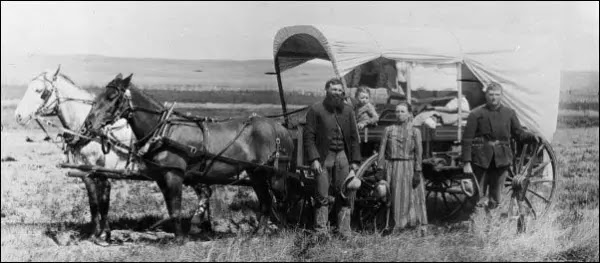
Early American settlers employed this method to traverse the vast land we now call the United States. The western migration predicated the need for a conveyance for not only people, but also the supplies required for such a grueling journey. According to the National Park Service, it is possible that upwards of 500,000 people utilized this means from 1841 to 1869. These brave adventurers were not the only individuals to use the Pioneer Wagon - also known as Covered Wagon or Prairie Schooner. During the Civil War, armies also needed help moving items and men.


Roger Hanson, a volunteer at the Tabor House Museum in Ellijay, Georgia and owner of an authentic wagon shared tidbits about one such example. Trying something new for these posts with short videos. Listen as Roger explains interesting history and features. (Some of the text below features his words; in case the videos are tad sluggish.)


This is a model 1858 Army Wagon. During the Civil War period the north built 70,000 in factories and the south 40,000 - generally based on the same design.

Mules pulled these wagons. After removing the mules, the rectangular attachment on the front tongue served as the feed trough. The empty section of the tongue held the related harnesses.

Studebaker Company created this model. They built 6,000 units during the war, at their factory in South Bend, Indiana.


Not all the wagons offered brakes. This is the actual chain brake, attached through the back wheels. For going up and down hills, the rear wheels remained locked. Basically, they could drag it up and down to give them some control of the wagon when it was heavily loaded. 

This maroon undercarriage, along with the body and bed of the wagon in sky blue are the proper colors. The Army began employing these colors in 1812. There is no documentation explaining why these choices developed. We can surmise their use because the soldiers' uniforms sported these shades at that time.

This main color existed on The Great Blue Army Wagon until 1907. At that juncture the color switched to green.


This is the tailgate for the wagon. The chains held the feed trough while in motion. This allowed the mules and other following animals to eat during stops in route. This allowed the convoy to remain compact.


Notice the case full of wagon grease under the wagon. The wooden bucket is original. Named the Tar Pot, it served all the wagons.


This canvas is called a wagon cover. The manufacturer - J. Clemens & Co., Manufacturers of Tents, Tarpaulins, & Wagon Covers, in St. Louis, Missouri. Does the name sound familiar? Mark Twain's (Samuel Clemens) uncle was the richest man in St. Louis during the war period and after the war.
The box at the front of the wagon held tools. The driver did not ride on the wagon step. Rather he rode a mule and controlled all six mules from the front.

During the Atlanta Campaign, Sherman arrived in Georgia with 4,000 wagons, including 24,000 mules. The Confederates utilized 3,000 of these wagons. This gives an idea of the logistics efforts involved.


Can you imagine the overwhelming task of transporting troops and all they required with carriages pulled by mules? Contrast that scenario with the options afforded by the Armed Forces of today. Night and day.

Have you ever seen a Prairie Schooner or Army Wagon in person? Did you know the Prairie Schooner garnered that name because it seemed as if the covers were gliding across the country as Schooner sails on the ocean. Nifty! Hope you enjoyed these little pieces of the past. Thank you to Roger Hanson for sharing living history with us.


As a child, Rebecca loved to write. She nurtured this skill as an educator and later as an editor for an online magazine. Rebecca then joined the Cru Ministry - NBS2GO/Neighbor Bible Studies 2GO, at its inception. She serves as the YouVersion Content Creator, with over 130 Plans, in 44 languages on the Bible.com app.

Rebecca lives near the mountains with her husband and a rescued dog named Ranger. She is a proud mom of an American soldier and a college senior. If it were up to Rebecca, she would be traveling - right now. First up, trips to see their two grown sons. As a member of ACFW and FHLCW, she tackles the craft of fiction while learning from a host of generous writers.

Connect with Rebecca: Facebook Goodreads Instagram Pinterest X/Twitter

Saturday, May 28, 2022

Traveling in a Covered Wagon – by Donna Schlachter – with Giveaway


From www.homestead.org

Read all the way through for a chance to win a free book!


In last month’s post, we looked at the kinds of wagons that carried families and their goods west, as well as their designs. We saw that the famous Conestoga wagon wasn’t well-suited for the rough travel across the plains and through the mountains. Still, that didn’t stop some folks from trying.

In this post, we’ll slow down a little and take a glimpse inside the typical wagon that traveled west toward California and Oregon from the 1850s and on through even into the 1920s. Not every family could afford to travel by stagecoach or even the train, and so many wagons continued as their only source of transportation.

In planning a trip of this magnitude—thousands of miles, six months or more on the trail—families had to consider what they’d need along the way; what they’d need once they got where they were going; and what they couldn’t bear to leave behind. In many ways, their questions were similar to what we might ask ourselves today if we decided to move halfway across the country. The major difference was the length of time and the difficulty of travel for them as opposed to us.

Food, of course, was a primary concern. A barrel of flour was a must, since most meals included either bread, biscuits, flapjacks, or some other form of starch. Meat was scarce, as were ways to preserve it so it would last the heat and rain of the journey, so most meat was hunted along the way. Beef jerky was often prepared and stored in burlap sacks.

Coffee, sugar, and baking ingredients, such as baking powder, salt, soda, and spices, were carried in smaller leather or paper sacks, often stored in a chest. Honey might be hidden away. A sack of beans was a staple, and if somebody in the wagon knew about healing, ingredients such as mustard for plasters, milk thistle for fever, and other natural ingredients would be vital in case of illness.

Quilts were a common thing to bring, as they would serve as mattress, cover, a bed under the wagon, and even an extra layer of clothing should the weather turn cold. Oilskins were a treasure for driving in the rain.

Depending on the beasts used to draw the wagon, different foodstuffs might be carried, too. For horses, grain in addition to sweet grass grazed along the way helped keep up their stamina. For oxen or mules, they could survive on foraging.
From dustyoldthing.com 
 
An extra wheel, a spare axle, a set of leathers, and if using horses, spare horseshoes would be stowed in boxes attached to the outside of the wagon. A butter churn hung from a hook at the rear tailgate could make butter in a day. Cook pots, including a dutch oven, coffee pot, and a large boiler, aided the wife in preparing meals. Sometimes, though, if weather was rainy or the wagon train was forced to keep moving, the family ate cold leftovers.

Additional tools, such as shovels, hammers, axes, ropes, and grinding stones were carried in a tool box built under the front seat or attached to the outside of the wagon. A bucket holding lard or grease would hang from a peg on the rear axle, and the hubs would be greased to keep them moving easily and not wearing on the wood.

A water barrel hung from the side of the wagon, or perhaps was kept inside, depending on the size of the family and amount of space. Often it was the younger children’s responsibility to fill this barrel at every available stop. The stock was watered first, then the family. Often water had to be rationed, since sometimes days could pass without seeing a river or lake. Bathing and laundry was limited to local water sources.

Clothing was hung from pegs or hooks suspended from the ribs holding up the canvas cover. Some families included large furniture, such as a rolltop desk, parlor chairs, or even an organ. As you can imagine, many of these pieces were discarded along the way.

 
From dustyoldthing.com

Books were often seen in piles along the trail. Folks would pick up a book from one pile, read it along the way, and discard it a hundred miles along the trail. Mothers often used these books to teach their children, a form of homeschooling, as they traveled.

Stories are often told of a family falling ill with cholera, typhoid, measles, smallpox, and the like. In that case, they’d pull out of the wagon train they were currently in and wait by the side of the trail. Once recovered, they’d join the next train along. Sometimes, if they were found to be sick, they’d be abandoned at the muzzle of a rifle. With few remedies, nobody wanted to be around the sick.

Forts and towns along the way often sold goods and supplies to families, so carrying cash was a necessity. Unfortunately, many emigrants were robbed and killed by trail pirates.

As you can see, traveling west took a great deal of planning, strength, and mental acuity. It’s no wonder there are so many graves along the Oregon, Santa Fe, and California trails. Some estimates are as high as an average of one grave per mile.


Question: what would be one thing you would have to take with you if you traveled west in a covered wagon? Leave a comment, and I’ll draw randomly for a print (US only) or ebook copy of Calli.


About Calli:


Calli works as a nurse with the US Army at Fort Bridger, Wyoming in 1880. When a wagon train full of discouraged emigrants passes through on its way east, a pregnant widow delivers her baby then dies. Bradley Wilson, leading this train, has few options. He asks Calli to travel with them until they find a relative to take the child in St. Joe, Missouri. Calli, drawn to both this dark and quiet man and the child, resists. But when she disappears, he wonders if she’s run away or been kidnapped. Can these two put their pasts behind them and move into a new future together? Or will Calli insist on having things her own way?

https://www.amazon.com/Calli-Prairie-Roses-Collection-Book-ebook/dp/B09SD6XPRQ


About Donna:

A hybrid author, Donna writes squeaky clean historical and contemporary suspense. She has been published more than 50 times in books; is a member of several writers groups; facilitates a critique group; teaches writing classes; ghostwrites; edits; and judges in writing contests. She loves history and research, traveling extensively for both.

www.DonnaSchlachter.com Stay connected so you learn about new releases, preorders, and presales, as well as check out featured authors, book reviews, and a little corner of peace. Plus: Receive a free ebook simply for signing up for our free newsletter!

www.DonnaSchlachter.com/blog


Resources:

https://dustyoldthing.com/photos-covered-wagon/

https://www.homestead.org/homesteading-history/covered-wagons-heading-west-life-on-the-oregon-trail/