Showing posts with label epidemic. Show all posts

Monday, November 20, 2023

Solving The Mystery of Cholera in Victorian London

 by Edwina Kiernan


During the Victorian era, against the backdrop of industrial revolution and urbanization, a sinister adversary emerged: cholera. 


This deadly disease claimed countless lives, fostering a growing atmosphere of fear and confusion. The quest to understand cholera and its mode of transmission would become a pivotal chapter in the history of public health. 


This article explores the Victorian struggle to comprehend and combat the cholera epidemic.


The Menace


Cholera, a bacterial infection, wreaked havoc throughout Victorian England. Characterized by severe diarrhea and vomiting, cholera led to rapid dehydration and, in many cases, death within hours. This deadly disease struck fear into the hearts of Victorians as its mode of transmission was, as yet, unknown.


Initially, the prevailing belief was that cholera spread through miasma — noxious fumes arising from decomposing organic matter. This misconception hindered efforts made to grasp the true nature of the disease and devise effective preventive measures.


Patients suffering from cholera, 1854


The Mastermind


One of the key figures in unraveling the mystery of cholera transmission was Dr. John Snow, a British physician. Snow challenged the prevailing miasma theory, proposing an alternative hypothesis: cholera’s transmission was waterborne. 


Through meticulous investigation and mapping of cholera cases in London, Snow identified a striking correlation between incidences of the disease and contaminated water sources. His famous map of the 1854 Broad Street cholera outbreak highlighted a cluster of cases centered around a contaminated public water pump. 


Snow's work laid the foundation for understanding that cholera was not airborne as previously believed, but waterborne — a revolutionary concept that reshaped public health strategies.


John Snow, physician


The Mystery Solved


The Broad Street cholera outbreak, also known as the Golden Square outbreak, was a watershed moment in the history of epidemiology. In the summer of 1854, a densely populated area in London experienced a sudden surge in cholera cases. 


Dr. John Snow's meticulous investigation during this outbreak provided crucial evidence supporting his waterborne transmission theory. By interviewing affected individuals and plotting cases on a map, Snow pinpointed the Broad Street water pump as the epicenter of the outbreak. 


Despite initial skepticism, the local authorities, persuaded by Snow's evidence, removed the pump handle, effectively curbing the spread of the disease. This event marked a turning point in understanding cholera, paving the way for modern epidemiology.


John Snow's cholera outbreak map


The Microbiological Proof


While Snow's epidemiological insights were groundbreaking, confirmation of the waterborne transmission theory came with later advances in microbiology. 


In the late 19th century, scientists like Robert Koch and Louis Pasteur made significant strides in understanding bacteria and their role in infectious diseases. The identification and isolation of the bacterium Vibrio cholerae provided concrete evidence linking contaminated water to the transmission of cholera. 


This microbiological confirmation not only solidified Snow's findings but also paved the way for the development of water sanitation measures that proved critical in controlling the spread of the disease.


The Measures Undertaken:


Armed with the knowledge of cholera's waterborne transmission, Victorian society initiated significant public health reforms. Sanitary measures, such as the improvement of sewage systems and the establishment of clean water supplies, became paramount in preventing cholera outbreaks. 


Legislation and policies aimed at ensuring the purity of public water sources gained prominence, transforming the urban landscape and reducing the prevalence of waterborne diseases. 


The Victorian era's battle against cholera not only revolutionized public health practices but also laid the groundwork for future advancements in understanding and combating infectious diseases.


Wednesday, March 25, 2020

An Epidemic of Another Sort


With news of the COVID-19 Coronavirus dominating the television, newspapers, magazines, and just about every discussion in this nation, I thought maybe we’d talk about a different epidemic. (Actually, since my novella, A Malleable Heart, deals with a young woman afflicted by the illness described in this post, I have been planning this blog post since last fall—long before we knew this current pandemic would hit the world. So I find the timing humorous. But…I digress). What epidemic am I talking about?

Poliomyelitis, or better known as Polio. It was also known by the name of “Infantile paralysis.”

What is Polio?

Polio is a disease caused by the Poliovirus, and it is passed from person to person via infected fecal matter. (Yes, you read that right. Let’s all say it together—EWWW, GROSS! Consider this another great reminder to wash your hands often! LOL) With our easy access to soap and water, hand sanitizer, and other ways to disinfect our hands and homes today (at least prior to this current craziness), perhaps it seems odd to think that so many people could become infected from fecal matter so easily. However, keep in mind that in 1940, only about half of all American homes had hot piped water, a flushable toilet, and bathing/showering facilities inside their homes. Even in 1960, about 25% of homes lacked such luxuries. So while it’s rather gross to think about, it’s understandable how this particular illness could be spread at that time in history. 

Outhouses.
© Jennifer Uhlarik
Among Polio victims, upward of 70% of cases hit people with normal immune systems. In those instances, people were asymptomatic, even after being exposed. In about 25% of cases, the infected person experienced mild symptoms like sore throat, fever, influenza-type symptoms, and perhaps some nausea, vomiting, and other gastrointestinal disturbances. Usually, these symptoms resolved within a week. By and large, this was how most Polio patients experienced the illness. However, there was another element to the sickness that, thankfully, affected a much smaller part of the population. 

In 5% or fewer cases, patients developed some involvement in the central nervous system. That could present in a two different ways: with paralysis and without it. If a patient’s nervous system was involved without resulting paralysis, the symptoms included an inflammation of the meninges (the protective covering around the brain and spinal cord). This hit with fever, head, neck, abdominal, and/or extremity pain, irritability, and lethargy.

Nurses attending to Polio victims who were placed in Iron Lung machines
to assist them with breathing issues.
That left about 0.5% of Polio patients who experienced paralysis of some variety. Of this small pool of cases, 79% of the affected patients were hit with “spinal Polio”, were once-healthy limbs (usually the legs) suddenly weakened and withered, becoming floppy and sometimes totally paralyzed. In fewer instances, the person experiencing paralytic Polio would be affected with “Bulbospinal Polio,” in which the extremities and the respiratory tract (including soft palate and pharynx) was affected. In these instances, patients would have difficulty or inability to swallow and/or breathe, as well as seeing their limbs wither and weaken. Fewest of all cases were the “Bulbar Polio” cases, where patients were affected in only the respiratory tract.

In those affected by paralytic Polio, the death rate was 2-5% in children and 15-30% in adults—this due to how it affected their ability to breath.

History of Polio

Egyptian art depicting a priest with withered leg,
possibly due to Polio.

If you know American history, you are probably aware that in the 1950s, America was hit hard by this disease. However, that wasn’t the start of Polio. Rather, Polio dates far into history, even though it wasn’t known by that name. For instance, there are some ancient Egyptian drawings that date from 1350 B.C. (or older) that depict an Egyptian priest with a withered leg. Is it known whether the man pictured actually had Polio? No, but the carving looks much the same as those known to be affected by this disease.

In 1789, a British doctor began documenting the symptoms of this then-unfamiliar disease, which he named a “debility of the lower extremities.” By 1840, a German doctor discovered that this disease might very well be contagious, but it wasn’t until the early 1900s when doctors postulated that the cause of Polio might be a virus. Outbreaks in 1894 and 1916 brought about great concern about this disease and furthered the research done on it—and within about 15 years, more researchers and doctors were able to identify the types of Poliomyelitis. In 1938, the National Foundation for Infantile Paralysis (which later became the March of Dimes) began with the hope of raising money for research on this deadly disease.

March of Dimes poster

During the summer of 1916, an outbreak of Polio occurred in Brooklyn, NY. Panic became widespread. Unlike our current COVID-19 which has hit every state in our nation, that particular outbreak was centralized in one area, so thousands of people from the affected communities fled their homes and ran to the mountains or vacation areas in hopes of escaping the illness. Those who stayed witnessed the closings of many businesses, movie theaters, swimming pools, beaches, as well as cancellations of meetings and conferences—much like we are today. From that summer forward, an outbreak of Polio occurred each summer in the United States, often confined to individual cities or geographical regions. The worst was the nationwide outbreak that occurred in the 1940s and 50s. For instance, in 1952, roughly 60,000 children became infected with Polio and over 3000 died from this dreaded illness.

Dr. Jonas Salk,
inventor of Polio Vaccine

Thankfully, in 1955, Dr. Jonas Salk developed the first vaccine to prevent Polio, and the tide began to tip in favor of ending this illness once and for all. There is no cure for Polio, so the vaccine was the best way to end it. In 1988, the World Health Organization, UNICEF, the U.S. Centers for Disease Control, and Rotary International banded together to form the Global Polio Eradication Initiative. They had the intention of vaccinating children worldwide to get rid of this disease forever. By the middle of 1994, the Americas were certified to be Polio-free, and more countries have continued to be added to that list as time has moved on. As of this date, only two countries in the world (Afghanistan and Pakistan) still have not been certified as Polio-free.

I hope this look into history and the eradication of Polio might inspire hope as our nation and the world faces the COVID-19 Coronavirus. At one time, Polio was immensely feared. It was a dreaded killer in our recent history, taking lives of children and adults alike. But doctors, scientists, and research organizations worked hard to find a vaccine and get it under control, even wiped out. We are seeing the same right now. People are working hard in our country and around the world to combat this current health crisis. We will see a vaccine emerge, and in the not-too-distant future, an end to the Coronavirus, just as we did with Polio. Stay hopeful! A quick look at history tells us we will be victorious once again.

It’s Your Turn: Does this peek into a different historical health crisis give you new hope for our current crisis? What are you doing in the midst of business closures, shut-downs, and potential supply shortages to remain hopeful and positive?

Jennifer Uhlarik discovered the western genre as a pre-teen when she swiped the only “horse” book she found on her older brother’s bookshelf. A new love was born. Across the next ten years, she devoured Louis L’Amour westerns and fell in love with the genre. In college at the University of Tampa, she began penning her own story of the Old West. Armed with a B.A. in writing, she has finaled and won in numerous writing competitions, and been on the ECPA best-seller list several times. In addition to writing, she has held jobs as a private business owner, a schoolteacher, a marketing director, and her favorite—a full-time homemaker. Jennifer is active in American Christian Fiction Writers, Women Writing the West, and is a lifetime member of the Florida Writers Association. She lives near Tampa, Florida, with her husband, college-aged son, and four fur children.


Coming May 1, 2020
Blacksmith Brides—Hearts Are Forged by the Flames of Gentle Love in 4

Historical Stories

A Malleable Heart (California—1870) by Jennifer Uhlarik
A hard-hearted blacksmith finds acceptance with the town laundress. But when his past comes to call, will he resist love’s softening or allow God to hammer his ruined life into something of worth?

Friday, February 7, 2014

1918 Flu Pandemic And Book Giveaway ends 2/14!

 The 1918 flu pandemic officially began in January of 1918. This was the first of two pandemics involving the now familiar H1N1 influenza virus. 500 million people all over the world were infected by this virus including the Pacific islands and the Arctic. 


To give you an idea what the 1918's were like, let me give you some highlights about the time. 

America was in a world war, but despite that, they had more leisure time than their previous generation. They flocked to dance halls, pool halls, movies, roller skating rinks, and saloons. Fans swarmed into the nation’s many movie theaters. America’s love affair with Hollywood celebrities was already a permanent part of the culture.
 
From 1896 to 1918 the number of passengers traveling by rail tripled. Only a few Americans could afford cars. Henry Ford and his new innovations was about to change all that. 

The use of telephones up to 1918 was extremely expensive. The phone companies were working hard to expand their limited lines to much of the country where service was unavailable.

Newspapers were the form of 'getting the news out'. Even small towns often had more than one newspaper. Breaking news that needed to get out was done so by printing another newspaper. These papers were called 'extra'. So now you know why we hear, "Extra, extra, read all about it!" The lad yelling that was letting people know there was breaking news. 


Okay now that you have some 1918 background, lets get back to the flu epidemic.

With entertainment big business and all those people getting together, it became a huge concern for public health experts. At the height of the epidemic government officials rushed in and closed many of these entertainment places, fearing the spread of the influenza virus.


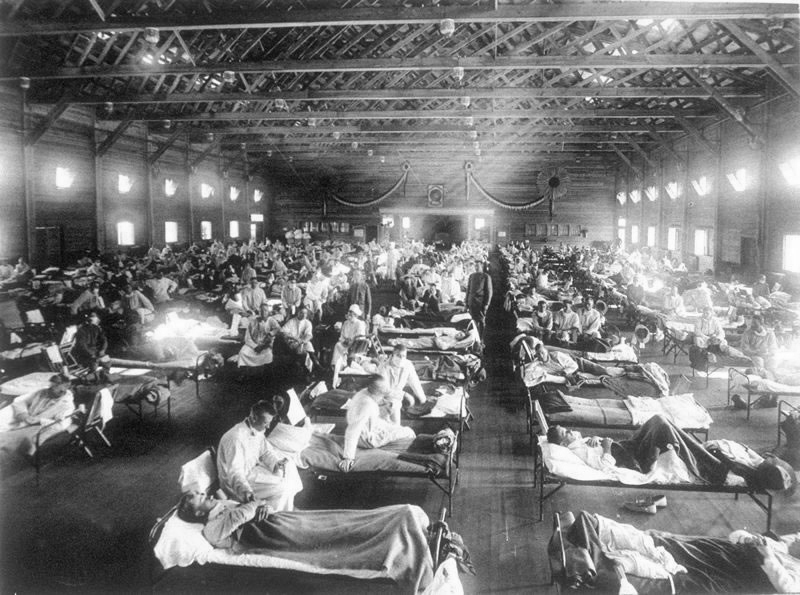
Some of the earliest victims of the flu were the American soldiers stationed here in the United States. As the epidemic spread the disease wasn't partial to US soil and quickly spread to military hospitals not only here but abroad. By November of 1918 the whole world was  affected by the growing pandemic. Otis Historical Archives, National Museum of Health and                                                                                                                                                 Medicine - public domain wiki


The rail systems being so popular became an easy channel for the spread of the influenza virus. During the epidemic, cities became concerned about how easily the virus spread, causing some cities to limit and even close their transportation systems. Many cities that remained opened had people wearing masks to reduce the risk of infection.

Between nine and sixteen million people died during the war. But the influenza pandemic would take a staggering fifty million lives, which at the time was approximately one fifth of the world's population. These high mortality rates made this one of the deadliest natural disasters in history. The 1918 flu killed more people than all the wars of the 20th century combined.


So who died in this epidemic? You might think the young and old. If you guessed that you'd be wrong. The 1918 disproportionately killed the healthy young adults. The reason wasn't known why them, but in modern research, researchers have discovered the virus killed through an overreaction of it's immune system. The stronger the immune system, the stronger the reaction. So the young adult body was ravaged, where a child or middle-aged adult had a milder reaction.

Death came quickly. Victims had such a violent immune response that there are stories where people died within hours of showing symptoms of the flu. Their lungs would fill with fluid and they would suffocate. Doctors were helpless to stop the toll that the influenza took on the young adults. 

Basha Bay Veatch Davis


On a personal note, my grandmother was one year old in 1918. Her Aunt Icey (her mother's sister) died of influenza. Ten days later my grandmother's mother, Basha Bay Veatch Davis contacted the flu and died, leaving my grandmother an orphan.


Sisters: Icey May, Basha Bay, and Rachel who was deaf
The two sisters, though they didn't live near each other at the time of their deaths, were best friends. They wrote many letters back and forth to each other, some of which we still have today. My great-grandmother, Basha Bay left one child, Delitha Vivian Gilbert to be raised by her grandmother Mahalia. Icey May had lost her only child and at her death left her husband childless. 


Mass Graves being dug

My husband's father was a young man in 1918. He told us about the flu epidemic. The memory embedded in his mind was looking out the window and seeing them stack bodies like cords of wood because the morgues couldn't keep up with them. 


So how, you might ask, is my great-grandmother ten years younger than my husband's father? That my friend is food for another blog post. =o


Leave a comment to be entered in drawing. Your choice of 1 of 6 books. Don't forget to leave your email address.

A Little Bit of Charm by Mary Ellis

Before the Season Ends by Linore Rose Burkard

A home for my Heart by Anne Mateer

When Mockingbirds Sing by Billy Coffey

Echoes of Titanic by Mindy and John Clark

Whispers from the Shadows by Roseanna M. White


Debbie Lynne Costello is represented by Tamela Hancock Murray of the Steve Laube Agency. She attended Heritage University, where she studied Journalism and worked in the editing department.


     She has completed five full length novels set in the Charleston, SC and Savannah, GA area in the late 19th century and is now seeking homes for them.


     She and her husband have four children. They live in upstate South Carolina with their family. She spent thirteen years coaching cheerleading and trying to make a difference in young girls’ lives. Debbie Lynne has raised Shetland sheepdogs for eighteen years and occasionally shows them. In her spare time, she sews, paints, makes jewelry, camps (in a fifth wheel) and enjoys the grandbabies.
WEBSITE: www.debbielynnecostello.com BLOG:  www.theswordandspirit.blogspot.com BLOG: www.fictionaddictionfix.blogspot.com