Showing posts with label 1918. Show all posts
Thursday, July 28, 2016
When the Flu Killed 20 Million People
by Tamera Lynn Kraft
We live in a relatively healthy period in time. We no longer die of the black plague or small pox. There are cures for rabies and inoculations for just about everything from the flu to chicken pox to polio. But less than one hundred years ago, a flu pandemic swept through the world and killed over 20 million people. Over 600,000 of those people were in the United States. Some estimates say the death toll world-wide was as high as 30 to 50 million.
The time was during the ending days of World War One in 1918. Roller skating rinks, movie theaters, and amusement parks were popping up every where as Americans had more money and leisure time than ever before. Although almost everyone in America lived on farms and in rural areas, people were increasingly moving to the cities and suburbs. Model Ts were affordable, and many were trading their horses in for cars. All the modern conveniences like indoor bathrooms, running water, electricity, and the telephone were starting to make their way into some homes. Women were starting to work outside of the home before they had children, and states were ratifying the amendment to give women the right to vote.
The only downside to living in America during this period of time was the Great War across the ocean. Germany and its allies were set on conquest and Europe was in a stalemate costing thousands of lives. In 1917, the United States entered the war, and many young men were sent overseas as Dough boys.
In 1918, the first cases of the pandemic flu epidemic hit. Many soldiers in army training camps through the US were some of the first victims. Military hospitals, both in the US and overseas, filled up quickly with more victims from the flu then from warfare. Nine million solders died from warfare, but 50 million died from the flu.
In March 1918, Haskell County, Kansas sent a message to the Public Health Department informing them of 18 cases of severe influenza. By May, cases of influenza overseas was being reported. By August the flu swept through North and South America, Europe, Africa, and Asia. The flu came in three major waves, the last hitting in Spring 1919, a few months after the Great War had ended. One factor for the defeat of the Germans was the devastating effects of the flu on their soldiers.
The Public Health Service fought the flu spread through education (fliers, ads, posters), quarantine, sanitary measures, and requiring masks be worn in public. Although these measures probably helped, the flu epidemic eventually just went away.
In my new novella, Resurrection of Hope, Vivian’s parents and sister died of the influenza epidemic. Most families during that time had family members who had died from the flu.
Tamera Lynn Kraft has always loved adventures and writes Christian historical fiction set in America because there are so many adventures in American history. She has received 2nd place in the NOCW contest, 3rd place TARA writer’s contest, and is a finalist in the Frasier Writing Contest.
Her novellas Resurrection of Hope and A Christmas Promise are available on Amazon and Barnes and Noble.
Sunday, November 23, 2014
World's End
Susan Page Davis here. Are you ready to step back a hundred years?
In January, 1917, my grandfather, who was 20, left his home in Central Maine and went to work on a farm in Massachusetts. I’m not sure why he went there, except that America was only three months away from entering World War I. Times were tight financially, and rumors of sabotage—some of them true—were rampant.
Grandpa, whose name was Oral D. Page, Sr., went alone in January. Perhaps there was a family connection. Perhaps the owner of World’s End had visited Grandpa’s hometown of Belgrade, Maine, where a lot of people from other states had summer lakeside cottages. At any rate, Grandpa’s parents, younger brother, and several cousins soon followed him to World’s End.
The farm was large and prosperous. It is situated in Hingham, Mass., on the edge of Cape Cod. Some of its fields were on an island, but this had in earlier times been joined to the mainland by a causeway. World’s End sold poultry, fruit, hay, and row crops, presumably to buyers in the nearby towns and Boston.
My three sisters and I were able to visit World’s End in 2007. The farm is now a 248-acre public park, maintained by the Trustees of Reservations. We took the trustees a copy of Grandpa’s diary from his time there, as well as copies of several photos he took at World’s End in 1917.
When he arrived there, Grandpa was put in charge of the poultry barn, but he took part in many other farm chores as well. Here are a few of the many activities he mentions in his journal: cutting ice and storing it in an ice house; feeding the poultry; setting up poultry brooders; cleaning barns and brooders; butchering; candling eggs (testing them by holding them up to a light); sorting apples; digging clams; hauling supplies; planting potatoes, corn, beans; weeding gardens and pulling witch grass; raking leaves; splitting wood; spreading lime; hauling manure; mowing, raking, and harvesting hay; mowing roadsides; hoeing potatoes and cultivating crops; picking strawberries, cherries, beans, plums, and other crops; digging potatoes; filling a silo with corn; shingling roofs.
But it wasn’t all work and no play. Some of the fun times included: sledding, skating on the meadow, dancing, swimming, going to the movies, listening to a Victrola, playing cards and other games, attending a high school play, going to the beach, riding a roller coaster, attending a camp meeting, and going to a fair. In the winter of 1917-18, Grandpa and some of the other young men made weekly trips to nearby Cohasset to take dancing lessons. Among others, they learned the onestep and the foxtrot.
What did one give a young man of the farming class for Christmas in 1917? Grandpa’s presents that year included a fountain pen, stationary, necktie, shaving mug, chocolates, garters and arm elastics. Sounds about right.
In March, he and his father went to the shipyard in Portsmouth to work on building ships for the Navy. Grandpa apparently didn’t stay long, but his father
remained at the shipyard for months. In August, Grandpa returned to see a ship launched.
On Aug. 5, 1918, Grandpa learned that his cousin, Alvah Wyman, “went to war.” The last entry in his 1918 diary was made on Sept. 6. In the back of the little book are several addresses of soldiers and other friends.
In front of the next year’s diary, 1919, we find: Oct. 12, 1918. My induction papers were made out today.
Grandpa was sent for training to Lewiston, Maine, where a girls’ school had been taken over for an army camp. Grandpa never made it to the European theater, as the flu epidemic struck the camp. On Nov. 11, 1918, the war came to an end.
Many soldiers went overseas to help with peacekeeping chores, but most of those at the camp in Lewiston were sick. Grandpa records:
Dec. 7. Turner was taken with influenza.
Dec. 8. We were all examined for our discharge.
Dec. 9. I was taken sick with influenza. Six of us in the same room.
Dec. 13. I got up and dressed. Am still pretty weak.
Dec. 14. Got my discharge and came home.
Back at home in Belgrade, all was not well. Grandpa’s younger brother became ill just days later:
Dec. 18. Roscoe was taken with influenza. We had the Dr. He inoculated Ma.
Dec. 19. I was taken sick again. Dr. was afraid of rheumatic fever.
Dec. 20. Ma was taken with influenza. Pa came home (from the shipyard).
All the family members eventually recovered from their bouts with influenza. However, several people in the community died from it, including a cousin, Myron Hersom, who had been with them at World’s End.
I hope you enjoyed our trip to World's End. Leave a comment and enter the drawing for one of my New England books: Maine Brides, White Mountain Brides, or my book set in 1915, The Crimson Cipher.

Susan Page Davis is the author of more than fifty published novels. A history major, she’s always interested in the unusual happenings of the past. She’s a two-time winner of the Inspirational Readers’ Choice Award, and also a winner of the Carol Award and the Will Rogers Medallion, and a finalist in the WILLA Awards and the More Than Magic Contest. Visit her website at: www.susanpagedavis.com .
In January, 1917, my grandfather, who was 20, left his home in Central Maine and went to work on a farm in Massachusetts. I’m not sure why he went there, except that America was only three months away from entering World War I. Times were tight financially, and rumors of sabotage—some of them true—were rampant.
Grandpa, whose name was Oral D. Page, Sr., went alone in January. Perhaps there was a family connection. Perhaps the owner of World’s End had visited Grandpa’s hometown of Belgrade, Maine, where a lot of people from other states had summer lakeside cottages. At any rate, Grandpa’s parents, younger brother, and several cousins soon followed him to World’s End.
The farm was large and prosperous. It is situated in Hingham, Mass., on the edge of Cape Cod. Some of its fields were on an island, but this had in earlier times been joined to the mainland by a causeway. World’s End sold poultry, fruit, hay, and row crops, presumably to buyers in the nearby towns and Boston.
My three sisters and I were able to visit World’s End in 2007. The farm is now a 248-acre public park, maintained by the Trustees of Reservations. We took the trustees a copy of Grandpa’s diary from his time there, as well as copies of several photos he took at World’s End in 1917.
![]() |
| My 3 sisters and I got a truck tour of World's End and saw the beautiful park that was once a farm. |
When he arrived there, Grandpa was put in charge of the poultry barn, but he took part in many other farm chores as well. Here are a few of the many activities he mentions in his journal: cutting ice and storing it in an ice house; feeding the poultry; setting up poultry brooders; cleaning barns and brooders; butchering; candling eggs (testing them by holding them up to a light); sorting apples; digging clams; hauling supplies; planting potatoes, corn, beans; weeding gardens and pulling witch grass; raking leaves; splitting wood; spreading lime; hauling manure; mowing, raking, and harvesting hay; mowing roadsides; hoeing potatoes and cultivating crops; picking strawberries, cherries, beans, plums, and other crops; digging potatoes; filling a silo with corn; shingling roofs.
But it wasn’t all work and no play. Some of the fun times included: sledding, skating on the meadow, dancing, swimming, going to the movies, listening to a Victrola, playing cards and other games, attending a high school play, going to the beach, riding a roller coaster, attending a camp meeting, and going to a fair. In the winter of 1917-18, Grandpa and some of the other young men made weekly trips to nearby Cohasset to take dancing lessons. Among others, they learned the onestep and the foxtrot.
What did one give a young man of the farming class for Christmas in 1917? Grandpa’s presents that year included a fountain pen, stationary, necktie, shaving mug, chocolates, garters and arm elastics. Sounds about right.
In March, he and his father went to the shipyard in Portsmouth to work on building ships for the Navy. Grandpa apparently didn’t stay long, but his father
remained at the shipyard for months. In August, Grandpa returned to see a ship launched.
On Aug. 5, 1918, Grandpa learned that his cousin, Alvah Wyman, “went to war.” The last entry in his 1918 diary was made on Sept. 6. In the back of the little book are several addresses of soldiers and other friends.
In front of the next year’s diary, 1919, we find: Oct. 12, 1918. My induction papers were made out today.
Grandpa was sent for training to Lewiston, Maine, where a girls’ school had been taken over for an army camp. Grandpa never made it to the European theater, as the flu epidemic struck the camp. On Nov. 11, 1918, the war came to an end.
Many soldiers went overseas to help with peacekeeping chores, but most of those at the camp in Lewiston were sick. Grandpa records:
Dec. 7. Turner was taken with influenza.
Dec. 8. We were all examined for our discharge.
Dec. 9. I was taken sick with influenza. Six of us in the same room.
Dec. 13. I got up and dressed. Am still pretty weak.
Dec. 14. Got my discharge and came home.
Back at home in Belgrade, all was not well. Grandpa’s younger brother became ill just days later:
Dec. 18. Roscoe was taken with influenza. We had the Dr. He inoculated Ma.
Dec. 19. I was taken sick again. Dr. was afraid of rheumatic fever.
Dec. 20. Ma was taken with influenza. Pa came home (from the shipyard).
All the family members eventually recovered from their bouts with influenza. However, several people in the community died from it, including a cousin, Myron Hersom, who had been with them at World’s End.
I hope you enjoyed our trip to World's End. Leave a comment and enter the drawing for one of my New England books: Maine Brides, White Mountain Brides, or my book set in 1915, The Crimson Cipher.
Susan Page Davis is the author of more than fifty published novels. A history major, she’s always interested in the unusual happenings of the past. She’s a two-time winner of the Inspirational Readers’ Choice Award, and also a winner of the Carol Award and the Will Rogers Medallion, and a finalist in the WILLA Awards and the More Than Magic Contest. Visit her website at: www.susanpagedavis.com .
Friday, February 7, 2014
1918 Flu Pandemic And Book Giveaway ends 2/14!
The 1918 flu pandemic officially began in January of 1918. This was the first of two pandemics involving the now familiar H1N1 influenza virus. 500 million people all over the world were infected by this virus including the Pacific islands and the Arctic.
America was in a world war, but despite that, they had more leisure time than their previous generation. They flocked to dance halls, pool halls, movies, roller skating rinks, and saloons. Fans swarmed
into the nation’s many movie theaters. America’s love affair with
Hollywood celebrities was already a permanent part of the culture.
From 1896 to 1918 the number of passengers traveling by rail tripled. Only a few Americans could afford cars. Henry Ford and his new innovations was about to change all that.
The use of telephones up to 1918 was extremely expensive. The phone companies were working hard to expand their limited lines to much of the country where service was unavailable.
Newspapers were the form of 'getting the news out'. Even small towns often had more than one newspaper. Breaking news that needed to get out was done so by printing another newspaper. These papers were called 'extra'. So now you know why we hear, "Extra, extra, read all about it!" The lad yelling that was letting people know there was breaking news.
With entertainment big business and all those people getting together, it became a huge concern for public health experts. At the height of the epidemic government officials rushed in and closed many of these entertainment places, fearing the spread of the influenza virus.
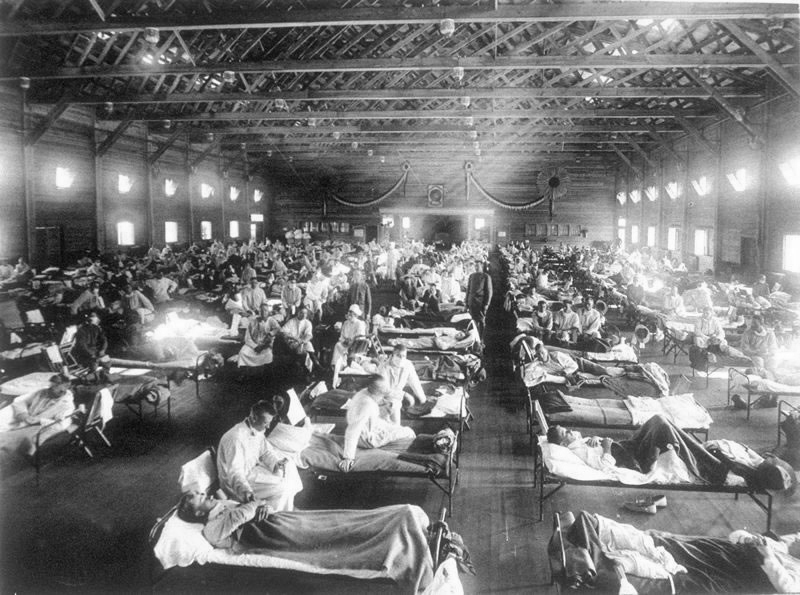
Some of the earliest victims of the flu were the American soldiers stationed here in the United States. As the epidemic spread the disease wasn't partial to US soil and quickly spread to military hospitals not only here but abroad. By November of 1918 the whole world was affected by the growing pandemic. Otis Historical Archives, National Museum of Health and Medicine - public domain wiki
The rail systems being so popular became an easy channel for the spread of the influenza virus. During the epidemic, cities became concerned about how easily the virus spread, causing some cities to limit and even close their transportation systems. Many cities that remained opened had people wearing masks to reduce the risk of infection.
So who died in this epidemic? You might think the young and old. If you guessed that you'd be wrong. The 1918 disproportionately killed the healthy young adults. The reason wasn't known why them, but in modern research, researchers have discovered the virus killed through an overreaction of it's immune system. The stronger the immune system, the stronger the reaction. So the young adult body was ravaged, where a child or middle-aged adult had a milder reaction.
Death came quickly. Victims had such a violent immune response that there are stories where people died within hours of showing symptoms of the flu. Their lungs would fill with fluid and they would suffocate. Doctors were helpless to stop the toll that the influenza took on the young adults.
On a personal note, my grandmother was one year old in 1918. Her Aunt Icey (her mother's sister) died of influenza. Ten days later my grandmother's mother, Basha Bay Veatch Davis contacted the flu and died, leaving my grandmother an orphan.
The two sisters, though they didn't live near each other at the time of their deaths, were best friends. They wrote many letters back and forth to each other, some of which we still have today. My great-grandmother, Basha Bay left one child, Delitha Vivian Gilbert to be raised by her grandmother Mahalia. Icey May had lost her only child and at her death left her husband childless.
My husband's father was a young man in 1918. He told us about the flu epidemic. The memory embedded in his mind was looking out the window and seeing them stack bodies like cords of wood because the morgues couldn't keep up with them.
So how, you might ask, is my great-grandmother ten years younger than my husband's father? That my friend is food for another blog post. =o)
Leave a comment to be entered in drawing. Your choice of 1 of 6 books. Don't forget to leave your email address.
To give you an idea what the 1918's were like, let me give you some highlights about the time.
From 1896 to 1918 the number of passengers traveling by rail tripled. Only a few Americans could afford cars. Henry Ford and his new innovations was about to change all that.
The use of telephones up to 1918 was extremely expensive. The phone companies were working hard to expand their limited lines to much of the country where service was unavailable.
Newspapers were the form of 'getting the news out'. Even small towns often had more than one newspaper. Breaking news that needed to get out was done so by printing another newspaper. These papers were called 'extra'. So now you know why we hear, "Extra, extra, read all about it!" The lad yelling that was letting people know there was breaking news.
Okay now that you have some 1918 background, lets get back to the flu epidemic.
With entertainment big business and all those people getting together, it became a huge concern for public health experts. At the height of the epidemic government officials rushed in and closed many of these entertainment places, fearing the spread of the influenza virus.
Some of the earliest victims of the flu were the American soldiers stationed here in the United States. As the epidemic spread the disease wasn't partial to US soil and quickly spread to military hospitals not only here but abroad. By November of 1918 the whole world was affected by the growing pandemic. Otis Historical Archives, National Museum of Health and Medicine - public domain wiki
The rail systems being so popular became an easy channel for the spread of the influenza virus. During the epidemic, cities became concerned about how easily the virus spread, causing some cities to limit and even close their transportation systems. Many cities that remained opened had people wearing masks to reduce the risk of infection.
Between nine and sixteen million people died during the war. But the influenza pandemic would take a staggering fifty million lives, which at the time
was approximately one fifth of the world's population. These high
mortality rates made this one of the deadliest natural disasters in
history. The 1918 flu killed more people than all the wars of the 20th century combined.
So who died in this epidemic? You might think the young and old. If you guessed that you'd be wrong. The 1918 disproportionately killed the healthy young adults. The reason wasn't known why them, but in modern research, researchers have discovered the virus killed through an overreaction of it's immune system. The stronger the immune system, the stronger the reaction. So the young adult body was ravaged, where a child or middle-aged adult had a milder reaction.
Death came quickly. Victims had such a violent immune response that there are stories where people died within hours of showing symptoms of the flu. Their lungs would fill with fluid and they would suffocate. Doctors were helpless to stop the toll that the influenza took on the young adults.
![]() |
| Basha Bay Veatch Davis |
On a personal note, my grandmother was one year old in 1918. Her Aunt Icey (her mother's sister) died of influenza. Ten days later my grandmother's mother, Basha Bay Veatch Davis contacted the flu and died, leaving my grandmother an orphan.
![]() |
| Sisters: Icey May, Basha Bay, and Rachel who was deaf |
![]() |
| Mass Graves being dug |
My husband's father was a young man in 1918. He told us about the flu epidemic. The memory embedded in his mind was looking out the window and seeing them stack bodies like cords of wood because the morgues couldn't keep up with them.
So how, you might ask, is my great-grandmother ten years younger than my husband's father? That my friend is food for another blog post. =o)
Leave a comment to be entered in drawing. Your choice of 1 of 6 books. Don't forget to leave your email address.
A Little Bit of Charm by Mary Ellis
Before the Season Ends by Linore Rose Burkard
A home for my Heart by Anne Mateer
When Mockingbirds Sing by Billy Coffey
Echoes of Titanic by Mindy and John Clark
Whispers from the Shadows by Roseanna M. White
Debbie Lynne Costello is represented by Tamela Hancock Murray of the Steve Laube
Agency. She attended Heritage University, where she studied Journalism and
worked in the editing department.
She has completed five full length
novels set in the Charleston, SC and Savannah, GA area in the late 19th century
and is now seeking homes for them.
She and her husband have four
children. They live in upstate South Carolina with their family. She spent
thirteen years coaching cheerleading and trying to make a difference in young
girls’ lives. Debbie Lynne has raised Shetland sheepdogs for eighteen years
and occasionally shows them. In her spare time, she sews, paints, makes jewelry, camps
(in a fifth wheel) and enjoys the grandbabies.
WEBSITE: www.debbielynnecostello.com BLOG: www.theswordandspirit.blogspot.com BLOG: www.fictionaddictionfix.blogspot.com
Subscribe to:
Comments (Atom)