Showing posts with label ice cream. Show all posts

Wednesday, July 23, 2025

WITH A CHERRY ON TOP

By Mary Davis


The year?


2000 B.C.


The place?


China.


The what?


The beginning of milking farm animals. Milk became a high-value product, causing anything made with it a sign of considerable prosperity.


So then, the Chinese created the first “ice cream” of sorts that was more like a pasty milk ice than the smooth creamy treat we consume today. It consisted of overcooked rice, spices, and milk that was then packed in snow (put in the “freezer”) to become solid. It symbolized great wealth. Next, they created fruit ices from fruit pulp.

By the fourteenth century, ice milk and fruit ice appeared in Italy. The secret recipes of chefs to the affluent were closely guarded. With the high cost of transporting and storing ice for summer for tasty iced desserts, only the wealthy could afford such a treat. From there, France was next in line to receive frozen desserts.


In the 1560s, with technical breakthroughs, large amounts of ice cream could be fully freezable. This was thanks to a Spanish physician living in Rome named Blasius Villafranca. He discovered that adding saltpeter (salt of rock) to the surrounding bath of ice and snow would cause the mixture to freeze more quickly. Florentine confectioners then produced the first solidly frozen ice cream.


As immigrants from Italy moved throughout Europe, they sold ice cream and other frozen treats from pushcarts. By 1870, these vendors were a familiar sight in London and came to be known as the “hokey pokey” man by British children. Even in America they became known as thus, until Ohioan Harry Burt changed all that when he marketed the first chocolate-covered ice cream on a stick. He named his creation the “Good Humor Sucker”, and so the Good Humor man was born.

Around this same time, in 1874, the ice cream soda was introduced. Then in the mid-1880s, the ice cream sundae made its debut. It’s believed that the fanciful spelling of the day of the week with an “e” instead of a “y” is because that was the only day it was sold.


Why only on Sundays?


One theory is that the religious community prevented the sale and consumption of soda water on Sundays because it was akin to “spirits.” So, when you remove the soda water from an ice cream soda, what’s left is ice cream and flavored syrup. A less widely held theory was that the syrup was expensive and families could only splurge on this treat one day a week—Sunday.

It would be many decades before whipped cream became a standard on sundaes and ice cream sodas. This was because cream had to be laboriously beaten by hand. However, college chemistry student Charles Goetz had just this task in his part-time job at an ice cream parlor. He also worked in the Dairy Bacteriology Department at the university working on improving sterilizing milk.

In the 1930s, Goetz theorized that if milk were stored under high pressure gas, bacteria might not multiply. Through his experiments, he discovered that when the milk was released, it foamed.


“It was evident to me that if cream were used the foamed product would be whipped cream.”


Every gas tested left an undesirable taste in the whipped cream. Through a dentist, he learned of a nonflammable gas that was odorless and tasteless—nitrous oxide, a.k.a. laughing gas. Ta-da! The first canned, commercial whipped cream. This also brought about the age of aerosols, which is financially nothing to laugh at.

Author Photo

Ice cream is likely America’s favorite dessert and is the foundation of a good sundae. How do you like to top your sundae?


THE QUILTING CIRCLE SERIES Box Set

Historical Romance Series

By Mary Davis

THE WIDOW’S PLIGHT (Book1) – Will a secret clouding a single mother’s past cost Lily her loved ones?

THE DAUGHTER’S PREDICAMENT (Book2) *SELAH & WRMA Finalist* – As Isabelle’s romance prospects turn in her favor, a family scandal derails her dreams.

THE DAMSEL’S INTENT (Book3) *SELAH Winner* – Nicole heads down the mountain to fetch herself a husband. Can she learn to be enough of a lady to snag the handsome rancher?

THE DÉBUTANTE’S SECRET (Book4) – Complications arise when a fancy French lady steps off the train and into Deputy Montana’s arms.

https://www.amazon.com/dp/B0CNZPRRS2/ref=sr_1_7?crid=3NJNTQ5SD1WGB&keywords=the+quilting+circle+by+mary+davis&qid=1700957455&s=digital-text&sprefix=%2Cdigital-text%2C155&sr=1-7


MARY DAVIS, bestselling, award-winning novelist, has over thirty titles in both historical and contemporary themes. Her latest release is THE LADY’S MISSION. Her other novels include THE DÉBUTANTE'S SECRET (Quilting Circle Book 4) THE DAMSEL’S INTENT (The Quilting Circle Book 3) is a SELAH Award Winner. Some of her other recent titles include; THE WIDOW'S PLIGHT, THE DAUGHTER'S PREDICAMENT, “Zola’s Cross-Country Adventure” in The MISSAdventure Brides Collection, Prodigal Daughters Amish series, "Holly and Ivy" in A Bouquet of Brides Collection, and "Bygones" in Thimbles and Threads. She is a member of ACFW and active in critique groups.

Mary lives in Colorado with Carolina Dog named Shelby. She has three adult children and three incredibly adorable grandchildren. Find her online at:
Books2Read Newsletter Blog FB FB Readers Group Amazon GoodReads BookBub

 Sources

Extraordinary Origins of Everyday Things by Charles Panati, p. 418-421

https://www.history.com/articles/where-do-ice-cream-sorbet-frozen-desserts-come-from

https://historycooperative.org/the-history-of-ice-cream/

https://www.foodrepublic.com/1519840/sweet-fluffy-history-whipped-cream/


Saturday, June 10, 2023

Let’s Eat

 By Suzanne Norquist

People around America are planning Fourth of July festivities and other outdoor fun. Menus include hot dogs, hamburgers, corn on the cob, apple pie, and more. But are any of these foods really American? And what did the colonists eat to commemorate our country’s independence?


In 1776, the Founding Fathers celebrated at Philadelphia’s City Tavern. There wasn’t a hot dog in sight. Not a hamburger. Nor a watermelon. Legend has it that John Adams and his wife ate turtle soup, salmon, and peas.

The following year, in 1777, fireworks marked the first anniversary of the signing of the Declaration of Independence. Revelers likely enjoyed these same foods, which became a tradition.


The soup remained on the menu for many years. However, with a decline in the turtle population, cooks switched to mock turtle soup (made with veal). However, this difficult-to-prepare dish didn’t taste the same.

In early July, the salmon run, and new peas are ready to harvest, making them a natural choice for the national celebration. Many New Englanders still serve the combination on Independence Day.


With wild pigs abundant in the south, barbequed pork joined the celebrations relatively early. It was an easy way to feed a large crowd. Other meats were barbequed as well. As settlers from the south moved west, they took the tradition with them.

Hot dogs didn’t come to America until the late 1800s. A German emigrant is believed to have sold the first hot dogs, called “dachshund sausages,” out of a food cart in New York. By 1893, they were a favorite at baseball games.

Hamburgers are also said to hail from Germany. However, a Danish restaurant owner claims to have cooked the first hamburger patty in 1900. Read the May 14th Heroes, Heroines, and History Blog for the whole story.

Another German dish to grace our tables is potato salad. It spread throughout Europe and came to the United States in the 1800s.

Dutch and German emigrants introduced apple pie. Which begs the question, why do we say, “As American as apple pie”? As the colonists distanced themselves from England, they left behind traditional English foods like scones and bread pudding and adopted new desserts. So, apple pie is considered American because it represents the break from the old kingdom.


Ice cream actually appeared in ancient Persia and made its way to ancient Greece and Rome. Later, it showed up in Europe and America. However, it wasn’t a treat for the masses until the invention of electric freezers.

Native Americans served baked beans before settlers arrived in the new land. The colonists adopted the dish—probably because it reminded them of pease porridge, a common English dish made from legumes.


We can also thank Native Americans for corn on the cob. They ate it before European settlers arrived. First cultivated by native people in Mexico, corn spread northward from there.

Ancient Egyptians harvested watermelon and selectively bred the unappetizing fruit until it tasted good. Over the years, it made its way around the world as a cherished treat in the dry seasons.


Americans came from many countries to create a unique culture. So, it is only fitting that we celebrate our heritage with a feast that blends many traditions. This melting-pot menu should be celebrated nearly as enthusiastically as our American heritage. Something to remember as you chow down and watch fireworks this year.

***


”Mending Sarah’s Heart” in the Thimbles and Threads Collection

Four historical romances celebrating the arts of sewing and quilting.

Mending Sarah’s Heart by Suzanne Norquist

Rockledge, Colorado, 1884

Sarah seeks a quiet life as a seamstress. She doesn’t need anyone, especially her dead husband’s partner. If only the Emporium of Fashion would stop stealing her customers, and the local hoodlums would leave her sons alone. When she rejects her husband’s share of the mine, his partner Jack seeks to serve her through other means. But will his efforts only push her further away?


Suzanne Norquist is the author of two novellas, “A Song for Rose” in A Bouquet of Brides Collection and “Mending Sarah’s Heart” in the Thimbles and Threads Collection. Everything fascinates her. She has worked as a chemist, professor, financial analyst, and even earned a doctorate in economics. Research feeds her curiosity, and she shares the adventure with her readers. She lives in New Mexico with her mining engineer husband and has two grown children. When not writing, she explores the mountains, hikes, and attends kickboxing class.

Tuesday, January 11, 2022

The best little Creamery around.

Blue Bell Ice Cream: From contented cows.  


By Martha Rogers

Up a little north of Houston in Brenham, Texas on Highway 290, sits a creamery know for its ice cream that comes in some of the best flavors you could ever want. Many states are now familiar with the iconic symbol of Blue Bell Creamery.

Very few people exist who don't like ice cream. Those of us who do like the best with our favorite flavors from Homemade Vanilla to Cookies and Cream, and all kinds of chocolate.

It all began back in the early days of the century when the Brenham Creamery opened in 1907 to purchase extra cream to make butter for the people of Brenham. In 1911 they began to use the cream to also make small quantities of ice cream. 

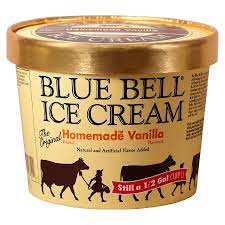
Eight years later, in 1919, the company came upon hard times and considered closing. The board of directors wanted to keep it open and hired a former school teacher, E.F. Kruse to take over the company. Though only 23 years of age, he would have a profound effect on the company. After he took over on April 1, 1919, he refused to accept a salary for the first few months in order to keep from placing the creamery in further debt. The picture shows some of the early workers and the packaging for the ice cream.


Under his leadership, production of ice cream expanded to the area surrounding the town and soon began making a profit. Krause is the one who suggested the name change to Blue Bell Creameries in 1930. The name came from the state flower Bluebonnet, a wildflower seen all over Texas every spring and especially around the town of Brenham.

In 1936 the creamery went from making ice cream by the batch with a 10 gallon batch every 20 minutes. Then they purchased the first continuous ice cream freezer. The new freezer made 80 US gallons of ice cream every hour. The frozen cream ran through a spigot which allowed it to be poured into any size container. 

Then in 1951, Krause was diagnosed with cancer and died within eight weeks. His sons, Ed and Howard, took over the leadership and soon began expansion to other parts of the state.

By 1960, they no longer made butter, instead they concentrated on ice cream only. The company expanded throughout Texas including Houston and other large cities. By the end of 1970, sales had quadrupled and by 1980, they produced over 10 million gallons of ice cream per year. 

Then the company expanded to Oklahoma and then throughout the South Central and Southern United States. They even built a plant in Broken Arrow, Oklahoma in 1992 and a third one in Sylacauga, Alabama in 1996. It seems that once a creamery is established within a marker, word-of-mouth ensures more sales.

In order to expand like it did, Blue Bell thoroughly researched new market to make sure that all employees in new markets would be fully trained in Blue Bell practices in order to uphold the product quality expected of the company.

In the early days, deliveries were made by small trucks outfitted to keep the ice cream frozen.
Today, semis can be seen on the highways
taking Blue Bell all over the country. One of 
their slogans is they sell all they can and eat the rest.


Tours of the creamery in Brenham are available, and they have a country store on the premises. Here is a picture of that creamery and a sign directing people to the tour. I have been on that tour, and all I can say is that at the end, I had my fill of ice cream, but still bought more to take home.


I would be remiss if I didn't mention the problems and recalls in 2015. The recalls eventually shut down production and resulted in job cuts and furloughs. Because of a contamination by Listeria, they shut down and began a cleanup procedure that followed federal and state guidelines. After three months, the company began production on a limited basis and returned its products to freezers in Texas and Alabama. They were part of a five-phase plan to get back to full production which they ultimately accomplished.

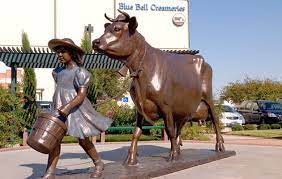
In front of the creamery stands a statue depicting icon seen on all cartons, trucks and signs advertising Blue Bell. 


Children love having their pictures made by the statue, and they are even allowed to climb up on the cow's back for pictures. A lot of children with smiling faces on school tours fill the area every year.

Wouldn't a bowl of your favorite ice cream taste good about now? 


What's your favorite flavor of ice cream? I'll take anything with chocolate in it.😊


Martha Rogers is a multi-published best-selling author of over sixty novels and novellas. She is a member of ACFW, CAN, and AWSA. Martha teaches a Sunday Bible class for senior women and is a retired English and Home Ec. Teacher. She lives in Houston with Rex, her husband of 62 years. 


Sunday, August 24, 2014

We All Scream for Ice Cream (and Oysters)


“Ice cream is happiness condensed.”
                                                                                                        -Jessie Lane Adams
Ice cream might not be the first thing that comes to mind when thinking about the Old West, but as early as 1880 ice cream parlors were all the rage and began springing up in even the most out of the way places. Some frontier towns like Tombstone had more than one. 

Marshal Wyatt Earp didn’t drink, but he sure did love his ice cream. Every afternoon he headed for the Tombstone ice cream parlor on Fourth Street.  It’s not hard to imagine that he was on his way to enjoy his favorite dish when he got sidetracked by the shootout at O.K. Corral. 

“Ice-cream is exquisite. What a pity it isn’t illegal.”
                                                                                                                                                  -Voltaire
Many restaurants, hotels and inns advertised Ice Cream and Oysters. Fortunately, the two weren’t served together; ice cream was the summer treat and oysters a winter delicacy.   

Some parlors were quite fancy.  One in San Antonio advertised plush carpets, oak furnishings and stained glass windows, but ice cream was also sold out of wagons (the first good humor men?) and tents.  Churches also got into the act and ice cream socials rapidly grew in popularity.

Nothing Says Love Like Ice Cream  

Many a young man courted his lady love at an ice cream parlor. A Texas newspaper in the 1880s had this advice: "Love takes away the appetite.  If the woman of your dreams is on her third dish of ice cream, she’s not in love with you."

The same newspaper also announced the wedding of a young couple who had known each other for only “fifteen minutes” before tying the knot. But a successful marriage was assured as both had a passion for ice cream.

Ice cream came in all flavors including fruit and even chocolate.  Then, as now, the
most popular was vanilla. One flavor you might have found in those old time ice cream parlors that you won’t find today is avocado.

Toward the end of the 1880s newspapers began issuing warnings against overindulging in that “insidious foe of health” ice cream. As far as I can tell no one paid much heed to the caveats and no such warning was issued for oysters.

So Where Did All That Ice Come From?
Before the train, ice was wrapped in sawdust and transported by wagons.  The early ice houses were merely barns insulated with three foot walls of sawdust and hay. By the late 1880s, most western towns had their own ice houses and Tombstone had two.


Tell me your favorite ice cream and
I’ll tell you what it says about your personality 
(at least I’ll try)! 


Working undercover is no job for a lady!
Or click here to order online.
Preorder book #1 of Margaret's exciting new series from your favorite bookstore or click cover to order online