
Showing posts with label idioms. Show all posts

Sunday, February 20, 2022

Shake Idioms (Wild West Sayings We Use Today)

Welcome to an all-new exploration of words and their history. Do you find it fascinating to learn about people from a bygone era? Words connect us to those who lived before us. Today we’ll discover slang expressions that use ‘shake' or 'shakes.’ Ready to climb into our literary time machine? It’s time for another word adventure.


Wild West Sayings We Use Today, Part 31


No Great Shakes
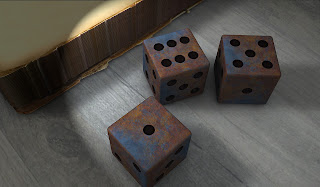
This idiom, which means ‘nothing to brag about,’ has been around since the early 1800s, and possibly before. Several theories exist on the origin of 'no great shakes.' Some believe it derived from gambling with dice. Others suspect the phrase evolved from an obsolete sense of ‘shake,’ which once signified ‘swagger.’

Historical Reference: The first known print citation came from Sir John Cam Hobhouse, the first Baron Broughton, a politician and friend to Lord Byron. In Recollections of a Long Life, his 6-volume memoir, Lord Broughton referred to an art show held in 1816: “W. said that a piece of sculpture there was 'nullae magnae quassationes,' and the others laughed heartily.” (Note: The others were proficient linguists, who understood the Latin for ‘no great shakes’ at once.

Example: I’ve tasted her meatloaf. She’s no great shakes at cooking.

Shake a Leg



The use of ‘shake a leg’ for ‘hurry up and get started’ appears to have come from an old nautical saying with a colorful backstory.

Historical Reference: In the 1700s through the 1800s, many men were kidnapped and forced into service on sailing vessels. To keep them from deserting, sailors were restricted from going ashore in port. However, the wives of married sailors could join their husbands onboard. In the bunk area in the mornings, the petty officer would shout, ‘show a leg,’ or ‘show a leg and put a stocking on it.’ Feminine ones could remain under the covers. Hairy legs betrayed their owners, who had to get up and work.

Example: Shake a leg, will you? We don’t have all day.

More Than You Can Shake a Stick At



This delightfully picturesque expression for ‘too many to count’ inspires interesting mental pictures. Shaking a stick can be considered threatening, so some people suggest this phrase came from warfare. Others picture children at play. No one knows the exact origin. I vote for children at play.

Historical Reference: The first print citation for this phrase appeared in “The Lancaster Journal” (Pennsylvania; 1818): "We have in Lancaster as many Taverns as you can shake a stick at."

Example: My mother has more yarn than you can shake a stick at.

Thanks for traveling into another installment of Wild West Sayings We Use Today. Don't rush off. I'd love to know your thoughts.
  • Were you aware of these phrases and meanings or did they surprise you?

What's New with Janalyn Voigt

The deadline for The Whispering Wind (Montana Gold, book 6) was the worst I’ve ever faced. To make a long story short, I hurt my back last fall by lifting a heavy canner. My injury had nearly healed when I decided it would be a good idea to carry a 50-lb. bag of sugar. (What could go wrong?) This reactivated the earlier injury. To alleviate the pain, I applied a muscle rub. This gave me a chemical burn, complete with nerve damage. Constant pain, sleep disruptions, and the inability to type without muscle spasms made meeting my deadline seem impossible at times.

Thankfully, my publisher was gracious. I could use dictation to type and voice-edit. And my dear husband stepped in to help with the dishes. He even cooked dinner one night. It turned out well, which is saying something. My husband’s informal nickname around here is ‘Mr. Burny Man.’ If you’ve read Hills of Nevermore (Montana Gold, book 1), Nate is modeled after my husband. Enough said.

I’m grateful to report that I turned in The Whispering Wind on Thursday. The story never stopped coming, which boosted my faith to continue working. The plot involves two people, ironically enough, in pain. I could relate, although my characters suffered emotional pain, whereas mine was quite physical. I’ve sustained no permanent damage, and the book is finished. God is good.

Learn more about Janalyn Voigt and her books.

Hills of Nevermore
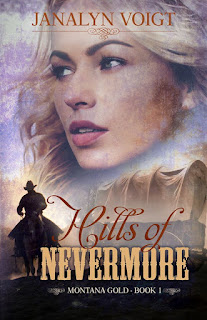
Can a young widow hide her secret shame from the Irish preacher bent on helping her survive?

In an Idaho Territory boom town, America Liberty Reed overhears circuit preacher Shane Hayes try to persuade a hotel owner to close his saloon on Sunday. Shane lands face-down in the mud for his trouble, and there’s talk of shooting him. America intervenes and finds herself in an unexpectedly personal conversation with the blue-eyed preacher. Certain she has angered God in the past, she shies away from Shane.

Addie Martin, another widow, invites America to help in her cook tent in Virginia City, the new mining town. Even with Addie’s teenage son helping with America’s baby, life is hard. Shane urges America to depart for a more civilized location. Neither Shane’s persuasions nor road agents, murder, sickness, or vigilante violence can sway America. Loyalty and ambition hold her fast until dire circumstances force her to confront everything she believes about herself, Shane, and God. Available in print, digital, and audiobook formats. Purchase Hills of Nevermore.

Based on actual historical events during a time of unrest in America, Hills of Nevermore explores faith, love, and courage in the wild west.


Tuesday, February 11, 2020

Roses are Red and Other Love Idioms

By Kathy Kovach


Ah, February! That little month in the dead of winter where outside the blustery wind chases snow into impossible drifts, (at least here in Colorado,) but inside, words of love are warming hearts. Words that are spoken, written, or stamped on candy. Have you ever wondered where these sayings come from...or from whence they came, if I may wax poetic?

ROSES ARE RED, VIOLETS ARE BLUE

The origins of this well-known poem can be traced back to 1590 in a book called The Faerie Queene by Sir Edmund Spenser. Two lines of that poem are what sparked generations of dewy-eyed lovers to declare their affections.

She bath'd with roses red, and violets blew,
And all the sweetest flowres, that in the forrest grew.

Then came a little poem in a collection of nursery rhymes originally published in 1784 entitled Gammer Gurton’s Garland. The verse goes as follows:

The rose is red, the violet’s blue,
The honey’s sweet, and so are you.
Thou are my love and I am thine;
I drew thee to my Valentine:
The lot was cast and then I drew,
And Fortune said it shou’d be you.

 The first two lines ended up in a 1901 Mother Goose book, replacing honey with sugar, and it was eventually pared down into the rhyme we know today:

Roses are red, violets are blue,
Sugar is sweet, and so are you.

I HAVE A CRUSH ON YOU

How did such a negative word become an endearing one? Back in the early 1800s, a British social gathering or dance was called a “crush.” It was termed thus because of the crowded rooms and the women’s full gowns. It’s not difficult to envision two people engaging in conversation as they try to get to know one another, and squeezing their way through the party. The term evolved into a desire to get to know someone better, crushing on them as they wish to get closer.

WEAR ONE’S HEART ON ONE’S SLEEVE

If you have teenagers, you know their vulnerability when they openly confess their adoration for someone. The connotation of this phrase today means just 
that, to be vulnerable when open to someone, something, or an ideal. It comes from a bold act practiced in the Middle Ages, when a knight would wear a colored ribbon on his arm to represent the lady he loves and for whom he is fighting.


SEALED WITH A KISS

It is said when Saint Andrew, the first called Apostle, was set to be crucified, he asked for his cross to resemble an X because he didn’t feel himself worthy to die in the same manner as his Lord. In the Middle Ages, a person who was illiterate would sign their name with an X to represent Saint Andrew. Then they would kiss the X to express their sincerity. Today, when we place an X on a love note, we are sealing it with kiss.
With Valentine’s Day upon us, will you let your Crush see your vulnerability as you wear your heart on your sleeve? Or will you write a love poem to your significant other in the manner of Roses are Red and seal it with a kiss? Perhaps the day is simply a great excuse to buy yourself a big box of chocolates. Whatever your plans, remember God’s love letter to us, where He declares, “I have loved you with an everlasting love; I have drawn you with unfailing kindness.” Jeremiah 31:3, NIV.


MissAdventure Brides Romance Collection
Seven daring damsels don’t let the norms of their eras hold them back. Along the way these women attract the attention of men who admire their bravery and determination, but will they let love grow out of the adventures? Includes:
"Riders of the Painted Star" by Kathleen E. Kovach
1936 Arizona
Zadie Fitzpatrick, an artist from New York, is commissioned to go on location in Arizona to paint illustrations for an author of western novels and falls for the male model.


Kathleen E. Kovach is a Christian romance author published traditionally through Barbour Publishing, Inc. as well as indie. Kathleen and her husband Jim raised two sons while living the nomadic lifestyle for over twenty years in the Air Force. Now planted in northeast Colorado she's a grandmother, though much too young for that. Kathleen is a longstanding member of American Christian Fiction Writers. An award-winning author, she presents spiritual truths with a giggle, proving herself as one of God's peculiar people.


Wednesday, March 25, 2015

Why Do We Say That?

A few weeks ago my husband and I were watching a western—for those who know us, this is a common occurrence. I don’t mind. I love westerns. Always have. But as we were watching, one of the characters walks into the saloon and asks for “a shot of whiskey.” My husband turns to me and asks, “Do you know why they call it a shot? Because if the cowboys didn’t have money they would pay for their drinks with a bullet. One small drink—a shot—one bullet, a shot.”

What? How many times have I said that very phrase not realizing why I said it? So then I started wondering about other things we say every day.

Or write.

In my upcoming release As Good As Gold (part of the Oregon Trail Romance Collection, available 4-1-15 from Barbour Publishing) the hero finds out that it’s the heroine’s birthday. When she asks how he knew, I thought he might say, ‘a little bird told me.’ But did they say that in 1851? When I researched, I discovered that the phrase can be traced back to the Bible.

Ecclesiastes 10:20 (KJV) “Curse not the king, no not in thy thought; and curse not the rich in thy bedchamber: for a bird of the air shall carry the voice, and that which hath wings shall tell the matter.” To further insure the phrase’s longevity, it was used and popularized in a song by Harvey Brooks in 1947.

Here are a few more popular sayings and their (suspected) origins.

Honeymoon
It is widely believed that this phrase has roots in medieval times. It was thought that if newlyweds drank mead (a wine made from honey) each evening for one month (which is a cycle of the moon) they would be blessed with a male heir in that year.

Wet Your Whistle
This saying supposedly came out of an English pub. Once the patrons starting

drinking they would get loud and the bartender had a hard time hearing the drink orders. A whistle was baked right into the rim of a ceramic beer mug. When they wanted a refill, the patrons would blow the whistle for another drink to ‘wet their whistle.’

Mind Your P’s and Q’s
In English pubs, ale was ordered in pints and quarts. When the crowd got rowdy, the bartender would tell them to ‘mind their p’s and q’s.’

Another plausible explanation is that the letters p & q are easily reversible. When a printer was running a press, the boss would tell him to ‘mind his p’s and q’s.’ But then again, they could have easily said b’s and d’s. But that doesn’t have quite the same ring to it.

Saved By The Bell
After discovering scratch marks on the underside of some coffins and having the ‘dead’ come back to life at funerals, the fear of burying someone alive became very real. (Keep in mind, this is before anyone knew what a coma was.) This led to the family tying a string to the deceased’s wrist. The string was attached to a nearby tree and bell. If they happened to wake up, they rang the bell and were saved.

Pipe Dream
A “pipe dream” once referenced the dreams experienced by those who smoked opium out of a pipe. Today, it refers to a plan or dream that is impossible to achieve.

Pass The Buck
During a game of cards, a token was used to show who was next to deal. This marker was a bit of buckshot or buck. In order to indicate who had the dealer’s responsibility, the players would literally pass the buck(shot).

Throw Out The Baby With The Bathwater
Some claim the phrase originates from a time when the whole household shared the same bathwater. The head of household would bathe first, followed by any men who lived there. The mistress of the house went next followed by the other women. Then the children bathed in order of their ages until it became the baby’s turn. Supposedly the water would be so dirty that a baby could accidentally be 'tossed out with the bathwater'.

What’s your favorite idiom and do you know its origins?

Feel free to share! Everyone who leaves a comment between now and March 31 will be entered into a drawing to win a paper copy of The Oregon Trail Romance Collection featuring novellas written by some of your favorite Christian authors.

Check out the collection HERE.