Showing posts with label living history. Show all posts

Tuesday, December 3, 2024

Living History at Fort Nisqually


Living history has a nice ring, doesn’t it? What exactly is living history? According to Dictionary.com, it is “any of various activities involving the re-enactment of historical events or the recreation of living conditions of the past.”

At Fort Nisqually on Puget Sound, these activities, events, and recreations enable visitors to experience what it was like as a resident in 1855. How neat is that? This living history museum features Heritage Skills Workshops where individuals can learn butchering/curing, leather working, cup or mug making, creating candlesticks or wall sconces, and basketry. The methods and tools used are representative of that period. 
Fort Nisqually also hosts camps and holiday events. In the fall, take a Candlelight Walking Tour, by candle and firelight. At Christmas there is a Regale. Imagine Christmas festivities from the end of the 19th century - parlor games, making ornaments, harvesting the Yule log, creating pomanders (oranges decorated with cloves), and a visit from Father Christmas.

Where is Fort Nisqually located? For reference, Puget Sound is a 95-mile-long estuary, the second largest in the United States. In the state of Washington and connecting to the Pacific Ocean, it flows past notable cities such as Seattle and Tacoma. It has an average depth of 450 feet! This waterway was the attraction for the location. The fort is in present day DuPont, WA.

Originally owned by the Hudson Bay Company, a British enterprise, the fort was a site for the fur trade since 1833. It was the first settlement with global access. Once the fur trade declined, another income avenue was necessary – commerce. The Puget Sound Agricultural Company (PSAC) had 160,000 acres to grow crops and raise livestock from 1839 – 1869. The time that current visitors witness, 1855, was an era where American settlements surrounded the British of this site. The year 1869 is when Britain left the territory and the remaining manager, Edward Huggins took it over as his homestead.

How does it exist today? The Works Progress Administration (WPA) recreated the fort in the 1930s on this site. There are two original buildings, the Factor’s House (1855) and the Granary (1850). Visitors can view 20 locations allowing insight into daily life during those times. The kitchen, wash house, root cellar, smoke house, necessary, kitchen garden, poultry house, laborer’s dwelling, bastion (photo above), and store are a few of the sites. A self-guided tour is possible using a free downloadable or printed guide. However, history comes to life with demonstrations, tours by docents in costume, and events.


Granary featured above. Produce and grain stored here. It is listed on the National Registry of Historic Places. The first of the original buildings on site.


Factor House parlor featured above left and parents' bedroom above right. This is the second original building at the fort. Examples of furniture, linens, dishes, decorations, tools, games, clothing, and more allow us to peek into many aspects of their days. 

In case you haven't visited a similar site before, you might wonder at points in the fort that have different functions than those of today. You may know that kitchens were separate from the house to prevent fires and root cellars stored food. The kitchen garden supported the settlement, with vegetables and fruit they would eat to be self-sufficient. There were field crops and orchards outside the palisade walls. The poultry house held chickens, ducks, and geese. 

The Laborer's dwelling was interesting. There was a side for bachelors with bunks and quarters for families. The parents shared their beds with children, or the young used mats on the floor. At left is a representation of a room that a laboring family would share. Notice the basics covered in one room, sleep, dress, cook, eat, and more. The Large Store held imported supplies and storage of those that would be shipped for sale. There was also a Sale Shop with imported goods for purchase. See images below.

Ever wonder at the creation of men's felt top hats? The beaver pelt at left is the raw material. After a lengthy process, the felt hat emerges. As a site for the fur trade. This was once a huge commodity.

One of the reasons I enjoy historical fiction is reading stories that show everyday life in varying times. How did they dress, eat, or gather? What objects or tools existed to enable them to function? This living history site offers visual representations that help garner appreciation and understanding. Have you visited an historical site with a window into the past?


As a child, Rebecca loved to write. She nurtured this skill as an educator and later as an editor for an online magazine. Rebecca then joined the Cru Ministry - NBS2GO/Neighbor Bible Studies 2GO, at its inception. She serves as the YouVersion Content Creator, with over 125 Plans, in 44 languages on the Bible.com app.

Rebecca lives near the mountains with her husband and a rescued dog named Ranger. She is a proud mom of a soldier. If it were up to Rebecca, she would be traveling - right now. First up, trips to see their two grown sons. As a member of ACFW and FHLCW, she tackles the craft of fiction while learning from a host of generous writers. Connect with Rebecca: Facebook Goodreads Instagram Pinterest X/Twitter


Friday, November 18, 2016

Reenactment Vs. Living History...and the Renaissance Faire?

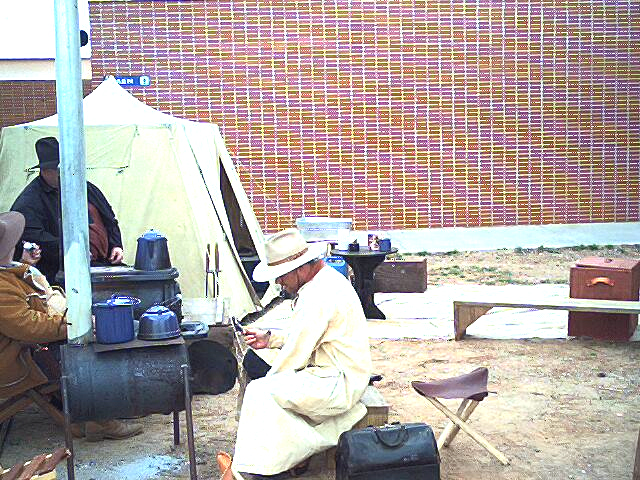
Old West Reenactment Camp


By Alanna Radle Rodriguez


Last month, Linore Rose Burkard did a blog on Ye Old Renaissance Faire, and it got me to thinking. What is the difference between a reenactment and living history? And where does the Medieval/Renaissance faire fall?


We have all tried to relive the past in different forms and fashion: The old kids’ game Cowboys and Indians, school Thanksgiving plays, movies and TV series, books, paintings, reenactments, museums and living history. Here in the State of Oklahoma, during the third or fourth grade, some students get to reenact the state’s land run. But why couldn’t this school “land run” be called living history? The terms reenactment and living history are very similar and are sometimes used interchangeably. Most may say there isn’t a difference, but to the historians, there is a difference. 


Hayes, Ohio 2015 Civil War Reenactment

A reenactment is an educational or theatrical performance that portrays a past event or times past, quite often following a script. In the United States, Civil War reenactments are everywhere. Living history is generally a recreation of living conditions and historical tools, usually a presentation that generally do not follow a planned script. Re-enactors may give you the sense of stepping onto a movie set, but living historians can give you a sense of stepping back in time. Some would say reenacting got its start in the Roman Coliseum. While many places have historical content and context, most reenactments and living history events are hosted by, or completely managed by, a museum or historical society. In many cases, living historians working directly with a museum or historical society. Most specialize in a specific time period and region, typically their own town and state. 


Reenactment of the Roman Legion XV "Apollinaris", taking place in Austria-Wikipedia

Today, people gather to celebrate Medieval or Renaissance times across the globe. Of course, these assemblies are aptly called Medieval or Renaissance Faires. This is where the line can blur between reenactment and living history. Generally, a faire is a celebratory gathering—a festival. You usually have groups that frequent these faires. The Society of Creative Anachronism (SCA) is a worldwide organization that provides reenactment encampments and sometimes living history. But most who visit a faire consider it a chance to dress up like a princess, Robin Hood, or a pirate. For others, it’s a perfect cosplay opportunity. A contraction of the two words “costume and play,” cosplay is the practice of dressing up like your favorite fictional character or even a different you from an alternate universe. While these “reenactors” stay in their cosplay character during an event, most living historians are just that. Historians. They have researched and confirmed their material, the process, the very way of life of their ancestors or the people they portray. Simply put, while living historians are playing a role in the overall scheme of an event or museum, they are still first and foremost, a student of history. 


Video Cosplayer-google search

Interesting Cosplay: "Snowba Fett" Mix between Snow White and Bobba Fett from Star Wars


To see the living historian at work is to take a step back to a different time and sometimes a different place. Did you know that when you talk to a living historian in garb, you are talking not only to an artisan, but an artist? You are. They make it their goal to allow for the full experience. Although you get to see the times portrayed own troubles and hardships, it is, for most people, an excellent way to contrast the complexities and troubles of the current day with a “simpler” time. If you haven’t had the chance to take a trip to either a cultural center or a living history museum, it would be an experience worth the having. 

Viking re-enactors at the Battle of Clontarf millennium commeration, Saint Anne's Park, Dublin-by Hibernian, Wikipedia

My husband and I are both re-enactors and living historians. When we volunteer at the 1889 Territorial Schoolhouse in Edmond, Oklahoma, we come alive, not only for the adults who come in but for the children too. It is so fun to ask children what they think I, as the schoolmarm, would use to heat my schoolhouse. “Wood!” they enthusiastically reply. At that time, Edmond was tall prairie grassland. There were no trees! I show them a picture of historic Edmond and ask them what’s missing. When they tell me a popular fast-food restaurant directly across the street, I can’t help but laugh. I tell them trees are missing! Early settlers would use cow chips to fuel the fire! “If you were in my classroom, once in a while it would be your responsibility to bring fuel for the stove for a week,” I tell them. Of course, I get a good, “EEEEEEEWWWWWW!!!!” and I laugh with the parents. 


Husband and I at the Schoolhouse

We love being asked questions as living historians! “Is that a real stove?” Yes, it is. This was our heater when we didn’t have electricity. “Where’s your smart board?” Well, see the big black board behind my desk? That’s our smart board. You have to write on it with chalk. “Where are your Ipads?” Slates were our Ipads. “Did you make your skirt?” Yes, I did. In living history situations real firearms are allowed, my husband is always asked, “Is that gun real? Can you use that knife? Why is your holster so high up?” My favorite one he gets asked a lot is, “Are you a REAL cowboy?” I can’t help but smile. Yes, my computer IT husband is a real cowboy. 

Part of my crew. Medieval Fair in Norman, OK 2011

So where do the Medieval/Renaissance Faires fit? Well, it depends on the faire. In Oklahoma, there are two famous faires: The Medieval Faire in Norman and The Renaissance Faire in Muskogee, and there are differences even between the two! The Medieval Faire does have the historical jousting put on by the SCA, but it has more of a modern market. The Renaissance Faire is to preserve the culture, fashion, goods and celebrations. While there are reenactments at most, if not all faires, re-enactors, living historians, and cosplayers all are intermingled at the faire!


Tinker Bell Cosplay


Born and raised in Edmond, Oklahoma, Alanna Radle Rodriguez is the great-great granddaughter of one of the first pioneers to settle in Indian Territory. Alanna loves the history of the state and relishes in volunteering at the 1889 Territorial Schoolhouse in Edmond. Her first published story, part of a collaborative novella titled Legacy Letters, came out September 2016. Alanna lives with her husband and parents in the Edmond area. She is currently working on a historical fiction series that takes place in pre-statehood Waterloo, Oklahoma.

Facebook.com/AlannaRadleRodriguez
Pinterest.com/alannaradlerodr/