Showing posts with label parachutes. Show all posts

Saturday, April 23, 2022

WEDDING GOWNS FROM THE SKY: Even War Can’t Stop Love

By Mary Davis

Parachute chic. / Christopher Sessums, Flickr // CC BY-SA 2.0
WWII and post-WWII brides had to be resourceful if they wanted a special dress for their wedding day because of rationing and shortages. Fabrics of any kind were designated as military and war essential—especially silk. This luxury fabric had it all—strong, lightweight, fire resistant, and easy to pack. Perfect for parachutes. But that meant those on the home front went without. So what was a bride to do for her special day? Use whatever was available. Some wore their Sunday-best dress, others borrowed someone else’s wedding dress, or they refashioned a family member’s outdated one. Orrrrrr . . .

. . . make a dress from a parachute with its yards and yards and yards and yards of beautiful white silk (or nylon late in the war). The best wedding gowns were made from their sweetheart’s parachute that brought them to safety. Ruth, Rosalie, Janet, and countless others all around the world did just that.

Violette de Courcy is licensed under a Creative Commons Attribution-NonCommercial-ShareAlike 3.0 Unported License // CC BY-NC-ND 3.0

While returning from a bombing raid over Japan in August of 1944, B-29 pilot Maj Claude Hensinger and his crew were forced to bail out when their aircraft caught fire. After it saved his life, Claude used his parachute as a pillow and blanket until he was rescued. When he returned to the States, he used his life-saving parachute in lieu of a ring to propose to Ruth, asking her to make her wedding dress out of it. Claude and Ruth wed on July 19, 1947. The couple’s daughter as well as their son’s bride wore this dress before it was donated to the Smithsonian.
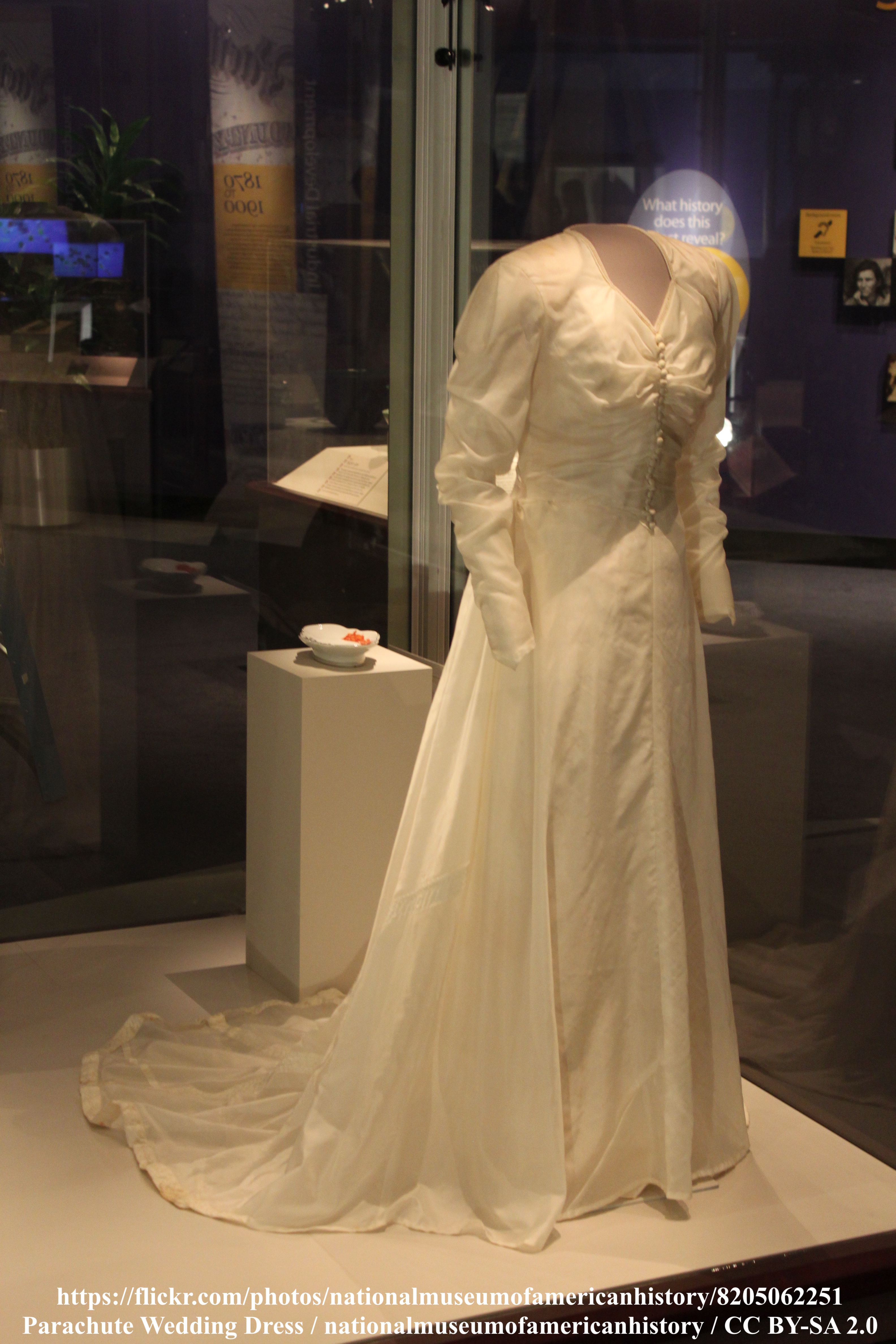
Parachute Wedding Dress / nationalmuseumofamericanhistory / CC BY-SA 2.0

On November 15, 1945, Rosalie Hierholzer walked down the aisle in a wedding gown fashioned out of her sweetheart’s bullet-hole riddled parachute. While flying over Germany, radio operator Temple Leslie Bourland and his crew had to bail out when their aircraft was hit by enemy fire. As Bourland floated toward the ground, he was shot in the hip, and his parachute received several bullet holes. When Bourland showed his fiancee his war mementos, Rosalie’s aunt offered to make her niece’s wedding gown from the silk, bullet holes included. With up to forty yards, there was plenty.

Reo Arland Casper, a native of Idaho, enlisted in the US Marines at age nineteen. Janet Gleason of Massachusetts signed up for the Navy WAVES (Women Accepted Volunteer Emergency Service) at age twenty-one. Their paths crossed at Fort Dix in New Jersey, where they struck up a friendship that evolved into a romance, and they fell in love. Janet packed Reo’s parachute for his final jump before graduation Paramarine training. Before he shipped out for his first duty, he proposed, and the pair planned to wed after the war was over. Knowing she couldn’t afford a wedding dress, Janet’s commanding officer gave her a Japanese silk parachute. With it, she fashioned the gown she would marry Reo in and packed it away until the end of the war. And the war did end, but Reo’s mother objected to the marriage because of religious differences. So, the couple went to Montana and eloped. They were married for fifty-eight years. You can learn more about Reo and his bride HERE as well as see Janet’s dress. 

Here are a few others.

“Wedding dress made from parachute silk which American soldier Tom Worthington acquired while serving in Japan during World War II.” Ben P L from Provo, USA, Wikimedia.org

“Wedding dress made in Normandie, France in the summer of 1944 from fabric from a parachute. This wedding dress was made from a silk American reserve parachute. Fabric had been scarce under the German occupation and parachutes were much sought after items for their potential to make new clothes. Photo taken in 2015 showing items from the former International Museum of World War II in Natick, Massachusetts, a few miles west of Boston.” Lee Wright, Wikimedia.org

“Dress, bordeaux red, 1945 from the white parachute material from a Second World War, military parachute which has been painted; the upper part has small shiny pearls. Photographed in the collection of the National Liberation Museum 1944-1945, the Netherlands, archive number 3.2.53.” KingaNBM
, Wikimedia.org
 
My guess is this one was either never worn as a “wedding dress” or after the wedding it was dyed red to get more use out of it. No wasting good fabric.
 
I love stumbling across little gems like this while researching. For my WWII novel, Mrs. Witherspoon Goes To War, I needed to know a thing or two about parachutes: the type, weight, steering capability, and such, when a wedding dress made from a parachute popped up. That’s way cool! I wanted to know more, and I WANTED to use it, but sadly, it wouldn’t fit into my story. Perhaps, someday I’ll have the perfect story to include this wonderful bit of history in.


MRS. WITHERSPOON GOES TO WAR (Heroines of WWII series)

A WASP (Women Airforce Service Pilots) flies a secret mission to rescue three soldiers held captive in Cuba.

Margaret “Peggy” Witherspoon is a thirty-four-year-old widow, mother of two daughters, an excellent pilot, and very patriotic. She joins the WASP. As she performs various tasks like ferry aircraft, transporting cargo, and being an airplane mechanic, she meets and develops feelings for her supervisor Army Air Corp Major Howie Berg. When Peggy learns of U.S. soldiers being held captive in Cuba, she, Major Berg, and two fellow WASPs devise an unsanctioned mission to rescue them. With Cuba being an ally in the war, they must be careful not to ignite an international incident.

Get it HERE!


MARY DAVIS, bestselling, award-winning novelist, has over thirty titles in both historical and contemporary themes. Her latest Quilting Circle release is THE DÉBUTANTE'S SECRET (The Quilting Circle  4), THE DAMSEL’S INTENT (The Quilting Circle  3) is a Selah Award Winner. Some of her other recent titles include; THE WIDOW'S PLIGHT (The Quilting Circle  1), THE DAUGHTER'S PREDICAMENT (The Quilting Circle  2),Zola’s Cross-Country Adventure” in The MISSAdventure Brides Collection , Prodigal Daughters Amish series, and "Bygones" in Thimbles and Threads. COMING IN OCTOBER 2022 THE LADY'S MISSION (The Quilting Circle  5).
Mary lives in the Pacific Northwest with her husband of thirty-seven years and one cat. She has three adult children and three incredibly adorable grandchildren.

Saturday, March 14, 2015

WOULD YOU HAVE JOINED THE WAVES DURING WORLD WAR II?


ANNE GREENE HERE. Despite the pain and fear and death that occurred during World War II, women made great strides in financial and personal freedom. The WAVES provided one avenue to those goals. 

WAVES was established on 30 July 1942 to replace men who could then be released for active sea duty. The name was an acronym for Women Accepted for Volunteer Emergency Service (as well as an allusion to ocean waves.) 


The WAVES could not serve aboard combat ships or aircraft. Initially they were restricted to duty in the United States. Late in the war, they were authorized to serve in certain U.S. possessions, and a number were sent to Hawaii. The war ended before any WAVES could be sent to other locations.

Within their first year, the WAVES were 27,000 strong. A large proportion did clerical work, but some took positions in the aviation community, medical professions, communications, intelligence, storekeeper and technology.

The use of the word Emergency signified that US Navy brass thought female service would cease when the war ended due to political resistance from many who did not believe women had a place in the US Navy. Despite the resistance from conservative officers, the demand was clearly there.
 
By mid-1943, 27,000 American women served in the WAVES. These women took up far more responsibilities. Secretarial and clerical jobs still made up a large portion of WAVES positions, but thousands performed jobs such as aviation mechanics, photographers, control tower operators, and intelligence personnel. By the end of the war, over 84,000 women served in WAVES with 8,000 female officers.

Entire staffs of men disappeared because women took over airfield control towers, manned vital naval communications networks, and served important roles in health and hospital work. Women trained in gunnery and blind flying instruction, aerology, aviation ground crew work, navigation and other fields. The Navy estimated that WAVES freed enough men to outfit an entire task force of 1 battleship, 2 aircraft carriers, 2 heavy cruisers, 4 light cruisers and 15 destroyers.

The Navy placed women in both mundane and dangerous activities. They operated all the laboratories and many of the firing bays at the crucial Indian Head rocket powder plant which conducted testing of American rocket propellants. They fixed aircraft, packed parachutes, provided weather information, served as link trainers, gunnery instructors, coordinated air traffic control and performed a host of other aviation-related jobs.

After the war, do you think these women were content to going back to being housewives? They changed the thinking of the nation about women’s place in society.   
At war’s end, Congress passed the Women's Armed Services Integration Act on 12 Jun 1948, allowing women to gain permanent status in all military branches of the United States. This put the WAVES program into obsolescence, but opened the way for women’s continued advancement in society.

My book, ANGEL WITH STEEL WINGS, releases late March or early April, 2015. ANGEL WITH STEEL WINGS is a World War II romance where Steel Magnolias meet Band of Brothers. Mandy McCabe escapes her dead-end life in Hangman’s Hollow, Tennessee, by becoming a Woman Air Force Service Pilot. Major Harvey Applegate lost his wife to the WASP program, and he’s convinced Yankee Doodle Gals have no place flying in the war effort. He determines to protect the remaining ladies by sending them packing back to the home front. Can Mandy save the WASP program on Harvey's base? Both Mandy and Harvey experience immediate attraction which increases Harvey’s desire to send Mandy home to safety. One love. Two goals. Someone has to give. 

ANNE GREENE delights in writing about wounded heroes and gutsy heroines. Her second novel, a Scottish historical, Masquerade Marriage, won three prestigious book awards. The sequel Marriage By Arrangement, finalled in a number of contests. A Texas Christmas Mystery also won several awards. Look for Anne’s new World War II historical romance, Angel With Steel Wings, early in 2015. The first book in Anne’s lady detective series, Holly Garden, PI, Red is for Rookie, débuts later in 2015. Anne’s highest hope is that her stories transport the reader to awesome new worlds and touch hearts to seek a deeper spiritual relationship with the Lord Jesus. Anne makes her home in McKinney, Texas. She loves to talk with her readers. Buy Anne’s books at http://www.Amazon.com. Talk with Anne on twitter at @TheAnneGreene. View Anne’s books, travel pictures and art work at http://www.AnneGreeneAuthor.com.
Learn more about Anne as well as gain tips on writing award-winning novels at http://www.anneswritingupdates.blogspot.com.