Showing posts with label wedding dress. Show all posts

Saturday, April 23, 2022

WEDDING GOWNS FROM THE SKY: Even War Can’t Stop Love

By Mary Davis

Parachute chic. / Christopher Sessums, Flickr // CC BY-SA 2.0
WWII and post-WWII brides had to be resourceful if they wanted a special dress for their wedding day because of rationing and shortages. Fabrics of any kind were designated as military and war essential—especially silk. This luxury fabric had it all—strong, lightweight, fire resistant, and easy to pack. Perfect for parachutes. But that meant those on the home front went without. So what was a bride to do for her special day? Use whatever was available. Some wore their Sunday-best dress, others borrowed someone else’s wedding dress, or they refashioned a family member’s outdated one. Orrrrrr . . .

. . . make a dress from a parachute with its yards and yards and yards and yards of beautiful white silk (or nylon late in the war). The best wedding gowns were made from their sweetheart’s parachute that brought them to safety. Ruth, Rosalie, Janet, and countless others all around the world did just that.

Violette de Courcy is licensed under a Creative Commons Attribution-NonCommercial-ShareAlike 3.0 Unported License // CC BY-NC-ND 3.0

While returning from a bombing raid over Japan in August of 1944, B-29 pilot Maj Claude Hensinger and his crew were forced to bail out when their aircraft caught fire. After it saved his life, Claude used his parachute as a pillow and blanket until he was rescued. When he returned to the States, he used his life-saving parachute in lieu of a ring to propose to Ruth, asking her to make her wedding dress out of it. Claude and Ruth wed on July 19, 1947. The couple’s daughter as well as their son’s bride wore this dress before it was donated to the Smithsonian.
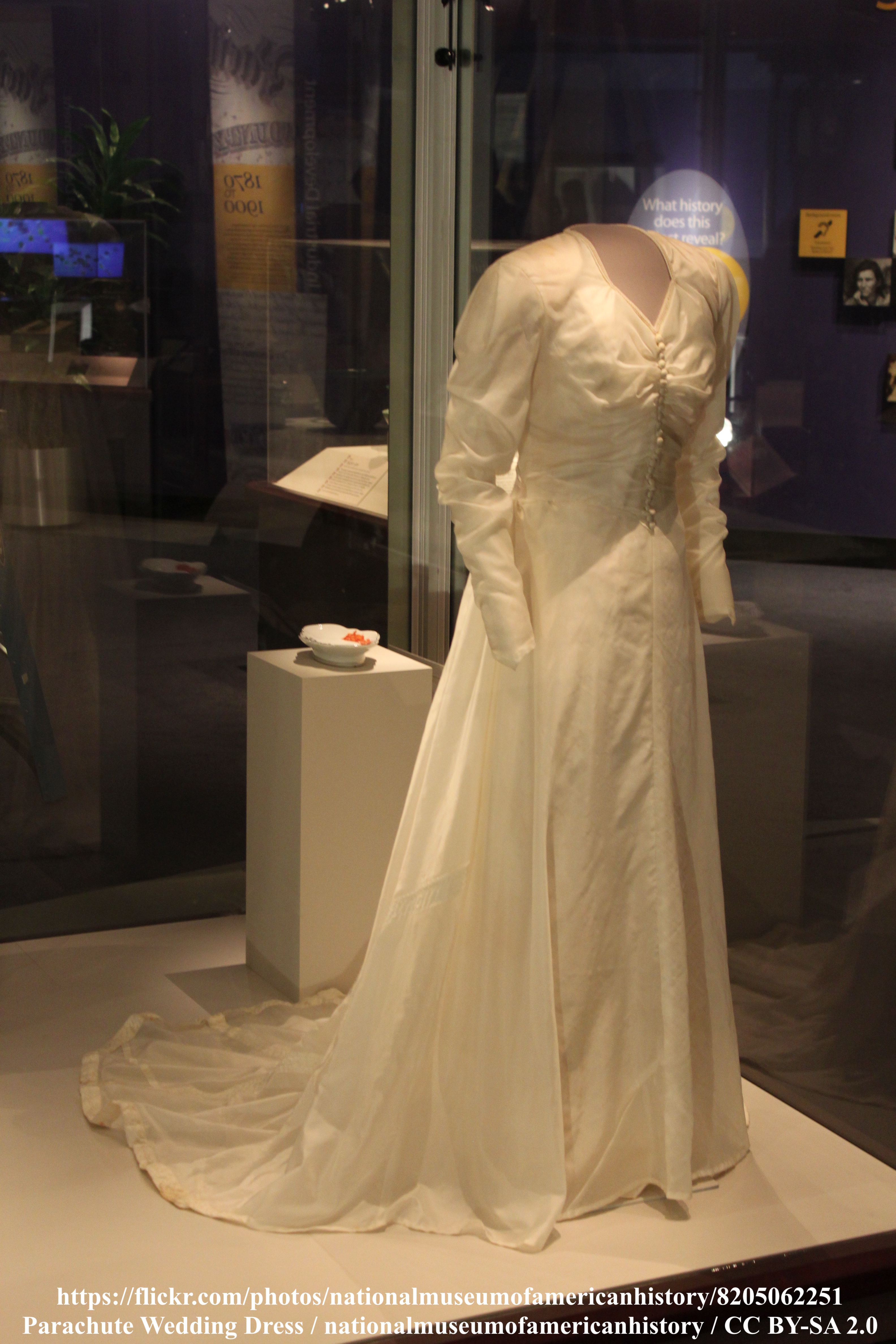
Parachute Wedding Dress / nationalmuseumofamericanhistory / CC BY-SA 2.0

On November 15, 1945, Rosalie Hierholzer walked down the aisle in a wedding gown fashioned out of her sweetheart’s bullet-hole riddled parachute. While flying over Germany, radio operator Temple Leslie Bourland and his crew had to bail out when their aircraft was hit by enemy fire. As Bourland floated toward the ground, he was shot in the hip, and his parachute received several bullet holes. When Bourland showed his fiancee his war mementos, Rosalie’s aunt offered to make her niece’s wedding gown from the silk, bullet holes included. With up to forty yards, there was plenty.

Reo Arland Casper, a native of Idaho, enlisted in the US Marines at age nineteen. Janet Gleason of Massachusetts signed up for the Navy WAVES (Women Accepted Volunteer Emergency Service) at age twenty-one. Their paths crossed at Fort Dix in New Jersey, where they struck up a friendship that evolved into a romance, and they fell in love. Janet packed Reo’s parachute for his final jump before graduation Paramarine training. Before he shipped out for his first duty, he proposed, and the pair planned to wed after the war was over. Knowing she couldn’t afford a wedding dress, Janet’s commanding officer gave her a Japanese silk parachute. With it, she fashioned the gown she would marry Reo in and packed it away until the end of the war. And the war did end, but Reo’s mother objected to the marriage because of religious differences. So, the couple went to Montana and eloped. They were married for fifty-eight years. You can learn more about Reo and his bride HERE as well as see Janet’s dress. 

Here are a few others.

“Wedding dress made from parachute silk which American soldier Tom Worthington acquired while serving in Japan during World War II.” Ben P L from Provo, USA, Wikimedia.org

“Wedding dress made in Normandie, France in the summer of 1944 from fabric from a parachute. This wedding dress was made from a silk American reserve parachute. Fabric had been scarce under the German occupation and parachutes were much sought after items for their potential to make new clothes. Photo taken in 2015 showing items from the former International Museum of World War II in Natick, Massachusetts, a few miles west of Boston.” Lee Wright, Wikimedia.org

“Dress, bordeaux red, 1945 from the white parachute material from a Second World War, military parachute which has been painted; the upper part has small shiny pearls. Photographed in the collection of the National Liberation Museum 1944-1945, the Netherlands, archive number 3.2.53.” KingaNBM
, Wikimedia.org
 
My guess is this one was either never worn as a “wedding dress” or after the wedding it was dyed red to get more use out of it. No wasting good fabric.
 
I love stumbling across little gems like this while researching. For my WWII novel, Mrs. Witherspoon Goes To War, I needed to know a thing or two about parachutes: the type, weight, steering capability, and such, when a wedding dress made from a parachute popped up. That’s way cool! I wanted to know more, and I WANTED to use it, but sadly, it wouldn’t fit into my story. Perhaps, someday I’ll have the perfect story to include this wonderful bit of history in.


MRS. WITHERSPOON GOES TO WAR (Heroines of WWII series)

A WASP (Women Airforce Service Pilots) flies a secret mission to rescue three soldiers held captive in Cuba.

Margaret “Peggy” Witherspoon is a thirty-four-year-old widow, mother of two daughters, an excellent pilot, and very patriotic. She joins the WASP. As she performs various tasks like ferry aircraft, transporting cargo, and being an airplane mechanic, she meets and develops feelings for her supervisor Army Air Corp Major Howie Berg. When Peggy learns of U.S. soldiers being held captive in Cuba, she, Major Berg, and two fellow WASPs devise an unsanctioned mission to rescue them. With Cuba being an ally in the war, they must be careful not to ignite an international incident.

Get it HERE!


MARY DAVIS, bestselling, award-winning novelist, has over thirty titles in both historical and contemporary themes. Her latest Quilting Circle release is THE DÉBUTANTE'S SECRET (The Quilting Circle  4), THE DAMSEL’S INTENT (The Quilting Circle  3) is a Selah Award Winner. Some of her other recent titles include; THE WIDOW'S PLIGHT (The Quilting Circle  1), THE DAUGHTER'S PREDICAMENT (The Quilting Circle  2),Zola’s Cross-Country Adventure” in The MISSAdventure Brides Collection , Prodigal Daughters Amish series, and "Bygones" in Thimbles and Threads. COMING IN OCTOBER 2022 THE LADY'S MISSION (The Quilting Circle  5).
Mary lives in the Pacific Northwest with her husband of thirty-seven years and one cat. She has three adult children and three incredibly adorable grandchildren.

Monday, September 28, 2015

Tidbits of 19th Century Wedding Gowns

One of the features on my 19th Century Historical Tidbits Blog is Historical Fashion Wednesdays. I post pictures from 19th Century publications of various fashion illustrations I've found. Over the years I've collected quite a few images. Today I'd like to post some Wedding Gowns from the 19th Century after all for those of us who write and read romance novels, weddings are a popular subject.

The first is a 1829 Wedding Dress:
1837
1857
1864
1865
1870
1881
1883


Lynn A. Coleman is an award winning & best-selling author who makes her home in Keystone Heights, Florida, with her husband of 41 years. Lynn's latest novel "The Shepherd's Betrothal" is the third book in her Historical St. Augustine, FL. series.

Check out her 19th Century Historical Tidbits Blog if you like exploring different tidbits of history.

Tuesday, November 25, 2014

Wedding Traditions

By Amy Lillard

I’m a romance author. I should be all about the weddings. But I’m not. They’re beautiful and memorable, but I’m more of a happily ever after girl. Yes, my own wedding was so romantic—in the courthouse in Arkansas on a Monday afternoon. Twenty-five years later, I have no regrets over my lack of a three hundred person guest list, pristine white dress, and extensive photo album. 

But there are those out there every day who long for the doves released at sunset, the white stretch limo, and twenty dollar a place setting at the country club.

Don’t get me wrong, I’m not casting stones. Everyone should have the wedding (or not) of their dreams. But have you ever wondered where these traditions came from?

My current work in progress—The Wildflower Bride— is a follow-up to my latest release, The Gingerbread Bride. And yes, it includes a wedding. In 1871. And so my research began. Which traditions are new? Which are old? Why do brides throw the bouquet? Why do they carry a bouquet? Well, here’s what I found out.

The White Wedding Dress:

In 1840, Queen Victoria married and wore white which started the tradition of the bride wearing white. The white dress was never intended to judge whether or not the bride was a virgin - that was the role of the veil.

After Prince Albert died in 1861, a great many brides wore black dresses and a white veil. This was something of a nod to the queen since she started the white wedding dress and then wore nothing but black after his death.

A white wedding dress showed a measure of the family’s wealth. A dress of such a delicate material and pristine color couldn’t hold up to stains or work. To have a dress for one occasion was opulence at its finest.

Many nineteenth century brides had only one best dress and they were generally

married in that dress. It was not uncommon for brides to be married in black or other dark colors, as this best dress could also double as suitable funeral attire.

The Wedding Party:
The tradition of bridesmaid dresses and the groom standing to the right of the bride evolved during the time of bridal dowries and bridal capture. A bride with a handsome dowry was sometimes kidnapped on her way to the wedding. She would be forcibly married to her captor, then raped to consummate the marriage. Her father would then have to pay the captor the dowry. The bridesmaid was dressed in the exact same clothes as the bride so as to confuse any potential captors.

When it became more difficult to steal the bride on the way to the wedding, a band of men would storm the church and use force to capture the bride during the ceremony. The groom stood on the right of the bride so he could wear a sword on his hip - if someone tried to steal the bride, he could draw his sword and not cut off the bride's head as he defended her.

June Weddings and Throwing the Bouquet:

June has been the most popular choice for weddings for centuries. Why? Because during the 1400 and 1500s, people only bathed thoroughly once each year. In May. As such, the overall population smelled relatively fresh in June, making it a good time to hold a special event like a wedding. Body odor was further masked by brides picking flowers and forming a bouquet on the way to the wedding.

In 1870, the bouquet was thrown and the couple would go on a honeymoon.

The Honeymoon:

In the 1860s, the younger brother of Napoleon, Jerome, came to America and found his bride in Baltimore. He took her to Niagara Falls after their ceremony which caused it to become a popular honeymoon spot.

The Wedding Shower:

This is the only tradition with a romantic history. In Holland during the 1500 or 1600s, a wealthy man's daughter fell in love with a poor man. The father refused to allow the couple to get married and said if they eloped he would not give the man the daughter's dowry. Without the dowry, the couple had no way of setting up a home together and could not marry. The townsfolk loved this couple so much they showered the couple with gifts and money in order for them to marry.

The Wedding Cake:

Wedding cakes date back centuries, but the white cakes that we are accustomed to seeing were very expensive up until the 17th century. Only the wealthy families could afford to have a very pure white frosting and this showed the wealth and the social status of the family. When Queen Victoria used white icing on her cake it gained a new title, royal icing.

The modern wedding cake as we know it now originated at the wedding of Prince Leopold, Duke of Albany, in 1882.


A Couple of Interesting Facts:

In 1880, wedding photos became the rage, though it was usually just the bride who was photographed.

Kissing the bride was also put on hold during the Victorian age. It was considered uncomely PDA.

Although I bypassed a lot of traditions, I had a wedding bouquet, something borrowed, and something blue. There was no music, a small cake, and a couple of bottles of champagne. Was there a particular wedding tradition that you observed or didn’t observe at your own wedding?

Tuesday, October 14, 2014

HOW PEOPLE MARRIED DURING WORLD WAR II


ANNE GREENE here:
 
The war years of 1941 to 1945 were filled with romance amid pain and suffering. During World War II many women arranged wartime weddings within a few days to accommodate a boyfriend coming home on a 24 hour leave, before being sent to combat. Frequently there was no time to get a special dress and often women could not afford the clothing coupons needed for a wedding dress.

Nevertheless happy weddings took place, with family members donating small amounts of staples like sugar, flour and eggs so that the war bride could bake a wedding cake.

Women borrowed hats, raided gardens for flowers and loaned wedding dresses. Bridesmaids reused dresses worn to other weddings. This sometimes gave a mix and match look to bridal group photographs. Most brides wore clothes so that every item could be used again in a different venue. Friends and family rallied around loaning a hat, a bit of lace, or a dress.

A bride often wore her hair high on top of her head in a waved roll. Abundant hair was helpful, but lack of it did not stop women from adopting the style. Ever resourceful, they used old stockings rolled up to create foundations to be covered by their own hair. This style became popular since it offered the glamour lacking in other areas of wartime life. The look is film star glam.

Army, Navy and Air Corps personnel usually wore their uniforms when they wed. In my book, ANGEL WITH STEEL WINGS, two ladies wed wearing their Women Airforce Service Pilots uniform. 

In 1944, an American B-29 pilot was returning with his crew from a bombing raid over Japan, when the plane’s engine caught fire. The pilot used his parachute to jump from the burning aircraft. Later the chute helped him survive by providing shelter until he was rescued. After returning home from war, he proposed to his girlfriend. She used the life-saving parachute as material for her wedding dress. She modeled her dress on one which appeared in the movie Gone With The Wind. The bride used the original parachute strings to create the train in the back. I can think of no other wedding dress that would be as meaningful as one that saved the life of the groom.

In my World War II historical romance, ANGEL WITH STEEL WINGS, you will find two romantic war time weddings.

Do you have a story about a World War II wedding from your grandmother or mother? Would you leave a comment and share?


ANNE GREENE delights in writing about wounded heroes and gutsy heroines. Her second novel, a Scottish historical, Masquerade Marriage, won three prestigious book awards. The sequel Marriage By Arrangement finalled in a number of contests. A Texas Christmas Mystery also won several awards. Look for Anne's soon to be released WWII historical romance, Angel With Steel Wings. Anne’s highest hope is that her stories transport the reader to awesome new worlds and touch hearts to seek a deeper spiritual relationship with the Lord Jesus. Anne makes her home in McKinney, Texas. She loves to talk with her readers. Buy Anne’s books at http://www.Amazon.com. Talk with Anne on twitter at @TheAnneGreene. View Anne’s books, travel pictures and art work at http://www.AnneGreeneAuthor.com.

Learn more about Anne as well as get tips on writing award-winning books at http://www.anneswritingupdates.blogspot.com.