Showing posts with label photography. Show all posts

Wednesday, October 7, 2026

The Birth of Amateur Photography

by Lynn U. Watson


It's so easy to take for granted the phone in your pocket or purse that takes amazing high-resoultion photos you see and share instantly. In my lifetime (and probably many of yours) you recall loading the film in a Brownie, an Instamtic, an SLR or another camera. 

You took the pictures, advancing the film for reach new image. You rerrolled the film (be sure you didn't open the camera before you did), removed the roll and took it to be developed. 

Most places sent the roll off for processing and printing. You prayed they turned out well after waiting a week or two to get them back. 

While researching late nineteenth century photography for my forthcoming book, Planted Promises, I discovered little round prints like these. They measure 2 5/8" in diameter. Considering this was the first of its kind, the details visible in such a small format surprised me. 


Until the late 19th century the only photography available was from professionals and out of reach for most people. In 1888 George Eastman, a bank clerk in Rochester, New York introduced the Kodak No. 1 Camera. He advertised the simple hand held device with the slogan "You press the button. We do the rest." 


Eastman created the name Kodak, because the letter "K" was strong and memorable. It was the first model in the brand new roll-film camera line, thus adding the #1 to its name.

The Kodak #1 arrived with a roll of film for 100 images. You took the pictures and sent the whole package, camera with the film still inside, back to the Eastman Company. The camera was reloaded and returned to the owner while the first roll was being processed. The cost of the #1 was $25 and included the processing, making images from the first roll 25 cents each. The next rolls were $2 per roll including the processing.  

A family's initial investment paid off well for the future of capturing their special moments. A photography craze was born. Within ten years of its introduction 1.5 million cameras were in the hands of consumers. Made-up words like kodaking, kodakers, and kodakery entered the American vocabulary.

The camera arrived with instructions for use, along with tips like how far away to be from the subject for getting a good image.Amateur photography was born. As this leisure hobby grew, photography clubs formed.

Those clubs advocated for photography to be recognized as fine art. Members exchanged ideas and techniques. Educational resources and workshops helped members grow in their photography skills. 

While my Kodak #1 research provided a great idea for some of the clues in my upcoming Christian Multigenerational Historical Fiction, Planted Promises, I'm very happy to have my iPhone handy at all times.


Motor-cycle-riding ballet dancer, Lyydi Matthieson, desires to trust God. Her belief that she’s a total reject threatens that trust. Then she stumbles upon a key that leads to a mystery quest 140 years, three families, and six generations in the making. Following the clues, her grandmother challenges Lyydi and her husband Benj to dream a new dream, reinvent themselves, and watch where God leads.

A host of lively characters and a nod to Nancy Drew will keep you turning pages in an attempt to tie all the threads together. 


Lynn's journey is a testament to creativity and compassion. Nurtured by her grandmother's love of needlework, Lynn built a custom clothing business and created, The Lynn'n Butterfly Collection (x-stitch designs) with her husband Steve. Her creative spirit extended beyond fabric. Lynn became a certified reflexologist opening Footsteps in Eden, a haven where she uses touch therapy and prayer to relax her clients. Today, Lynn, Steve, and their feline overlord, Jasmine, call Bartlett, Tennessee home. You’ll find Lynn there, Stepping through Time Stitching Stories of Faith.


Pre-Order of Planted Promises available late October/early November. To be alerted when pre-order is live, join Lynn's Facebook Group: Coffee, Kuchen, and Good Books.


NOTE: All black and white & sepia images are from Internet and are Free to Share and Use. Image of girl with camera is from Pixabay.com


Monday, March 9, 2020

When Photography Required Chemistry


By Suzanne Norquist

Photography in the late 1800s fascinates me. Fancy chemical bottles, glass plates, and wooden box cameras with dark cloth draped over the back. Nothing like the digital camera on my phone.


In 1839, the daguerreotype was introduced to the public. It was a process that created highly detailed photographs on silver-plated sheets of copper. Only one copy could be made at a time, so each is an original.

By the 1860s, the wet plate process was the primary form of photography. A negative could be created on a glass plate, and multiple images produced from that negative. A less expensive alternative. And who doesn’t want copies for their friends?

It is the word “wet” in the wet plate process that created challenges. As long as the chemicals on the glass plates remained damp, they were photosensitive. Once dried, they were useless. A photography outing in the mountains required a portable darkroom, which is like a small laboratory.

A review of the list of materials carried by one photographer in 1870 on an expedition highlights the challenges.


Cameras were not one-size-fits-all. A larger photograph required a bigger camera. And, as you might imagine, these cameras were big.


The next item on the list is a dark tent.


No ordinary tent would do. If any light filtered through the fabric, it would ruin the picture. A lamp behind an orange curtain or a kerosene safety lamp (with orange glass) provided illumination for working. Some photographers used specially designed wagons or carts as portable darkrooms. An assistant might come along to set up the tent and lay out the equipment.


The negative image was captured on glass plates.


Rottenstone was an abrasive material used with the flannel to clean the glass. Imagine traveling in a wagon with all that glass! The photographer might also take along a glass plate cleaning vice as shown in the photograph below.


The glass had to be treated with chemicals before it was used to take a picture.


Colloid is a syrupy substance that sticks the silver nitrate (the light-sensitive material) to the glass. Alcohol was used to dilute it. The photographer held the clean glass plate flat on his fingertips and poured some colloid on it. Then he gently tipped it from side to side to “flow” it over the plate and completely cover it.


That is only the first use of the chemicals. See what I mean about photography requiring chemistry? Next, the plate would be placed in a silver nitrate bath for several minutes. 


Today, these chemicals would come with a warning label, and the nitric acid would only be opened under a fume hood. Yikes!


The process of coating the plate usually took about five minutes. It was then placed in the camera and exposed to light when the photographer removed the lens cover.

Once the plate had been exposed, the photographer returned to the lab—Dark Tent—to develop the negative, using the following materials.


The developer and fixer were each poured into trays. Then the glass would be dipped in the developer, and the image would appear. That must have seemed like magic. Next, the plate would be moved to the tray of fixer to stop the developing process.

Then, the negative was sealed and protected with varnish.


The negative could be transported and used to create a photograph on specially treated paper.


The whole process usually took about half an hour. It could be done in 15 minutes if pressed. And that is just for one picture.


And all of this says nothing about the long exposure time required for the picture or the need for good lighting.

Wet plate photography faded into history with the invention of a dry film by George Eastman in 1888. He ended an era with the slogan, “You press the button, we do the rest.”

But, what fun is just pressing a button?

***

Suzanne Norquist is the author of two novellas, “A Song for Rose” in A Bouquet of Brides Collection and “Mending Sarah’s Heart” in the Thimbles and Threads Collection. Everything fascinates her. She has worked as a chemist, professor, financial analyst, and even earned a doctorate in economics. Research feeds her curiosity, and she shares the adventure with her readers. She lives in New Mexico with her mining engineer husband and has two grown children. When not writing, she explores the mountains, hikes, and attends kickboxing class.

She authors a blog entitled, Ponderings of a BBQ Ph.D.


“Mending Sarah’s Heart” in the Thimbles and Threads Collection

Four historical romances celebrating the arts of sewing and quilting.

Mending Sarah’s Heart by Suzanne Norquist

Rockledge, Colorado, 1884

Sarah seeks a quiet life as a seamstress. She doesn’t need anyone, especially her dead husband’s partner. If only the Emporium of Fashion would stop stealing her customers, and the local hoodlums would leave her sons alone. When she rejects her husband’s share of the mine, his partner Jack seeks to serve her through other means. But will his efforts only push her further away?

For a Free Preview, click here: http://a.co/1ZtSRkK

Thursday, April 11, 2019

Journalism Award


The Pulitzer Prize
For over one hundred years, this prize has been awarded to outstanding journalists for achievements in newspaper, magazine, and literature writing and music composition.

The prize, established by Joseph Pulitzer in 1917, seeks to honor those who excel in their field which now includes twenty-nine categories. Each winner receives a certificate and a monetary prize that is now at $15,000.


Pulitzer, born in 1847, became a newspaper publisher and a leading figure in the Democratic Party. The state of New York elected him as a congressman where he crusaded against big business and corruption. He even helped keep the Statue of Liberty in the city of New York.

Pulitzer, a newspaper publisher, willed money to Columbia University to begin a journalism school and to establish the prize. At first, $250,000 was allocated to the prize and scholarships.  He designated four awards in journalism, four awards in letters and drama, one for education, and four scholarships designated as “traveling scholarships.”

The fierce competition between William Randolph Hearst New York Journal and Pulitzer’s New York World led “yellow journalism” with sensationalism, sex, crime, and other graphic horrors. The wide appeal of such journalism eventually led the way for mass-circulation newspapers that depended on advertising revenue rather than the actual price of the paper.


After Pulitzer’s death in 1911, the first prizes were awarded on June 4, 1917. They were considered to be the most notable award that a write could attain. l. At that time, the Chicago Tribune was already a noted newspaper, but Colonel McCormick controlled the newspaper, and he didn’t deem the prize as important or noteworthy, but rather a type of mutual admiration society. The paper didn’t compete for the prize until McCormick’s tenure ended in 1961.

Even the Pulitzer didn’t escape scandal. In 1981, Janet Cooke of The Washington Post won the prize for her story, “Jimmy’s World.” It told the story of a eight-year-old heroin addict. The mayor of D.C. at that time even said they knew who Jimmy was and that he was in treatment for his addiction. When Cooke finally admitted that her story was all fiction, the mayor had to retract the statement much to his embarrassment, and the police called off a citywide search for the boy. The foundation stripped Cooke of her prize.

Almost four decades later, the ramifications of Cooke’s story are still being felt by women in the field of journalism.

Journalists are not the only award winners. Some of the prize winners include names like Charles Lindbergh, Sylvia Plath,
and John F. Kennedy. The most recent winner of the prize for journalism is Caroline Fraser for her story, “Prairie Fires: The American Dreams of Laura Ingalls Wilder in 2018. “Angela’s Ashes: A Memoir” won the prize in 1997 for Frank McCourt and was made into a movie that opened to mixed reviews.

Now, a little over a century later, the prize will once again be awarded this month on Monday, April 14, 2:00 PM – 7:00 PM.

Winning Photography: https://bit.ly/2TXJWyS

Below are pictures that won the award for photography. These pictures became embedded in our culture as iconic symbols of their times. Almost anybody you ask could tell you the significance of the photo.  Can you identify the occasion?


Martha Rogers is a free-lance writer and multi-published author from Realms Fiction of Charisma Media and Winged Publications. She was named Writer of the Year at the Texas Christian Writers Conference in 2009. She is a member of ACFW and writes the weekly Verse of the Week for the ACFW Loop. ACFW awarded her the Volunteer of the Year in 2014. Her first electronic series from Winged Publications, Love in the Bayou City of Texas, debuted in the spring of 2015.  Martha is a frequent speaker for writing workshops and the Texas Christian Writers Conference. She is a retired teacher and lives in Houston with her husband, Rex. Their favorite pastime is spending time with their twelve grandchildren and five great-grandchildren.

Sunday, February 4, 2018

Romance on a Toboggan


Toboggan Party, glass negative, ca 1910-1915. Source: Library of Congress Prints and Photographs Division Washington, D.C.

The social aspect of tobogganing with friends is an enjoyment that can be experienced on snow or in water. Today's post shows images of winter tobogganing, with water tobogganing images to follow at a later date.

In today's modern world the sport of tobogganing might be considered too childish for adults with hectic lives, but a century ago, it was used as a social event for all ages, and especially as a romantic pursuit at a time when chivalry, chaperones and decorum often stood between two interested parties. 

In Sketches from America published in 1870, John White states "...a toboggin is made to hold at least two persons, as in the practice of the sport these two persons are usually of different sexes..." He goes on to explain that the person who steers the toboggan is at the back and can choose the snowbank he wishes to end up in when he upsets the craft and tumbles into the snow with his seat mate of choice. How clever.


Tobogganing, Quebec, 1863. Credit: Library and Archives Canada, Acc. No. R9266-919 Peter Winkworth Collection of Canadiana

Tobogganing certainly was an event enjoyed by all levels of society, including Lady Dufferin, viceregal consort of the 1872-1878 Governor General of Canada, who held toboggan parties on the grounds of Rideau Hall. (For more on composite photography, see my post here.)


"The Toboggan Party", Rideau Hall. This illuminated composite photograph is from Lady Dufferin's personal album. c 1872-1875. Source: Credit: William James Topley/Library and Archives Canada/PA-008492

Around the same period, Outing: The Gentleman's Magazine of Sport, Travel and Outdoor Life, Vol IX Oct 1886-1887 states that, "At present every Canadian city has its toboggan clubs with their elaborately built and prepared slides." The article, Snow-shoe and Toboggan by Newell B. Woodworth, goes on to say that in November 1884, the Saratoga Toboggan Club in New York had the first designated slide in the United States, as opposed to untended natural hills and slopes. 


Saratoga Toboggan Club at their custom-built, members-only toboggan slide, ca 1884-1885. Courtesy of the Saratoga Springs Public Library

By 1886, the Saratoga club slide had been moved to the Glen Mitchell Hotel where it became the longest in the nation running with almost 2,000 feet of iced surface.

Boston, Mass. had an informal toboggan run in Franklin Park prior to 1904 when a large slide was created to provide the public with an alternative sport to ice skating.


Toboganning [sic] scene at Franklin Park, Boston, Mass. C1904 Panoramic. Source: Library of Congress Prints and Photographs Division Washington, D.C.

In Burlington, Vermont, the Charles H. Emerson & Co. manufactured wood products including his patented STAR toboggans, promoted as being, "The Best Flat Toboggans Made". 


[Advertisement for Star toboggans, showing people sledding in daylight] / Phoenix Litho. Co., Chicago. C1886. Source: Library of Congress Prints and Photographs Division Washington, D.C.

Near Wilmington, Delaware, the Winterthur Museum is a good place to look for snow images, including these next two showing the social aspects of tobogganing.


[Tobogganing for all ages, undated.] Courtesy, the Winterthur Library, Winterthur Archives


[Tobogganing by horse, undated.] Courtesy, the Winterthur Library, Winterthur Archives

Since I've shown you enough photos of the bottom of a toboggan slide, what about one from the top? Taken during the 1922 Ottawa Winter Carnival, the toboggan slide ran alongside the drained Rideau Canal locks and down to the Ottawa River. If not a participant, the best vantage point was on the stone terrace of the Chateau Laurier which was also the launch point of the slide. 


Rideau Canal Toboggan run, Ottawa Winter Carnival, 1922. Credit: Canadian National Railways/Library and Archives Canada

Tobogganing on an iced slide of this magnitude would be exhilarating, don't you think? 


~~~~~~~~~~~~~~~~~~~~~~~~~~~~~~~~~~~~~~~~~


Anita Mae Draper's historical romances are written under the western skies of the Saskatchewan prairie where her love of research and genealogy yield fascinating truths that layer her stories with rich historical details. Anita's short story, Here We Come A-Wassailing, was a finalist for the Word Guild's 2015 Word Awards. Her novellas are included in Austen in Austin Volume 1, The American Heiress Brides Collection, andThe Secret Admirer Romance Collection. Readers can check out Anita's Pinterest boards for a visual idea of her stories to enrich their reading experience. Discover more at:
Website - www.anitamaedraper.com
Pinterest - www.pinterest.com/anitamaedraper/


Thursday, July 13, 2017

"Saturday Night in a Saloon"

"Saturday Night in a Saloon"
Picture Courtesy of Library of Congress
Recently I was doing some research and I came across this famous Minnesota picture. I knew it was taken in Minnesota, but I didn't know much about it...so I had to investigate further. It was taken in 1937 in Craigville, Minnesota in Koochiching County by Russell Lee.

Can you place it?

This iconic picture was used in the opening credits for the television show Cheers. A seemingly lighthearted photograph, this picture actually reveals a great deal about a town in Northern Minnesota that wasn't so idyllic.


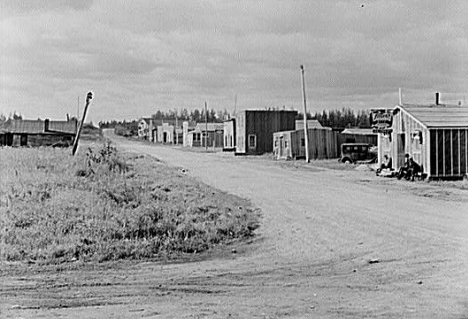
Main street. Craigville, Minnesota, 1937
Main Street, Craigville, Minnesota 1937
Picture Courtesy of Library of Congress
Upon further research, I discovered this picture of Main Street in Craigville, Minnesota in 1937. It wasn't much. Most of the buildings weren't even finished. Logging was its main industry until 1952. During the logging season anywhere between 5,000-7,000 loggers would come into town.

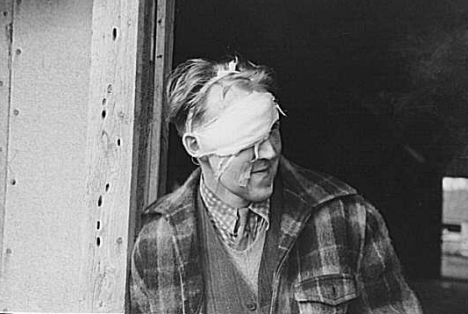
Lumberjack with bandaged head after being beaten up and "rolled" in a saloon on Saturday night in Craigsville Minnesota, 1937
A lumberjack after a brawl in a saloon on Saturday night.
Picture Courtesy of Library of Congress
With the influx of loggers (and their hard earned money), the town was filled with all sorts of criminal activity. Prostitution, murder, theft and bootlegging--to name a few. It was so bad, no one could do anything about it. The town had a terrible reputation, not only in Minnesota, but across the USA.

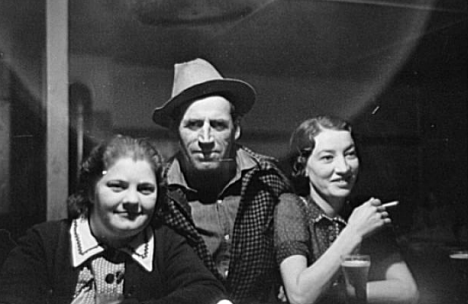
Lumberjack and two "attendants" in saloon of Craigsville Minnesota, 1937
A lumberjack with two "attendants."
Picture Courtesy of Library of Congress
In 1937, photographer Russell Lee visited Craigville and documented the "seedy" lifestyle of the loggers, prostitutes, bootleggers and business owners. If you look closely, this man and his two "attendants" are the same people in the "Saturday Night in a Saloon" picture.

Researching can be an interesting adventure. You never know what you're going to unearth. Some of the stories I read about Craigville made me cringe. It was a dangerous town. I wanted to cry when I read about the prostitutes who inhabited the rough buildings. I always wonder what would lead a woman into such a sad choice. I don't think I'll ever look at this picture the same way.

Craigville is now a ghost town in Northern Minnesota. Some buildings remain, but they're falling apart and overgrown with weeds. The town that brought so much pain, to so many people, is now decaying in the Koochiching Forest.
Photographer Russell Lee
Russell Lee was an American photographer, best known for his work for the Farm Security Administration. He traveled around the United States between 1936 and 1943 documenting various American classes and cultures. Apparently he heard about the notorious town of Cragiville, Minnesota. Many of his photos are in the Library of Congress.

I wonder if Russell Lee had any idea how famous his "Saturday Night in a Saloon" photo would become?

In the words of Paul Harvey: "And now you know the rest of the story."

Have you seen the photo "Saturday Night in a Saloon" before? Did you have any idea what the real story was behind it?

Gabrielle Meyer lives in central Minnesota on the banks of the Upper Mississippi River with her husband and four children. As an employee of the Minnesota Historical Society, she fell in love with the rich history of her state and enjoys writing historical fiction inspired by real people, places, and events. 

Find Gabrielle on Facebook, Amazon, Goodreads, Website, Newsletter