Showing posts with label tornadoes. Show all posts

Saturday, June 11, 2022

When Sky and the Earth Wreak Havoc

Worst Natural Disasters in History 

by Martha Rogers


I've been through many storms from hurricanes to tornadoes to floods, and they have always fascinated me and had me thinking about the results left behind. Our country has seen many natural disasters caused by what insurers call "An Act of God."

When a weather pattern forms circles with a low-pressure center, whether rotating clockwise or counterclockwise, it is technically known as a cyclone. This includes hurricanes and tornadoes as well as larger systems such as a middle-latitude cyclones. Hurricanes and typhoons are two names for the same type of storm--a strong tropical cyclone. The names are interchanged in various areas of the world. Today, we look at some of the greatest ones in history before 1950.

Several years ago I did an entire blog on the Galveston hurricane that devastated the island and caused hundreds of death. It happened before hurricanes had names and is simply known as the Galveston Hurricane of 1900. It hit shore and became the deadliest storm to hit on American soil in history with 140 MPH winds and fifteen foot waves. Estimates of deaths ranged between 8,000 and 10,000 people killed. Even a year later, bodies were found washed ashore. 
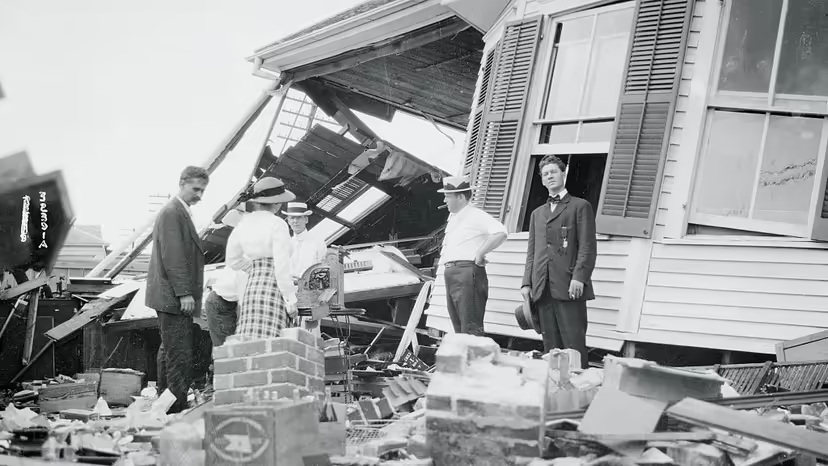

Since then, hurricanes have hit the Gulf and Atlantic coast lines from deep South Texas to both coasts of Florida and up the Atlantic coast on up to Canada. Meteorologists refer to hurricanes as the most deadly storms to hit land. Because of the length of time they take to move through an area and how long they can last, death tolls and destruction runs high.

Most of us remember the more recent ones from Carla, to Camille, to Katrina, Rita, Ike, Sandy, Andrew to name a few. The damage from a hurricane can be as devastating today as it was over a one hundred years ago. Now, the National Weather Service can be much more accurate in their predictions of where the storms will make landfall, how large they are and how fast the winds are.

Most of remember the tornado featured in The Wizard of Oz. That fictional storm took place in Kansas. In reality, Kansas, Missouri, Oklahoma and other mid-west plains states are in the heart of tornado country and what has been called "Tornado Alley." 
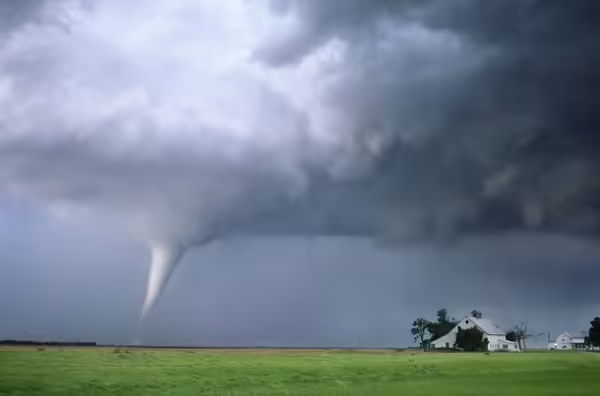

Of all the destructive power of storms, none have the ferocity and form of tornadoes. They come down like a sword from the sky and lash out at their surroundings as though with malicious and mindful intent to destroy. These columns can reach speeds of over 300 mph and measure from a mile to many miles across. They scar the earth and destroy homes and buildings in brief moments of twisting and turning in their fury. 

They year 1925 saw such a storm rage across the mid-west bringing destruction to towns across three states from Missouri to Illinois and into Indiana. The


distance was 219 miles and the tornado traveled it in about three and half hours. Because of the straight path for 183 miles, scientists believe it might have been a family of tornados spawned by a massive supercell storm. It is one of the deadliest and most destructive tornadoes to hit the mid-west states.

In March of1888, a hurricane on the Atlantic coast came ashore as a blizzard that devastated states along the upper coast. Known as the Great White Hurricane, it immobilized cities such as New York with the amount of snow that fell. It paralyzed the East Coast from the Chesapeake Bay to Maine and on up to the Canadian Atlantic coast cities.


Brooklyn, New York in March, 1888
The snow piled high in the streets and kept people indoors for several days. Damage to spring crops like the apple trees in Connecticut ran high, and loss of life. Property damage ran to more than $20 million and 400 lives were lost, include 100 sailors across the east coast. 

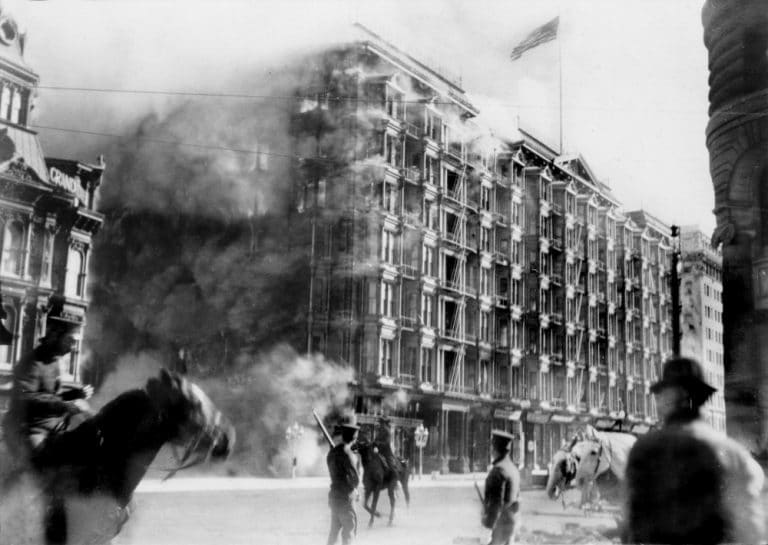
Other natural disasters which took hundreds of lives and caused millions in property damage include the great earthquake in San Francisco. 
This massive earthquake occurred the morning of April 8, 1906 and took the lives of 3,4400 people and destroyed close to 80% of the city. The quake lasted only a minute, but firefighters spent four days putting out fires. Thousands were left homeless and lived in tents.

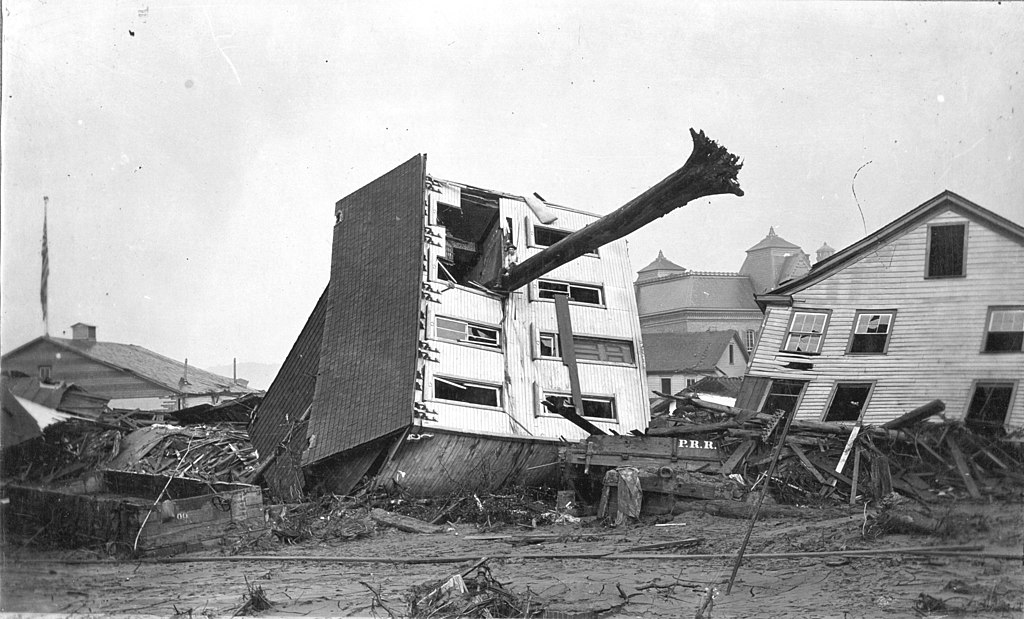
The Johnstown Flood is also listed with the top natural disasters and was the first one attended to by the American Red Cross. It became crucial in the history of natural disasters because of the lack of disaster and crisis management. A combination of heavy rain and a dam break sent 20 million gallons of water into the Mississippi River. This surge of water created a 70 foot high wave of water that traveled over fourteen miles on May 31, 1889. It destroyed everything and everyone in its path.

This is the John Schultz home in Johnstown. As it floated away down the street, a tree skewered it. Miraculously, the six people inside the home survived.

Tsunamis, volcano eruptions, typhoons are other acts of nature that wreak havoc over the land and sea. We can be thankful today for the Natural Weather Service which can warn us of such storms and disasters and allow us to find shelter and safety.

I have featured storms in several of my books. The Great White Blizzard is featured in my book Summer Dream. Have you ever been through a strorm that left behind destruction and/or death? Comment below and leave your email address for a chance at a free copy of this book.

Rachel Winston is the daughter of a minister in Briar Ridge, Connecticut. 
When a friend of her best friend's brother comes to visit, Rachel is attracted to him, but Nathan Reed wants nothing to do with a Christian, much less the daughter of a minister because of tragedy in his own family that caused him to turn from God.

After he is caught in a blizzard and nearly dies, the ministries of Rachel and her mother show him the true meaning of God's love. Now he must make amends with his family for his past and pray that Rachel will wait for him.


Martha Rogers is a multi-published author and writes a weekly devotional for ACFW. Martha and her husband Rex live in Houston, Texas where they are active members of First Baptist Church. They are the parents of three sons and grandparents to eleven grandchildren and great-grandparents to six. Martha is a retired teacher with twenty-eight years teaching Home Economics and English at the secondary level and eight years teaching Freshman English at the college level. She is a member of ACFW, ACFW WOTS chapter in Houston, and serves as President of the writers’ group, Inspirational Writers Alive.  


Thursday, November 10, 2016

The "Mayo" Tornado

Erica Vetsch here:

I live in Rochester, Minnesota, which has a current population of about 110,000 people. Rochester is also home of the world famous Mayo Clinic. Last year, more than 1.3 million patients visited the Mayo Clinic which employs more than 35,000 doctors, nurses, and health care professionals at both the Clinic and the two hospitals run by the Clinic.

Photo Courtesy of http://www.mayoclinic.org/


But back in 1883, the population of Rochester was only 5,000 residents, and there were NO hospitals. So how did a small town in southeast Minnesota become the home of the #1 healthcare center in the United States in 2016 (as per US News and World Report)?

A tornado.

In August of 1883, a series of tornadoes hit SE Minnesota, causing nearly 40 deaths and 200 injuries. An estimated F5 tornado wreaked a path of destruction through the center of Rochester in the late afternoon.

A bit of the devastation caused by the tornado.


With no hospital to treat the wounded, a dance hall downtown was cleared out and Dr. William W. Mayo and his two sons, Charlie and Will, began treating the injured. Sister Mary Alfred of the Sisters of St. Francis Convent in Rochester aided in the efforts.

In the aftermath of the storm, Sister Mary Alfred determined to found a hospital in Rochester. Her only request was that Dr. William Worrell Mayo be the chief physician of the new establishment. The Sisters of St. Francis raised the funds, and by 1889, St. Mary's opened as a 27 bed, 1 Operating Room hospital.

Sisters of St. Francis at St. Mary's Hosptial


The building has been under constant renovation and expansion over the last 125+ years.  Currently, St. Mary's Hospital has more than 1200 hospital beds and more than 50 operating rooms.

An aerial shot of St. Mary's Hospital...it's actually undergoing
a major construction project to enlarge it once again. 


Erica Vetsch is a transplanted Kansan now residing in Minnesota. She loves history and romance, and is blessed to be able to combine the two by writing historical romances. Whenever she’s not immersed in fictional worlds, she’s the company bookkeeper for the family lumber business, mother of two, wife to a man who is her total opposite and soul-mate, and avid museum patron.


You can visit her online at www.ericavetsch.com and on Facebook at Erica Vetsch Author


Tuesday, June 28, 2016

Some of the Deadliest Tornadoes in History Happened Around Palm Sunday


by Tamera Lynn Kraft
 
Throughout US history, super cell tornado outbreaks have been deadly. Early warning systems and storm shelters have helped greatly, but people are still killed by tornadoes every year, and the property damage is extensive. Since tornadoes have been recorded and measured by the National Weather Service, one weekend has proven more deadly than the rest – Palm Sunday weekend.

In my novella, Resurrection of Hope, the 1920 tornado outbreak is a part of the story, but there have been others. Here are the super cell tornado outbreaks.

March 28, 1920


At least 37 tornados hit the Midwest and Deep South. 380 were killed, 1,215 injured including over 200 in Georgia, 56 in Indiana, and 55 in Ohio. 

April 11-12, 1965


In the Midwest states of Indiana, Ohio, Michigan, Wisconsin, Illinois, and Iowa, 47 tornados killed 271 people, 60 in Ohio, and injured 1,500, over 1,200 in Indiana.

April 3-4, 1974


The second largest outbreak in US history happened 3 days before Palm Sunday. 148 confirmed tornados hit with 30 F4/F5s.  It struck the states of Illinois, Indiana, Michigan, Ohio, Kentucky, Tennessee, Alabama, Mississippi, Georgia, North Carolina, Virginia, West Virginia, and New York and destroyed the city of Xenia, Ohio. On September 20, 2000, another F4 took the same path through Xenia, destroying the town again. Because warning sirens were in place, this time, it only killed one person.

March 27, 1994


This tornado outbreak killed 40 people and injured 141. 29 tornados struck Texas, Alabama, Georgia, South Carolina, and North Carolina. Goshen United Methodist Church in Piedmont, Alabama was struck during a Palm Sunday service where 21 people died.


Tamera Lynn Kraft has always loved adventures and writes Christian historical fiction set in America because there are so many adventures in American history. She has received 2nd place in the NOCW contest, 3rd place TARA writer’s contest, and is a finalist in the Frasier Writing Contest.
Her novella, A Christmas Promise, is available on Amazon. Her novella Resurrection of Hope will be released next month.

Wednesday, May 18, 2016

The Finger of God

By Alanna Radle Rodriguez

My fascination with tornadoes started at an early age. From my first experience of running from a tornado in a vehicle when I was almost five on May 8th, 1986, to my experience directing storm spotters in a local civil defense department on the acclaimed May 3, 1999 when I was 17. It didn’t help when the movie Twister came out twenty years ago on May 10, 1996. It only made me want to become a meteorologist more. When a character was asked in the movie what it was like being in the tornado, the reply was, “The Finger of God.” Hence the title. It’s tradition in my house to watch the movie as we usher in the current year’s tornado season, as inaccurate as the movie is. My goal was to become a meteorologist. With poor math skills, that dream was killed by high school graduation. Although I still find myself “arm-chair storm chasing”.

There is something tantalizing, hypnotically beautiful about the dancing, swirling column of clouds tearing up landscape, eating livelihoods, and claiming lives as its own. As I sit here working on this on May 9th, the tv is on one of our local stations doing live footage of a killer tornado down in Katie, Oklahoma. A multi-vortex, counter-clockwise twister. Although the spinning, earth-eating monsters are common, the multi-vortex and counter-clockwise spin is a rare occurrence and tells of great strength and power of the tornado. But as I watch the live footage and think about past experiences, I can’t help wonder what the people of the plains a century and a half would have done.

Pictures litter the web of “oldest know photograph of a tornado”. CYCLONE NEAR WAYNOKA, OK MAY 1898. AUGUST 28, 1884, 22 MILES SOUTHWEST OF HOWARD, SOUTH DAKOTA. Some even have the same cloud formation with different landscape. OKLAHOMA CYCLONE, NO. 1 & 2 COPYRIGHT 1892 by North Losey, Oklahoma City, Okla. Are examples. I’m not debating that there wasn’t a “photoshop” trick that even photographers of that age could do with the glass frames and put different backgrounds to different landscapes. But what did the pioneers do with tornadic activity? They didn’t have storm spotters to keep them warned, or doppler radar to see a forming hook echo, or softball sized hail coming towards their farm. They didn’t have tv to inform them that the supercell mesocyclone heading straight for their home or town. No, but they did have a few things that we have today. Past experiences, they kept an eye on the skies. And dugouts. Wait, what? We don’t live in dugouts today. True, but let me explain. What were dugouts? They were holes dug out in either the ground or in the side of a hill. Sometimes they were incorporated with sod houses, structures that were made out of grass and the underlying dirt and root system. They provided excellent insulation and the dugout was a natural root cellar to keep foods stored and a storm shelter! So, in a way, the settlers of our great American West were lightyears ahead of us today.

I have a friend who is originally from Montana and now lives in Oklahoma said, “I can’t understand why homes in Tornado Alley don’t have building codes to have a storm shelter of some kind in every home. Like California has codes for earthquakes and some states in the east a certain degree of pitch in the roof for heavy snow fall.” A very good question! Why haven’t Tornado Alley homes been built with some kind of shelter in them? Then again, why aren’t any of the homes built to a universal measurement to allow a wheelchair through, or an ambulance stretcher? That’s a topic for another time. While I am a bit jealous of the natural insulation of the sod houses and dugouts, I will admit that I do not mind missing the muddy drips from the rain soaked dirt roofs, the snakes coming out of their holes in the walls. Oh! I won’t be missing a cow or horse stepping through the roof! Makes sense though. Roof is part of the pasture!
 
Born and raised in the Edmond, OK area, Alanna Radle Rodriguez is the great, great, granddaughter of one of the first pioneers to help settle the area around what is now Seminole, Oklahoma. The fourth generation in a line of women in her family to be born in Indian Territory/Oklahoma, she has lived in her beloved state all her life. With her knowledge of surrounding area history, her heart relishes in volunteering at the Oklahoma Territorial Schoolhouse in Edmond. She lives with her husband and parents in the Edmond area, currently working on a historical romance set in pre-statehood Waterloo, Oklahoma.

Wednesday, February 17, 2016

The Waco Tornado of 1953

By Golden Keyes Parsons

Waco, Texas, is the site of many interesting historical happenings, but one that locals still talk about is the F5 tornado which hit the downtown area on May 11, 1953. It is the 10th worst tornado in the nation. The irony was that an Indian legend held Waco was immune from tornadoes because of the surrounding bluffs of the Brazos River. Most of the locals believed the legend, and so were not alarmed when the weather began to deteriorate and throw the small city into eerie darkness. A geology professor at Baylor University did research on the situation after the fact and found that the opposite is true. Waco sits upon a geological formation which actually makes the town more vulnerable to deadly tornadoes.

Through the years I've heard stories from two friends about the tornado that fateful day when 114 people lost their lives, 597 were injured, 600 houses destroyed, along with 1000 other buildings, and 2000 vehicles. One was a Baylor student who went his friends to the downtown area which was where the tornado hit to pull people out of the rubble. He tells of extricating bodies of those who perished as well as the injured. 
Another friend tells about her father who was on the upper floor of the medical buildings which was hit and rode the building as it fell and emerged unhurt.

Another interesting story emerged of a dentist who was working on a patient with a radium needle used to treat mouth cancer. The dentist was injured and when he woke up in the hospital, he immediately inquired about the needle. A team of
physicists from Baylor University took a Geiger counter and went to the ruins of the building to search for the dangerous object. They did find it in the rubble of the basement and took care of the problem. 

The destruction of the 1953 tornado in Waco was one of the primary factors in developing a nationwide severe warning system. 

We now live in Waco, and in the eight years we've been here I would say that every tornado season we do have several instances of tornado watches (conditions are favorable for a tornado), and of tornado warnings as well (tornadoes have been sighted -- take cover!). I have lived through one tornado, but it was not here in Waco, but in East Texas, north of Tyler. We were running a conference center at the time, and the twister hit the dorm, jumped over our house, and moved on. The devastation to the dorm was stunning ... bunk beds and mattresses thrown into the woods, but the hymn book was still sitting on the piano. We were grateful to God nobody was hurt. Have you ever experienced a tornado first hand? I would love to hear about it. Leave a comment below!


Although a multi-published fiction author, Golden Keyes Parsons’ first published non-fiction work, Spiritual Spring Cleaning, (BoldVision Books) just released in April 2015. Her series, Darkness to Light, (Thomas Nelson) chronicled the journey of her ancestors in 17th century France and was a finalist for ACFW’s Debut Author of the Year in 2008. Her fourth novel, His Steadfast Love, a Civil War novel, was a National Readers Choice finalist. Parsons has also written a biblical fiction series entitled Hidden Faces, Portraits of Nameless Women in the Gospels (WhiteFire Publishing). Golden lives in Waco, TX, with her husband, Blaine. www.goldenkeyesparsons.com