Showing posts with label waffles. Show all posts

Wednesday, January 26, 2022

Waffling on the Idea?


  By Cindy Regnier 

Hubby likes to indulge in a waffle supper on occasion. He is convinced they are far better than pancakes, though I can’t see the difference beyond one being baked and the other fried. So how did someone sometime envision a waffle made from pancake batter? When the hubs suggested I look into it for a blog post, I kind of pooh-poohed the idea. Waffles can’t be old enough for an historical blog topic. You need non-stick waffle irons and electricity to make them – right? Nope. I stand corrected. What I found out was really quite interesting. Waffles have been around for hundreds of years, maybe even since the 13th Century. Not waffles like Americans know and love them today, but waffles nonetheless. Here’s what I learned:

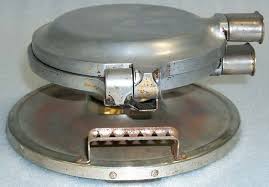
The first waffle irons with the characteristic honeycomb pattern appeared in the 1200’s when a craftsman designed and forged cooking irons. 
The original irons were hinged and the batter poured in and pressed together, much like we do today. The first waffles were baked over an open fire, of course, rather than with electricity, but they quickly became quite popular. This time period is when the word “guafre” was coined. The English adaption of this French word became “wafla.” You can still find this printed word in some old English recipes.

As the hand forged waffle irons required to make them were scarce, most waffles were sold by street vendors. By the 16th Century, they were a well-known staple for all social classes. The poorest folks made them from basic flour and water, more like a thick biscuit while the more well-to-do added ingredients like eggs, milk, and honey. In the 1800’s Waffle “Frolics” or parties become the rage in the South. Guests topped their waffles with sweet molasses or syrup. Some even used a savory kidney stew So guess where the popular-today southern treat of Chicken and Waffles originated?

The first waffle iron patent was issued in1869 to Cornelius Swarthout of Troy, New York.

The anniversary of the patent marks what’s now known as National Waffle Day – August 24. By 1911 the first commercial electric waffle iron was created by General Electric, and by the 1930’s the appliance became a staple in the American kitchen.

But what about those things we pull out of the freezer and stick in a toaster? “Eggo” was introduced in U.S. grocery stores in 1953, originally called “Froffles,”. The name changed in 1955 because everyone referred to them as “Eggos” due to their eggy taste.

Belgian waffles, as we know them today, debuted at the New York World’s Fair in 1964 with an enterprising vendor selling his wife’s recipe for Brussels waffles—fluffy yeast waffles with strawberries and whipped cream. Apparently he changed the name to Belgian from Brussels so they weren’t associated with those little green vegetables so many of us find distasteful! 

If you love waffles , I hope you remember some of these fun facts the next time you treat yourself. Just for fun let me know how you like to eat waffles. Savory or sweet? Syrupy? Lots of butter? Just between us, my favorite way is plain and toasty, straight from the waffle iron. 


Rand Stafford isn't looking for true love. He'd ridden that trail until his fiancée left him with a shattered heart. What he needs now is a wife to help him care for his orphan nieces. Desperate, he sends an advertisement to a Baltimore newspaper and hopes for the best.
   Fleeing her former employer who would use her to further his unlawful acts, a newspaper advertisement reads like the perfect refuge to Carly Blair. The idea of escaping the city, the intrigue, and the danger to hide herself on a cattle ranch in Kansas is her best shot for freedom.
   But its sanctuary comes with a price—a husband. While marrying a man she doesn't know or love means sacrificing her dreams, it's better than being caught by the law.
   Or is it?

Tuesday, September 28, 2021

The History of Breakfast (with giveaway) By Donna Schlachter


Photo by Daria Shevtsova from Pexels

Breakfast—who doesn’t love the smell of bacon and coffee in the morning? Makes the whole getting up part of the day worthwhile. Of course, not everybody favors this meal, and in some cultures, they don’t even celebrate the sunrise or the new day ahead by digging into a platter of food.

So how, then, did breakfast come about?

Actually, the word “breakfast” didn’t come into common usage until the 1400s, when the term meant breaking the fast. Prior to that, eating food in the morning was called "partaking of the morning meal".
Photo by Rachel Claire from Pexels

 
In Ancient Egypt, bread made from wheat, falafel, fava beans, onion, and other spices comprised their daily meal, usually in the morning, before they went to work. Yes, the peasants ate but once a day.

Later, in Greece, Homer mentions a meal eaten shortly after sunrise, particularly by laborers eager for something light to start their day. Barley bread dipped in wine, sometimes accompanied by figs or olives, fed the body if not the soul. Pancakes of varying recipes, topped with honey, sesame, and cheese, came later.

In Rome, everyday staples like bread, cheese, salad, and meat left from the previous night were consumed, along with wine mixed with honey and spices. At some point, two other meals were added per day.

During the medieval period, breakfast lost favor when the time spent around the table was reduced to twice a day, midday and evening. Children were often the exception, as well as the elderly, the sick, and heavy laborers, who might be granted a morning meal of a piece of bread and a bit of cheese.

By the 1400s, however, meat was now included, and the rich indulged in breakfast, making it a more common practice. By the end of the 1500s, breakfast was now customary, including coffee and tea, which were believed to aid in evacuation of “superfluities”.

Most cultures consume some kind of meal in the mornings nowadays, reflecting the local products available. In Africa, fruit and vegetables in season, along with milk and meat, comprise the meal. In Europe, the croissant originated in Vienna in 1863, and by 1875, had become standard fare in French breakfast.

As with most things, warnings abounded in the early 1500s that breakfast wasn’t healthy since dinner wasn’t yet digested. However, by the latter part of that century, public and medical opinion contended that breakfast was the most important meal of the day.

In the United States, waffles were introduced by pilgrims from the Netherlands. Pioneers consumed breakfasts featuring cornmeal-based breads and cereals, cooked in various manners such as corn pone, johnnycakes, and corn dodgers. After the Civil War, ham-and-egg sandwiches were popular but not relegated to the morning meal. The first breakfast sandwich recipe was published in a cookbook in 1897.

Hot and cold cereals have been popular in America since the 1800s, caused by a movement that contended that the consumption of eggs, pancakes, bacon, and coffee was too indulgent. Canned juices became popular in the 1900s after the discovery of vitamins, with orange juice the favorite overall.

Most of the heroines I’ve written about struggled with cooking, usually because they weren’t taught to cook when they were living with their mother. Many of our own breakfast traditions arise from our family experiences, although I’m always game to adopt a new dish, so long as it isn’t too spicy.


Giveaway: leave a comment to enter a random drawing for an ebook copy of “Hollenberg Hearts”, my latest Pony Express release.


About “Hollenberg Hearts”:

Catherine Malloy escapes a poor past in response to a mail order bride ad her best friend answered. However, Margaret dies before meeting the man who owns horses and property in Kansas.

Benjamin Troudt works for the Hollenberg family at their way station in Kansas, and owns nothing but the clothes on his back. Unbeknownst to him, his pastor is corresponding with a potential wife from back East for him.

When Catherine, now calling herself Maggie, arrives, Benjamin knows nothing of the pastor's match-making, and rejects her. However, a seriously ill pregnant woman needs tending. Perhaps Maggie can prove herself useful.

Not only does she do just that, but she finds herself attracted to the very man who is looking for ways to send her away.


About Donna:

Donna writes historical suspense under her own name, and contemporary suspense under her alter ego of Leeann Betts, and has been published more than 40 times in novellas, full-length novels, and non-fiction books. She is a member of several writing communities; facilitates a critique group; teaches writing classes; ghostwrites; edits; blogs regularly; and judges in writing contests.


www.HiStoryThruTheAges.com Stay connected so you learn about new releases, preorders, and presales, as well as check out featured authors, book reviews, and a little corner of peace. Plus: Receive a free ebook simply for signing up for our free newsletter!

www.HiStoryThruTheAges.wordpress.com

Facebook: www.Facebook.com/DonnaschlachterAuthor

Twitter: www.Twitter.com/DonnaSchlachter

Books: Amazon: http://amzn.to/2ci5Xqq

Etsy online shop of original artwork: https://www.etsy.com/shop/Dare2DreamUS


Resources: https://en.wikipedia.org/wiki/History_of_breakfast