Tuesday, May 7, 2013

History, Romance and Los Angeles by James Scott Bell


I am thrilled to have James Scott Bell with us today as a guest blogger, and I want to thank Jillian Kent for connecting us. Please give Mr. Bell a warm CFHS welcome. Take it away James.
 
I never thought I’d write a historical with a strong romance element, let alone a series of them.

Back in the late 1990s I was all about thrillers. Legal thrillers mostly. But a writer (one who is going to be any good, at least) has to follow where his wild mind leads.

One day mine led me to what I thought was a pretty good idea. Legal thrillers were getting to be a crowded category. What could I do that was different? How about a historical legal thriller with a woman as the protagonist?

That held great possibilities, because the further back you go the fewer women you find practicing law. I thought about setting, too, and found one that has hardly been touched: the history of my own home town, Los Angeles, at the turn of the last century.

Perfect! In 1903 women were just starting to enter the legal profession. What if I had a young, idealistic woman arriving from back East, who wanted to be a trial lawyer? All sorts of delicious possibilities ensued.

That idea became the Kit Shannon series published by Bethany House. These books have now been re-published as e-books. You can read about them here. Bethany thought to team me up with one of their popular romance writers, Tracie Peterson, so she could “show me the ropes” as it were. We did the first three books together, then I did three on my own, and it felt great. Tracie and I developed a voice together, and I was able to carry that on. I had evolved!

What I like about historicals is that they are fixed in time. You don't have to worry about new technologies being invented, which sometimes happens right after you finish a book!

It was also nice to revisit what I consider to be the superior rules of romance. The civility, the restraint, the courtesy, the courting. The romantic dance required that you learn some steps. You didn’t just let it “all hang out,” which was the cry of the 1960s and is now the tired default setting of our culture.

I really got into the research. Big time. I compiled two huge binders of notes. I went to used bookstores and got books from the time and also reference books dealing with the period. For awhile I lived at the downtown branch of the Los Angeles public library, poring over the microfiches of the Los Angeles Times and The Los Angeles Examiner (the Hearst paper).

There was a time when I was so immersed in the period that I could close my eyes and feel like I was walking the streets of 1903 Los Angeles, with Kit Shannon in front of me. I tell you, if life was The Twilight Zone I might have gotten stuck there.

And I love Los Angeles as a setting. I'm third generation here. My grandparents built a house in Hollywood in 1923 that is still there. (My wife and I recently went to see it again, and the owner was there and let us in. Brought back all sorts of memories of when I was a kid spending the weekend with my grandparents! Memories of taking the bus with my grandmother down Hollywood Boulevard, to go to J. J. Newberry's and maybe the Chinese Theater for a movie. And memories of what they did every Saturday night: watch Lawrence Welk. Well, at least I liked the tap dancer).

Here are some interesting notes about my town over a hundred years ago:

1903: Eggs priced at 15¢ a dozen was considered expensive.

1904: Albert Kinney builds fifteen miles of concrete canals radiating from a core he hoped to turn into a cultural center. It was modeled after Venice, Italy, and so bore that name. People stayed away until he replaced high artistry with vaudeville acts and sideshow freaks. Then Venice thrived! (This is sort of a metaphor for Los Angeles itself).

In those days, police rode horses and wore the "rounded" type of police hat.

1904-Buffalo Bill parades down Broadway.

In 1905 you could buy an Oldsmobile Runabout for $675. The luxury Pierce Stanhope would cost you $1450.

You could get a turkey dinner for 25¢.

Stenographers made $10/week.

In those days, in the city, doctors reported that cases of depression and anxiety were on the increase (boy, what would they think of today?) Only back then they called it "Agitated melancholia."

1907-The movie industry begins when part of Selig Polyscope Company's version of The Count of Monte Cristo is filmed at the beach. Los Angeles weather draws more producers from the East.

It was also a time of religious hucksterism (not much has changed!) You had a plethora of seers, sages, swamis and snake-oil salesmen on the loose. And they advertised in the papers and city directory. One such ad from 1904:

Romanya, the Gypsy Queen, 345 S. Main

"I tell all. Settle lovers' quarrels, re-unite the separated; tell whom and when to marry; how to control and win the one you love; how to overcome enemies. A visit will convince all. Skeptics and unbelievers invited."

Most important of all, for me, was that the courtrooms of the era were wide open and rollicking. The man many consider the greatest trial lawyer who ever lived, Earl Rogers, was hitting his stride in 1903. So I made him a prominent character in the series. (That's another thing I enjoyed doing: putting real historical characters into the books, acting and speaking consistent with the research I did on them.)

After all the research and writing, I became devoted to Kit Shannon. My original intent was to write the series so she spanned the decades, right up to the 1960s. Now, with digital publishing available, maybe I still can.

But the readers will decide.

Thanks for having me here today. 


James Scott Bell is a multi-bestselling author and writing coach. His Plot & Structure (Writer's Digest Books) has been a consistent #1 bestseller since it's publication almost a decade ago. His latest project is the fiction writing software program, Knockout Novel, which does not require downloading and can be used to deepen any novel or novel-in-progress. Visit his website at www.jamesscottbell.com.


he courtrooms of 1903 Los Angeles are a man’s world––until Kit Shannon arrives
With shoulders squared and dreams set high, Kit Shannon arrives in Los Angeles feeling a special calling to the law. Yet under the care of her socialite aunt, Kit quickly comes to realize that few understand her burning desire to seek justice and practice a profession known only to men. When her aunt adamantly refuses to support her unconventional career aspirations, Kit questions whether she is truly following God's will. And when her growing love for a man pledged to another threatens scandal, Kit knows her days might be numbered in Los Angeles.

A chance meeting with Earl Rogers, the city's most prominent criminal trial lawyer, garners Kit an apprentice position. And work on a notorious murder case. Someone has been killing prostitutes in Los Angeles, but Kit is certain it is not Rogers’ client. Determined to find the truth, Kit runs full on into forces that want to stop her, forces that stretch all the way to the citadels of power in the City of Angels.


Monday, May 6, 2013

Chimney's Made of Cats? MEEOWWW! ~ Ramona K. Cecil


While researching my latest released novel, Heart’s Heritage, I came across the term “cat-and-clay chimney.” The phrase sparked both curiosity and a tinge of horror. I couldn’t help envisioning my childhood pet, Fluffy, and scores of his feline brethren plastered among the stone and mortar of a log cabin’s chimney.


Relax, all you cat lovers. Like me, I’m sure you’ll be relieved to learn that no cats were ever injured or killed in the making of any chimneys—at least not that I know of. “Cat-and-clay” actually refers to a kind of chimney construction using sticks and clay instead of bricks or stones. The “cat” part of the term is from the old Scottish language and refers to oblong rolls of pliable clay mixed with weeds, grass, horsehair; anything at hand that can help to reinforce the clay and hold it together.

The cat-and-clay, or also known as “mudcat” and “stick and mud” construction appears to have been brought to America by early Scottish and Irish immigrants. When early pioneers—many of Scots-Irish heritage—build their first homes on the American frontier they found an abundance of clay and wood, but not always an abundance of good stone. Or in some cases they simply needed to construct a sturdy cabin quickly and didn’t have the time or manpower to lug tons of stone to their building site. While the man/men of the family constructed the chimney’s wooden frame, the women and children could easily fashion the clay and grass “cats,” which were a 
lso used as chinking between logs of the cabin’s walls. Even when field stones were accessible, cabin builders would often use them only in construction of the chimney’s hearth and firebox to about four feet high. Finishing the upper part of the chimney in cat-and-clay made the job go much quicker.
           
A man named Oliver Johnson recounts in his reminiscences of Early Marion County in A Home in the Woods, Pioneer Life in Indiana:
“When the back wall and jam was laid up with mud cats to the top of the frame, the chimney was started. It was cribbed up out of oak sticks, two laid one way and two the other, with a layer of soft clay under each stick. As you was goin’ up the chimney, you kept reachin’ down on the inside and outside with handfuls of soft clay to smear on a good coat.”

There were drawbacks in this type of chimney construction, which Johnson also chronicled in his reminiscences admitting: “The heat and the rain would cause the clay to fall out. When that happened, you had to tear down the chimney and build it over. Once in a while it would catch fire, and then you had to run out and grab a pole, jam it back of the chimney and pry till it fell over.”

Spring came late to Indiana this year. We’ve found ourselves continuing to rely on the furnace’s heat deep into April. But the next time a shiver compels me to trudge over to the thermostat to bump it up a degree, I don’t think I’ll grumble. At least I didn’t have to build a chimney made of cats.  


Ramona K. Cecil lives in southern Indiana, where she writes historical romance novels for the Christian market. Most of her stories are set in her native Hoosier state as was her latest, Heart's Heritage, which released in January. You can check out Heart's Heritage and her other books at www.ramonakcecil.com.


Sunday, May 5, 2013

FEEDING AN ORPHAN INFANT IN THE 1890S - Lena Nelson Dooley


I just love all aspects of research. Here's some valuable information I uncovered while writing a western novel.

While writing my Summerside Press book, I came up against a problem. The heroine and her two servants needed to travel from Boston to Golden, New Mexico, by train. On their journey, they would also take an orphaned baby. My dilemma? How to feed the baby. The year is 1892.

I knew that when a mother died, a wet nurse (a mother who was nursing her own infant) would often step in and keep the baby alive. Or the people with the motherless baby would hire a wet nurse. On wagon trains, when a mother of an infant died, other nursing mothers on the wagon train helped feed the child. All this information wouldn't help me.

In my search for information, I found out that the first commercial infant formula was invented in Europe in 1869. The powdered formula was added to warmed cow's milk. A version of this formula was also sold in the US that same year. However, the cost of $1.00 per bottle was prohibitive for most families.

Henri Nestle created a formula, also in Europe, to treat malnourished babies. This formula didn't require adding cow's milk to the powder. When mixed with water, it was the first complete formula. In 1870, Nestle brought his infant formula to the US. It sold for only $.50 per bottle, still a rather high price for most families. But through marketing, this product was available worldwide, including throughout the whole United States.
I'm sure the Nestle name is familiar to you. If you go to the Nestle website, you find that the company is still very active in helping underdeveloped countries feed their babies.

I decided to use Nestle Infant Food in my story.

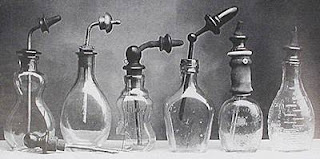
I own a 1897 Sears and Roebuck catalog. In that book, there are a number of formulas available for order. And the nursing bottles are quite interesting. There is one shaped like a banana. Others are teardrop shaped clear glass with writing molded into the side. I've chosen to use the teardrop one to symbolically fit with the tears over the loss of the mother.

And they even had three different colors of rubber nipples in that catalog. Here are some other shapes of baby bottles and nipples.

I love the way that research leads me to so much interesting information.


Actually, in my newest series, McKenna's Daughters, the three heroines lost their mother soon after birth on a wagon train, so I was able to use the nursing mothers filling for their loss. So often as an author, we are able to use the information we uncover more than once in our books.

Identical triplets born on one of the last wagon trains on the Oregon Trail were separated at birth because their mother died giving birth. They don't find out that they have sisters until near their 18th birthday. Each book is one sister's story. They're available in bookstores everywhere and here:
Maggie's Journey (McKenna's Daughters)
Mary's Blessing (McKenna's Daughters)
Catherine's Pursuit (McKenna's Daughters)

Saturday, May 4, 2013

The Welsh in Me

Louise Gouge here, still exploring my ancestry, and having to work hard to find information about my Welsh lineage briefly mentioned by my parents and grandparents and confirmed by DNA.

Who are these people?

When I think of the Welsh, the only ideas that come to mind are towns with interesting and hard to pronounce spelling (with very few vowels to help us); homey thatched roof cottages; and gorgeous movie stars like Catherine Zeta Jones, Ioan Gruffud, and Anthony Hopkins. I also think of Kenneth Branagh, playing Shakespeare’s Henry V and proclaiming in Act IV, Scene 1, “I am a Welshman!” And of course we all know that the heir to the British throne has been designated the Prince or Princess of Wales since the sixteenth century (though possibly as far back as 1301).


But what other important information should we know about Wales?
Historically, the Welsh known to be a Celtic people, as are the Scots and Irish. The Celts were nomadic and traveled all over Europe, leaving their imprint in many places from Turkey to the British Isles. If you enjoy all things Celtic, you may want to invest in a wonderful BBC series called The Celts, a two-disk DVD set that transports you to a long distant past and explains much about how these people branched out into so many people groups. Find more information at http://is.gd/p1Ffgt, where I found the following information:

A very brief and ridiculously incomplete history

Like most of Europe, Wales emerged from the Dark Ages as a feudal society. Urban centers were few, with Cardiff boasting a whopping big population of 2,200 by 1300. Wales, you see, was an agrarian society, and most everyone lived and worked on a farm. Prior to the Norman invasion in 1066, women held a surprisingly high status in regard to property and rights over their children. In the 1500s, the Welsh became a part of the Protestant Reformation under England’s Tudor dynasty (though not during the reign of Mary I, of course). From that time on, with what is now called “the Act of Union,” the two countries almost seemed a single entity. The Welsh appear to have been more accepting of English rule than the Scots or Irish, and perhaps that helped them to blend. But please understand that I come to this conclusion from just a cursory online glance at Welsh history. If I were to speak to a Welshman, I would doubtless hear a very different viewpoint. (Picture above of Cardiff Castle by Million Moments (Own work) [GFDL (http://www.gnu.org/copyleft/fdl.html) or CC-BY-3.0 (http://creativecommons.org/licenses/by/3.0)], via Wikimedia Commons)


There is a picture of a beautiful and majestic Welsh Cross at www.dreamstime.com/welsh-cross-stock-photography-imagefree6858802)

Sorry that I can't go deeper.
To keep this blog short, I’ve only scratched the surface of Welsh history, yet I have a strong conviction that any people group in my lineage deserves much deeper study. What really makes me sad about my Welsh connection is that I know of no celebrations in America that are attached to Wales, such at St. Patrick’s Day for the Irish in me or Scottish Highland Games for my Scottish roots. When I looked for "costumes," one "official" site said the “traditional” Welsh costumes are 19th century inventions. Again, it would take deeper research to discover the truth about that. On the other hand, a quick search for Welsh food comes up with lots of mutton and vegetable recipes (yum!) and the note that the Welsh love a hearty breakfast. So that's where I get my love of breakfast!

Regarding dances, I also learned that some Welsh religious reformers saw dancing as sinful and so abolished it. I'm guessing that they might have been abolishing the pagan rituals of the past, because the Welsh dancing I've found online is quite sweet and very similar to our energetic American folk and square dancing. Check out this YouTube video for a peek at the dancing and to listen to the announcer speaking in Welsh. http://www.youtube.com/watch?v=pIOS19WzEZM

Regarding literature, one must of course mention Dylan Thomas and his lovely poetry. (I personally plan to “rage against the dying of the light” when my time comes!) Who hasn't studied him in lit classes? Also at YouTube, you can find video of the poet himself reciting his verses.

But what else?
Clearly, I need to do a deeper study of my Welsh ancestry. In the meantime, if you know anything about Welsh culture, please leave a comment and tell us all about it. I’m sure I’m not the only one lamenting my ignorance on the subject!


Florida author Louise M. Gouge (left at Busch Gardens/Tampa) writes historical romance for Harlequin’s Love Inspired imprint. She also teaches English and humanities at Valencia College in Kissimmee, Florida. Her July 2013 LIH novel is A Lady of Quality, a Regency romance.

Friday, May 3, 2013

HISTORY OF THE TYPEWRITER - Cynthia Hickey

Imagine writing a book without the ease of a computer. What about a typewriter. Even a typewriter would be easier and faster than writing an entire novel by hand. Right? Well, maybe. In 1829, William A. Burt received a patent for his machine called a typographer: A wooden box with a swinging lever on one end used for impressing. The typeface letters were attached on the underside of the lever. Pressing down imprinted the letter on the paper. When finished, you tore off the paper like a paper towel. Unfortunately, Burt’s invention took longer than writing by hand. He improved his invention six months later to no avail. Although his inventions did a good job of typing neat letters, he couldn’t generate enough interest to make the machine a success, and Burt died without his typographer being in demand. When his printers went on strike, newspaper man, Christopher Sholes, tried his own unsuccessful attempts at inventing a typesetting machine. Finally, frustrated at his failure, he enlisted the help of another printer, Samuel Soule, and invented a number machine. A third friend, Carlos Glidden, amazed at this invention, suggested a version to type letters. In June of 1968 they received their patent and created a machine that broke more often than it worked. A fourth man, James Densmore, entered the mix and bought out Soule and Glidden. He furnished the funds to make thirty machines, each one better than the one before. In 1871, they felt they were ready to begin manufacturing. In 1873, the men offered their machine to the gun manufacturer, Remington and Sons. They were offered either a lump sum or royalties. Sholes took the cash and received twelve thousand dollars. Densmore chose the royalty and received a million and a half. I wonder if during their frustrating times of trial and error, any of these visionary men knew just how much their invention would change the world? How much it would improve the working conditions of women or how much their invention would change over the years? In my second Harvey Girl novel, releasing spring of 2014, my main character is all about modern things. Hair, clothes, speech. I can’t help but wonder how this feisty gal would have handled something as amazing as a typewriter. I wrote my first story on this typewriter of my mother’s. Last year for Christmas, my son found one at a garage sale and bought it for me. While I don’t type my stories on it, preferring the ease of a laptop, we leave each other messages. I love the clackety-clack of it’s keys. What did you type your first story on or did you choose to write it by hand? Leave a comment for a chance to win a $10 gift card to Amazon. And stop by my newly designed website to say howdy! www.cynthiahickey.com

Wednesday, May 1, 2013

1915 Ford Model T by Christina Rich

Last month I told you I was saving my favorite car for last, and so I have. I'm super excited to introduce you to the 1915 Ford Model T.

 One of the reasons I love this car so much is because of the excitement surrounding it. Obviously these folks aren't quite old enough  to have been around when this car came off the production line, but it didn't stop their enthusiasm. And let me tell you, it was contagious. It was because of them that I went back and started taking pictures of some of the minor details on the other cars.

I just loved this lady with the hat. She was full of giddiness and smiles. It was like her first time sitting in a car. It wasn't hard to imagine a younger version back in the early 1900s preparing for a nice, quiet drive in the country with her beau.


You should have seen her when she pushed the horn. She jumped back and giggled like a school girl as its unique ahoogah cry echoed through the mall.

According to one of the forums I came across, the 1915 Model T did not come out of the factory with this particular horn. However, this horn, also known as the Hand-Klaxon is period correct, although from most of the pictures I've come across, the actual horn part was brass in color and not the black you see in my photo.


 Aren't these cool? I asked the owner if the goggles were for effect. Turns out he had to drive his car with the top down and it was just too cold that morning to drive without his eyes unprotected.

Still, I think they added the perfect touch.


I don't know why, but I find these outer compartments fascinating. I kind of wish my SUV had one so the tools wouldn't clutter up the back. The black box might not be too appealing to the eye, but I think it gives the car character. It screams luxury and practicality all at the same time.


Have you ever seen a key to one of these cars? I hadn't. For some reason I imagined them to be a cross between our modern keys and those old skeleton keys you see pictured with antique locks. Boy was I wrong.
 
When I saw the owner pull it out of his pocket I knew I had to take a picture. It kind of looks like something my grandma had used to wind up an old music box she had.  And what's cool, this key would start other cars, too.
And now for my favorite part of this vehicle. Isn't that cool?

These side lamps were lit with kerosene.


As were the tail lamps.It would have been nice to see this one lit too, but there is enough here to make the rest up in my imagination.


Now for something even cooler. According to the owner of this vehicle, the 1915 was the first model that came with the kerosene side lamps as well as the brass-rimmed electric headlights. Prior to this year, all headlights, or head lamps were powered by an Acetylene Generator on the running board and fueled by Acetylene Gas. Like the side lamps, the driver would have to light the gas, which sounds kind of dangerous to me.


Well, that ends my tour of some of the 20th century's early motorized vehicles. I hope, if you hadn't already, you came away with a bit of appreciation for these antiques that are such a huge part of history.


Born and raised in Kansas, where she currently lives with her husband and children, Christina loves to read stories with happily ever afters, research,  take photos, knit scarves, dig into her ancestry, fish, visit the ocean, write stories with happily ever afters and talk about her family and Jesus.
A semi-finalist in the Genesis, she just recently signed two contracts with Love Inspired Historical for a Biblical romance. You can find her at http://christinarich.wordpress.com/


Inventions and Their Patents—and a Giveaway!


By Kathleen Y’Barbo

            The nineteenth century was known for great advances in science and industry. The latter half of the century brought about the mechanization of business, an increase in higher learning, and the age of machines that ushered in the Industrial Revolution.
            I am currently writing a book series that centers on inventions and inventors. After creating a few fictional discoveries, I wondered just how my characters might go about filing for and receiving patents on these inventions. The process, as it turns out, is much simpler than I expected.
            The United States Patent and Trademark office has declared that there are three types of patents: utility, design, and plant patents. Utility patents are awarded for processes, machines, or other compositions or for improvements to these things. Design patents are just that, a patent given for creation of a design. Finally, plant patents are given to those who invent or discover new varieties of plants.
            Before making a request for a patent, a patent search must be done. This is generally where an inventor will bring in an attorney who specializes in this area. My research showed that there were only a few attorneys who specialized in working through the details of patents during the latter years of the nineteenth century. Harry A Toulmin, Sr. of the Springfield, Ohio firm of Toulmin & Toulmin, was on the leading edge of this practice of law. Among the patents he researched and brought to fruition were five different design elements of the Wright brothers’ flying machines.

            Since the inventors in my stories are applying for utility patents, I took the search further to see what would have been required during the latter half of the nineteenth century. First, an application would be filled out showing, among other things, the details of the item being patented as well as providing information on the invention and its creator or creators. 
            All inventors must be named and their citizenship data included. Drawings are included as well as background information and any claims on the scope of the patent. A fee must be paid and sworn oath must be provided that states, among other things, that the inventors believe they are the original and first inventor of the item. Patent applications are generally published 18 months after application. The time between application and the granting of the patent can vary greatly, but it is not a quick process and can take years.
            A look back at the US Patent Office reveals an interesting history. A disastrous fire struck the Patent Office, then housed in Blodget’s Hotel, on December 15, 1836. All 10,000 patents and several thousand related patent models were destroyed thanks to an old and defective fire hose that would not funnel water onto the fire. 
            Hundreds of thousands of dollars were spent over the next ten years in an attempt to restore all of the lost information. Eventually, the Patent Office declared the effort a lost cause. A fire in 1877 repeated the problems of the earlier fire. While postal workers doing a poor job of banking the fire in the basement fireplace had caused the 1836 fire, no cause was ever determined for the destruction of the building, which had been declared fireproof. Thanks to lessons learned in the first fire, however, no patents were lost the second time around due to duplicates being housed elsewhere.
            Perhaps it is the United States Patent Office that gives us an admonishment that is as valuable now as it was back in 1877: Save your work!

--------------------

As the month of May begins, I’m celebrating with a contest! FLORA’S WISH, book 1 of the Secret Lives of Will Tucker series features a Pinkerton agent whose other interest is inventing. I’m giving away a copy of FLORA’S WISH in a random drawing. Leave a comment on this post to enter. Tell me what sort of invention—real or fictional—that you would love to see me use in an upcoming book. Or just tell me that you would like to win. A winner will be chosen at random. Contest ends at noon Central time on May 2.


Bestselling author Kathleen Y’Barbo is a Carol Award and RITA nominee of forty-five novels with almost two million copies of her books in print in the US and abroad and nominations including a Career Achievement Award, Reader’s Choice Awards, and several Romantic Times Top Picks. A proud military wife and tenth-generation Texan, she now cheers on her beloved Aggies from north of the Red River. Find out more at www.kathleenybarbo.com.