Wednesday, August 31, 2016

A Polish Young Man's WWII Survival Story

By Cindy K. Stewart

Germany and the Soviet Union defeated and divided Poland between them in September of 1939. The Soviets quickly arrested and deported University professors, police officers, border guards, lawyers, doctors, pastors, priests, physicians, engineers, journalists, pilots, teachers, landowners, writers, chaplains, civic leaders, and any other person deemed a threat to the establishment of a communist society. The Soviets arrested anyone wearing a uniform, even boy scouts!  


A column of arrested Polish police officers, civilian public servants and other 
"enemies of the people," being escorted by the Red Army in "liberated" Eastern
Poland in September 1939. From the Soviet Cinema Newsreel.

Mietek in 1943
The fascinating story of Mietek Rymaszewski begins in the small town of Malkowicze in Soviet-occupied Eastern Poland during the winter of 1940. Mietek belonged to a youth cadet organization but had been too young to fight at the outbreak of WWII. After a number of families from his town were deported to Siberia in February, word came of his own impending arrest due to his youth organization ties.

Mietek packed underwear, food, and a little money, bade farewell to his mother and younger brother and left during the night with two female school friends. He never returned to Malkowicze. The train ride toward the border was interrupted twice by NKVD (secret police) passenger checks. At the first check he was questioned about the contents of the suitcase he carried for one of his friends. He replied that he was taking the items to his sister at college, and the NKVD let him pass. The two girls said they were traveling to college, and they were allowed through. At the next passenger check, Mietek and his friends moved to a group that had already been processed, avoiding another search. The threesome arrived safely in the city of Łomża, near the border between Soviet occupied Poland and East Prussia (Germany).


German-Soviet Occupation of Poland in 1939

Mietek and his companions went to a prearranged address where they waited for an opportunity to cross into German-controlled territory. The moon was full and the nights were too light to avoid detection in the open, flat country covered with deep snow. Growing impatient, Mietek left with a guide who took him to within three kilometers of the border. Before parting, Mietek questioned his guide thoroughly about nearby villages, landmarks, woodlands, and the best places to cross the border. Later when he was intercepted by a Russian soldier, he posed as a local citizen, accurately describing the area. The soldier let him pass, but Mietek returned to Łomża because of the impossibility of successfully crossing the border. The Russian patrols were too active at the time.  
  
Łomża, Poland

Mietek’s two schoolmates sold some of their jewelry and returned home, but the jewelry dealer sold out the owner of the house and the other potential escapees. The NKVD surrounded the house, arrested everyone, and took them to the NKVD station in an old seminary. The officers plied the prisoners with questions. Who were they? Where were they from? And what they were doing in Lomza? The prisoners were put in separate cellars at the old seminary so they couldn’t talk with one another but not before Mietek let his companions know he had changed his name. He was determined to protect his mother.

Fifty men shared the cellar with Mietek, including smugglers from Warsaw who bragged about their exploits. They described their route in detail, and Mietek memorized everything he heard. Since the penalty for those coming into the Soviet occupied section of Poland was less severe than for those caught escaping, Mietek prepared his story. When he was questioned, he said he had come from Warsaw and was headed to Bialystok (about 80 km/50 miles away) to find his uncle. He described his journey, including a detour at the river Narew where the bridge had been blown up. He had crossed an improvised bridge and took another train.

When Mietek’s interrogators asked him how he had crossed the border (from German-occupied territory into Russian-occupied territory), he claimed he didn’t know he’d crossed the border. The NKVD believed him. An army officer came in to report the arrival of new captives, and the NKVD berated the officer for not having stopped Mietek at the crossing.

Mietek's interrogation lasted for several weeks, and the NKVD officers used a variety of methods to coerce confessions from the prisoners for whatever they were accused of committing—usually spying. The prisoners were forced to sit on a small stool with sharp edges and corners, which cut into their spines. The NKVD used special handcuffs, tightening them until the prisoners’ hands turned blue, causing pain and then numbness. They stood the prisoners against a wall and pointed a gun to their heads. Another interrogator would enter and gently question the prisoners and then pretend that he was going to shoot them also. Prisoners were pulled in for questioning at two o’clock in the morning, submitted to a volley of rapid-fire questions, and suffer if their answers were inconsistent. 

A well-known engineer in Mietek’s cellar was accused of spying, and the NKVD tortured him for hours at a time. He would come back covered in bruises, bleeding, and unable to walk.

Someone scratched a hole in the wall, allowing communication with the women prisoners in the next cellar. The women collected a matchbox full of lice, and when an inspector visited, they complained about the conditions. The inspector said the lice problem was their own fault, so they threw their collection at him, and he raced out of the cellar.


Łomża Prison

Mietek was transferred to the Łomża Prison and later taken with hundreds of other prisoners to the railway station and loaded into cattle trucks. Destination – Siberia.


Soviet Deportation Cattle Truck

Come back on the first of next month to read about Mietek's continuing story.

***

Source: 


CindyStewart, a high school teacher, church pianist, and inspirational historical fiction author, was the historical category winner for ACFW’s 2014 First Impressions writing contest, a 2014 Bronze medalist in My Book Therapy’s Frasier contest, and tied for second place in the 2015 South Carolina ACFW First Five Pages contest. Cindy is passionate about revealing God’s handiwork in history. She resides in North Georgia with her college sweetheart and husband of thirty-four years and enjoys visiting with her married daughter, son-in-law, and three adorable grandchildren. She’s currently writing a fiction series set in WWII Europe.

Tuesday, August 30, 2016

How Much Did That Artifact Bring?

By Miralee Ferrell

As a lover of many things historical, I tend to gravitate toward TV shows that portray old objects being unearthed, restored, or sold as found. Whether it be Pawn Stars, American Pickers, sunken treasure recovery shows, or something like Antiques Roadshow, I enjoy them all--even some of the Barrett Jackson auto auctions that often feature cars and trucks older than I am. Yep, they do exist. 

I've like episodes of Fixer Upper (home restoration) as I love seeing a person or couple choose a hundred-year-old house to purchase and have restored. There are many treasures hiding across America waiting to be found in someone's barn, attic, basement, or field, that often they don't even realize they possess. I thought it would be fun to share a few finds over the years that made news or gained attention on one of those shows.

In July 2011, on Antiques Roadshow a man from Oklahoma broke the Antiques Roadshow record with his collection of Chinese cups carved from rhinoceros horns. His collection dates back to the 18th century, and was appraised by Lark Mason for $1-$1.5 million at auction.
The episode aired in January 2012. Watch the appraisal here.

(my disclaimer--I do NOT approve of collecting or purchasing any form of ivory or rhino horns--I almost didn't share this due to that, but I was so shocked by the price, I decided to do so)

Napoleon’s Sword – $6.4 million

This sword is embellished with gold and saw action in battle in early 1880s.


After the battle, the sword reached Napoleon’s brother hands, as a wedding gift.
It was declared a French national treasure (1978). Also, it was auctioned in France for $6.4 million. It stands as a symbol of victory, power and strategy!


Jim Younger's "Fiddle" Played by Him at the Famous 1898 Christmas Party at Stillwater Prison. Of all the significant relics in the Wilbur Zink collection, this violin is perhaps the most evocative. Cora McNeil, who served as the Younger brothers' unofficial secretary while they were incarcerated, was present at the December 25, 1898, party for the inmates held at the home of Warden Wolfer. The tree was decorated with ornaments made by the inmates, and Cole Younger himself was dressed as Santa.


Cora was accompanied to the party by her nine year old daughter Edwynne. It is widely believed that Cora was at one time Jim Younger's mistress, and quite possibly Jim was Edwynne's father. In any case, "Uncle Jim," as she called him, obviously held her in special regard. His violin was under the tree as a present for little Edwynne.
     In 1968 Edwynne Neill Deane, still alive, penned a handwritten account of the event, and that account, along with a typed and notarized version, accompanies this lot. The violin is expected to bring at least $10,000. 

This rare cabinet photo of Jesse James originates from an ambrotype taken on July 10, 1864, at Platte City, Missouri. It shows James, aged 19, dressed as a

Quantrill Guerilla, a paramilitary force that waged war against the Union army during the final days of the US Civil War. James was fiercely pro-Slavery, and his later criminal exploits were hailed as heroic by former Confederates in the South.

Sold at Heritage Auctions in 2013 for $7,170.


What's the most interesting historical artifact or 'treasure' you've discovered? 


Outlaw Angel
by Miralee Ferrell

On the run from a dangerous outlaw, Angel works her way across several states disguised as a boy and working as a varmint tracker and horse wrangler. After taking a job on a Wyoming ranch owned by a bachelor and his widowed sister, she finally reveals her true identity and must fight to prove her worth as a ranch hand while somehow discovering her role as woman.

Hiring a woman doesn’t sit well with Travis Morgan, and the dark-haired beauty is causing a ruckus among his cowboys. Just as Angel decides she’ll never be able to please her boss, an unexpected surprise arrives from across the ocean and makes trouble on the ranch. Will Angel leave with the person who’s come so far to claim her?Miralee Ferrell is a best-selling and award-winning author with 19 books to her
credit and another releasing this year. She lives in Washington state with her husband, two dogs, 2 cats, and 14 chickens, and loves traveling to various places for historical research. You can connect with Miralee, learn more about her books, and sign up for her newsletter at her 
website, or join her author group on Facebook.


Take Time For a Good Book--You Deserve It!


Summer's winding down, but now more than ever you deserve to get in a little reading. With fall comes hectic school schedules, carpooling the kids to sports, dance, church and who knows what all. Allow us to recommend a good book as the perfect antidote to the coming crazy busy season. We've got one to fit your every reading mood, from sweet and romantic to mysterious or downright suspenseful. 

We proudly recommend the following.


Why? Because they're ours--they come right from our hearts--the authors who write the posts for this blog each day.

Click on the Book Covers to Get Your Copy!


The Charleston earthquake has left destruction like nothing Doctor Andrew Warwick has ever seen. On a desperate mission to find the lady who owns his heart, he frantically searches through the rubble, where he finds her injured and lifeless. After she regains consciousness, the doctor’s hopes are quickly dashed as he realizes she doesn’t remember him. Things only get worse when he discovers she believes she’s still engaged to the abusive scoundrel, Lloyd Pratt. Now Drew is on a race with the wedding clock to either help her remember or win her heart again before she marries the wrong man.

Waking in a makeshift hospital, Olivia Macqueen finds herself recovering from a head injury. With amnesia stealing a year of her memories, she has trouble discerning between lies and truth. When her memories start returning in bits and pieces, she must keep up the charade of amnesia until she can find out the truth behind the embezzlement of her family’s business while evading the danger lurking around her.


New from Vickie McDonough!
Dusty Starr is unstoppable in the rodeo arena, but when it comes to love? He was bucked off long ago. Now he has a second chance at love, but will he have what it takes to win? 


In 1942, Lexie Smithfield becomes heir to her family's vacation home on Jekyll Island, and a mysterious telegram beckons her return. Ten years before, tragedies convinced her mother the island was cursed, and the home in the exclusive Millionaire's Club was abandoned.  Russell Thompson knows what really happened, but swore never to tell. Will Lexie discover the real danger before it's too late? 


DAWN OF LIBERTY

Three riveting short stories follow Samuel Adams as he struggles through the events surrounding the Declaration of Independence and evokes the Dawn of Liberty.

Liberty comes with a price. Can a fledgling nation bear the cost?
British forces advance upon a struggling colonial army. The time of decision has come. Declare independence, or give up the fight. The weight of a nation rests on Samuel Adams' shoulders as he joins the delegates of the Second Continental Congress. Can he raise the cause of Liberty above the fear of the King's wrath in the hearts of his countrymen?


Seattle debutante Sofi Andersson will do everything in her power to protect her sister who is suffering from shock over their father's death. Charles, the family busy-body, threatens to lock Trina in a sanatorium--a whitewashed term for an insane asylum--so Sofi will rescue her little sister, even if it means running away to the Cascade Mountains with only the new gardener Neil Macpherson to protect them. But in a cabin high in the Cascades, Sofi begins to recognize that the handsome immigrant from Ireland harbors secrets of his own. Can she trust this man whose gentle manner brings such peace to her traumatized sister and such tumult to her own emotions? And can Neil, the gardener, continue to hide from Sofi that he is really Dr. Neil Galloway, a man wanted for murder by the British police? Only an act of faith and love will bridge the distance that separates lies from truth and safety.


New from Anne Greene!
https://www.amazon.com/Anne-Greene/e/B004ECUWMG
A kidnapping. A ticking clock. Three hot PI’s. A Black Widow kills again. Will Holly’s first case end in disaster? Will the two men in Holly’s life give her too much heat?

Motivated by the murky circumstances surrounding her father’s reputation-ruining murder, Holly vows to clear his muddied name, prove herself as a PI, and redeem Garden Investigation’s integrity and dwindling list of clients. Then her best friend, Matt, is kidnapped…and everything changes.


http://www.amazon.com/Messenger-Moonlight-Stephanie-Grace-Whitson/dp/1455529087/ref=sr_1_1?ie=UTF8&qid=1462230994&sr=8-1&keywords=Messenger+by+Moonlight

Orphaned Annie Paxton and her brothers have lost the only home they've ever known and are determined to make a better future in St. Joseph, Missouri. Annie dreams of a pretty house with window boxes, having friends, and attending church every week. But then her brothers land jobs as Pony Express riders, and Annie puts her dreams on hold to work as a cook at Clearwater Ranch on the Pony Express route.  Annie struggles to adapt to her new job, and the gruff station owner doesn't seem inclined to make her life any easier. A friendship has just begun to blossom and builds between them when Annie attracts the attention of a refined, dashing lieutenant from nearby Fort Kearney. Annie must learn how to trust her instincts and follow her heart--even if she's conflicted about which way it's leading her.


From heart-pounding battles on the high seas to the rigors of Valley Forge and the Shawnee’s savagely fought wars, Valley of the Shadow continues the thrilling saga of America’s founding.


New from Susan Page Davis! 1918, Rural Maine. Judith Chadbourne gave up her teaching job after her mother’s death to help her father with her five siblings. But when her brother Joel is drafted, the household chores and farm work may overwhelm her. Their neighbor, Ben Thayer, seems rich and mysterious, but his heart aches from his own loss. Judith accidentally breaks the antique ornament her mother loved. The splintering star echoes her family’s shattering. Joel falls ill at the army camp, and Ben’s concern may bring the beginnings of trust. Can love take Judith beyond the frozen Maine winter?


Beautiful historical romance novellas written just for you by some of today's best-selling and award-winning Christian authors! Sit back and relax while these four talented women whisk you back to simpler times in America's past... but with that simplicity came hard work and change, so curl up in your favorite spot and see what Mary, Ruthy, Pam and Cara have brought your way as you "Spring Into Love" with this new delightful Christian romance collection!


Meet 12 adventurous Victorian era women—a beekeeper who is afraid of bees, a music teacher whose dog has dug up a treasure, a baker who enters a faux courtship, and six more—along with the men they encounter while making summertime memories. Will these loves sown during summer be strengthened by faith and able to endure a lifetime?


New from Martha Lou Rogers! Summer Patterson, a photo-journalist for a popular magazine, is on a mission to capture the charm and nostalgia of the old Route 66 through the West Texas Panhandle in story and picture, but when her car breaks down in a "middle of nowhere" town, her mission takes a turn she never expected. Cody Harper is a retired rodeo champ filling in as a mechanic until he can get his own ranch. Repairing Summer's foreign car will take days, so he arranges for her to stay with his grandmother Ellis. Meeting the people of McLean, Texas and riding with Cody to discover the beauty of a part of Texas she'd never seen leads her in a direction she had no plans to take. She returns to her busy life in the city of Dallas, but her heart is back in West Texas where she lost it along Route 66.  Getting it back will be no easy task, especially if Cody has his way.


It's the spring of 1861 on the Gulf Coast of Texas. Amanda never thought she would marry because of a promise she made to her dying mother, but her attraction to Captain Kent Littlefield is undeniable.
When Texas secedes from the Union, her brother Daniel aligns with the Confederate States, while Kent remains with the Union troops.
Her heart is torn between the two men she is closest to and the two sides of the conflict. Amanda prays to God for direction and support, but hears only silence. Where is God in the atrocities of war―and whose side is He on?


Discover four heroines in historical Austin, TX, as they find love--Jane Austen style. Volume 1 includes:

If I Loved You Less by Gina Welborn, based on Emma
A prideful matchmaker examines her own heart when her protégé falls for the wrong suitor.

Refinements by Anita Mae Draper, based on Sense and Sensibility
A misguided academy graduate spends the summer falling in love . . . twice.

One Word from You by Susanne Dietze, based on Pride and Prejudice
A down-on-her-luck journalist finds the story of her dreams, but her prejudice may cost her true love . . . and her career.
Alarmingly Charming by Debra E. Marvin, based on Northanger Abbey
A timid gothic dime-novel enthusiast tries to solve the mystery of a haunted cemetery and, even more shocking, why two equally charming suitors compete for her attentions
.


New from Tamera Lynn Kraft!
After Vivian’s fiancé dies in the Great War, she thinks her life is over. But Henry, her fiancé’s best friend, comes to the rescue offering a marriage of convenience. He claims he promised his friend he would take care of her. She grows to love him, but she knows it will never work because he never shows any love for her.

Henry adores Vivian and has pledged to take care of her, but he won’t risk their friendship by letting her know. She’s still in love with the man who died in the Great War. He won’t risk heartache by revealing his true emotions.
 

amzn.to/1X112d6

In this action-packed sequel to PULSE, author L.R.Burkard takes readers on a heart-pounding journey into a landscape where teens shoulder rifles instead of school books, and where survival might mean becoming your own worst enemy.

Now that an EMP has sent the United States into a Dark Age, Andrea, Lexie and Sarah have more to worry about than the mere loss of technology. Threats of marauders and rumors of foreign soldiers mean no one can let down their guard. The appearance of FEMA camps might be reassuring--except military outfits seem determined to force people into them...With evil threatening on every side, can the U.S. recover before everyone--and everything--is destroyed?  


Do you allow yourself to read for leisure? Leave a comment and let's compare notes!  

Top image, from Pinterest

Sunday, August 28, 2016

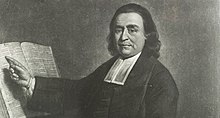
How a Native American Brought the Great Awakening to Indians


by Tamera Lynn Kraft

Samson Occom, a native American born in a wigwam, became one of the first ordained Indian preachers, the first Native American to be published, and the only one to travel with Evangelist George Whitefield during the Great Awakening in America. He brought Christianity to the Indian tribes in his area of the country, yet most have never heard his story.

Samson was born in 1723 as part of the the Mohegan tribe near New London, Connecticut. His parents were Joshua and Sarah Ockham, direct descendants of Uncas, a famous Mohegan chief. At the age of 16, Occom heard his first sermon during the Great Awakening. His mother Sarah was one of the first Mohegan converts.

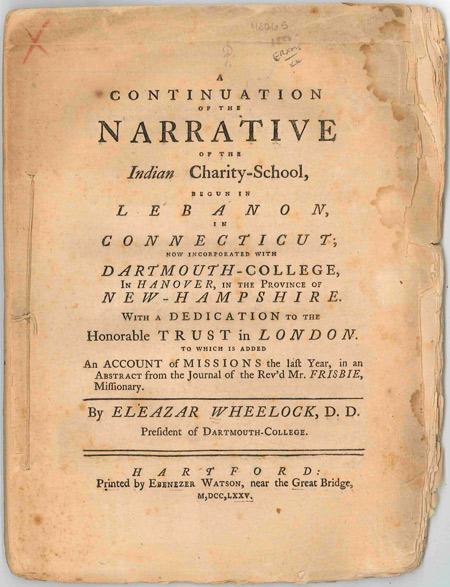
Samson was stirred by what he heard and began to study English so he could read the Bible for himself. A year later he became a Christian under the preaching of James Davenport. He started going to a school for Indians and white boys started by evangelist Eleazar Wheelock and spent four years at Wheelock’s school. He was a gifted student, but poor eyesight prevented him from going to college.

He taught school and ministered to the Montauk Indians for eleven years. He used many creative methods including singing and card games as teaching devices. When Azariah Horton, the white Presbyterian minister to the Montauk, retired, Samson took his place as pastor.

Samson married Mary Fowler in 1751, and they had ten children. The church  paid him a much smaller salary than the white men doing the same job. To make ends meet, he bound books and carved spoons, pails, and gun stocks for his white neighbors. Despite the prejudice he faced, in 1759, Samson became on of the first ordained ministers in the Presbyterian Church.

His passion was to share the Gospel with other Native Americans, and he was commission by the Scotch Society of Missions to preach to the Cherokee in Georgia and Tennessee. Fighting among the Cherokee and white settles put those plans on hold, so instead he went to New York to preach among the Oneida.

In 1765, Samson traveled with George Whitefield, Great Awakening preacher, during his sixth preaching tour in the colonies. Later that year, he traveled to England with Nathaniel Whitaker to raise money for Wheelock’s Indian Charity School. Over the next two years, he preached over 200 sermons in England and was well received. He raised over 11,000 pounds, the most ever raised for a ministry in the colonies. While in England Samson visited with John Newton, writer of Amazing Grace, and received an honorary degree from the University of Edinburgh which he politely declined.


When he returned to America in 1768, Samson found that Wheelock had failed to care for his wife and children as promised. Samson’s family was living in poverty. The rift widened when he learned Wheelock had used the money he’d raised to move the school to New Hampshire and decided to exclude Indians. Wheelock renamed the school Dartmouth.

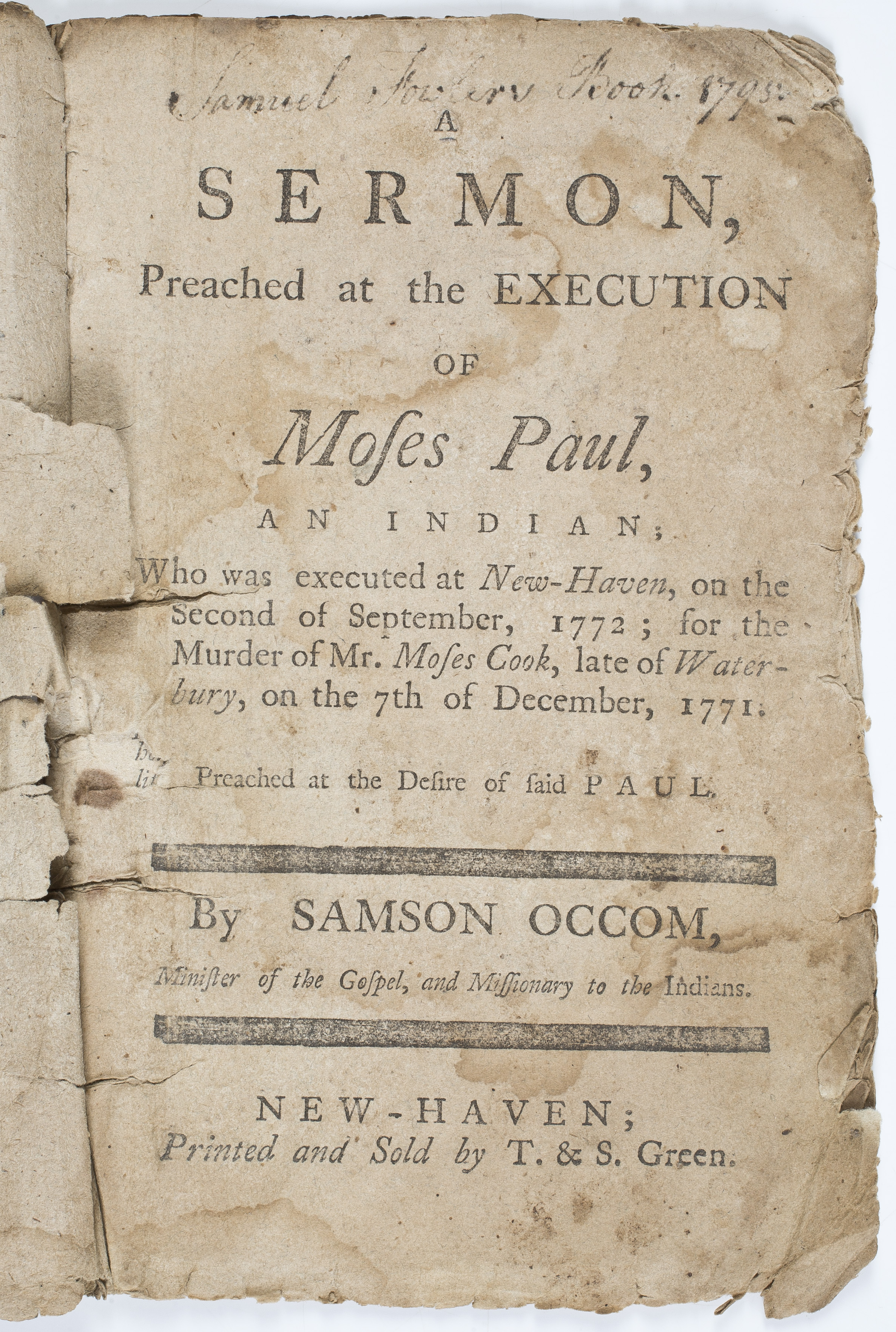
Samson was a prolific writer throughout his lifetime. He kept a diary from 1743 to 1790 about his work that became an historic document. In 1772, he preached a temperance sermon at the execution of a Native American who murdered a man while he was drunk. That sermon became a best seller. He also wrote and published hymns. He is recognized as the first Native American to become published.

When Samson became a defender of land claims of the Montauk and Oneida against speculators, false rumors were spread that he was a heavy drinker and not even a Mohegan which caused the loss of support from his denomination and several missionary societies. He wrote an autobiography to defend himself, but it did little good.

Throughout the 1770s and 1780s, Samson preached among the Mohegan and other tribes in New England. After the Revolutionary War, he settled in Brothertown, New York on a reservation for New England Indians where he establish the first Indian Presbyterian Church. In 1791, he died while gathering wood to finish the new church building.

His legacy continued after his death through his children, students, and converts who also ministered to Native Americans. Two of his students also became authors. Besides being the first Native American who was published, Samson fought for Native American rights, spread the Gospel to New England tribes, and promoted education for Native Americans. 

Tamera Lynn Kraft has always loved adventures and writes Christian historical fiction set in America because there are so many adventures in American history. She has received 2nd place in the NOCW contest, 3rd place TARA writer’s contest, and is a finalist in the Frasier Writing Contest.

Her novellas Resurrection of Hope and A Christmas Promise are available on Amazon and Barnes and Noble.

Tidbits About Black Powder

Black Powder was around long before the 19th century. There were some significant changes in black powder during this century. Below is a brief outline with some tidbits for you. Please note that it wasn't until 1890 that the term black powder was used, prior to that it was simply called powder. Primarily the change in the name was due to the change in use of the smokeless power (white powder)

1800
Brought about a change in the standard composition of black powder around the world. 15/2/3 of KNO/S/C (elements of the periodic table)

1804
DuPont Powder Mill Established.
Prior to DuPont there were no quality control or regulations on the size of the grain of your powder. So, you'd find out which powder worked best for your weapon and used it.

1810
DuPont becomes America's largest powder producer.
Smokeless powder comes into use.

1825
Europe developes Granulations for specific use

1841
William Bickford (English) invented the first safety fuse.

1846
Ascanio Sobrero (Italian) discovered Nitroglycerin
Nitroglycerin is a mixture of nitric acid, sulphuric acid, and glycerol

Christian Schonbein discovered nitrocellulose or guncotton

1863
Joseph Wilbrand (German) invented Trinitrotoluene (TNT)

1864
The California Powder Works produced it's first powder. Expanded with the Chinese labor force.
Saltpeter (key ingredient of black powder) is in somewhat short supply in East
Saltpeter is now imported from India
Peyton Powder was composed of nitroglycerin, nitrocellulose, ammonium picrate (smokeless & semi-smokeless powder)

1865
Albert Nobel invented the blasting cap.

1867
Albert Nobel patented Dynamite

1888
Albert Nobel invented Ballistite a smokeless powder

1889
Sir James Dewar & Sir Frederick Abel invented Cordite (Another smokeless powder)

1890
The first appearence of the term Black Powder

1894
Military drops Black Powder as prinicipal small arms propellant


Lynn A. Coleman is an award winning & best-selling author who makes her home in Keystone Heights, Florida, with her husband of 42 years. Lynn's latest novel "The Shepherd's Betrothal" is the third book in her Historical St. Augustine, FL. series. Coming in Oct. The Rails to Love Romance Collection

Friday, August 26, 2016

Marland Mansion—Ponca City, OK

with Linda "Lin" Farmer Harris

I enjoy a great mystery and when it's associated with a stately mansion it's even more intriguing.

Earlier this year we toured the Ernest Whitworth Marland Estate Mansion, 901 Monument Road in Ponca City, Oklahoma. The architecture and tile work in the home are incredible.

Marland Mansion-Front-Courtesy Marland Estate Mansion

Marland Mansion-Back-Courtesy Marland Estate Mansion
As we toured, I thought y'all might be interested in sightseeing with me. So I whipped out the camera and started snapping. However, one thing I learned upon returning home is what interested me might not be of interest to you. For example, the blue and pink bathrooms throughout the mansion.

Marland Mansion-Typical Tub under Shower-Harris photo

Marland Mansion-Typical Shower over Tub-Harris photo
Before Marland built the Monument Road mansion, his first home was 22 rooms set on eight acres of formal, terraced gardens at Tenth and Grand, near downtown Ponca City. His first wife Virginia Collins Marland oversaw the collection of shrubs, foliage, and flowers, deemed by the citizens as the most beautiful garden this side of the Mississippi.

First Marland Mansion—Tenth and Grand-Courtesy Marland Estate
After seeing the Davanzati Palace in Florence, Italy, he wanted to build his own palace on the Oklahoma prairie. In 1925 he hired master architect John Duncan Forsyth and scores of internationally renowned artists, decorators, stone masons, tile setters, and sculptors to make his dream a realty. Forsyth also built many other homes in Ponca City and in Tulsa. Virginia died in 1926 after a long illness and never lived in the new mansion.

Workmen labored from 1925 to 1928 to create the 43,561 square feet masterpiece built within limestone exterior walls and red clay tile roofs. The building and furnishing cost was $5.5 million dollars.

The docent said the 55 rooms are distributed over four levels and include 12 bathrooms, 10 bedrooms, 3 kitchens, and 7 fireplaces. I asked who was in charge of changing out the 861 light bulbs. He laughed and said, "Thankfully, not me."
Marland Mansion-Aerial View-Courtesy Marland Estate

We didn't have time to tour all of the small historic museums housed in some of the restored original buildings on the grounds. The chauffeur's cottage, now designated as Lydie's Cottage, reflects many elements of the main house.


Chauffeur's Cottage-Courtesy Marland Estate Mansion
E.W. and Virginia were childless so they invited two of her sister's children, George and Lydie (pronounced Ly-de) Roberts into their home. Eventually, they adopted the two children. Two years after Virginia's death, Lydie's adoption was annulled and she became the second Mrs. Marland, but the first to live in the mansion.

Mr. Marland was founder and president of Marland Oil that would become Conoco Oil Company and later Conoco/Phillips. He pioneered employer paid insurance, paid eye care and dental bills, and built over 400 homes for employees. After a hostile take over of his oil company by J.P. Morgan & Co., he went into politics and was elected to the U.S. House of Representatives in 1932. He was elected as the 10th Governor of Oklahoma in 1934. He ran for U.S. Senate twice, but lost both times.

E.W. Marland Accomplishments as Oklahoma Governor-Harris photo
He commissioned sculptor Jo Davidson to create the three Marland family statues from French limestone.

Courtesy of Marland Estate Mansion

Lydie and George Marland-Courtesy of Marland Estate Mansion
Marland died in 1941 after the sale of the mansion and grounds to the Carmelite Fathers for a monastery. After it was home to the Marland family, it became a monastery, a college, a convent, and now a historic home museum.

During my tour I was fascinated by the ceiling tiles and hand-painted panels. My pictures don't do justice to the beauty of the art work.

Marland Mansion-Harris photo

Marland Mansion-Harris photo
The wood work was intricate and detailed. Even the lattice patterned heating vents were amazing.

Marland Mansion-Harris photo

Marland Mansion-Harris photo
Can't have a mansion without a dumbwaiter with telephoning system or an elevator.
Dumbwaiter—Marland Mansion-Harris photo

Elevator Door—Marland Mansion-Harris photo

Elevator Door Open—Marland Mansion-Harris photo
The furnishings from the period were lavish, skillfully created, and abundant. Every room was a masterpiece. I hope you get a chance to visit the mansion.

What's the mystery I mentioned? Well, in 1953, Lydie packed up her Studebaker with tapestries and paintings and left Ponca City. She wasn't seen locally or heard from by friends and acquaintances for 22 years. However, while she was gone, the taxes on the cottage and its property left to her in Marland's will were paid through her lawyers.

In 1958, The Saturday Evening Post ran an article "Where is Lydie Marland?" It's believed that she lived near Central Park in New York City, and in the '60s participated in the peace marches in Washington, D.C. surrounding civil rights and the Vietnamese War.

In 1975, the Felician Sisters announced plans to sell the "convent" mansion. Lydie came home and asked the citizens of Ponca City to support the purchase of the mansion as a city treasure. She moved into her cottage on the estate grounds and lived a reclusive life until her death in 1987.

What mansions turned historic museums have you visited? What's your favorite.

Blessings,
Linda "Lin" Farmer Harris


Lin and her husband, Jerry, live on a hay and cattle ranch in Chimney Rock, Archuleta County, Colorado. Lots of pioneer homesteads, but no estate mansions.


Turning Tidbits of History into Unforgettable Stories
The Lye Water Bride
California Gold Rush Romance Collection