Showing posts with label 150th anniversary. Show all posts

Monday, October 4, 2021

The Great Chicago Fire - Its 150 Year Anniversary

 By Pamela S. Meyers

From Chicago History Museum
Printed in Chicago Tribune 9/27/21

As I write this during the last week of September, we’re coming up on the 150th anniversary of the Great Chicago Fire that ignited on October 8, 1871, and continued until October 9.

Growing up in Lake Geneva, Wisconsin, not far from Chicago, I was always aware of that catastrophic event. Especially so, since it had a strong influence on the history of my hometown when it caused many well-to-do Chicagoans to move their families to Geneva Lake. Their intention was to make it a temporary displacement, but many chose to make the area their home away from home and built beautiful lakeshore mansions there. 

Ironically, the weather around Chicago right now is very similar to what it was leading up to the fire. Back in 1871, the summer had been particularly dry and summer-like temperatures still prevailed in early October. 

The city of Chicago, including buildings in the business district as well as homes in the neighborhoods, was constructed mostly of wood. Even the sidewalks were wooden. The hot southwest winds blowing through the city streets, combined with the dry weather conditions, and lack of recent rain made a perfect recipe for fire. 

Although rumor has said a cow belonging to a woman named Mrs.
Public Domain
O’Leary, caught the woman’s barn on fire when it kicked over a lantern, it’s never been confirmed. Regardless of what sparked a fire that hot, dry night, the blaze did begin in the O’Leary neighborhood and spread quickly. 

The red-hot sky across the Chicago River from the affluent neighborhoods to the north alerted the wealthy inhabitants to the fire. Assured the river would stop the blaze from spreading their direction, people continued on with their usual Sunday night activities ... until a ball of fire erupted over the city and exploded, sending small orbs of flame to the ground. 
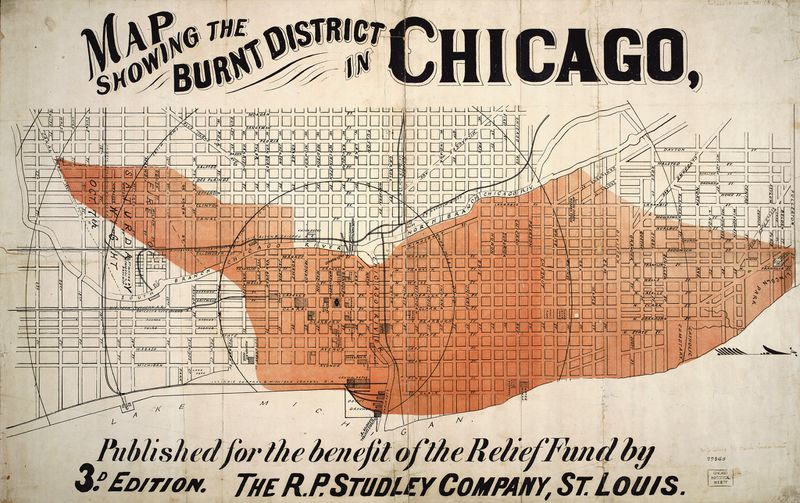
Resource: Chicago Tribune, 9/27/21


Soon, the courthouse bell clanged out a call to all firemen to report for duty. The river was no match for the ugly flames as they ate up the oil slick in the water, climbed the riverbank, and ignited the homes along the riverbank. People raced to fill their carriages with as much as they could of their possessions, and the streets filled with horses, carriages, and people on foot, all heading north. Many made it as far as Lincoln Park near Lake Michigan and scurried into the lake to soak their clothing to protect themselves from falling sparks. 

People from all walks of life filled the park, from squalling babies being comforted by their nursing mothers and elderly grandmothers to worried men attempting protect their families and calm their horses.

The following day, the flames finally died down, but those who had escaped the fire had no home to return to. Much of Chicago’s business district and its neighborhoods were destroyed. The Chicago Tribune reported in the September 28, 2021, edition that 17,450 buildings were destroyed and of that number, six remain standing today, including the infamous water tower on Michigan Avenue.

Water Tower & Pumping Station on 
Michigan Avenue After the Fire
Source: Chicago Tribune 9/28/21


Water Tower and Pumping Station Today
Source: Chicago Tribune 9/28/21

Chicago wasn't the only city to experience a large fire that night. Farther to the north, Peshtigo, Wisconsin was destroyed and across Lake Michigan, the town of Holland, Michigan burned to the ground.


Have you ever experienced a fire that damaged your home or place of work? 

Resources: 
  • The Great Chicago Fire; Robert Cromie; Rutledge Hill Press; 1958
  • Nationalgeographic.org/article/chicago-fire-1871-and-great-rebuilding The Great Chicago Fire; Wikipedia
  • Chicago Tribune, 9/28/2021, The Great Chicago Fire Destroyed. 17,450 Buildings. Here Are Six That Survived.


Pam Meyers says of herself: I'm just a Wisconsin girl living in Illinois. She lives in the Chicago suburbs and makes her way north to her hometown of Lake Geneva, Wisconsin every chance she gets. Her historical novels set in Lake Geneva are available on Amazon and other online book stores, as well as in stores around Lake Geneva.


"This is the kind of book you hate to put down, with unexpected twists and turns that leave you on the edge of your seat!" An Amazon Reader


Wednesday, July 8, 2015

Five Centuries-Old Slang Expressions We Still Use Today

 
Since you are reading this, I assume you enjoy history. Do you also find words and their meanings fascinating? If so, you’re in for a treat because today we’ll explore the origin and meaning of five expressions from history that we still use today.


Bean counting comes to us courtesy of the ancient Greeks, who voted with this foodstuff. Today we use the expression to mean over-precise, and usually annoying, data tracking. Being called a bean counter is definitely no compliment.

To spill the beans, or reveal a secret sooner than intended, also hails from this practice for reasons that can be imagined. If the container holding the different colored beans used for tallying, white for yes and black for no, accidentally tipped over, results might be revealed early.

If you’ve ever had to eat humble pie, or display the humility to admit a mistake, it may interest you to know that in medieval times a deer’s innards and trimmings, or umbles, might be baked into pies and served at the lower tables during a feast. In 1663, Samuel Pepys, praised a particular cook in his diary for her rendition of this dish.

We can thank excellent fabric dyers in Coventry, England, for the term true blue. Describing a person who remains loyal to himself, to another, or to a cause, this expression originally referred to blue fabric dyed to remain colorfast. John Rays, in A Compleat Collection of English Proverbs (1st edition; ca. 1670) mentions the stellar reputation of Coventry's fabric dyers.


The Covenanters, a group of Scottish loyalists who adhered to the National Covenant despite the rule of James I, would later take up the term. Members wore a blue badge to show their allegiance.


In England and Ireland, conservatives known as Tories rallied the color to their cause. The United Kingdom’s conservative party still uses this color.


Red letter days, in modern calendars, are those marking important events, a practice handed down from medieval times. In the Boke of Eneydos (ca. 1490), William Caxton explained how churches recorded holy days and church festivals “with rede letters of coloure of pupre.” Pupre was a kind of red dye.


In the 1300’s a no man’s land referred to a wasteland between one kingdom and another. In feudal culture, wild lands were considered fearsome, and people mainly preferred to shelter near a castle stronghold.

The term didn't mean the space between two conflicting armies until World War I.


It’s fun to connect with the past in everyday living. I've given just a smattering here, but many of the words we use have survived, or even acquired additional usefulness, through time. They link us, indelibly, to those who have gone before us in a younger world.

About the Author


Escape into creative worlds of fiction with Janalyn Voigt, an author whose unique blend of adventure, romance, suspense, and fantasy creates breathtaking fictional worlds for readers.

Beginning with DawnSinger, Janalyn's epic fantasy series, Tales of Faeraven, carries readers into a land only imagined in dreams.
 
Janalyn is represented by Sarah Joy Freese of Wordserve Literary. Her memberships include ACFW and NCWA. When she's not writing, she loves to discover worlds of adventure in the great outdoors with her family.


Source

Monday, April 20, 2015

With Malice Toward None--Lee's Surrender at Appomattox

Image result for surrender at appomattox civil war
The Bennett Place, Appomattox Courthouse, VA
On a Sunday in April, 150 years ago this month, the war that had torn America in two at last drew to a close.  The victorious Union General Ulysses S. Grant rode into Appomattox Courthouse, Virginia to accept the surrender of Robert E. Lee, his Confederate equal and fellow West Point graduate.  Lloyd Lewis, who was with Grant at the laying down of arms, recalled that the General said he felt sad in spite of being on the winning side because “compassion for the brave old foe drowned all the elation of his own triumph. . . .”

Image result for general ulysses s. grant at Appomattox Courthouse
General Ulysses S. Grant
When the leaders converged at a brick house at the edge of the town, Grant looked more like the loser than Lee, covered with dust and wearing the disheveled coat of a private, appearing said Lewis, “like a Missouri farmer who had by mistake crawled into a blouse that carried, unnoticed, three little silver stars on its shoulders.”  Lee, on the other hand, conducted himself as the aristocratic gentleman that he was, schooled in the old manners and customs of his native South, a region that now lay in ruins.  While both sides had suffered catastrophic losses, it would take the South until well into the twentieth century to recover fully.

Image result for General Robert E. Lee
General Robert E. Lee 
Lee was guarded as he met Grant and his staff, unsure of what further hurts would be inflicted upon his people according to the terms of surrender.  In silence the Union’s general wrote them down--the enlisted men were to give up their weapons while the officers could retain their own, as well as keep their property.  They had permission to return to their homes without fear of being harmed by any Union soldier or government authority, in exchange for their pledge never to rebel against the United States of America again.  Lee was surprised by the generous spirit of the conditions, and Lewis recalled that his face “lit up” as he said, “This will have a very happy effect upon my army.”

 Image result for surrender at appomattox civil war
The surrender takes place
He went on to ask Grant if the Confederate soldiers could keep their horses, and Grant gave his permission since most of them were farmers who needed the animals for their livelihoods.  “At this,” Lewis recorded, “Lee melted entirely.  ‘This will have the best possible effect upon the men.  It will be very gratifying and will do much toward conciliating our people,’” he said.

Image result for surrender at appomattox civil war wiki images
Generals Lee and Grant 
There was something else on Lee’s mind, however.  At this point, the older general leaned closer and quietly told Grant that his men were starving—they’d been surviving on only parched corn for several days.  “It was,” said Lewis, “like one brother confiding in another.”  And so they were.  Although they had been mortal enemies during the war, the two men had a bond closer than national allegiance, a strong Christian faith.
Image result for surrender at appomattox civil war wiki images
The room where the surrender occurred
Grant sprang into action, directing his staff to travel throughout the Union regiments to drum up provisions for the Southern soldiers.  He told them to “ask every man who has three rations to turn over two of them.  Go to the commissaries, go to the quartermasters.  General Lee’s army is on the point of starvation.” As word of Lee’s surrender reached the Union soldiers, many began to celebrate by firing their guns into the spring air.  Grant, however, immediately ordered them to stop.  “The rebels are our countrymen again,” he said.  “The best sign of rejoicing after the victory will be to abstain from all demonstrations on the field.”

Image result for surrender at appomattox civil war wiki images

Grant was living out his faith, as well as President Lincoln’s soothing message from his second inaugural address just weeks earlier:

“With malice toward none; with charity for all; with firmness in the right, as God gives us to see the right, let us strive on to finish the work we are in; to bind up the nation’s wounds; to care for him who shall have borne the battle, and for his widow, and his orphan—to do all which may achieve and cherish a just, and a lasting peace, among ourselves, and with all nations.”
Image result for lincoln's second inaugural with malice toward none wiki images
Excerpt from Lincoln’s second Inaugural Address
What is your reaction to this stunning story about the end of the Civil War?

 
Rebecca Price Janney is a theologically trained historian with a special love of American history.  In her book, Great Events in American History, from which this account is taken, she takes many of the dates we all had to learn in school and puts a faith-based story behind them.  Rebecca lives in suburban Philadelphia with her husband and her son.