Showing posts with label 1900 Hurricane. Show all posts

Tuesday, April 11, 2017

SURVIVORS

Historic homes on Galveston Island 
by Martha Rogers

Galveston is a diverse city with its modern hotels and beach front properties as well as the historic homes that survived the 1900 hurricane which destroyed almost everything in its path and killed thousands of people. The homes featured today are those surviving the winds and water.

In 1847, John Seabrook Sydnor built what is known as Powhatan House. He was a pioneer merchant as well as mayor. His home is one of Texas’ most beautiful Greek revival homes. It was the central section of an early hotel before it was moved to its present location. It is no longer a home for a family but home to the Galveston Garden Club.


The limestone and brick Moody Mansion was built between 1893 and 1895 and designed by William H. Tyndall. The interior is beautiful with rare hand-carved wood, stained glass, and coffered ceilings. Serving as a museum today, it contains many Moody family heirlooms. The present day ballroom is decorated exactly as it was for Mary Moody’s social debut on December 12, 1911.
Moody Mansions exist in other areas, but the one in Galveston is the most fascinating to me. 

The day I was in Galveston with my sister and aunt, we didn’t have time to tour the building, but we took pictures of the outside.

The historical society was gracious enough to allow me to use interior  photos from their website. As you can see, it is quite elegant. Because of its construction, it survived the hurricane.

It now serves as a museum.

Interior Views: Master Bedroom, Interior Staircase and the Sitting Room

Photos courtesy of http://www.moodymansion.org/photos/  


Ashton Villa is one of the most well-known and oft visited sites in Galveston. James M. Brown built the home in 1859 and it’s a true interpretation of southern hospitality. On a tour of the home, you will see antiques, family heirlooms, and
original art. Miss Bettie Brown, James’ daughter, hosted any number of social gatherings for the wealthy socialites of Galveston.

Mr. Brown lived in the house until his death on Christmas Day, 1895. His wife died in 1907 and the house went to Bettie who lived there until her death in 1920. The house was sold to the Shriners who used it as offices until 1970 when the Galveston Historical Foundation took it over. It was opened to the public in 1974. 

One home is being restored after being abandoned for a number of years. It was built by Henry Biessner, a prominent business man in 1890-1891.

The Biessner home became known as “Noah’s Ark” following the hurricane because of the number of people who sought sanctuary there and were saved because of its sturdy construction. It was built on ten food brick piers and from there rises two stories with a multi-gabled roof and a prominent front gable. The height off the ground allowed the high waters to flow beneath the house. The bottom floor you see open was that way in 1900. 

Another brick and terra cotta house, known as the Landes-McDonough House was built by Henry Landes, a Confederate veteran and capitalist. George A.
Dickey and D.A. Helmich were the architects behind the structure in 1887. Beautiful, elaborate ironwork on the verandas, parapets along the edges of the roof, a large tower, arched windows with fancy tile and molded trim as well as elaborate shutters make this home an outstanding example of the historic homes in Galveston.


Trube Castle is a home designed to replicate castles Trube remembered from his childhood in Kiel, Denmark. The original cost of this mansion was $9,700. This three story home is built of bricks covered by stucco mixed with Belgian cement to recreate a stone effect.
The house features a mansard slate roof, seven gables, and a battlement tower to give it a castle distinction. it is an eclectic example of a Victorian home. The home is a Texas Landmark. It has twenty-one rooms and covers 7,000 square feet.
The home, owned by the Trube family until 1985, was given to charity when
Mary Trube died. Still privately owned, it is available for parties, wedding celebrations and receptions as well as corporate events. It is also open for tours with reservations.


The last house on my list is the Sonnentheil House, an architectural mystery because no one claimed it as his design. It is exceptional in design because of the curved and angled advances that are projected through framed panes of openwork arches with diagonal lattices linked by perforated frieze bands. The home was built in 1886 by German native Jacob Sonnentheil who served with the Confederacy during the Civil War. It became a recorded Texas Historic Landmark in 1962.

All of these homes survived the hurricane and many became refuges for those fleeing the storms. They stand today as an example of the wealth and life-style of Galveston socialites in the 19th Century. 

Do you have historic homes in your area? What style of architecture is most represented?

My latest release is now available on Amazon. 


Cassie Miller is awarded a fellowship to study at a prestigious music school, but mistakes by Marc Rossi, the man in charge, threaten to ruin her success at the school and lead to her dismissal. As they work together to find the truth, they discover love, but will it win out over the mishaps and miscues that lead to a showdown of talent?


Martha Rogers is a free-lance writer and multi-published author from Realms Fiction of Charisma Media and Winged Publications. She was named Writer of
the Year at the Texas Christian Writers Conference in 2009. She is a member of ACFW and writes the weekly Verse of the Week for the ACFW Loop. ACFW awarded her the Volunteer of the Year in 2014. Her first electronic series from Winged Publications, Love in the Bayou City of Texas, debuted in the spring of 2015.  Martha is a frequent speaker for writing workshops and the Texas Christian Writers Conference. She is a retired teacher and lives in Houston with her husband, Rex. Their favorite pastime is spending time with their eleven grandchildren and four great-grandchildren. 


Friday, November 11, 2016

Galveston Isand

Not Just a Beach
by Martha Rogers


Galveston is another Texas city with a fascinating past. She’s part Southern, part Texas and uniquely her own. She has more history than many cities much larger than she is. Galveston has always been “a town in its own right,” and even today she is often referred to as “The Republic of Galveston Island.”

The first people to land on the island besides the natives were the Spaniards led by Cabeza de Vaca who shipwrecked on the island around 1528. The inhabitants at that time were the Akokisa and Karankawa Indians who camped, fished, and buried their dead there in the marshes.

The explorer lived among them for several years as a medicine man and slave. He died there among the natives. Later, in the late 1600’s, the French came led by La Salle who claimed the area for King Louis. He named the island St. Louis.

In the 1780’s, Bernardo Galvez, a Spanish colonial governor, sent Jose de Evia to map out the area along the Gulf of Mexico from Texas to New Orleans. Evia named the water between the island and the mainland of Texas, Galveston Bay. Later the city took the name but Galvez died before ever seeing the island named for him.

When the settlers came, the first known one was a pirate. The privateer Jean Lafitte established a colony in 1817. When Lafitte was forced to leave, he burned the town behind him. From the ashes, Michel Menard and Samuel Williams with others rebuilt the town, and many of the homes of these early pioneers are still standing.

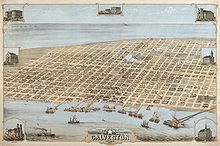
Early map of Galveston: 

 Of course everything is bigger in Texas. After she was incorporated in 1839, Galveston took no time in becoming the most active port west of New Orleans and growing to the largest city in Texas at the time.
By SMU Central University Libraries - Busy Dock Scene, Galveston, Texas. Public Domain, 

Galveston had to be first in a number of things, among them were the first opera house, first hospital, first golf course and the first country club. She was one of the richest cities in the world per capita. All major railroads served the city and over half of Texas’ cotton crop was exported through Galveston. The Strand had become not only the financial center of Galveston and Texas, but much of the Southwest as well.

One of the luxury hotels in the 19th century. 


By 1900, the town had become the fourth largest in Texas following Houston, Dallas and San Antonio with a population around 37,000. Then the 1900 Storm hit the island with one-third of the city destroyed and over 6,000 lives lost.


Those who remained were determined to restore the city and make it safer. They did so by raising the entire level of Galveston by eight feet with 17 feet at the seawall slanting down so water would run off into the bay. It worked when fifteen years later, another storm hit and only eight lives were lost.

Despite their efforts, the city never returned to its former glory. Even her shipping suffered when Houston built a ship channel and the vessels sailed up the channel to larger city. An economic decline in the mid-1960’s caused many of the beautiful old buildings to fall into disrepair and some were demolished.  

Ashton Villa is one of the homes built in 1859 that was restored. 


The 36-block business district was fully restored with the persistence of Cynthia and George Mitchell. Once known as the “Wall Street of the Southwest,” opulent Victorian buildings and residences lined the streets with banks, wholesale houses, shipping companies, auction houses, and sailor boarding houses. The buildings restored by the Mitchells were held to the highest standard of preservation and restoration. They have been recipients of numerous awards. They overhauled the downtown historic Victorian style buildings and it became an historic landmark with 2,000 buildings scattered across Galveston listed in the National Register of Historic Places.

One of the Historical Markers: 


Two huge events occur every year on the island. One is Mardi Gras which turns the town into a carnival with parades and parties down the street spanned by Mardi Gras arches built by world famous architects. This 75 year old tradition was restored in 1985 after it had been lost during WWII.

The second event is Dickens on the Strand which takes place in December and takes the city back to the Victorian times of Charles Dickens for the Christmas season.  


Another event that is well attended is the annual Historic Home Tour held in May before the real heat and humidity of Texas take over. Here is one of the homes featured on the tour. This home was built in 1893.


Taking a stroll through the area and visiting the many shops and eating places along the way is a step back in time. Modern improvements make the time spent in the historic district of Galveston an enjoyable experience.

What historical places have you visited?

Here's my latest novel, just in time for Christmas.

Christmas at Stoney Creek


News reporter Tom Whiteman befriends a homeless man, Joe, and brings him home to Stoney Creek, a town that accepts people for who they are and not how they appear. Tom’s journalistic instincts suggest there’s more to the old man than appearances tell. A carpenter by trade, Joe works at odd jobs around town and makes many new friends including Faith Delmont, a girl who grew up with Tom. Contradictions in the man’s manners and way of speaking whet Tom’s nose for news and raises even more questions. As he and Faith seek the truth, they learn that God’s love can turn tragedy and loss to triumph and true love comes to those who seek it.     


Martha Rogers is a free-lance writer and multi-published author from Realms Fiction of Charisma Media and Winged Publications. She was named Writer of the Year at the Texas Christian Writers Conference in 2009. She is a member of ACFW and writes the weekly Verse of the Week for the ACFW Loop. ACFW awarded her the Volunteer of the Year in 2014. Her first electronic series from Winged Publications, Love in the Bayou City of Texas, debuted in the spring of 2015.  Martha is a frequent speaker for writing workshops and the Texas Christian Writers Conference. She is a retired teacher and lives in Houston with her husband, Rex. Their favorite pastime is spending time with their eleven grandchildren and four great-grandchildren


Monday, April 11, 2016

175 years Legacy of a Church Plus a Give Away

Texas: Mission Field of Unreached People
Yesterday, April 10, First Baptist Church in Houston, Texas celebrated its 175th anniversary. What began as a few people with a missionary preacher has grown into what is now called a Mega-church. In years following Texas’ independence in 1836, Texas reigned as a Republic, not a state. Religious groups in the United States viewed Texas as fodder for missionaries.

With a $2500 donation from a Christian layman in Georgia, the Baptist Home Mission Society of New York sent a young missionary preacher, James Huckins, to Texas to organize and charter a church.

On April 10, 1841 the church was officially organized, and the first official minutes of the church written down with a grand number of twenty-two members. Elder James A. Huckins remained as pastor for two years. Many well known men in Texas history have served as pastors since those early years, through the Civil War, the turn of the century and on and on until today.


Methodists, Presbyterians, and Episcopalians were already hard at work in the town of Houston. The Baptist congregation was small and met in homes much like the early churches seen in the New Testament until elder William M. Tryon came on the scene and saw the need for church building. Under his leadership the building was erected and dedicated on the fifth Lord’s day in May, 1847.


The church suffered through yellow fever and cholera epidemics, but continued to serve and grow even after the death of Tryon from yellow fever.


Even though Texas became a state in late 1845, Dr. Rufus Burleson came to Texas as a missionary in 1848. As part of the wild frontier, Texans were an “unreached people.” The gold rush in California in 1849 drew a large number of Texans to seek their fortunes in gold, but Dr. Burleson stayed on. He served as pastor through those rough times until he was called to be the second president of Baylor University. Under Huckins' leadership, First Baptist church had been instrumental in the founding of Baylor in 1845, and now Dr. Burleson would leave Houston for the university.

The church survived despite hard times without a pastor even through the days of the Civil War and the Reconstruction. Such things as women’s temperance, the type of services, music in the services, and splits because of differences of opinion did not defeat the church.

During the 1880’s, unorganized expansion and dissatisfied members leaving or withdrawing led to a high death rate of organized churches for almost thirty years. First Baptist survived and three new churches were organized in 1891, 1895, and 1896 with many members from First Baptist.

First Baptist built and dedicated a beautiful new brick building in 1880 with a tower and steeple that would rise 145 feet above the ground. Some difficult times came on the church, and Reverend Then in 1900 the magnificent building was destroyed in the Galveston Hurricane. With $8,000 a new site was purchased and a cornerstone laid on November 12, 1902. One humorous anecdote concerns where they met while the church was being built. Baptist were known for their ban on dancing, so with great irony, they met in a dance hall the fall of 1900 until they moved into the building in 1902. This building was damaged in another storm in 1915, but was repaired.


This is a picture of the church in 1900 before the hurricane.


In 1907, the church led in creating the city's first Baptist Hospital which became Memorial Baptist Hospital, a forerunner of the immense Memorial Hermann Health System of today. The people of the church were difference makers in their city. They left a legacy that is being passed on to future generations today.

Case of the Disappearing Organ
The most famous incident in the church history concerned a new organ. In the 1840’s, a generous donor helped purchase a new organ for the church. A particular faction in the church did not like the idea of musical instruments in the church although vocal music was highly regarded. The disapproval became so strong that the organ simply disappeared one day under very mysterious circumstances.

The whereabouts of the organ were unknown and finally members who bought the organ gave up on looking for it. Then Houston decided to dredge Buffalo Bayou to make changes for what later became the Houston Ship Channel. The one time offensive organ, after resting about 40 years on the bottom of Buffalo Bayou, rose to the surface. Now the organ’s sad fate was made known and once and for all solved the case of the disappearing organ.


Another amusing anecdote about the music is the fact that in the 1920’s, the churches strongly disapproved of choir robes. The ladies wore their finest clothes and did not remove their hats entering the choir loft. For Easter and Christmas, white baptismal robes were used with the women pinning artificial white roses to the front of their gowns.

The early music programs also made great use of ensembles, quartets and trios among the youth and children as well as adults.

Today music can be quite the controversy in churches as older groups want the traditions and complain because the organ is not used often enough and they don’t like the new worship songs. They also complain because the choir doesn’t wear robes every Sunday. Seems that throughout history, controversy of some kind has arisen in the church over music. The more things change, the more they stay the same.

This is a picture of the church as it was in 1975 when the congregation voted to leave downtown and purchased land at the intersection of Interstate 10 and Loop 610 where it stands today.


Pictures and information from the Church History Book published in 1985


The Church on the First Sunday in new building 1977

Last month I posted a give away of my book WINTER PROMISE, but we didn't have enough to have a drawing, so I'm extending it to this month.
Leave a comment below about your own church to enter the drawing. If you tweet about the blog, that will be an extra entry. Winter Promise is the paperback book that will be mailed to you, or you may opt for a copy of my newest E-book release, Love Comes to Bluebonnet Inn. It's your choice.


Jolene Burns is the innkeeper’s daughter, in her late twenties and still single. Jolene’s mom and her friends are anxious for Jolie to find a good man and settle down like her brothers, but she is content managing the bed and breakfast and forgetting the disaster of her broken engagement. When a good looking male guest registers at the Inn, Jolie’s mother checks his marital status. She learns he is single and sees him as a prospect for her daughter. The young man, Clay Hill, is a writer who has come to town incognito to find seclusion to write his next novel under his pen name of Clive Hendrix. As the ladies go into matchmaking mode, Jolie conspires with Clay’s to escape the ladies’ endeavors. Despite his efforts to remain anonymous, the owner of the bookstore discovers his true identity and makes a big show of having a famous writer in their town, and plans a big book-signing event for him.  Jolie and Clay find themselves smack dab in the middle of the festivities and falling in love in the process.

Martha Rogers is a free-lance writer and the author of the Winds Across the Prairie, Seasons of the Heart, and The Homeward Journey series as well as the novella, Key to Her Heart in River Walk Christmas, Not on the Menu in Sugar and Grits and Christmas Blessing in Mail Order Christmas Angels. She was named Writer of the Year at the Texas Christian Writers Conference in 2009 and is a member of ACFW. She writes the weekly Verse of the Week for the ACFW Loop. ACFW awarded her the Volunteer of the Year in 2014. Her first electronic series from Winged Publications, Love in the Bayou City of Texas, debuted in the spring of 2015 and Where Love Grows Series in 2016. Martha is a frequent speaker for writing workshops and the Texas Christian Writers Conference. She is a retired teacher and lives in Houston with her husband, Rex. Their favorite pastime is spending time with their eleven grandchildren and four great-grandchildren. 


Sunday, October 11, 2015

Queen of the Waves...Galveston Memorial


by Martha Rogers

Last month I wrote about the Galveston Hurricane of 1900, but there was too much to cover in one post. So this month tells about the loss of lives at the St. Mary’s orphanage.

Called St. Mary’s Orphan Asylum, the building sat near 69th Street and what is now Seawall Boulevard. A historical marker is there at the spot. All over the world, on September 8th, the members of the Sisters of Charity of the Incarnate Word sing an old French Hymn, “Queen of the Waves” in memory of those who lost their lives that fateful day.


Every year in Galveston, a ceremony is held at the memorial and includes prayer and wreath laying at the marker. Sometimes they will also sing the hymn, "Queen of the Waves." 

In 1911, the Hotel Galvez was built on the land of the orphanage. Legend and folk-lore tells of the spirits of children in the hotel roaming the halls in places they died on that fateful day.

The building for the asylum was located where it was because it was far enough away from town to avoid the threat of yellow fever. The asylum thrived and grew to have close to 100 children in residence with ten nuns to oversee them. The left picture is of the older orphans and the one on the right one is of the youngest. 


At that time Galveston prospered and was one of the busiest seaports on the Gulf Coast of Texas. The whole area seemed poised for greatness in the history of Texas. No longer the queen she once was, Galveston has gone down in history not for her greatness, but for her tragedy.

On that day in 1900, ninety-three children and ten nuns occupied the buildings. Some of the children were babies and none had reached their teen years. The campus consisted of two large two-story dormitories just off the beach, one for girls, one for boys. A row of tall sand dunes supported by salt cedar trees
offered some protection from the waters of the Gulf of Mexico. The balconies along the back of the buildings faced the gulf.

As the rains continued to fall on September 8, the water began eating away at the sand dunes causing them to dissolve. As the waters rose and reached the buildings, the Sisters gathered all the children into the chapel of the newest building, the girls’ dormitory, where they sang hymns, one them being “Queen of the Waves.”

As the waters rose, the Sisters moved the children to the second floor. One of the workers, Henry Esquior, collected clothesline rope to tie the children together if necessary. 

With wind gusts of 100 miles per hour, the waters of Galveston Bay and the gulf met, completely flooding the city with the tidal surge striking the south shore at 7:30 in the evening. Water filled the first floor. Almost every window was broken out sending the wind and rain roaring through the building. The boys’ dormitory collapsed and was carried away by the flood waters.

The Sisters cut the clothesline rope into sections and tied the children together. Each sister tied herself between six to eight children. Eventually the building lifted from its foundation. The bottom fell out and the roof came crashing down to trap those inside.

Miraculously, three boys survived and were found in a tree where they floated for more than a day before being rescued. Then they told their story to the Sisters at the hospital.

The Sisters were buried wherever they were found, some with children still tied to them. Even in death, they kept their promise not to let go.

Despite their loss, the Sisters of Charity of the Incarnate Word continued with their mission of helping orphaned children and opened a new asylum one year later at 40th and Q Streets. This time it was located within the city limits and continued in operation until 1967.


Martha Rogers is a free-lance writer and the author of the Winds Across the Prairie and Seasons of the Heart series as well as the novella, Key to Her Heart in River Walk Christmas and Not on the Menu in Sugar and Grits. Her latest series, The Homeward Journey, has three books, Love Stays True, Love Finds Faith, and Love Never Fails. She was named Writer of the Year at the Texas Christian Writers Conference in 2009 and is a member of ACFW. She writes the weekly Verse of the Week for the ACFW Loop. ACFW awarded her the Volunteer of the Year in 2014. Her first electronic series from Winged Publications, Love in the Bayou City of Texas, debuted in the spring of 2016.. Martha is a frequent speaker for writing workshops and the Texas Christian Writers Conference. She is a retired teacher and lives in Houston with her husband, Rex. Their favorite pastime is spending time with their eleven grandchildren and three great-grandchildren. 

Look for her new novella: Christmas Blessing Coming October 16th

Riley Thornton needs a mother for his three children. Annelle Pugh needs to get away from her domineering father. She knows nothing about children, but answers the call for mail-order brides to Wyoming thinking she can learn on the job. Despites cooking and housekeeping disasters, tries hard to win the hearts of the children and Riley. Will Christmas bring the blessing the entire family needs to be complete?


Friday, September 11, 2015

The Great Storm 1900

Galveston Hurricane 
by Martha Rogers

Those who live on the coast line of North or Central America know about and most likely have endured the winds and rains of tropical storms and hurricanes. Today we have radar to warn us days in advance with all types of “spaghetti” drawings for possible paths. Planes fly into the eyes and can give us information as to wind speed and size. Such was not the case on the Texas coast in September of 1900.

One hundred and fifteen years ago this past September 8, the most devastating storm in history battered the town of Galveston and claimed thousands of lives. They had little warning and no defense for the winds and rains that would descend on the town and sweep in from the Gulf of Mexico.

On September 8, 1900, 38,000 people resided in Galveston, a bustling busy seaport with its natural harbor of Galveston Bay. At the time it was the biggest city in the state. A proposition to build a seawall for protection was submitted, but it was dismissed by the majority of the population and the city government as too costly. On that morning, the people of Galveston were completely unaware that this day would be the last day for their town as they knew it and the last for so many of their friends and loved ones.

Although the skies did give some warning that a storm approached, the citizens of Galveston had weathered storms before and were not worried. That morning the high tides flooded some inland streets, but still the residents didn’t think that unusual as they were almost at sea level. At mid-morning the rains took over and the winds began whipping the trees. By mid-afternoon, the storm hit with such force and intensity that darkness descended over the city.


Classified by today’s standards, the storm would be a Category 4 with winds of 145 miles per hour. The winds blew and the rains came steadily until the next day when the storm finally made it’s exit early in the morning of September 9. What was left behind was total devastation with bodies littering the landscape strewn with debris resembling matchsticks carelessly tossed about. Houses that had withstood hurricanes in the past burst apart or were torn from their foundations as were business establishments.


That hurricane is the third deadliest in US history for the Atlantic side of the nation topped only by the Great Hurricane of 1780 and the 1998’s Hurricane Mitch. With 8,000 official deaths and upwards to 12,000 estimated by some, the town of Galveston was all but wiped from the face of the Texas coast as 30,000 were left homeless.

St. Mary's Hospital took in as many injured survivors as they could, but they were soon overwhelmed. Removing the dead took several days and with so many bodies recovered, the town ended up burning them because of the stench and lack of facilities to handle that many bodies.


As residents began picking through rubble for any signs of their former life, they began to realize that the town they had known and loved had been all but completely destroyed. Not to be defeated, the town rebounded and began rebuilding, but it never regained the status as seaport that it once had. 


One of the most heart-breaking stories is that of the orphanage. Among the dead were 10 sisters and 90 children from the St. Mary's Orphans Asylum, operated by the Sisters of Charity. Next month I will tell their story.


Today a memorial designed by David Moore stands at 4800 Seawall Blvd. as reminder of all the lives lost on that day in 1900.


Have you ever been through a storm like a hurricane or tornado?
If so, briefly describe your experience.


Martha Rogers is a free-lance writer and the author of the Winds Across the Prairie and Seasons of the Heart series as well as the novella, Key to Her Heart in River Walk Christmas and Not on the Menu in Sugar and Grits. Her latest series, The Homeward Journey, has three books, Love Stays True, Love Finds Faith, and Love Never Fails. She was named Writer of the Year at the Texas Christian Writers Conference in 2009 and is a member of ACFW. She writes the weekly Verse of the Week for the ACFW Loop. ACFW awarded her the Volunteer of the Year in 2014. Her first electronic series from Winged Publications, Love in the Bayou City of Texas, debuted in the spring of 2016.. Martha is a frequent speaker for writing workshops and the Texas Christian Writers Conference. She is a retired teacher and lives in Houston with her husband, Rex. Their favorite pastime is spending time with their eleven grandchildren and three great-grandchildren.