Showing posts with label Galveston. Show all posts

Saturday, February 11, 2017

Bishop's Palace

More Than a Home
by Martha Rogers


When I was a child, we visited Galveston several times. I remember driving by Bishop’s Palace on Broadway and thinking what a grand place it was for church bishops to live. Later, as a teenager, I asked my dad how many bishops lived there and why it was so large. He then told me the story of the Palace. Because it didn’t become available for tours until the sixties, I wasn’t able to tour the building until 2001 when my sister and I took my aunt and nephew on the tour. What delightful surprises we found in the beauty of the home.

Now over 120 years old, the house is listed as a National Historic Landmark. The building began as a home for Colonel Walter Gresham, his wife Josephine and their nine children. 
Gresham was an attorney and politician as well as the founder of the Gulf, Colorado and Santa Fe Railroad and worked to bring about the merger of the line with the Atchison and Topeka Railroad. Gresham served in the Civil War and also served in the Texas Legislature.

He commissioned architect Nicholas Clayton to design and build the home in 1887. A huge house built on a small lot, it is very different from other Victorian style homes of the area. Although classified Victorian, the style is more like a Chateau.

The home consisted of a combination of materials from cast iron, solid wood, and native stone. Clayton expanded on the Victorian style by using stones of irregular shape and color as well as Tudor arches, towers with pointed roofs, and ornate carvings of animals and vegetation. Because of its structure of steel and stone, it survived the 1900 Galveston hurricane, and the Gresham’s welcomed hundreds of survivors into their home as a shelter from the ravages of the storm.

It soars three stories over the street below with a raised basement level giving it four floors. The basement once housed the kitchen and servant’s areas but now contains the store and gift shop. Three formal floors rise above this level.
 
Mrs. Gresham played a part in the décor by painting the fresco of cherubs on the ceiling in the dining room.


 My favorite room is also on this floor. I call it a garden room, but I believe it is the Conservatory on the tour.
This floor also has the parlor, music room, kitchen, library, and servant’s vestibule.

The second floor had a bathroom with a tub that had three spigots for hot, cold, and rain water. Also on this floor were Mr. and Mrs. Gresham’s rooms, the daughter’s rooms and a guest bedroom.  The fourth floor was reserved for the boys’ bedrooms, Mrs. Gresham’s art studio, and storage.

It is as beautiful today as it was in the early days. Preservation has kept the Palace in very good shape with the beauty of the stained glass windows, intricate carvings in stone and wood, and original furnishings.


The interior rooms are grand and spacious with great carvings and marble columns in the entrance hall. Rooms on the first floor have fourteen foot ceilings and an intricately carved staircase rises from the entrance hall. The decor is abundant with wood carvings, marble columns, and decorative carvings and painting on ceilings and walls.

First know as the Gresham house for the man who built it, the Roman Catholic Diocese of Galveston purchased the home in 1923 as it was situated across the street from Sacred Heart Church. It served as a residence for Bishop Christopher E. Byrne until the diocesan offices moved to Houston and earned the name, Bishop’s Palace. One of the Gresham daughters’ bedrooms  was converted into a chapel.


In 1963 the house was opened to the public with proceeds from tours of the home going to help fund the Newman Center set up in the basement of the home to serve Catholic students from the University of Texas Medical Branch.


Built at a cost of $250,000, the home is said to be worth well over five million today. The house is now owned by the Galveston Historical Foundation and tours are available daily. A portion of the admission charge is now used to help preserve and restore the property.

This is how it appears today with careful preservation and restoration. She's a grand old lady with all the elegance of her original days 

If you are ever in Galveston, this is one place I highly recommend for a visit. 

My latest release is set in Hawaii at the commemoration of the 75th anniversary of Pearl Harbor. Be True tells the story of the Benson family with a long history of Navy men. Kari Benson’s Marine fiancé died in Afghanistan and she is determined not to become involved with a military man agan. Even though her great-grandfather, grandfather, father, and brother
are all military, she vows to stay away from any man associated with the military. While in Hawaii to commemorate her grandparents’ anniversary in the same chapel where they married and Pearl Harbor Memorial recognition of her great-grandfather, she meets Lieutenant Spencer Langston who is the public affairs Navy officer assigned to escort them to all activities. When his kindness and attention to detail for the family begins to rock her boat of resolve, she flees back to New York. Spencer is determined to break down the walls of her heart. When he shows up on Kari’s doorstep on Valentine’s Day, she remembers her grandmother’s advice to be true to her heart and God’s will. Will she be willing to fall overboard to be rescued by Spencer or grab her life-jacket and hang on to the past?

This book is dedicated to a real hero of WWII. John Elam served in the U.S. Navy during that war. He was our next door neighbor when Rex and I were newlyweds and had our first two boys. He would have been 92 this past January.


Martha Rogers is a free-lance writer and multi-published author from Realms Fiction of Charisma Media and Winged Publications. She was named Writer of the Year at the Texas Christian Writers Conference in 2009. She is a member of ACFW and writes the weekly Verse of the Week for the ACFW Loop. ACFW awarded her the Volunteer of the Year in 2014. Her first electronic series from Winged Publications, Love in the Bayou City of Texas, debuted in the spring of 2015.  Martha is a frequent speaker for writing workshops and the Texas Christian Writers Conference. She is a retired teacher and lives in Houston with her husband, Rex. Their favorite pastime is spending time with their eleven grandchildren and four great-grandchildren. 


Friday, November 11, 2016

Galveston Isand

Not Just a Beach
by Martha Rogers


Galveston is another Texas city with a fascinating past. She’s part Southern, part Texas and uniquely her own. She has more history than many cities much larger than she is. Galveston has always been “a town in its own right,” and even today she is often referred to as “The Republic of Galveston Island.”

The first people to land on the island besides the natives were the Spaniards led by Cabeza de Vaca who shipwrecked on the island around 1528. The inhabitants at that time were the Akokisa and Karankawa Indians who camped, fished, and buried their dead there in the marshes.

The explorer lived among them for several years as a medicine man and slave. He died there among the natives. Later, in the late 1600’s, the French came led by La Salle who claimed the area for King Louis. He named the island St. Louis.

In the 1780’s, Bernardo Galvez, a Spanish colonial governor, sent Jose de Evia to map out the area along the Gulf of Mexico from Texas to New Orleans. Evia named the water between the island and the mainland of Texas, Galveston Bay. Later the city took the name but Galvez died before ever seeing the island named for him.

When the settlers came, the first known one was a pirate. The privateer Jean Lafitte established a colony in 1817. When Lafitte was forced to leave, he burned the town behind him. From the ashes, Michel Menard and Samuel Williams with others rebuilt the town, and many of the homes of these early pioneers are still standing.

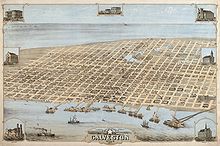
Early map of Galveston: 

 Of course everything is bigger in Texas. After she was incorporated in 1839, Galveston took no time in becoming the most active port west of New Orleans and growing to the largest city in Texas at the time.
By SMU Central University Libraries - Busy Dock Scene, Galveston, Texas. Public Domain, 

Galveston had to be first in a number of things, among them were the first opera house, first hospital, first golf course and the first country club. She was one of the richest cities in the world per capita. All major railroads served the city and over half of Texas’ cotton crop was exported through Galveston. The Strand had become not only the financial center of Galveston and Texas, but much of the Southwest as well.

One of the luxury hotels in the 19th century. 


By 1900, the town had become the fourth largest in Texas following Houston, Dallas and San Antonio with a population around 37,000. Then the 1900 Storm hit the island with one-third of the city destroyed and over 6,000 lives lost.


Those who remained were determined to restore the city and make it safer. They did so by raising the entire level of Galveston by eight feet with 17 feet at the seawall slanting down so water would run off into the bay. It worked when fifteen years later, another storm hit and only eight lives were lost.

Despite their efforts, the city never returned to its former glory. Even her shipping suffered when Houston built a ship channel and the vessels sailed up the channel to larger city. An economic decline in the mid-1960’s caused many of the beautiful old buildings to fall into disrepair and some were demolished.  

Ashton Villa is one of the homes built in 1859 that was restored. 


The 36-block business district was fully restored with the persistence of Cynthia and George Mitchell. Once known as the “Wall Street of the Southwest,” opulent Victorian buildings and residences lined the streets with banks, wholesale houses, shipping companies, auction houses, and sailor boarding houses. The buildings restored by the Mitchells were held to the highest standard of preservation and restoration. They have been recipients of numerous awards. They overhauled the downtown historic Victorian style buildings and it became an historic landmark with 2,000 buildings scattered across Galveston listed in the National Register of Historic Places.

One of the Historical Markers: 


Two huge events occur every year on the island. One is Mardi Gras which turns the town into a carnival with parades and parties down the street spanned by Mardi Gras arches built by world famous architects. This 75 year old tradition was restored in 1985 after it had been lost during WWII.

The second event is Dickens on the Strand which takes place in December and takes the city back to the Victorian times of Charles Dickens for the Christmas season.  


Another event that is well attended is the annual Historic Home Tour held in May before the real heat and humidity of Texas take over. Here is one of the homes featured on the tour. This home was built in 1893.


Taking a stroll through the area and visiting the many shops and eating places along the way is a step back in time. Modern improvements make the time spent in the historic district of Galveston an enjoyable experience.

What historical places have you visited?

Here's my latest novel, just in time for Christmas.

Christmas at Stoney Creek


News reporter Tom Whiteman befriends a homeless man, Joe, and brings him home to Stoney Creek, a town that accepts people for who they are and not how they appear. Tom’s journalistic instincts suggest there’s more to the old man than appearances tell. A carpenter by trade, Joe works at odd jobs around town and makes many new friends including Faith Delmont, a girl who grew up with Tom. Contradictions in the man’s manners and way of speaking whet Tom’s nose for news and raises even more questions. As he and Faith seek the truth, they learn that God’s love can turn tragedy and loss to triumph and true love comes to those who seek it.     


Martha Rogers is a free-lance writer and multi-published author from Realms Fiction of Charisma Media and Winged Publications. She was named Writer of the Year at the Texas Christian Writers Conference in 2009. She is a member of ACFW and writes the weekly Verse of the Week for the ACFW Loop. ACFW awarded her the Volunteer of the Year in 2014. Her first electronic series from Winged Publications, Love in the Bayou City of Texas, debuted in the spring of 2015.  Martha is a frequent speaker for writing workshops and the Texas Christian Writers Conference. She is a retired teacher and lives in Houston with her husband, Rex. Their favorite pastime is spending time with their eleven grandchildren and four great-grandchildren


Sunday, October 11, 2015

Queen of the Waves...Galveston Memorial


by Martha Rogers

Last month I wrote about the Galveston Hurricane of 1900, but there was too much to cover in one post. So this month tells about the loss of lives at the St. Mary’s orphanage.

Called St. Mary’s Orphan Asylum, the building sat near 69th Street and what is now Seawall Boulevard. A historical marker is there at the spot. All over the world, on September 8th, the members of the Sisters of Charity of the Incarnate Word sing an old French Hymn, “Queen of the Waves” in memory of those who lost their lives that fateful day.


Every year in Galveston, a ceremony is held at the memorial and includes prayer and wreath laying at the marker. Sometimes they will also sing the hymn, "Queen of the Waves." 

In 1911, the Hotel Galvez was built on the land of the orphanage. Legend and folk-lore tells of the spirits of children in the hotel roaming the halls in places they died on that fateful day.

The building for the asylum was located where it was because it was far enough away from town to avoid the threat of yellow fever. The asylum thrived and grew to have close to 100 children in residence with ten nuns to oversee them. The left picture is of the older orphans and the one on the right one is of the youngest. 


At that time Galveston prospered and was one of the busiest seaports on the Gulf Coast of Texas. The whole area seemed poised for greatness in the history of Texas. No longer the queen she once was, Galveston has gone down in history not for her greatness, but for her tragedy.

On that day in 1900, ninety-three children and ten nuns occupied the buildings. Some of the children were babies and none had reached their teen years. The campus consisted of two large two-story dormitories just off the beach, one for girls, one for boys. A row of tall sand dunes supported by salt cedar trees
offered some protection from the waters of the Gulf of Mexico. The balconies along the back of the buildings faced the gulf.

As the rains continued to fall on September 8, the water began eating away at the sand dunes causing them to dissolve. As the waters rose and reached the buildings, the Sisters gathered all the children into the chapel of the newest building, the girls’ dormitory, where they sang hymns, one them being “Queen of the Waves.”

As the waters rose, the Sisters moved the children to the second floor. One of the workers, Henry Esquior, collected clothesline rope to tie the children together if necessary. 

With wind gusts of 100 miles per hour, the waters of Galveston Bay and the gulf met, completely flooding the city with the tidal surge striking the south shore at 7:30 in the evening. Water filled the first floor. Almost every window was broken out sending the wind and rain roaring through the building. The boys’ dormitory collapsed and was carried away by the flood waters.

The Sisters cut the clothesline rope into sections and tied the children together. Each sister tied herself between six to eight children. Eventually the building lifted from its foundation. The bottom fell out and the roof came crashing down to trap those inside.

Miraculously, three boys survived and were found in a tree where they floated for more than a day before being rescued. Then they told their story to the Sisters at the hospital.

The Sisters were buried wherever they were found, some with children still tied to them. Even in death, they kept their promise not to let go.

Despite their loss, the Sisters of Charity of the Incarnate Word continued with their mission of helping orphaned children and opened a new asylum one year later at 40th and Q Streets. This time it was located within the city limits and continued in operation until 1967.


Martha Rogers is a free-lance writer and the author of the Winds Across the Prairie and Seasons of the Heart series as well as the novella, Key to Her Heart in River Walk Christmas and Not on the Menu in Sugar and Grits. Her latest series, The Homeward Journey, has three books, Love Stays True, Love Finds Faith, and Love Never Fails. She was named Writer of the Year at the Texas Christian Writers Conference in 2009 and is a member of ACFW. She writes the weekly Verse of the Week for the ACFW Loop. ACFW awarded her the Volunteer of the Year in 2014. Her first electronic series from Winged Publications, Love in the Bayou City of Texas, debuted in the spring of 2016.. Martha is a frequent speaker for writing workshops and the Texas Christian Writers Conference. She is a retired teacher and lives in Houston with her husband, Rex. Their favorite pastime is spending time with their eleven grandchildren and three great-grandchildren. 

Look for her new novella: Christmas Blessing Coming October 16th

Riley Thornton needs a mother for his three children. Annelle Pugh needs to get away from her domineering father. She knows nothing about children, but answers the call for mail-order brides to Wyoming thinking she can learn on the job. Despites cooking and housekeeping disasters, tries hard to win the hearts of the children and Riley. Will Christmas bring the blessing the entire family needs to be complete?


Friday, September 11, 2015

The Great Storm 1900

Galveston Hurricane 
by Martha Rogers

Those who live on the coast line of North or Central America know about and most likely have endured the winds and rains of tropical storms and hurricanes. Today we have radar to warn us days in advance with all types of “spaghetti” drawings for possible paths. Planes fly into the eyes and can give us information as to wind speed and size. Such was not the case on the Texas coast in September of 1900.

One hundred and fifteen years ago this past September 8, the most devastating storm in history battered the town of Galveston and claimed thousands of lives. They had little warning and no defense for the winds and rains that would descend on the town and sweep in from the Gulf of Mexico.

On September 8, 1900, 38,000 people resided in Galveston, a bustling busy seaport with its natural harbor of Galveston Bay. At the time it was the biggest city in the state. A proposition to build a seawall for protection was submitted, but it was dismissed by the majority of the population and the city government as too costly. On that morning, the people of Galveston were completely unaware that this day would be the last day for their town as they knew it and the last for so many of their friends and loved ones.

Although the skies did give some warning that a storm approached, the citizens of Galveston had weathered storms before and were not worried. That morning the high tides flooded some inland streets, but still the residents didn’t think that unusual as they were almost at sea level. At mid-morning the rains took over and the winds began whipping the trees. By mid-afternoon, the storm hit with such force and intensity that darkness descended over the city.


Classified by today’s standards, the storm would be a Category 4 with winds of 145 miles per hour. The winds blew and the rains came steadily until the next day when the storm finally made it’s exit early in the morning of September 9. What was left behind was total devastation with bodies littering the landscape strewn with debris resembling matchsticks carelessly tossed about. Houses that had withstood hurricanes in the past burst apart or were torn from their foundations as were business establishments.


That hurricane is the third deadliest in US history for the Atlantic side of the nation topped only by the Great Hurricane of 1780 and the 1998’s Hurricane Mitch. With 8,000 official deaths and upwards to 12,000 estimated by some, the town of Galveston was all but wiped from the face of the Texas coast as 30,000 were left homeless.

St. Mary's Hospital took in as many injured survivors as they could, but they were soon overwhelmed. Removing the dead took several days and with so many bodies recovered, the town ended up burning them because of the stench and lack of facilities to handle that many bodies.


As residents began picking through rubble for any signs of their former life, they began to realize that the town they had known and loved had been all but completely destroyed. Not to be defeated, the town rebounded and began rebuilding, but it never regained the status as seaport that it once had. 


One of the most heart-breaking stories is that of the orphanage. Among the dead were 10 sisters and 90 children from the St. Mary's Orphans Asylum, operated by the Sisters of Charity. Next month I will tell their story.


Today a memorial designed by David Moore stands at 4800 Seawall Blvd. as reminder of all the lives lost on that day in 1900.


Have you ever been through a storm like a hurricane or tornado?
If so, briefly describe your experience.


Martha Rogers is a free-lance writer and the author of the Winds Across the Prairie and Seasons of the Heart series as well as the novella, Key to Her Heart in River Walk Christmas and Not on the Menu in Sugar and Grits. Her latest series, The Homeward Journey, has three books, Love Stays True, Love Finds Faith, and Love Never Fails. She was named Writer of the Year at the Texas Christian Writers Conference in 2009 and is a member of ACFW. She writes the weekly Verse of the Week for the ACFW Loop. ACFW awarded her the Volunteer of the Year in 2014. Her first electronic series from Winged Publications, Love in the Bayou City of Texas, debuted in the spring of 2016.. Martha is a frequent speaker for writing workshops and the Texas Christian Writers Conference. She is a retired teacher and lives in Houston with her husband, Rex. Their favorite pastime is spending time with their eleven grandchildren and three great-grandchildren. 

Saturday, June 1, 2013

Hurricanes!

by Kathleen Y'Barbo

          June 1 is the start of hurricane season in the United States. Mention hurricanes in American history, and most thoughts turn to the Galveston hurricane of 1900. And while as of this writing, it remains the deadliest documented weather disaster in American history it is one of many major hurricanes to impact the region. 
          In fact, it might be argued that hurricanes affected not only the lives of those whose land they hit, but also they affected history. Entire cities, or in some case island, were lost and persons who might have gone on to greatness perished.

Here are just a very few of the major hurricanes that have been recorded:
  • July 1502: Christopher Columbus warns of an impending storm but is refused safe mooring in Santa Domingo by Nicholas de Ovando, Governor of Hispanola. Twenty-one of the thirty ships hit by the storm were sunk, resulting in the loss of 500 sailors.
  • August 1667: A storm surged through North Carolina, Virginia, and Maryland destroying 80% of tobacco and corn crops as well as leveling 15,000 homes.
  • October 1780: A hurricane passed through the Caribbean and then turned north to plow through the colonies, finally passing through Newfoundland four days later, leaving as many as 24,000 fatalities in its wake. Because record-keeping only goes back to the 1850s, statistics on this storm are based on eyewitness reports.
  • September 1818: Jean Lafitte's pirate encampment at Galveston is battered by a storm that covered the island in four feet of seawater and destroyed all but six buildings erected by the pirate captain and his men
  • August 1886 and September 1886: Two storms roughly one month apart battered the Texas coast and effectively ended Indianola, Texas's reign as the leading port city and handing that title to Galveston. The September storm also wiped the city of Sabine Pass, Texas--a close neighbor to my hometown of Port Neches, Texas--off the map. It should be mentioned that Indianola was almost destroyed in 1875 when a hurricane leveled the town. The city rebuilt only to face this disaster almost exactly nine years later.
  • September 1900: Galveston, Texas is hit by what was later termed the Storm of the Century, a hurricane that leveled Galveston and then traveled all the way up through Canada emerging back into the Atlantic Ocean. Nurse Clara Barton's efforts have been documented as well as the recovery efforts of many who brought the once-great city back to life after somewhere between 6000 and 12,000 of its citizens were killed. In the process of this recovery, every existing structure in the city was raised by one floor and a great Seawall was built to protect the citizens from further disasters of this magnitude. In addition, an entirely new form of government called the "Galveston plan" emerged.
          As a native Texan born in the Gulf Coast region, I cannot remember a time when June 1 wasn't noted with all the respect due a harbinger of bad tidings. Only once during my childhood do I recall evacuating from the path of a hurricane--Hurricane Carla--and as a small child, I thought it great fun to listen to the wind and rain and sleep on my great aunt's sofa while the adults gathered around the radio.             
          Several times during the past decade, I have spent a night or several in a hotel or in a borrowed room at a relative's home while I watched Giraldo or Anderson Cooper stroll down the streets of my city with microphone and cameraman in tow. Once I returned to find a neighbor's immense pine tree poised on my roof with branches jutting through the ceilings in my kitchen, dining room, and master bedroom. But thanks to insurance companies, competent weathermen, and building contractors, the ultimate impact was minimal.
          However, can you imagine not knowing a hurricane was heading your way? What must it have been like for citizens of prior centuries to watch clouds gather and wind howl and not know whether this was a summer storm or a hurricane? How does a farmer or business man from a prior century overcome massive losses to crops, homes, and families? And how long the summer months must have seemed until finally November rolled around!

__________________________________


Bestselling author 
Kathleen Y’Barbo is a multiple Carol Award and RITA nominee of forty-five novels with almost two million copies of her books in print in the US and abroad. A Romantic Times Top Pick recipient of her novels, Kathleen is a proud military wife and an expatriate Texan cheering on her beloved Texas Aggies from north of the Red River. To find out more about Kathleen or connect with her through social media, check out her website at www.kathleenybarbo.com.