Showing posts with label 1900. Show all posts

Friday, November 17, 2017

Wagon Traffic Jams and Stop signs


I was at the Salt & Straw Ice-cream shop in Portland with a group of friends. When we finished with our treat we stepped out to cross the street. Like most folks, we used the crosswalk and lo-and-behold the vehicles stopped to let us pass.

How did the cars know to stop and wait for us to get across?
When were crosswalks invented?

After reading all about The Manure Crisis, I was intrigued and went after the answer.


Phelps was 40 when he made his first move to fix the traffic issues.

Thanks to William Phelps Eno (1858-1945) we crossed in relative safety about a hundred and seventeen years after he made his mark on society. Stop signs and crosswalks are easy and known by all who learn to drive. And they are enforced by the law. But how did they get there? Can you imagine thinking up traffic rules before there was such a thing?


It all began when he was nine years old.

He was out on the town with his mother, when they were caught in a traffic jam comprised of no more than a dozen horses and carriages. He observed that it wasn’t that many vehicles, but no one knew what to do.

Here are a few of the things Phelps began:

Stop sign
Pedestrian cross walk
Traffic circle
One-way streets
Taxi stands
Pedestrian islands


The first stop signs were black and white not red. This one is from 1925


He is know for implementing his plan in New York, London, and Paris.

First roundabout in UK was in Letchworth in 1909

Taxi stands were made for this kind of taxi.


But there was still the obstacle of getting the news out to the public and getting the rules enforced.

No social media back then.

He created his changes with his pen.

Yup. You heard me. His pen.

He wrote an article in 1900 that was published titled, “Reform on Our Streets Traffic Urgently Needed.” Being published in the paper made him an instant expert and authority on the subject and led to the first written transportation policy in 1903.

Interesting fact:
The Father of Traffic Safety never drove a car.

William Phelps Eno never was comfortable with cars. He thought they were a passing fad and stuck to riding horseback. If he did find the need to drive in a car somewhere, he hired a chauffeur. He ended up with a drivers license, but it was an honorary gift not one he earned.

Eno's guidelines were just in time since Henry Ford established Ford Motor Company in 1901.
I wonder what he would think of our super highways and intersections if he could see them now?


I wonder if it would be possible to make such a culture-changing observation these days? Inventions yes… but can you think of something that would universally affect everyone for the better? Gotta love innovators. 

If you've made it this far, I'd like to tell you about something new. I started a podcast. If you are a podcast listener and you need a dose of joy-meets-common sense come on over to Life Caraphrased. 


CaraGrandle is a Historical Romance Novelist who prefers to write about the early settlers of the Pacific Northwest. Think trappers and loggers and scroungy backed woodsmen. She is represented by the Steve Laube Agency. Cara leads the author4TheAuthor writers group on Facebook, home to 190 writers. Together they're pressing back on busy and making a space for their dreams. Cara hosts a Writers Encouragement show weekly on Periscope. The show is on Tuesday mornings at 9:00am PST. Cara's Periscope show includes live, interactive author-interviews with leading Christian fiction novelists, editors, publicist and agents under the handle @CaraGrandle.

Cara is currently out on submission. Follower her journey on her Facebook author page.

Prayers much appreciated. Smile.


Sunday, August 7, 2016

Signs, Maps, and Rand McNally plus a GIVEAWAY


It's easy in a day and age when most everything is geared toward convenience that we don't really think about the beginnings of those conveniences. I thought I'd talk about one of those things we take for granted. Road signs and maps.

One would think that road signs were a fairly modern thing. At the oldest perhaps the 19th century. After all we've all seen those old wood poles with about 10 arrows nailed on them and a city written on each arrow. 
Rome Marker
By JĂșlio Reis - Own work, CC BY-SA 3.0, https://commons.wikimedia.org/w/index.php?curid=934562

But road markers are much older than that. Let's go back to ancient Rome. The ancients Romans who are so famous for their aqueducts and bath houses among a few of their architectural feats were the some of the first in the western world to make road markers which they called milestones. They used tall columns to communicate information to people as they traveled down the road. The milestones would indicate how far they were from Rome and it also gave them information on directions to the city.  

William Rand and Andrew McNally
Public Domain Wiki

Now lets jump forward to  the 19th century and William Rand who started working for the Chicago Tribune in 1859. Shortly after he took in an Irishman named Andrew McNally to help me for a weekly pay of $9 which was a pretty good amount of money for the time. By 1868 the two men had done so well they bought out the Tribune's contracts and went out on their own to start their own business. 


Trains were covering the country bringing people and supplies from coast to coast and Rand and McNally saw a good opportunity. They turned their attention to the needs of the ever growing railway. They printed tickets as well as the timetables needed for the railway. Within two years they were doing railroad guides, business directories, and a newspaper.

The 1871 great fire of Chicago nearly put the two men out of business, but the quick thinking of Rand saved their business. He managed to save two of the ticket printing machines. The two men took the machines to McNally's home where they buried them in the sand on Lake Michigan in hopes to protect them from not only the fire but also the heat and debris. Three days later the men were back in business at a rented office. 

After the Chicago Fire
In 1872 Rand McNally publishes its first map in the December issue of the Railway Guide. In 1904 they publish the first automobile road map of the New York City area.


Rand sold his interest in 1899 and in 1905 McNally died. The business passed to his son. But the world was quickly changing and automobiles were becoming more and more popular making a need for a better signage. A group of car owners met at the Waldorf Astor Hotel in New York City and formed a car club. Other car clubs around the country formed. Suddenly there was a need for signs on major roadways.

All these car clubs put up their own signs, so in some places there were a dozen signs telling people the same thing. The popularity of the car clubs also brought the need for road maps but imagine trying to make a road map when 1 road may have twelve names. Yikes! Talk about confusing. 

The Department of Transportation wanted more standardized signs to make traveling less confusing. Rand McNally, on a map of Peoria Illinois debuts a new highway sign system. That system became the model for the system that was used all over the United States. Rand McNally once again saw a need that moved beyond the map industry. In 1924 the company publishes the Rand McNally Auto Chum which is the first edition of what will become the Rand McNally Road Atlas.

A few more interesting tidbits.

The first electric traffic signal was in 1914 in Cleveland.
The first stop sign was put up in 1915 in Detroit.
In 1918 the first state to put up the official route signs was Wisconsin.
In 1920 Detroit put up the first three-colored traffic signal.
 
GIVEAWAY:
I'm giving away a copy of choice of one of Shattered Memories or my medieval, Sword of Forgiveness. Tell me a fun story about you and maps, signs, or roads or something about the post for a chance to win. Don't forget to leave your email address. Share on FB or Twitter for an extra entry.


After the death of her cruel father, Brithwin is determined never again to live under the harsh rule of any man. Independent and resourceful, she longs to be left alone to manage her father's estate. But she soon discovers a woman has few choices when the king decrees she is to marry Royce, the Lord of Rosencraig. As if the unwelcome marriage isn't enough, her new husband accuses her of murdering his family, and she is faced with a challenge of either proving her innocence or facing possible execution.

Royce Warwick returns home after setting down a rebellion to find his family brutally murdered. When all fingers point to his betrothed and attempts are made on his life, Royce must wade through murky waters to uncover the truth. Yet Brithwin's wise and kind nature begins to break down the walls of his heart, and he soon finds himself in a race to discover who is behind the evil plot before Brithwin is the next victim. Purchase here.

NOW AVAILABLE IN AUDIO HERE!


Debbie Lynne has enjoyed writing stories since she was eight years old. She raised her family and then embarked on her own career of writing the stories that had been begging to be told. She and her husband have four children and live in upstate South Carolina. She has worked in many capacities in her church and is currently the Children’s director. Debbie Lynne has shown and raised Shetland sheepdogs for eighteen years and still enjoys litters now and then. In their spare time, She and her husband enjoy camping and riding their Arabian and Tennessee Walking horses. Visit Debbie Lynne at www.debbielynnecostello.com
www.theswordandspirit.blogspot.com
https://www.facebook.com/debbielynnecostello https://plus.google.com/+DebbieLynneCostello/posts
https://twitter.com/DebiLynCostello


Tuesday, July 5, 2016

Alberta Ranch Summer Recreation Photos


My childhood memories of summertime are filled with swimming in the lake, berry-picking, fishing, and hiking. Although I no longer enjoy those activities, it's nice to know things haven't changed much over the years and that when given the opportunity people of all ages still enjoy the same summer events as they did one hundred years earlier.

All of the photographs in this post, my final in a series of posts about life on an Alberta ranch in the early 1900's, were taken by rancher Hugh Beynon Biggs and donated to the Glenbow Museum Archives. 

Since the first one is merely entitled, Tennis players, Springfield [Biggs] ranch, near Beynon, Alberta, we don't know who the subjects are, but some of their faces are familiar from other photos in this ranching series. Although it couldn't be called common, there are enough photographs and mentions of tennis being played in prairie farm and ranch yards to know this was a popular past time for those who could afford it. 

Tennis players, Springfield [Biggs] ranch, near Beynon, Alberta. ca. 1900. Courtesy of Glenbow Museum Archives

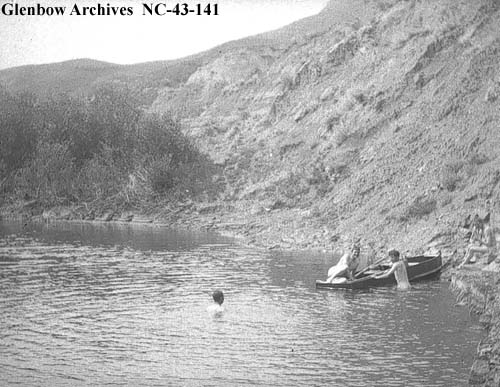
There's nothing better on a hot summer day than heading down to a well maintained pool with water so clean you can see the bottom. Sounds good, but not for the common folk one hundred years ago. Back then, the old swimming hole was a dangerous place without a beach so getting in was a trek across rocks, or down a slippery grass or mud slop. Once you got in you couldn't see the bottom because you'd be stirring up the silt. The bottom itself was usually rocky or mucky or somewhere in between. We used to swim in a lake which was fun once you got used to the silky muck oozing up between your toes. Once you got out, you had to check for leeches, or blood-suckers as we called them, that would hide between your toes or go looking for scabs that had softened in the water. 


Boating and swimming at Springfield [Biggs] ranch, near Beynon, Alberta. ca. 1900. Courtesy of Glenbow Museum Archives

An amusing event happened a few years back when we stopped at a popular provincial campground. The beach was crowded and people of all ages were in the water. I jumped in with the rest of my family and was really enjoying myself, despite the fact that I couldn't see the silty bottom, until I felt a little sting on my leg. The second time it happened I asked a little girl of about six years of age who was splashing nearby if the lake had any blood suckers. She looked confused. I made an ow sound as I felt another sting. Suddenly, the little girl's face brightened. Her eyes grew round and the cords on her neck stuck out as she said, "There's leeeeeeches."

Yes, there were leeches. I'd forgotten about a small scrape on my leg and after making a dash for shore, I looked down to see a blood sucker clinging to my shin. Ugh. 

I've caught my biggest fish while casting from a boat in Alberta and Quebec, but you don't need a boat to get in some decent fishing. You don't even need to know how to choose a lure, tie a fly, or read the water, but all of these help to make the fishing trip fun. I would have loved to fish beside the person in this next shot. The water appears so quiet and still...the kind of day where you can see the fish reach up to snatch an insect from the surface, hear the little splash, and then seen the ripples spread out. This is relaxation at its finest. 


Fishing in creek near Springfield [Biggs] ranch, near Beynon, Alberta. ca. 1900. Courtesy of Glenbow Museum Archives

Unpack the wagon, unhitch the team, and settle down for a picnic while you watch the kids burning energy. The dog in this next photo sure knows how to enjoy life or perhaps he's pooped out from running? Likely as not he rode in the wagon with them and just wants so loving. 


Group on picnic, Springfield [Biggs] ranch, near Beynon, Alberta. ca. 1900. Courtesy of Glenbow Museum Archives

This next photo of the woman and child in a canoe shows that canoes haven't changed over the years. Since the water doesn't appear deep and it's near impossible to get in and out of a canoe without tipping it, I'm assuming that the photographer pushed the canoe out to where he wanted to take the photograph. It's a beautiful shot which shows the fashion of the day with an inspiring reflection in the water. 


Woman and child in canoe, Springfield [Biggs] ranch, near Beynon, Alberta. ca. 1907-1910. Courtesy of Glenbow Museum Archives

This final shot shows an aerial tram or tramway and is used to get from one side of a river or gorge to the other in cases where roads aren't possible or would take too much time to go around. It's similar to a zipline, except it's not on a slope which means it's moved across by sheer muscle, hand over hand. In this case, it looks like the ranch hand is crossing with his saddle which makes sense as he would leave his horse on one side of the river, and then cross over to the other side, do his work, and then return.


Man on tramway over creek near Springfield [Biggs] ranch, near Beynon, Alberta. ca. 1900. Courtesy of Glenbow Museum Archives
Although the man crossing the aerial tram in the above photo is hard to see, he could also be sitting on a seat like in this following image from A Railroad in the Clouds by J. Eglinton Montgomery, first published in Scribner's Monthly Illustrated Magazine for People, and then with the issues from May 1877 to Oct 1877 compiled in The Century, Volume 14 which happens to be a free download at this time.


Engineer Crossing the Chasm Over the Rimac, The Century, Volume 14

So why am I including the aerial tram on this post about summer activities? Because in today's world zipline adventures have sprung up wherever there is any kind of a slope, gorge, or valley and it's a great way to look at the earth in an exciting way.

Have you ever taken a ride on a zip line or aerial tram? Care to share your experience? 


For more photos of this Alberta Ranch, check out these other posts:
Mar 5, 2016 - Riding Side Saddle
May 5, 2016 - Alberta Ranch Cowboy Chore Photos 
Jun 5, 2016 - Alberta Ranch: Summer Haying


~~~~~~~~~~~~~~~~~~~~~~~~


Anita Mae Draper's stories are written under the western skies where she lives on the prairie of southeast Saskatchewan with her hubby of 30 plus years and the youngest of their four kids. Anita's short story, Here We Come A-Wassailing, published in A Cup of Christmas Cheer, Volume 4, Heartwarming Tales of Christmas Present, Guideposts Books, October 2014, was a finalist for the Word Guild's 2015 Word Awards. Her first novella, Romantic Refinements is found in Austen in Austin Volume 1, WhiteFire Publishing, Jan 2016. Discover more at  www.anitamaedraper.com


Romantic Refinements by Anita Mae Draper


It's the Texas-style version of Marianne Dashwood in Jane Austen's Sense and Sensibility...

A  misguided academy graduate spends the summer falling in love . . . twice.
One of four novellas based on Jane Austen's heroines found in 


Austen in Austin Volume 1