Showing posts with label 1940s. Show all posts

Tuesday, July 28, 2026

Famous Horses in History…Trigger – by Donna Schlachter with Giveaway


Roy and Trigger courtesy MorganHorse.com


Trigger the horse was one half of a famous team that included Roy Rogers. So let’s spend a little time looking at the famous man whose untiring devotion to the horse, and whose acute business sense saw the benefit in marketing this animal to his audience (many of whom were children), made Trigger’s fame possible.

Roy was born in 1911 in Cincinnati, Ohio, the third of four children. Leonard Franklin Slye lived with his family on a hand-built houseboat, which they moved to dry land during the Great Flood of 1913 and continued living in it.

In 1922, when Leonard/Roy was 11 years old, he was given a horse and learned to ride. The family was musical, so Leonard/Roy learned to sing, yodel, and play several instruments. During the Depression, the family moved to California, and although Leonard/Roy worked as a fruit picker and other itinerant jobs, he longed to pursue singing. He eventually co-founded the Sons of the Pioneers, making their first records in 1934 when he was 23. The actor Gene Autry gave them their first break with singing parts in his movies. Sometimes, who you know matters.

Just a few years later, Leonard/Roy got a lengthy contract with Republic Pictures, who wanted to cash in on the popularity and recent passing of Will Rogers, so Leonard/Roy changed his name to Roy Rogers. His first movie, Under Western Stars, released in 1938, required the use of a horse. Several were brought to him, and he chose the third mount, Golden Cloud, not even looking at the rest.
Roy and Trigger (MorganHorse.com)


From the beginning, Roy observed that Golden Cloud was no ordinary horse. Smiley Burnett, a co-worker, said, “he is quick off the trigger”, and Roy thought that a good name.

Trigger’s ancestry has always been up for debate, but Roy did some research, and he learned that the sire was at least part Morgan, part Thoroughbred, and his dam was also part Morgan. Despite that, Trigger’s bloodlines included the work ethic of the Morgan and the intelligence and agility of the Thoroughbred.
Trigger doing tricks with Roy (MorganHorse.com)
 
Hollywood Horse Trainer Glenn Randall trained Trigger on more than 150 tricks, including his famous two-legged rear, sitting in a chair, covering himself with a blanket and taking a nap, and because of a hectic travel schedule, was even housebroken.

Although Roy carefully guarded the secret that there was more than one Trigger, the horses were not identical. Trigger had one white stocking, while Trigger Jr. and Little Trigger had four. Their sizes were slightly different, and had Roy stood them side by side, even the little children would have realized their beloved Trigger had look-alikes. Interestingly, because Trigger was never bred, neither of his stand-ins were direct descendants. When asked why he didn’t allow Trigger to breed, Roy said he didn’t want to risk losing the docile spirit of the horse, as that made him trainable and also able to stand quietly while inexperienced riders sat on him.

Here are some interesting facts about Trigger and Roy:

-- Trigger, as Golden Cloud, had first been used in a movie featuring Olivia de Havilland as Maid Marion in The Adventures of Robin Hood

-- Trigger and Roy appeared in 88 movies from 1938 through the mid-1950s

-- Trigger had his own fan club, with members worldwide.

-- Trigger and Roy have their prints in front of Grauman’s Chinese Theatre 
Handprints and hoof prints at Grauman's Chinese Theater (MorganHorse.com)

-- Little Trigger was the horse that folks called “the smartest horse in the movies”, but Trigger got the fame

-- The Denver Broncos NFL team received permission to use the mold that created the form for Trigger after he died, and Bucky the Bronco was used to create the blue stallion with the blazing orange eyes that is synonymous with the Bronco team. The mold was destroyed after that.

-- In 1999, actor Val Kilmer led a horse named Triggerson on stage at the 71st Academy Awards as a tribute to Roy Rogers and his cowboy peers. Triggerson was reportedly grandsired by Trigger Jr.


Trigger died of natural causes one day shy of his 30th birthday at Roy’s ranch in Apple Valley, California. Unwilling to let his long-time friend and companion go, Roy arranged for a professional taxidermist to preserve the hide on a foam likeness of Trigger. The likeness was put on display in the original Roy Rogers-Dale Evans Museum in Apple Valley in 1967, then moved to the new museum location in Victorville, California, in 1976, and then resided in Branson, Missouri, since 2003.
Classic two-legged stance (Courtesy of wikipedia)
 
When the museum closed in 2010, its contents were sold at public auction. Trigger’s likeness was initially purchased by a television station, which planned to include it in a western museum, but those plans never materialized. But that hasn’t stopped Trigger. Instead, he’s spent the years since greeting visitors at the station’s corporate headquarters, along with Buttermilk, Dale Evans’ horse, and Bullet, Roy’s companion dog. The trio are occasionally lent to venues like John Wayne: An American Experience, and The Texas Cowboy Hall of Fame, where they continue to delight audiences of all ages. 
 
As Roy would say, "Happy trails to you!"


Leave a comment about any fond memories you have of Trigger and Roy Rogers, and I will randomly draw from all comments for a free ebook of Hollenberg Hearts to be sent to one lucky recipient.


About Hollenberg Hearts: A mail order bride. A crippled stationmaster. No way out for either of them—except with each other. Can they surrender their hearts and find true love?


About Donna:

A hybrid author, Donna writes squeaky clean historical and contemporary suspense. She has been published more than 60 times in books; is a member of several writers' groups; facilitates a critique group; teaches writing classes; and judges in writing contests. She loves history and research, traveling extensively for both, and is an avid oil painter. She is taking all the information she’s learned along the way about the writing and publishing process, and is coaching committed writers eager to tell their story. Learn more at https://www.donnaschlachter.com/the-purpose-full-writer-coaching-programs Check out her coaching group on FB: https://www.facebook.com/groups/604220861766651

Website: www.DonnaSchlachter.com

Newsletter: https://www.thepurposefullwriter.com/newslettersignup Stay connected so you learn about new releases, preorders, and presales, as well as check out featured authors, book reviews, and a little corner of peace. Plus: Receive 2 free ebooks simply for signing up for our free newsletter!

Facebook: www.Facebook.com/DonnaschlachterAuthor

Amazon Author Page: https://www.amazon.com/stores/Donna-Schlachter/author/B01180A2EE

Bookbub: https://www.bookbub.com/authors/donna-schlachter

Goodreads: https://www.goodreads.com/author/show/14116621.Donna_Schlachter


Resources:

Rearing image of trigger: (picture credit): https://ohiomemory.org/digital/collection/p267401coll32/id/15871/)

https://saddleupcolorado.net/blog/-roy-rogers-horse-trigger-breed-facts-where-he-is-no/?srsltid=AfmBOorpRamQCZ0b9o7ULLbs7GjmUBPAbA46x6t732KOmF74aA9J4MS9

https://en.wikipedia.org/wiki/Trigger_(horse)

https://www.morganhorse.com/upload/photos/page_1144_4-tmh_oct2020_historical_morgans_in_western_films_iv_roy_rogers_trigger.pdf

Monday, October 7, 2024

The History of Camp Forrest ~ by Michelle Shocklee


As the daughter of a World War II veteran, I'm always eager to learn new things about the war and the people who experienced it. As I began to think about the topic for my next book, I knew I wanted to write about the homefront during WWII. So I started to research what was happening in Tennessee during the war, and I came across information about a military installation called Camp Forrest located outside of Tullahoma. Some of the really cool historical tidbits I learned convinced me I'd found the setting for my new book! 

Let's virtually visit Camp Forrest together.

Photo courtesy of US Air Force

Camp Forrest began life as a small National Guard facility called Camp Peay. Camp Peay, named after former Tennessee Governor Austin Peay, was built in 1926 and occupied 1,040 acres of Tennessee farmland. As things heated up in Europe, with Germany invading defenseless countries at an alarming rate, officials in the US military and government knew it was only a matter of time before the United States would be forced into war. 

Soldiers at Camp Forrest (credit unknown)
With that in mind, the government quietly began to prepare. Camp Peay was taken over by the US Army and was expanded to encompass 85,000 acres. Because it was not Army tradition to name military bases for a politician who didn't have a distinguished military background, the camp was renamed after Confederate General Nathan Bedford Forrest, a native of Tennessee whose birthplace was nearby. Unfortunately, Gen. Forrest had a rather tarnished reputation, which didn't please a lot of people, but the name stuck and was used throughout the war. 

After Pearl Harbor was attacked and the United States declared war on Japan, Germany, and Italy, thousands of would-be soldiers soon poured into Camp Forrest for training. The 30,000-plus-acre Spencer Artillery Range was used to train soldiers in heavy artillery. Infantry units practiced maneuvers on the camp's extensive grounds, including a Ranger battalion that practiced rappelling off cliffs. Those same Rangers put their training to use when they scaled the bluffs at Point du Hoc near Omaha Beach in Normandy.

Incoming troops enjoyed use of the amenities found on most military installations of the era: service clubs, guest houses, a library, post exchanges, a post office, hospital facilities, chapels, theaters, and barracks buildings. The camp was also home to Red Cross and Army Emergency Relief facilities. Recreation facilities included swimming, archery, tennis, a sports arena, and a nine-hole golf course.

https://www.hmdb.org/m.asp?m=40256
Yet despite the opportunities for fun and relaxation, the reality of war was always present. From late 1942 to early 1943, 24,000 prisoners of war were held at Camp Forrest. These POWs were members of the German Wehrmacht, with many of them captured in Africa. During that time, the 2,000-bed hospital at Camp Forrest also saw an huge increase in patients as American warriors wounded in Europe were sent home to recuperate.

But why did I choose Camp Forrest as the setting for my new novel All We Thought We Knew? Because of this fascinating fact: 

Beginning in May 1942, Camp Forrest became one of the many Enemy Alien Internment camps that were scattered throughout the country. People with ties to Germany, Japan, and Italy were arrested and detained in internment camps as soon as the US joined the war, with many of them being held for the duration of the war and afterwards. When I read about the many German people who were kept at Camp Forrest against their will, I knew I'd found the topic for my book!

I'll write more about Enemy Aliens in my post next month and tell you about the people who inspired the character of Gunther Schneider! Stay tuned!

Your turn: Are you interested in the history of World War II? Why or why not? Inquiring minds would like to know! 


Michelle Shocklee 
is the author of several historical novels, including Appalachian Song, a 2024 Christy Award Finalist; Count the Nights by Stars, winner of the Christianity Today Book Award; and Under the Tulip Tree, a Christy Award and Selah Award finalist. Her work has been included in numerous Chicken Soup for the Soul books, magazines, and blogs. Married to her college sweetheart and the mother of two sons and mother-in-law to two beautiful daughters, she makes her home in Tennessee, not far from the historical sites she writes about. Visit her online  at www.MichelleShocklee.com


ALL WE THOUGHT WE KNEW

1942
Ava must put her life back together after her husband is killed at Pearl Harbor. A job at Camp Forrest provides income, but it also puts her in contact with Enemy Aliens interned on the military installation. Can she trust the German medical student whose friendship means more to her than it should?

1969
Mattie ran away from the pain when her brother was killed in Vietnam. Now she’s back in Tullahoma facing another devastating loss. Yet it is the bundle of WWII letters Mama insists she reads that makes her question everything she thought she knew about herself.

https://www.tyndale.com/p/all-we-thought-we-knew/9781496484178

Monday, August 14, 2023

Remembering V-J Day

V-J Day, or Victory Over Japan Day, commemorates the Japanese surrender to the Allies on August 15, 1945. However, because of time zone differences, the announcement was made in the United States on August 14, 1945. 

On this date, a little after noon (Japan Standard Time), Emperor Hirohito announced in a radio broadcast that Japan had accepted the terms of the Potsdam Declaration. Earlier that same day, a cable was sent to President Harry Truman advising the Allies of the surrender and the impending declaration.


Truman’s announcement was made via a nationwide radio broadcast that aired at seven p.m. Eastern Time.


August 15th remains the official V-J Day for the United Kingdom and Japan. However, the Japanese know this day as the “memorial day for the end of the war” (終戦記念日, Shūsen-kinenbi) or "the day for mourning of war dead and praying for peace" (戦没者を追悼し平和を祈念する日, Senbotsusha o tsuitōshi heiwa o kinensuru hi). The latter was adopted as the official name by the Japanese in 1982 (Wikipedia).


Surrender of Japan, Tokyo Bay
Our official commemoration, unlike England’s and Japan’s, is September 2nd. This is the date when the surrender document was signed on board the battleship USS Missouri in Tokyo Bay. 

Finally, almost four years after the Japanese bombed Pearl Harbor, World War II had come to an end.


Life magazine reported two weeks later that people celebrated “as if joy had been rationed and saved up for the three years, eight months and seven days since Sunday, Dec. 7, 1941.” 


The news ticker at Times Square, which found itself host to the largest crowd in its history up that time, read: 


OFFICIAL *** TRUMAN ANNOUNCES JAPANESE SURRENDER ***


“The six asterisks represented the branches of the U.S. Armed Forces” (Van Gelder).


Kissing the War Goodbye
Servicemen celebrated by kissing anyone who let them, and the New York Times published Victor Jorgensen’s iconic photograph of a sailor kissing a nurse.

Today is the 78th anniversary of an event that affected millions of people around the world including many—if not most—of our own parents, uncles and aunts, grandparents, and great-grandparents. Yet, it’s a day that now slips by with barely a mention except for two notable exceptions (Wikipedia):


A few towns throughout the U.S. still observe V-J Day, but Moosup, Connecticut “holds the distinction of being the oldest continuous parade celebrating V-J day since the actual surrender of the Japanese in 1945” Their parade is held the second Sunday in August.


Rhode Island observes Victory Day on the second Monday of August though it is not recognized as a state holiday.


Shall we pause a moment to remember a few of those celebrations? Since a picture is worth a thousand words, I’ll let pictures tell the rest of the story. 


Civilians and service personnel in London's Picadilly Circus

Dancing Man in Sydney, Australia


Allied Military Personnel in Paris

The following photo is particularly meaningful for me. I had the privilege of meeting photographer Ed Westcott’s daughter and her husband when I visited Oak Ridge, the Secret City, while researching my novella “Blue Moon” (Homefront Heroines, Barbour).


Citizens and workers of Oak Ridge, Tennessee

I'll share these photos with my granddaughters, who share my interest in WWII history, in our own celebration of today's joy. Will you celebrate with us?


Homefront Heroines ~ Four Young Women Dream of Victory and Love During WWII


This collection includes Johnnie's novella, "Blue Moon," set in Oak Ridge, Tennessee in August 1943.

After humiliating each other, a WOOPs officer and an Army Intelligence agent team up to protect a top-secret atomic bomb facility from sabotage.


Johnnie Alexander writes award-winning stories in multiple genres. A fan of classic movies, stacks of books, and road trips, she shares a life of quiet adventure with Griff, her happy-go-lucky collie, and Rugby, her raccoon-treeing papillon. Visit her at johnnie-alexander.com.


Photos 


Surrender of Japan, Tokyo Bay, 2 September 1945: Representatives of the Empire of Japan on board USS Missouri (BB-63) during the surrender ceremonies. Standing in front are: Foreign Minister Mamoru Shigemitsu (wearing top hat) and General Yoshijirō Umezu, Chief of the Army General Staff. Army Signal Corps - Naval Historical Center Photo # USA C-2719. Photograph from the Army Signal Corps Collection in the U.S. National Archives. Permission details: This file is a work of a U.S. Army soldier or employee, taken or made as part of that person's official duties. As a work of the U.S. federal government, it is in the public domain in the United States.


Kissing the War Goodbye. Victor Jorgensen - US archives. "New York City celebrating the surrender of Japan. They threw anything and kissed anybody in Times Square." National archive number 80-G-377094 Naval Historical Center #520697. Though the photo is tagged “Public Domain,” another note titled Permission Details says: “This tag does not indicate the copyright status of the attached work. A normal copyright tag is still required. See Commons:Licensing.


Civilians and service personnel in London's Picadilly Circus celebrate the news of Allied Victory over Japan in August 1945. Ministry of Information Photo Division. This photograph D 25636 comes from the collections of the Imperial War Museums. The photo is tagged “Public Domain.” Permission Details: This photograph was scanned and released by the Imperial War Museum on the IWM Non Commercial Licence. The image was catalogued by the IWM as created for the Ministry of Information, which was dissolved in 1946. Consequently the image and faithful reproductions are considered Crown Copyright, now expired as the photograph was taken prior to 1 June 1957.


Dancing Man in Sydney on August 15, 1945. Movietone News - Movietone Special: Peace: Australia Celebrates. Public Domain. File:1945-Dancing-Man.jpg.


Allied military personnel in Paris celebrating V-J Day on August 15, 1945. Unknown, but in Office of the Chief Signal Officer collection - Picturing the Century: One Hundred Years of Photography from the National Archives "American servicemen and women gather in front of "Rainbow Corner" Red Cross club in Paris to celebrate the unconditional surrender of the Japanese." Permission details: This file is a work of a U.S. Army soldier or employee, taken or made as part of that person's official duties. As a work of the U.S. federal government, it is in the public domain in the United States.


Citizens and workers of Oak Ridge, Tennessee celebrate V-J Day on August 14, 1945[a]. Ed Westcott / US Army / Manhattan Engineer District - Ed Westcott / American Museum of Science and Energy. In a photo by Ed Westcott, residents of Oak Ridge, TN, fill Jackson Square to celebrate the surrender of Japan. Oak Ridge was one of the three main sites of the Manhattan Project, and was responsible (though those working there did not know it) for refining uranium to be shipped to Los Alamos to be fashioned into atomic bombs. Permission details: This work is in the public domain in the United States because it is a work prepared by an officer or employee of the United States Government as part of that person’s official duties under the terms of Title 17, Chapter 1, Section 105 of the US Code.


Sources (accessed August 7, 2023)


Japanese translations found on Wikipedia. The article’s footnote reads: 厚生労働省:全国戦没者追悼式について (in Japanese). Ministry of Health, Labour and Welfare. 8 August 2007. Archived from the original on 21 March 2008. Retrieved 16 February 2008.


Van Gelder, Lawrence (11 December 1994). "Lights Out for Times Square News Sign?". The New York Times. Archived from the original on 8 May 2016. Retrieved [for Wikipedia] 20 January 2013.


"Victory Celebrations". Life. 27 August 1945. p. 21. Archived from the original on 21 June 2013. Retrieved [for Wikipedia] 25 November 2011.


"It's Victory Day, an only-in-Rhode Island institution since 1975". Archived from the original on 14 August 2013.

Thursday, January 13, 2022

New Monthly Series ~ Stolen and Lost Artwork


While researching various aspects of World War II, I came across a 2006 documentary called The Rape of Europa which was based on Lynn H. Nicholas’s book, The Rape of Europa: The Fate of Europe's Treasures in the Third Reich and the Second World War, published in 1995.


The documentary and the book sparked my interest in the Monuments Men and I read everything I could find on the Monuments, Fine Arts, and Archives program. This group, established in 1943, was tasked with protecting artwork, historic structures, and cultural monuments from theft and damage plus the recovery of stolen treasures.


My main resource was The Monuments Men: Allied Heroes, Nazi Thieves, and the Greatest Treasure Hunt in History by Robert M. Edel (published in 2009). I was so fascinated by the stories of these heroic men that the hero of my first published novel, Where Treasure Hides, joins the Monuments Unit toward the end of the war.


Needless to say, I was thrilled when The Monuments Men movie starring George Clooney, Matt Damon, Bill Murray, and other well-known actors came to theaters the year after my novel was released.


All that initial research occurred over a decade ago. However, I've been intrigued by art thefts, whether by the Nazis or criminals or even do-gooders (anyone else a Leverage* fan?) ever since.


Over the next few months, I’ll share more about the Monuments Men and their quest to protect Europe’s art amidst the chaos of war, about French art historian Rose Valland who worked with the French Resistance to secretly record the paintings the Nazis took from the Jeu de Paume Art Museum, and about such historic heists as the thirteen paintings stolen from Boston’s Isabella Stewart Gardner Museum in 1990.


Though paintings such as The Mona Lisa (stolen in 1911) and The Scream (stolen in 2004) have been recovered, the whereabouts of the stolen Gardner paintings remain a mystery. Numerous works of art stolen during World War II have never been found. One of the most famous of these is Raphael’s Portrait of a Young Man which was stolen from the Princes Czartoryski Museum, located in Krakow, Poland, in 1939. 


Here’s a bit of interesting trivia I found about the most often stolen piece of art as quoted from “Who is the Most Stolen Artist of All Time?” on the Live Science website (October 2012).


“The title for the most frequently stolen single major artwork seems to be contested. Guinness World Records gives it to Rembrandt's 'Jacob de Gheyn III,' which was stolen four times since 1966, surfacing once in a left-luggage office, once on the back of a bicycle, once under a graveyard bench and once in a taxi.

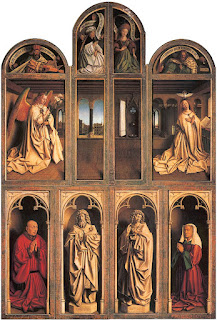
The other candidate, the Ghent Altarpiece, or ‘Adoration of the Mystic Lamb,’ which was the joint work of the Flemish brothers Hubert and Jan van Eyck, was stolen seven times over six centuries, according to art historian Noah Charney's website. One of those times was during WWII when it was placed in an Austrian salt mine along with thousands of other stolen art and cultural treasures."

This image depicts the back of the Altarpiece when the panels are closed.

If there’s a particular art heist or aspect of stolen/lost art that you’d like me to write about, please let me know. I’ll add your topic to my list and do my best to write about it in the coming months.


Johnnie imagines inspiring stories in multiple genres. A fan of classic movies, stacks of books, and road trips, she shares a life of quiet adventure with Griff, her happy-go-lucky collie, and Rugby, her raccoon-treeing papillon. Visit her at johnnie-alexander.com.


About Where Treasure Hides:

~~CBA Best Seller

~~Serious Writer Maxwell Award

~~Blue Ridge Autumn in the Mountains Golden Leaf Award

~~ACFW Genesis Winner

~~Translated into Dutch & Norwegian


*For those who may not be familiar with the TV show, Leverage (2008-2012) “follows a five-person team: a thief, a grifter, a hacker, and a retrieval specialist, led by former insurance investigator Nathan Ford, who use their skills to carry out heists to fight corporate and governmental injustices inflicted on ordinary citizens” (Wikipedia ~ who explained it better than I could). Most of the cast have returned for Leverage: Redemption (now available on Amazon Prime with IMDb subscription).


Tuesday, December 14, 2021

Annie Fox ~ Head Nurse at Pearl Harbor


December 7, 1941 ~ Never Forget

Remembering Pearl Harbor ~ 80 Years Later

The thirty-bed hospital at Hickam Field opened less than a month before the surprise attack on Pearl Harbor. On that frightful morning, the Hawaiian paradise exploded into a burning bloodbath of death and destruction.

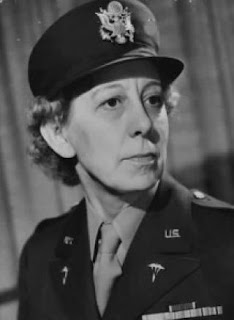
Though 1st Lt. Annie Fox joined the US Army Nurse Corps near the end of World War One, she’d never been in a battle…until now.

The forty-seven-year-old head nurse of the Hickam Field hospital immediately organized the nurses and also the wives of the military personnel who volunteered to tend the wounded and gather supplies.

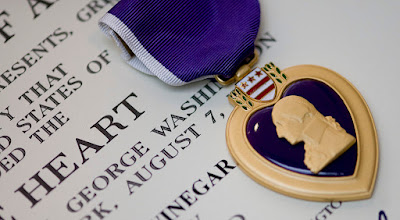
Because of her courage and leadership, Lt. Fox was awarded the Purple Heart on October 26, 1942. She was the first American woman to receive this prestigious medal.

Here’s a quote from her citation:

“During the attack, Lieutenant Fox in an exemplary manner, performed her duties as head nurse of the Station Hospital… [She] worked ceaselessly with coolness and efficiency and her fine example of calmness, courage, and leadership was of great benefit to the morale of all with whom she came in contact” (National Women’s History Museum).


Sometime later, the rules for who could receive a Purple Heart changed. Only those who had been wounded in battle were now eligible to receive the medal.

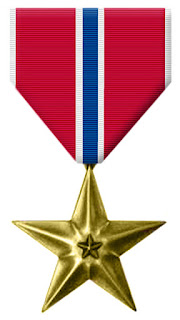
For that reason, Lt. Fox was awarded the Bronze Star in October 1944 and her Purple Heart was rescinded. In making this decision, "the Report of Decorations Board cited the same acts of heroism as those cited for the Purple Heart. The last paragraph of the report reads: 'The Bronze Star Medal is in lieu of the Purple Heart awarded. . .'" (Military-History Fandom).

Lt. Fox’s courage was again recognized in March 2017 when Hawai’i Magazine included her in a list of “15 Extraordinary Hawai’i Women Who Inspire Us All" compiled by Matthew Dekneef (March 8, 2017).

The listing recognizes Lt. Fox, ranked number 13 on the list, as the first woman to receive the Purple Heart and explains how the medal was rescinded and replaced by the Bronze Star.

Brief Bio:
  • Annie Gayton Fox was born on August 4, 1893 in Nova Scotia. Her father was a medical doctor.
  • She joined the US Army Nurse Corps in 1918 and served in both WWI and WWII.
  • Before she retired from active duty in December 1945, Annie had been promoted to captain and then to major.
  • She died on January 20, 1987 at the age of 93.
As we commemorate the 80th anniversary of Pearl Harbor, let us also remember the courage of Head Nurse Annie Fox and those who served alongside her to save as many lives as possible on that “Day of Infamy.”

[Photo Credits: Public Domain]


Johnnie Alexander imagines characters you'll want to meet and stories you won’t forget in multiple genres. A fan of classic movies, stacks of books, and road trips, she shares a life of quiet adventure with Griff, her happy-go-lucky collie, and Rugby, her raccoon-treeing papillon.

Purchase The Cryptographer's Dilemma at http://bit.ly/ja-TCD.

Connect with Johnnie at johnnie-alexander.com.

Monday, July 6, 2020

The Roswell Incident of 1947: What's it all about

By Michelle Shocklee

I'm a New Mexico girl, born and raised. My daddy was born in Roswell in 1921, so the small town in the eastern part of the state is quite familiar to me. But ever since the events of a hot summer night in 1947, the town hasn't been the same.
Brig. Gen. Ramey & Col. Dubose identify debris
found near Roswell, NM in July 1947

Sometime between mid-June and early July 1947, rancher W.W. “Mac” Brazel found wreckage on his property in Lincoln County, New Mexico, approximately 75 miles north of Roswell. Stories of "flying saucers" and "flying discs" had already appeared in the national press that summer, leading Brazel to believe the wreckage could be something of that nature. He brought some of the material--rubber strips, tinfoil, and thick paper--to Sheriff George Wilcox of Roswell, who in turn brought it to the attention of Colonel William Blanchard, the commanding officer of the Roswell Army Air Field. Several officers from the air field arrived at the ranch on July 7 to gather more debris. 

What happens next is a mixture of facts and legend, with a healthy dose of conspiracy theory thrown in for good measure, which continues to this day. 

On July 8, the RAAF released a statement, writing that, “The many rumors regarding the flying disc became a reality yesterday when the intelligence office of the 509th Bomb Group of the Eighth Air Force, Roswell Army Air Field, was fortunate enough to gain possession of a disc through the cooperation of one of the local ranchers and the sheriff's office of Chaves County.” This statement was published in the local newspaper. 


Apparently, that wasn't a good idea. The RAAF changed their story the next day. The mysterious object found on the ranch was simply a harmless, high-altitude weather balloon, they claimed. Nothing to see here, people. 


Picture of Jesse Marcel, the head intelligence officer on the case. "Not a flying disc."
With government officials declaring the mystery wasn't all that mysterious, the story quickly faded. It wasn't until the 1970s and 80s, when UFO researchers began writing books with speculations of a cover-up, did interest in the Roswell Incident begin.  All sorts of claims were made, including those of alien bodies being recovered and hidden at an Air Force base. 

It wasn't until 1994, forty-seven years after the debris was found, that the truth (I assume) came out.

In July of that year, the U.S. Air Force released a report in which they conceded that the “weather balloon” story had been bogus. According to the 1994 explanation, the wreckage came from a spy device created for an until-then classified project called Project Mogul. The device—a connected string of high-altitude balloons equipped with microphones—was designed to float furtively over the USSR, detecting sound waves at a stealth distance. These balloons would ostensibly monitor the Soviet government’s attempts at testing their own atomic bomb. Because Project Mogul was a covert operation, the new report claimed, a false explanation of the crash was necessary to prevent giving away details of their spy work.

Merchandise at Roswell store; photo on Google

Aliens and UFOs have become big business in Roswell. You can't 'swing a cat' without hitting an alien or spaceship. People come from around the world to do their own investigating and to see the sights. Whichever story you believe--the government cover-up of an alien crash site or the government's admission to secret spying--Roswell is still an interesting little town to visit. 

Your turn: have you been to Roswell? What'cha think about all this UFO stuff?
Welcome to Roswell; photo on Google


Michelle Shocklee is the author of several historical novels, including her September 2020 release, Under the Tulip Tree. Her work has been included in numerous Chicken Soup for the Soul books, magazines, and blogs. Married to her college sweetheart and the mother of two grown sons, she makes her home in Tennessee, not far from the historical sites she writes about. Visit her online at michelleshocklee.com.

UNDER THE TULIP TREE
Releasing 9.8.20; PREORDER available now!

Sixteen-year-old Lorena Leland’s dreams of a rich and fulfilling life as a writer are dashed when the stock market crashes in 1929. Seven years into the Great Depression, Rena’s banker father has retreated into the bottle, her sister is married to a lazy charlatan and gambler, and Rena is an unemployed newspaper reporter. Eager for any writing job, Rena accepts a position interviewing former slaves for the Federal Writers’ Project. There, she meets Frankie Washington, a 101-year-old woman whose honest yet tragic past captivates Rena.

As Frankie recounts her life as a slave, Rena is horrified to learn of all the older woman has endured—especially because Rena’s ancestors owned slaves. While Frankie’s story challenges Rena’s preconceptions about slavery, it also connects the two women whose lives are otherwise separated by age, race, and circumstances. But will this bond of respect, admiration, and friendship be broken by a revelation neither woman sees coming?

Monday, May 11, 2020

Escape to Candy Land


By Kathy Kovach


One of my favorite tropes is, “When life hands you lemons, make lemonade!”

There is no denying what has been happening to our communities, our country, and our world the past couple of months during this pandemic. Many of us have gone underground trying to flatten the curve. Some people have used their self-isolation to be creative, to get closer to their families, or to catch up on their favorite forms of entertainment.

Quarantine is not new, and, as energetic bloggers and meme creators have pointed out, one should never let a good forced confinement go to waste.

Sir Isaac Newton discovered gravity in 1665 during the epidemic caused by the bubonic plague. William Shakespeare wrote King Lear during an earlier plague in
London. Victor Hugo, an outspoken critic of French politics, went into isolation to avoid punishment and finished a little piece he had begun earlier called Les Miserable.

The renowned artist Frida Kahlo had contracted polio at an early age and was no stranger to bedrest. But it
wasn’t until she was older that the bus she was riding on in her native Mexico collided with a streetcar. Frida suffered a plethora of broken bones, a dislocated shoulder, and a crushed foot. The severe injuries, including those to her spine and pelvis, sent her back to bed where she discovered a love for art that would later become an emotional outlet. Her now-famous self-portrait was created as she looked at herself in the mirror above her bed.

Another polio sufferer, American teacher Elizabeth R. Abbott, used her creative juices during the polio scare of the 1940s and 50s. While a patient in 1948, she saw a need as she watched children confined inside the hospital walls. Polio wards were often in hospitals miles away from the families who had to work and take care of the
other children. That left the young patients lonely and bored. Out came the butcher paper on which Elizabeth invented a game that would not only keep the little ones busy, but give them a sense of the freedom they craved.

The game was Candy Land, simple enough that a child who couldn’t read would be able to play without an adult. As their imaginations worked their way through a magical land of candy canes and gum drops, they were able to experience the movement that their legs had abandoned. In addition, the bright colors gave them a reprieve from the dull hospital walls and antiseptic atmosphere.

Ms. Abbott, aware of the popularity of the game in her own circles, decided to approach the Milton Bradley company, once known for school supplies but now a pioneer in board games. The original Candy Land sported the same bright primary colors envisioned by its creator and featured a boy and girl, poised to romp down the square-filled path. The boy had a brace on his leg in honor of the children who were the alpha-testers of the game. The brace was later airbrushed away as the game hit the mass market.

Candy Land quickly became Milton Bradley’s bestseller, and has gone on to
entertain children for seventy years. In 2005 it was inducted into the National Toy Hall of Fame. Elizabeth Abbott must have become crazy rich with her little idea, right?

Wrong.

She donated all of her royalties to children based charities.

Here’s hoping that something good comes out of this lockdown. Something that future historians will look back and marvel on. It won’t happen in my house, however. Life handed us lemons, and we’re kicking back and drinking the lemonade, slow and easy.


A Bouquet of Brides Romance Collection
Meet seven American women who were named for various flowers but struggle to bloom where God planted them. Can love help them grow to their full potential?
"Periwinkle in the Park" by Kathleen Kovach
1910, Colorado
Periwinkle Winfield is a hiking guide helping to commission a national park. But a run-in with a mountain man who is determined to keep the government off his land may place her in great danger.


Kathleen E. Kovach is a Christian romance author published traditionally through Barbour Publishing, Inc. as well as indie. Kathleen and her husband Jim raised two sons while living the nomadic lifestyle for over twenty years in the Air Force. Now planted in northeast Colorado she's a grandmother, though much too young for that. Kathleen is a longstanding member of American Christian Fiction Writers. An award-winning author, she presents spiritual truths with a giggle, proving herself as one of God's peculiar people.