Showing posts with label American. Show all posts

Friday, March 2, 2018

Inside the White House: The Red Room


For visitors of the White House in Washington D.C., the Red Room is a favorite on the tour--and it's also been a favorite of many members of presidential families. As one of the three parlors on the state floor, it's been used as a reception room for decades, but it hasn't always been that way. Nor has the room always been red!
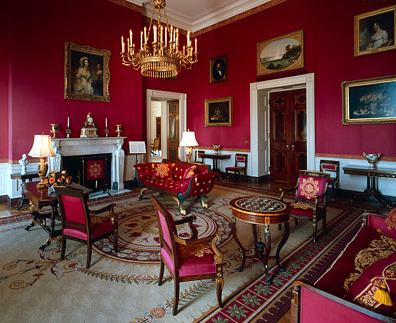
The Red Room during the Clinton Administration. Public Domain. 
In 1803, Jefferson appointed Benjamin Latrobe as "Surveyor of Public Buildings," and Latrobe set about overseeing repairs and modifications to the house. When he drew his design for the state floor of the White House (what is now the first floor), he referred to what we now call The Red Room as the "President's Antichamber" (sic) for the Cabinet Room or the President's Library (now the State Dining Room).

When Dolley Madison became first lady in 1809, she transformed the space into a Yellow Drawing Room, where she held her Wednesday night receptions. It's assumed the walls and furnishings were gold or yellow, but the curtains she ordered were made of scarlet velvet. 

After the White House was gutted in the fire of 1814, President Monroe's administration oversaw the reconstruction. He ordered furnishings in the Empire style: carved wood mounted with ormulu (decorative gilded bronze hardware in designs like dolphins, leaves, and sphinxes). The chamber still doesn't appear to have been called the Red Room, however; it was known as the Washington Parlor during the Polk and Tyler Administrations because Gilbert Stuart's portrait of George Washington hung in the room.

While the name may have changed, the furnishings do not appear to have changed much between Monroe's time and the Lincoln Administration, for contemporary journalist Noah Brooks described the ormulu work, crimson and gold furnishings, and age of the pieces dating from Madison's time. The Lincolns used it as a music room and informal meeting place; Mary Todd Lincoln received private callers here, and President Lincoln met his friends for social evenings in this room. 
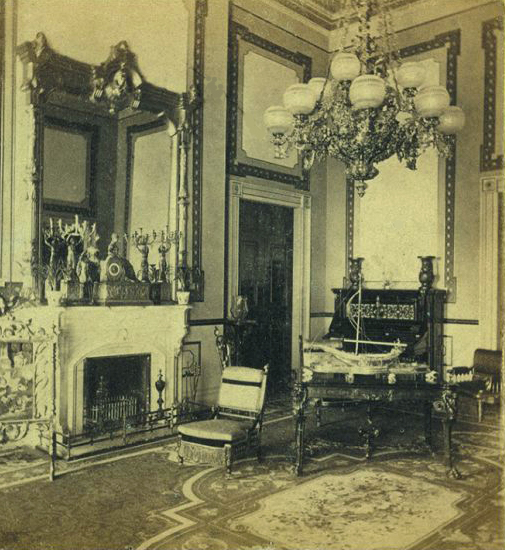
The Red Room during the Grant Administration, which was used as their family living room. Note the light color of the walls. Public Domain.
Hand-tinted etching of the Red Room, 1887, Cleveland Administration. Library of Congress
During the Theodore Roosevelt Administration, renovations were completed on the White House, including the Red Room, by architectural firm McKim, Mead & White. The walls were hung with burgundy silk velvet, and the Empire style furnishings were replaced with late nineteenth-century pieces.

The Red Room During the Theodore Roosevelt Administration, hand-tinted. Public Domain
When the White House was reconstructed during the Truman Administration, the Red Room was dismantled and rebuilt with lower ceilings to accommodate air conditioning. Few pieces of furniture remained in the house that were original, so B. Altman's stores' design department was hired to furnish the rooms. The walls were papered with red silk damask and curtains to match, and a large matching rug covered the floor.

Jacqueline Kennedy's refurbishment of the White House began in the Red Room, and it was done in a French style. The walls were hung with a pinkish-red color, cerise, and authentic Empire-style pieces were purchased to augment sofas donated from the families of Martha Washington and Dolley Madison, as well as items pulled from storage. 
Funeral Reception for John F. Kennedy, 1963. Public Domain.
Most of the furniture still present in the Red Room came from the Kennedy Administration and the Nixon Administration. During the Nixon renovation, the walls were changed from cerise to scarlet, and the 1842 portrait of Van Buren's daughter-in-law and hostess, Angelica Van Buren, was placed over the fireplace--where it remains to this day.

Nancy Reagan, 1981. Note the painting of Angelica Van Buren over the mantel. Public Domain.
The Clinton Administration changed the walls to a deeper scarlet color, which is more in keeping to the early nineteenth-century decor. Each piece of furniture is covered in fabric woven in the United States.

Whatever its decor has been over the past two hundred years, the Red Room has remained a popular place for gathering: a family living room for the Grants, a cozy setting for tea parties for the Eisenhowers, a place for intimate dining parties for the Clintons, a spot to receive female members of the press for Eleanor Roosevelt, and a favorite room of Nancy Reagan. 

It's my favorite, too.

***

BIO:

Susanne Dietze began writing love stories in high school, casting her friends in the starring roles. Today, she's the award-winning author of a dozen new and upcoming historical romances. A pastor's wife and mom of two, she loves fancy-schmancy tea parties, the beach, and curling up on the couch with a costume drama and a plate of nachos. You can visit her on her website, www.susannedietze.com, to learn about her new romance, A Mother For His Family


Saturday, September 16, 2017

The Mad Hatter and Camel Urine


Did you know the crazy Mad Hatter in Alice and Wonderland is based on a historic fact?

When tall, black beaver-felt hats were the raving fashion, the hatters would bring in beaver pelts from all over, including multiple thousands from across the ocean in what would become The United States.


Once they received the furs from near and far, they had to find a way to treat the pelts to release the top layer of hair that was coarse and ugly (not good for the hats) and gathered the shorter, softer, under fur. The fine layer was then mixed with glue, shaped, and molded to fit a hat form. And like the 80s hair band—the taller, the bigger, the better.


But here’s the kicker, to release that long hair and access the fine fur the beaver skin had to be coated with mercury.

Yup mercury.

You know where I’m heading don’t you.

The hatmaker would heat the glue-fur combo over a lantern or candle to get a better shape out of the material. Unwittingly, they would breathe in mercury fumes which are a neurotoxin which led to several crazy hatmakers suffering from Mad Hatter Syndrome.


I was so intrigued when I learned this random little fact. Even more so, when I found that the Mad Hatter in the original Alice in Wonderland was supposedly based on the author's crazy-hatter friend.

But as I shared my tidbit with my friends, I found that many knew this crazy fact already.

BUT!!!

They didn’t know this extra special detail.

I laugh.

How on earth did the hatmaker’s figure out that mercury released the fur?

And here it is.

Some entrepreneuring individual figured out that camel fur, plus, camel urine equals released fur that could be used as felt. And the craft of felting was born.

As the demand for hats grew, so did the demand for camel urine. Eventually there wasn’t enough camel urine to go around. So, some other get-it-done fellow figured he would try human urine and see if it worked too. 


It did.

I know. Ugh.


As the easier to obtain and cheaper resource of human urine became the norm, they noticed the poor hatmaker with syphilis being treated with mercury produced a finer end product than their healthy counterpart. Eventually they got around to selling hats with urine-free mercury treatments. Improving sales and making hatmakers sick with the mercury exposure.

I think I’m just fine with seeing the elegant top hats behind museum glass or staged on vintage mannequin.

Camel pee… yuck.

I found a new respect for the crazy, mad hatters. Dealing with furs, camel urine, mercury poison, and fancy lords of the highest rank, on top of learning how to felt to perfection was no small task. They had to have some tenacity to be good at their jobs.

My hats off to you, hatters.


Do you know of any interesting facts behind the trades? How or why certain tricks-of-the-trade came about or trades that have become obsolete? I’d love to hear them.


CaraGrandle is a Historical Romance Novelist who prefers to write about the early settlers of the Pacific Northwest. She is represented by the Steve Laube Agency. Cara leads the author4TheAuthor writers group on Facebook, home to 185 writers. Together they're pressing back on busy and making a space for their dreams. Cara hosts a Writers Encouragement show weekly on Periscope. The show is on Tuesday mornings at 9:00am PST. Cara's Periscope show includes live, interactive author-interviews with leading Christian fiction novelists, editors, publicist and agents under the handle @CaraGrandle. 

Cara is currently out on submission. Follower her journey on her Facebook author page. 
 

Sunday, May 21, 2017

Let's Go to the Diner!


photo by Jim Brueckner

By Marilyn Turk

Have you ever been to a diner?
These nostalgic restaurants were popular from the 1920’s to the 1950’s, but today’s fast food restaurants replaced them. Some of you may remember the diners in TV shows like “Happy Days” and “Alice.”  Norman Rockwell’s 1958 painting, The Runaway, shows a young boy and a protective highway patrolman at the counter of an anonymous diner.
According to Webster’s Dictionary, a diner is “a restaurant in the shape of a railroad car,” and was nicknamed from the term “dining car.”
In 1858, Walter Scott of Providence, Rhode Island, began selling sandwiches and coffee to night workers. His business grew so well that in 1872, he quit his day job and started selling food from a horse-drawn covered express wagon, credited as being the first diner. Soon, others copied his idea and set up wagons that served workers and pedestrians at night, since most restaurants were closed by 8:00 p.m.

Photo courtesy Flickr by Liz West
When the wagon vendors joined the lunchtime business, their inexpensive, fast meals gained popularity, and the wagons began to crowd the streets. Towns and cities passed ordinances to restrict their hours of operation. This prompted some owners to park their wagons in semi-permanent location to circumvent the law.

As horse-drawn street cars were replaced by new electric ones, wagon vendors bought the old cars and converted them into diners. During this time, diners gained the reputation of “greasy spoons,” and many were open 24 hours a day.

After women gained the right to vote in 1920, diner owners began to clean up their image to attract the women’s business. They spruced up their businesses with a fresh paint, added flowers and shrubs outside, and booth service inside.

Diner menus typically featured American classic fare like hamburgers, French fries, and sandwiches. In addition, many served hand-blended milkshakes and desserts like pies, displayed in glass cases.
Prefabricated diners entered the scene in the 1920’s with innovations such as indoor bathrooms, tables, and longer dimensions. The 1930’s saw more streamline versions, made to symbolize speed and mobility.

Diners maintained their popularity during the Depression because they offered inexpensive places to eat. After World War II, the demands for diners increased. Servicemen eligible for G.I. loans saw diners as an easy way to make an income. In 1948, a dozen diner manufacturers competed for business. New materials such as Formica, Naugahyde and terrazzo floors made their entrance into diner design. All stainless steel exteriors and large windows were added to attract motorists as populations became more mobile.

The introduction of new fast food restaurants caused diners to lose popularity during the 1960’s until a revival began in the late 1970’s.

Interest in the American diner continues today. People intent on preserving the diner atmosphere where people from all walks of life gathered for inexpensive meals prompted a number of vintage diners to be rescued from demolition and relocated to new sites. The Massachusetts Historical Commission has placed all vintage functioning diners on the National Register of Historic Places.

Did you have a favorite diner? What did it look like? What was your favorite food there?


Marilyn Turk loves to study history, especially that of lighthouses and the coast of the United States. She is the author of Rebel Light, a Civil War love story set on the coast of Florida, A Gilded Curse, a historical suspense novel set on Jekyll Island, Georgia, in 1942, and Lighthouse Devotions - 52 Inspiring Lighthouse Stories, based on her popular lighthouse blog. (@ http://pathwayheart.com)