Showing posts with label White House. Show all posts

Thursday, January 25, 2024

Babies In the White House


by Jennifer Uhlarik


In the history of the United States, quite a few children have been born at the White House. However, only one of those was the child of a sitting president. Do you know who it was? If the rest weren’t a sitting president’s children, who were they? Let’s dig in and find out!


Thomas Jefferson

I think it is fair to say that Thomas Jefferson’s time in the White House saw the most children born. The very first baby born in the White House was Asnet Hughes, the son of 14-year-old Ursula Granger, a slave girl Jefferson brought from Monticello with the intention that she study under the White House’s French chef, so that he could enjoy delicious food once his presidency was over. However, young Ursula gave birth to her child in the early part of 1802, and by mid-August, the sickly child died. She returned to Monticello soon after her baby’s death, married Asnet’s father, and had a dozen more children with him.


Another slave girl, Edy Fossett, was brought from Monticello in 1802 with the same intention—to have her study under the French chef for the White House. But Edy was also pregnant upon her arrival, and in January 1803, she delivered a son who lived until 1806 and passed away from illness. Around this time, Edy’s enslaved sister-in-law, Fanny Hern, also came to the White House to help Edy with kitchen duties. Despite the fact Edy’s husband Joe and Fanny’s husband Davy, also slaves of Jefferson’s, remained at Monticello, they all saw each other often enough that the women went on to have more children. Edy bore two other children during her time in the White House—and several more after her return to Monticello, and Fanny had two children with Davy while in Washington.


Peter Fossett,
one of Edy Fossett's children

Also in 1806, James Madison Randolph, Thomas Jefferson’s own grandchild, was born. With his wife Martha, Jefferson had six children, but only two—the eldest (Martha) and the fourth child (Mary)—survived into adulthood. Since Jefferson was a widower, the duties of First Lady often fell to his two daughters. After Mary’s death in 1804, those duties fell largely to Martha who, with her husband and children, moved into the White House. On January 17, 1806, James Madison Randolph was born. The boy grew up, never married, and died of illness days after his twenty-eighth birthday.


Mary Louisa Adams,
grandchild of Pres. John Quincy Adams


After this, there was a span of roughly twenty years where no children were born in the White House. It wasn’t until John Quincy Adams won the presidency that another child made an appearance—and this child was Adams’ granddaughter, Mary Louisa. She was born on December 2, 1828, to newlyweds John Adams II and Mary Catherine Hellen. Mary took little interest in her marriage and only slightly more interest in her child, so little Mary Louisa was greatly influenced by her doting grandparents, John Quincy and Louisa Adams. The First Lady is said to have paced the floor with her teething granddaughter in the middle of the night, and the President tutored her regularly in math and languages.


President Andrew Jackson had been recently widowed before his time in the White House, so he brought his nephew, Andrew Jackson Donelson with him to act as his private secretary. Donelson and his wife Emily already had one child together, but soon after they moved into the White House, Emily realized she was again in the family way. Mary Emily Donelson was the first of three children they would have while residing in the White House. She was born August 31, 1829. Her next younger brother, John Samuel Donelson, came along on May 18, 1832, followed by the youngest child, Rachel Jackson Donelson, on April 11, 1835. Mary lived a good long life, staying connected to Washington politics for most of it. At the outbreak of the Civil War, John joined the Confederacy and died at Chickamauga in his early thirties. And Rachel eventually moved to Texas and lived a quiet life, though she was ill for much of it and eventually died of illness in her early 50s.


Emily Donelson, daughter-in-law
of Andrew Jackson, who served
as First Lady and gave birth to three of
Jackson's grandchildren in the  White House.


Martin Van Buren was another widower who assumed the role of U.S. President. His son, Abraham, married Angelica, and after their European honeymoon, moved into the White House to act as private secretary and first lady respectively. In 1839, Rebecca Van Buren was born—but tragically died soon after from an unknown illness. Some sources say it was as few as five days, some say six months, and still others fall somewhere in between—but regardless, little Rebecca survived only a short time.


President John Tyler saw two grandchildren born in the White House—granddaughter Letitia Tyler on April 13, 1842, and grandson Robert Tyler Jones on January 24, 1843. Both would go on to support or fight for the Confederacy during the Civil War. In fact, Robert was in the midst of Picket’s Charge, and when the man carrying the regiment’s flag was killed, Robert picked it up and advanced to the stone wall where he was severely wounded but survived.


Daguerreotype of James K. Polk


As several former presidents did, James K. Polk asked his nephew Joseph Knox Walker to act as his private secretary. Walker’s wife, Augusta Adams Tabb, gave birth to her fourth child, daughter Sally Walker, on March 15, 1846. In December 1847, Joseph Knox Walker, Jr. was born to the pair. Both children were doted on, although precocious Sally was known to barge into cabinet meetings and other important moments of her grandfather’s presidency. Unfortunately, Joseph Jr.—better known as Knox—died at age 10 after falling off a horse.


Almost another twenty years passed after Knox’s birth before another child made an appearance in the White House. This child was granddaughter of Ulysses S. Grant, Julia, born on June 7, 1876. Despite being just an infant or toddler, she was allowed to be in Presidential receiving lines at official White House events during her time there. She later lived in Europe, married a Russian prince, divorced him after thirty-six years of marriage and three children. Julia returned to America where she stayed involved in politics nearly until her death at age 99.


Esther Cleveland

The only baby to be born in the White House to a sitting president is Esther Cleveland, second daughter of President Grover Cleveland. She was born September 9, 1893. President and Mrs. Cleveland did have another child while he was still president, but that daughter (Marian) was born elsewhere. Esther married a British Army officer, had two children, and lived to be eighty-six.


The last baby to be born in the White House—and the only one born in the 20th Century—was Woodrow Wilson’s grandson, Francis Bowes Sayre, Jr. He made his appearance on January 17, 1915, and went on to become an Episcopal reverend, dean of Washington D.C.’s National Cathedral, and fought for Civil Rights in the 1960s. Sayre lived to be 93, after a long and influential life.


Francis Bowes Sayre, Jr. with his parents.


It's Your Turn: Were you aware that so many children were born on the White House premises? Would you have wanted to give birth in the White House if such an option were available to you? Why or why not?


Award-winning, best-selling novelist Jennifer Uhlarik has loved the western genre since she read her first Louis L’Amour novel. She penned her first western while earning a writing degree from University of Tampa. Jennifer lives near Tampa with her husband, son, and furbabies. www.jenniferuhlarik.com


AVAILABLE NOW


Love’s Fortress by Jennifer Uhlarik


A Friendship From the Past Brings Closure to Dani’s Fractured Family


When Dani Sango’s art forger father passes away, Dani inherits his home. There, she finds a book of Native American drawings, which leads her to seek museum curator Brad Osgood’s help to decipher the ledger art. Why would her father have this book? Is it another forgery?


Brad Osgood longs to provide his four-year-old niece, Brynn, the safe home she desperately deserves. The last thing he needs is more drama, especially from a forger’s daughter. But when the two meet “accidentally” at St. Augustine’s 350-year-old Spanish fort, he can’t refuse the intriguing woman.


Broken Bow is among seventy-three Plains Indians transported to Florida in 1875 for incarceration at ancient Fort Marion. Sally Jo Harris and Luke Worthing dream of serving on a foreign mission field, but when the Indians reach St. Augustine, God changes their plans. However, when Sally Jo’s friendship with Broken Bow leads to false accusations, it could cost them their lives.


Can Dani discover how Broken Bow and Sally Jo’s story ends and how it impacted her father’s life?


Monday, September 2, 2019

Outside the White House: The Vegetable Garden

by Susanne Dietze

The White House in Washington, D.C. has had a vegetable garden of some type since it was completed in the year 1800. The first was planted by Abigail Adams, wife of second president John Adams, who grew the food to feed to their family.

Second President John Adams, Public Domain
Third president Thomas Jefferson added ornamental and fruit trees to the garden, but in 1825, President John Quincy Adams expanded the garden by planting herbs, vegetables, and more fruit trees to feed the household.

In 1835, President Andrew Jackson had an orangery--or glass hothouse--built on the grounds. Tropical fruit was grown here in the orangery until 1857, when larger greenhouses were built. These remained until 1902, when they was torn down to make room for the West Wing.

File:Green houses, White House, Washington, D.C. LCCN2012646240.jpg
White House Greenhouses, 1889. Johnston, Frances Benjamin, 1864-1952, photographer. Public Domain.
In 1943, World War II caused food shortages across America, and Victory Gardens were one way to combat it. First Lady Eleanor Roosevelt joined in the cause, planting a garden on the grounds of the White House. 

Something shifted in perception after the War, however, and a vegetable garden was not part of the White House for several years. President Clinton wanted a vegetable garden, but was told it was not in keeping with the formal look of the White House grounds, so he and his wife Hillary planted a garden atop the White House roof. The produce they grew was used in the White House kitchens.

In 2009, First Lady Michelle Obama began work on the largest vegetable garden at the White House: 1,100 square feet on the South Lawn (it later expanded to 1500 square feet). Until this point, Obama had not gardened, but she thought it would be a good way to teach children, including her own, to have healthier diets rich in more vegetables and fruits. Seedlings were started in the White House greenhouse.

On its first planting day, two dozen fourth and fifth graders from Bancroft Elementary and Harriet Tubman Elementary came to assist. Among the seedlings planted were lettuces, kale, collards, and cabbage. Other vegetables followed, in season. Summer crops have included corn and tomatoes, and other years new items were added, like Lincoln Oats, sea kale, peanuts, pumpkins, herbs, papaya, figs, lemongrass, and tomatillos. 

Lest history be forgot, two raised beds are devoted to heirloom varieties cultivated by earlier presidents, such as Thomas Jefferson's "early blood turnip" beets. Another bed is solely for flowering blooms that attract pollinators, like lavender, butterfly weed, goldenrod, and milkweed. The White House also keeps bees, so pollinators are always close by.

Throughout the administration, schoolchildren were invited to help with planting and harvesting. The crops were used in the White House kitchens, and any excesses were donated to homeless shelters.

Current First Lady Melania Trump joined schoolchildren in harvesting lettuce, kale, radishes, and mustard, and planting cabbage, carrots, turnips, and other vegetables in the autumn of 2017.
File:Visitors view the Kitchen Garden during the White House Fall Garden Tour, 2012.jpg
 Oct. 14, 2012. Official White House Photo by Lawrence Jackson.
Public Domain
The current garden was funded in 2016 by a $2.5 million donation by Burpee Seeds. The vegetable garden is open to tours biannually.

**
Susanne Dietze is the RITA-nominated author of over a dozen stories with Timeless Heart, including Cameo Courtships. She does not think President Jefferson's "blood turnips" sound particularly good. Learn more on her site, www.susannedietze.com.

Tuesday, July 2, 2019

Outside the White House: The Rose Garden


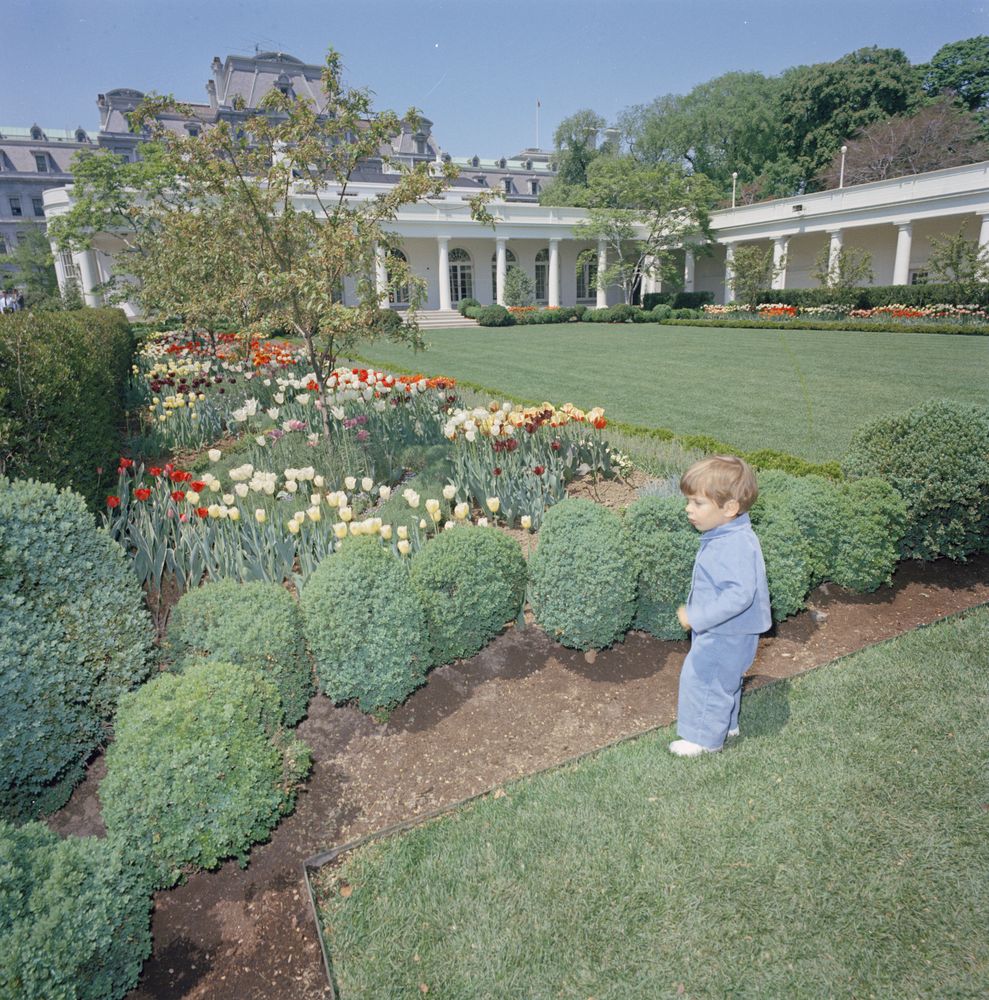
JFKWHP-ST-C112-1-63.jpg
John F. Kennedy, Jr., April 26, 1963. Cecil Stoughton. White House Photographs. John F. Kennedy Presidential Library and Museum, Boston. Public Domain
Roses have been cultivated at the White House for at least a hundred and fifty years. Before the Civil War, a complex of buildings, such as a milk house, ice house, servant quarters, and offices stood where the West Wing is today, outbuildings catering to the First Family's needs. In addition, there stood several greenhouses--growing food and flowers--including a "rose house." 

File:Green houses, White House, Washington, D.C. LCCN2012646240.jpg
White House Greenhouses, 1889. Johnston, Frances Benjamin, 1864-1952, photographer. Public Domain.
The rose house was a rectangular glass structure, and inside, roses were planted in rows, watered by pipes. The roses were utilized to decorate the White House.
JFKWHP-KN-C17851.jpg
May 20, 1961. Robert Knudsen. White House Photographs. John F. Kennedy Presidential Library and Museum, Boston. Public Domain
In 1902, the outbuildings and greenhouses were removed to make way for the West Wing, and Edith Roosevelt created a "Colonial Garden" for the First Family's personal enjoyment. She had sweet peas, quince, and black-eyed susans planted here, as well as jasmine, which she and President Theodore Roosevelt enjoyed on warm evenings as they sat in rocking chairs on the South Portico.

In 1913, First Lady Ellen Loise Axson Wilson, wife of Woodrow Wilson, established the space as an rose garden. Other presidential families altered the garden to suit their preferences, but roses have been a constant bloom here for over a hundred years, which is how it got the name, Rose Garden.

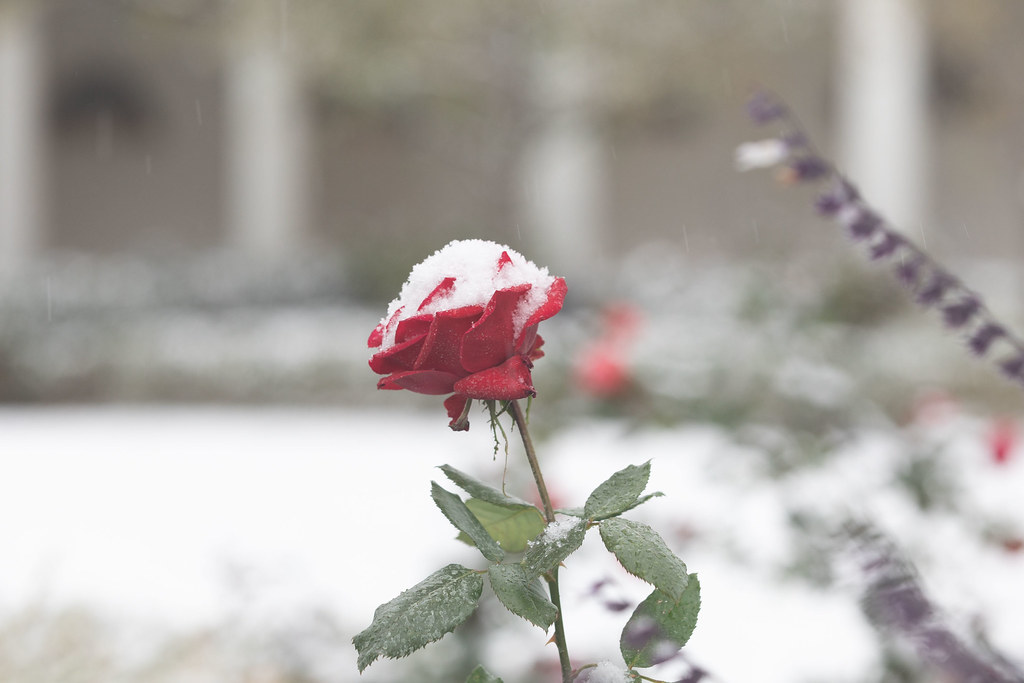
Image result for the white house rose garden
The Rose Garden of the White House covered in snow, Nov. 15, 2018 (Official White House Photo by Shealah Craighead). https://goo.gl/images/dzJqoT
In 1961, however, President Kennedy wanted the garden to be updated into something more than a private family garden. He and the First Lady had recently visited Europe, and he'd noted that the White House didn't have as quality a garden as many that he'd seen in France, England or Austria. He felt a beautiful garden at the official residence was imperative, and assigned Rachel Lambert Mellon the task of renewing the Rose Garden.
JFKWHP-KN-C22687.jpg
Aerial view of the Rose Garden, July 8, 1962. Robert Knudsen. White House Photographs. John F. Kennedy Presidential Library and Museum, Boston. Public Domain.

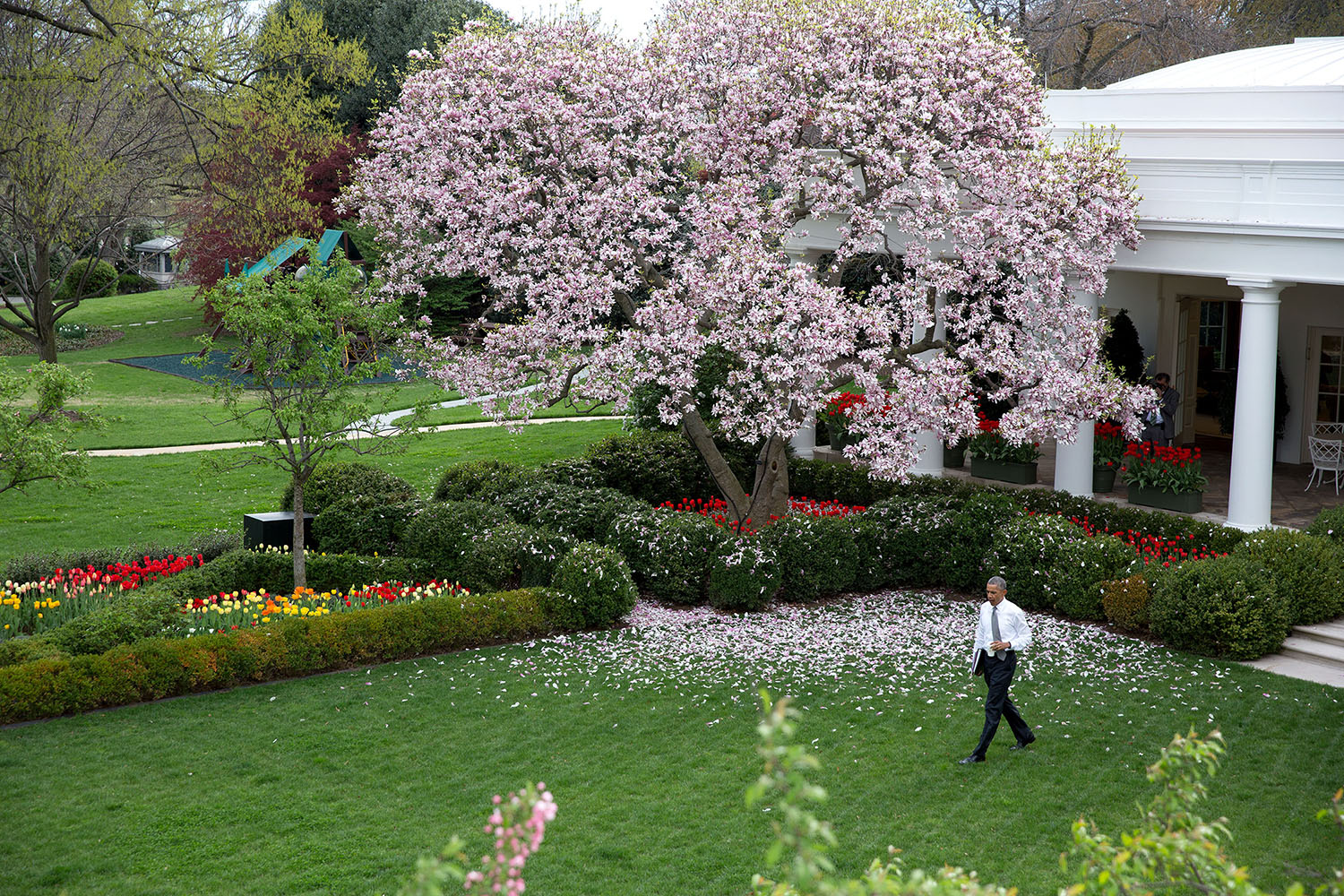
Mellon got to work, ensuring a 50-by-100 foot lawn would be central in the garden, a size large enough for a thousand people to attend receptions or ceremonies, but small enough to be covered by a tent, if necessary. The lawn was bordered by flower beds of American specimens, planted in a French style. Each flower bed is planted with Katherine crabapples, Littleleaf lindens, and thyme hedges. The garden is anchored at each of its four corners by Magnolia trees found along the banks of the Tidal Basin.
Image result for the white house rose garden
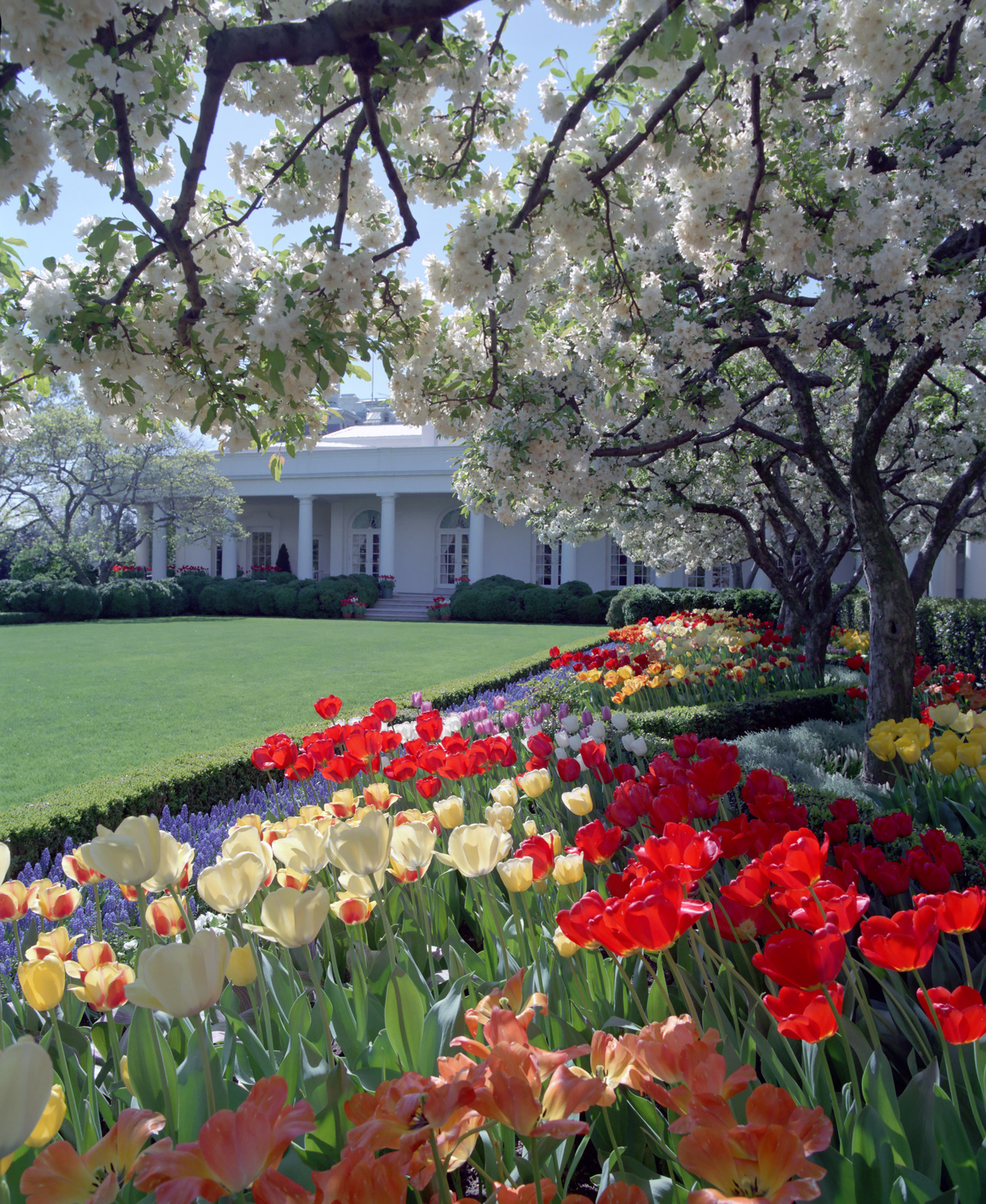
Rose Garden in Spring. Public Domain
Among the roses, seasonal flowers are added for color and variety. In the spring, jonquils, grape hyacinth, and tulips lend a cheery aspect. In the autumn, flowering kale and chrysanthemum bloom until early winter. The garden had become more formal, as well as brighter.

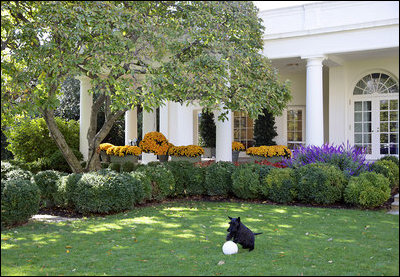
File:Oval Office view from Rose Garden.jpg
George W. Bush's dog Barney frolics in the Rose Garden, Autumn 2006. Public Domain.
In Kennedy's mind, however, the garden would no longer be simply for the First Family's enjoyment, but would serve public needs, as well. Presidents Wilson, Hoover, and Coolidge used the space to meet informally with press, to meet guests, or be photographed, but Kennedy wanted the garden to accommodate more functions. To that end, steps at the west end near the Oval Office were redesigned so they could also function as a platform or stage. Across the garden, a flagstone terrace was laid beneath one of the Magnolias where the President could hold a small luncheon or sit with guests.

To that end, Kennedy welcomed Project Mercury astronauts in the garden. Sports figures are often hosted here, including the Stanley Cup champions the Caroline Hurricanes after their victory in 2006, by George W. Bush. Numerous news conferences take place in the garden, as well as dinners and ceremonies. 

File:Mercury Astronauts Receiving the Collier Trophy - GPN-2002-000085.jpg
October 10, 1963. NASA Administrator James E. Webb (center) cites the space achievements of the Project Mercury Astronauts who received the 1963 Collier Trophy Award in a ceremony held at the White House on October 10, 1963 in the Rose Garden. President John F. Kennedy (left) and Vice President Lyndon Johnson accompanied Webb at the ceremony. Five of the Mercury Seven astronauts are visible in the row behind James Webb. They are (starting from JFK's left): Alan Shepard, Donald "Deke" Slayton, John Glenn, Virgil "Gus" Grissom, and Scott Carpenter. Public Domain.
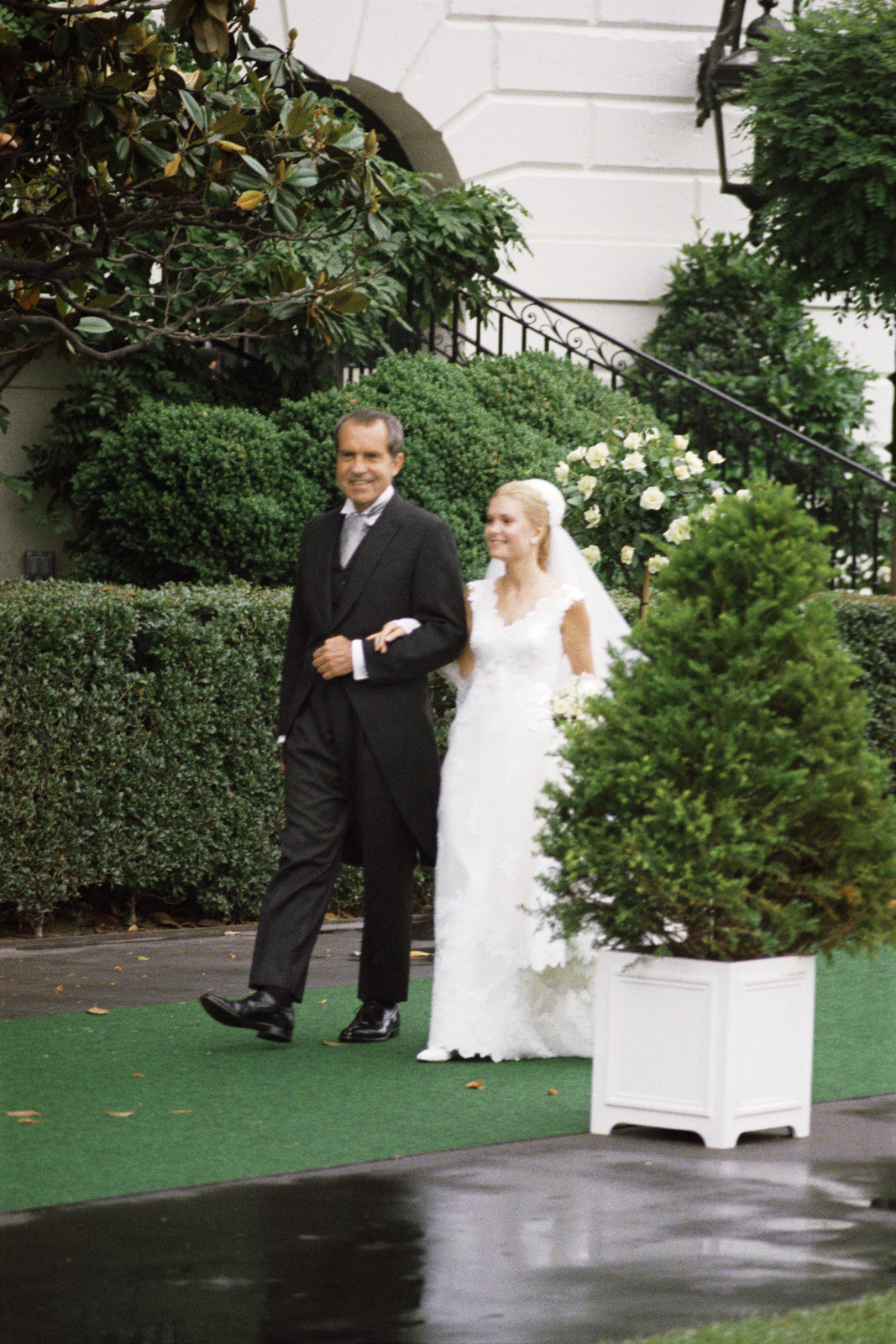
Perhaps one of the most famous uses of the Rose Garden was the 1971 marriage of Tricia Nixon to Edward F. Cox.

Image result for the white house rose garden
Public Domain. https://goo.gl/images/AWMxZ8
While the Rose Garden is often used for public events, it nevertheless remains a space of beauty, contemplation, and relaxation available for the First Family's use.
Image result for the white house rose garden
President Obama strolls through the Rose Garden. (Note: a play structure for his daughters is visible to the left of the magnolia tree.) Public Domain. https://goo.gl/images/EhG7Ew

***

Susanne Dietze is the RWA RITA-nominated author of over a dozen romances, including A Mother for His Family and the newly-released Cameo Courtships. You can learn more about her on her website, www.susannedietze.com.

Friday, April 12, 2019

Inside the White House: The Yellow Oval Room


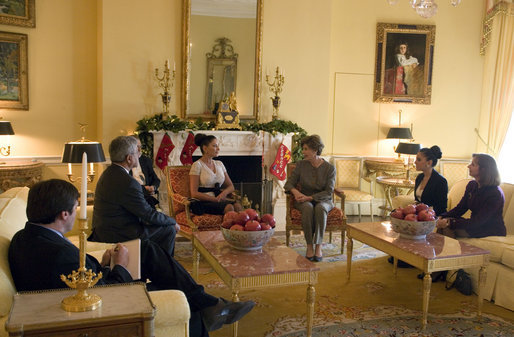
The Yellow Oval Room is one of three oval-shaped rooms in the White House. Located on the second floor of the residence where the first family lives, it is directly atop the Blue Room. 

Image result for white house yellow oval room
Laura Bush hosts a coffee for Mehriban Aliyeva, First Lady of the Republic of Azerbaijan, Thursday, Dec. 7, 2006. White House photo by Shealah Craighead https://goo.gl/images/Roz76G
President John Adams, first resident of the White House, held the very first presidential reception in this room, which at the time was referred to as "the upstairs oval parlor." The room was not even finished for the reception, held on New Year's Day in 1801.

From then on, the Adams family used it as a ladies' drawing room. It was furnished with crimson pieces brought from the President's House in Philadelphia, and papered in yellow with gilded stars. Dolley Madison had her hand in decorating the room in 1809, choosing yellow damask.

The room didn't stay yellow, however. Andrew Jackson's niece Emily Donelson decorated it in green.
Image result for white house yellow oval room
Circa 1868. Public Domain. https://goo.gl/images/1ne33k
In 1851, Abigail Fillmore received an allocation from Congress to purchase books for a White House library, which she set here. The family entertained here, and it was also a favorite spot for Mr. and Mrs. Lincoln to enjoy one another's company. However, Abraham Lincoln changed the room by adding a door to the east wall and creating a passage so he could quietly move around upstairs without being seen by the throngs of people crowding in what is today the Treaty Room: at that time, the presidential offices were upstairs (in what is now the Lincoln Bedroom) and people were free to come and go within the White House. Mr. Lincoln could hardly leave the office without being mobbed, so little wonder he had an escape route!
Image result for white house yellow oval room
The Oval Room, 1886. Public Domain. https://goo.gl/images/LwHrLR
During the Harrison administration, the room continued to be used as a library, and in 1889, they placed the very first White House Christmas tree here. It was also in this room where the Harrison family gathered when President Harrison lay dying and officials filled the bedroom.

When the West Wing was built in 1902, the oval room was reverted to a parlor again, although several presidents used it for private meetings.

President Harding decorated the room in blue, displayed the First Lady's collection of miniature elephants, and played poker here with his friends--and drank alcohol, even though it was Prohibition. 

The Hoovers brought in Chippendale couches upholstered in gold-and-black brocade and "lettuce" green curtains. They would have all the furniture moved out for "moving picture" nights.

Franklin D. Roosevelt converted the room into his private study, decorating the room with ship models, Under FDR, the oval study took on a nautical look, displaying the president's collection of naval prints and ship models. Here, he would work on his stamp collection, and here, he learned of the Japanese attack on Pearl Harbor on December 7, 1941. 

Harry Truman continued to use the room as a study, but his contribution is better recognized from the exterior of the White House: The Truman Balcony. Added to the South Portico in 1948, the balcony can be accessed by the Yellow Oval Room. 
Image result for white house truman balcony
President Truman reading on the Truman Balcony. https://goo.gl/images/EhVzgs
Eisenhower used the room as a Trophy Room, a place to display his military awards. Jacqueline Kennedy returned it to a sitting room, however, bringing back yellow furniture. Since her refurbishment, the Yellow Oval Room received its current name, and it has been the most formal room on the family floor. World leaders are still brought here before state dinners to exchange ceremonial gifts.
Image result for white house yellow oval room
1962. https://goo.gl/images/7TB5Uf

Image result for white house yellow oval room
The Kennedys, March 28, 1963, Cecil W. Stoughton. Public Domain. ://goo.gl/images/ihFB74

The room has been refurbished several times since, during the administrations of Nixon, Carter, Reagan, and George W. Bush--but it remains yellow to this day.

***


Susanne Dietze is the author of over a dozen romances with Timeless Heart. You can learn more about her on her website, www.susannedietze.com.


Wednesday, September 12, 2018

Kitchens of Famous Americans


Modern American kitchen. https://goo.gl/images/AWbmhc


Most of us think of open concept kitchen and living areas as the latest trend in home building. The truth is, from the earliest days of Colonial history until the Victorian Age, open concept described the architectural style of most homes unless the owner was quite wealthy. 


Since my husband and I are painting the small kitchen in our South Florida condo, and I want to make use of every square inch even though it’s not open concept, I began to wonder about the history of kitchens in America. That’s just the way my mind rolls. The Library of Congress is a great resource, so I started my research there. Browsing through the archives, I stumbled upon photos of restored kitchens used by our founders and other well-known Americans. 

The kitchen has always been the heart of the home, but in the founding days of our Republic and during westward expansion, kitchens also served as living room, bedroom, and dining room as well…unless you lived at the White House or in wealthier homes where kitchens were housed in separate buildings to keep the house cool and as a deterrent to fire. Until modern times, kitchens were designed for function, not frivolity.


Historically accurate chuckwagon used
for modern-day reenactments. https://goo.gl/images/6n5sp9


Even chuckwagons, used for storing food and cooking utensils and driven by cattlemen or pioneers headed west across the prairies, could be classified as kitchens, albeit rudimentary ones. The actual cooking was done over an open campfire.


Let’s look at a few of the kitchens used by people whose names you’ll recognize.


Photo by Carol M. Highsmith, photographer. Kitchen in the Ford Mansion. The mansion was the site of the "hard winter" December through May 1780 quarters of George Washington and the Continental Army at The Morristown National Historical Park in Morristown, New Jersey. Morristown New Jersey United States, 2017. -08-25. Photograph. https://loc.gov/item/2017882224/.


In most American history books, the author will describe the hard winter of 1780 when George Washington’s Continental Army tied rags around their freezing feet and ears and huddled over campfires with little to eat. As the leader of the army, Washington stayed in the Ford Mansion, but even though he enjoyed better rations at a table warmed by the kitchen fireplace, he regularly rode among his troops to rally their spirits.


After securing our freedom and serving as the first President of the United States, George Washington and his wife Martha retired to their large country estate named Mount Vernon. The home and its gardens and outbuildings sit on the banks of the Potomac River in Fairfax County, Virginia, and underwent expansion under Washington’s ownership. The Washington family had owned land there since 1674 when George’s great-grandfather put down roots. 


Detroit Publishing Co., Copyright Claimant, and Publisher Detroit Publishing Co.
Martha Washington kitchen at Mt. Vernon.
Mount Vernon Estate Mount Vernon Estate United States Virginia, None.
[Between 1900 and 1920] Photograph.
https://www.loc.gov/item/2016796113/


In 1775, the kitchen had been significantly enlarged from the original just before Washington assumed command of the Continental Army in Boston. It was comprised of three workrooms on the ground floor and a loft where food was stored and where the cook presumably slept. 


After Washington’s death, the inventory of the estate showed the kitchen was equipped with skillets, a griddle, a variety of pots and pans, a toaster, fire spits, coffeepots, and much more. 


Detroit Publishing Co., Copyright Claimant, and Publisher Detroit Publishing Co.
The Kitchen, Paul Revere House, Boston, Mass.
Boston Boston. Massachusetts United States, ca. 1909. Photograph.
https://www.loc.gov/item/2016814827/


The original three-story home of Colonial patriot Paul Revere is the oldest in downtown Boston. Built in 1680, rather than placing the kitchen in a separate building, it was housed in a two-story extension built on the back of the house. The prosperous silversmith and engraver is best known for his midnight ride in April 1775 to alert volunteers that the British were at the colonial militia’s doorstep. The battles of Lexington and Concord followed. No doubt, because of Revere’s wealth, his table would have been laden with the best the marketplace afforded.


Barnett Mcfee Clinedinst, photographer.
Kitchen, New White House.
Washington, D.C., ca. 1902. Nov. 1906. Photograph.
https://www.loc.gov/item/2002735757/


Of course, one of the most famous kitchens in America is that of the White House in Washington, DC. The photo above was taken early in the 20th Century when Theodore (Teddy) Roosevelt served as the 26th President of the United States. We can only assume the kitchen was well-equipped to handle state dinners and the hosting of world dignitaries.

Learn more about the history of kitchens at the Library of Congress or Wikipedia.org. With the advent of the Internet, there is no subject that you can’t study, including the lowly kitchen.

If you have a photo or know a story about the kitchen of another famous American, would you please share it with us? 


***


My feisty Irish bride Kate O'Brien McKean asks her husband for an annulment in Dreams of My Heart, book 1 of The Reluctant Brides series, setting off a chain reaction of events that endangers them both. The historical romance set in 1875 Montana Territory is published by Mountain Brook Ink. The book is available at Amazon in both ebook and print and free with Kindle Unlimited. 


Barbara J. Scott


After a career spent acquiring and editing books by numerous bestselling Christian authors, Barbara J. Scott has returned to her true love—writing. She is currently writing the second book in the Reluctant Brides series—Love of My Heart. Barbara and her husband Mike recently moved to the Ft. Lauderdale area to be closer to two of their four grandchildren. Reading, writing, and research are her passions. Want to know more? Connect with Barbara at www.BarbaraJScott.com.


Thursday, August 2, 2018

Inside the White House: The Treaty Room

The Treaty Room is located on the second floor of the White House, in the president's family quarters. While it is currently used as a private study, the room has been used in numerous ways over the years, and many significant decisions have been made here.
File:WHTreatyJFK.jpg
Treaty Room, Kennedy Administration, with Grant's table. Public Domain

President Lincoln used this particular room as a waiting room for the Presidential Office next door (which is now the Lincoln Bedroom). After Lincoln's assassination, his successor, President Johnson, chose to use the chamber as a meeting place for the Cabinet.

The Cabinet continued to meet here during subsequent administrations, and in 1869, President Ulysses S. Grant ordered a large walnut conference table with overstuffed chairs for the Cabinet to use. The table is fitted with eight locking drawers, which meant President Grant and each of the seven members of Cabinet had his own drawer in which to store things. 
File:White House Treaty Room 1901.jpg
The Cabinet Room, 1901, using Grant's Cabinet Table. Public Domain.
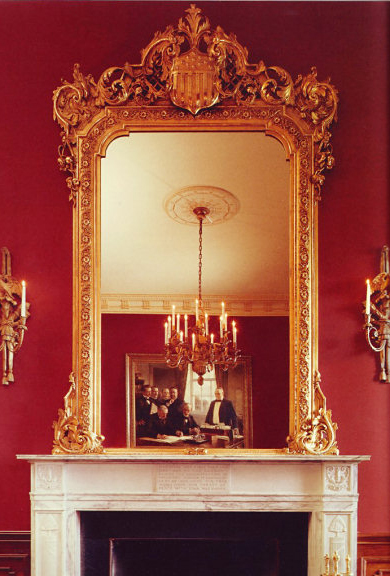
At this table in 1898, Secretary of State, William R. Day, and French Ambassador Jules Cambon (acting on behalf of the Spanish government) signed a peace protocol establishing an armistice in the Spanish-American war . The moment was recorded in a painting by Theobald Chartran (which can be viewed in the background of the below picture of President Obama).


File:Barack Obama reading a letter in the Treaty Room.jpg
President Obama in the Treaty Room, using the Grant Table as a desk. In the background, note Theobald Chartran's painting "Signing of the Peace Protocol Between Spain and the United States, August 12, 1898." Public Domain
In 1902 when the Presidential offices were moved to the West Wing, President Theodore Roosevelt's Cabinet members were allowed to purchase the overstuffed chairs in the room for $5 a piece as souvenirs. 

For the next several years, the room served various purposes, but it became known as the Monroe Room during the Hoover Administration when First Lady Lou Hoover turned it into a parlor using furnishings from the Monroe Administration, including the desk on which Monroe signed the Monroe Doctrine. The Truman Administration, however, redecorated using contemporary pieces.

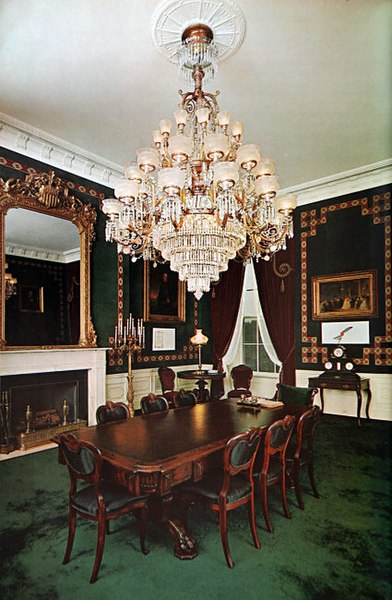
In 1961, Jacqueline Kennedy oversaw the redecoration of the room, so that it closer resembled the Cabinet Room of Grant's administration almost a hundred years before. President Grant's conference table was returned, and the walls were papered in dark green, in a pattern similar to the paper in the room at the Peterson House (across the street from Ford's Theater) where Abraham Lincoln died. Theobald Chartran's painting "Signing of the Peace Protocol Between Spain and the United States, August 12, 1898" was hung in the room, as were copies of several treaties signed at the White House--and the name Treaty Room was chosen for the chamber.

President Kennedy signed the Nuclear Test Ban Treaty in the room in 1963, and President Nixon signed the US instrument of ratification of the Treaty on the Limitation of Anti-Ballistic Missile Systems in 1972.
File:President Kennedy signs Nuclear Test Ban Treaty, 07 October 1963.jpg
President Kennedy signing the Limited Nuclear Test Ban Treaty, October 7, 1963, in the Treaty Room (but not using the Grant table). Robert L. Knudson. Public Domain.
In 1979, President Carter had Grant's conference table moved to the north grounds of the White House for the signing of the peace treaty between Israel and Egypt; likewise, President Clinton also had the table moved outdoors for the signing of the Israeli-Palestinian accords in 1993 and the declaration ending the war between Jordan and Israel in 1994.

In 1993, the Treaty Room was decorated in rich colors and used as a private office for President Clinton. The walls were papered in simulation red-leather-style paper, and a gilded walnut chandelier that once hung in the Red Room was installed.
Treaty Room, Clinton Administration. Note the Theobald Chartran painting reflected in the mirror. Public Domain.
President George W. Bush had the room painted off-white and trimmed with olive green. In 2001, he addressed the nation here, to announce the War in Afghanistan had started.
File:Treaty Room in 2001.jpg
President Bush in the Treaty Room, with his feet on the Grant Cabinet Table, in 2001. White House Museum. Public Domain.
Like his predecessors, President Obama used the room as a private office. 

While often overlooked among other, more famous chambers in the White House, the Treaty Room has been a place of incredible importance. Throughout the decades, policy was debated in this room, armistices negotiated, and treaties signed. One can only imagine what the walls would say if they could talk!

***
Susanne Dietze began writing love stories in high school, casting her friends in the starring roles. Today, she's the Selah award-winning author of over a dozen historical romances who's seen her work on the ECPA, Publisher's Weekly, and Amazon Bestseller Lists for Inspirational Fiction. Married to a pastor and the mom of two, Susanne lives in California and enjoys fancy-schmancy tea parties, genealogy, the beach, and curling up on the couch with a costume drama and a plate of nachos. You can visit her on her website, www.susannedietze.com