Showing posts with label Bavaria. Show all posts

Tuesday, December 12, 2023

Inspiring Hope and Joy at Nuremberg’s Christkindlesmarkt

By Kathy Kovach

Nuremberg Christkindlesmarkt in front of Frauenkirche (church)

Who doesn’t love a good craft bazaar, especially at Christmas? Holiday music piping through the booths, cinnamon and vanilla wafting from the cookie table, the glittering shiny baubles and curios enticing the patron to draw near. And the colors!

Ever wonder where this tradition started?

Well, keep wondering, because no one knows.

It’s possible this marketing opportunity first became popular as early as 1530. However, it’s unclear whether sellers gathered specifically for Christmas or simply for a winter bazaar to hock their crafts and wares. The first real proof of a true holiday event showed up in writing in the year 1628. It was found at the bottom of an oval 19-centimeter-long spruce bentwood box decorated with flowers. The inscription read, “Sent to Regina Susanna Harßdörfferin by Miss Susanna Eleonora Erbsin (or Elbsin) on the occasion of the Christmas Market of 1628”. The box now resides at Germanisches Nationalmuseum.

The trinket was bought in Nuremberg, Germany—the second largest city in Bavaria after Munich—which is said to be the home of the first Christkindlesmarkt, or Christmas Market.

Who is the Christkind?

The Protestant reformer Martin Luther is the one who introduced the Christkind (or Christkindl) as the giver of gifts in 1545. Previously, that title went to the benevolent Saint Nicholas who brought gifts to children on December 6th. Martin Luther was determined to remove the Catholic reference of a saint to focus on the Christ. Hence, in his own household, the Christ Child began bringing presents on December 25th. Lutherans adopted the practice as did many German Catholics. The tradition still holds for many countries today.

The Christ Child refers to Jesus from ages birth to twelve. Tradition holds that a small, angelic-like being was the Christkind who brought gifts to children in their homes. They never witnessed this, but a small bell would ring somewhere in the house to indicate His leaving. They would then run to the tree to see what they received.

The Nuremberg Christkindlesmarkt became the standard kickoff to the holiday season, much like our Black Friday sales. By 1737, the number of craftsmen grew to 140, all from Nuremberg.

While we love fairs and festivals, often stocking up on unique gifts for family and friends, the German market went deeper. As of 1933, the Christkind set the tone before anyone could drop a pfennig (penny). An actress had been hired and, dressed as the Christkind Angel—the symbol of the Spirit of Christmas—she read a prologue from the church balcony welcoming everyone into a season of hope and good will toward men. Bells rang, a children’s choir sang, and the Christkindlesmarkt became the established kickoff to the holiday season.

The Christkind Angel on the balcony of Frauenkirche

The market had been canceled a few times in its history, most notably during World War II. It resumed in 1948 amidst the bombed ruins of the church where it started with a new prologue of hope, given once again by the beautiful, winged Christkind Angel. You can read that welcoming poem HERE.

Nuremberg in ruins 1945. Frauenkirche in background.

Christmas markets have spread worldwide, most adopting the same appearance, crafts, and tastes as those associated with Germany. But the most important to remember is the Christkind, welcoming one and all, and putting the emphasis on what is really important, the Reason for the Season, Emmanuel, God with us.

On a personal note:

I’ve had a blast spending time in Germany with you this year. As I’ve mentioned before, my husband was in the Air Force and we were blessed to live in several places throughout his 23-year career. Most notably, we were stationed at Rhein Main AFB in Frankfurt not once, but twice! We volunteered for the second tour to be able to show our two sons what they were too little to appreciate the first time around. Our youngest was born over there. Our favorite area was Bavaria, a state in southern Germany. The alpine region helped soothe our homesickness for the Colorado Rocky Mountains where we both grew up.

As my Christmas present to you, following are links to all of the articles I’ve written this year in case you’ve missed them or wish to revisit. Merry Blessed Christmas and a Happy Holy New Year!

JANUARY - King Ludwig II: Fairytale King of Bavaria

FEBRUARY - King Ludwig II: Moon King of Bavaria

MARCH - King Ludwig II: Mad King

APRIL - The Miracle of Ettal Abbey

MAY - Rothenburg – Saved by a Tankard of Wine

JUNE - The Eagle’s Nest: Sweet Little Teahouse, or Diabolical Lair

JULY - Rhine Aflame, Germany’s Independence Day

AUGUST - Don’t Lick the Walls – Salt Mine Bertchesgaden

SEPTEMBER - Königssee – ECHO. . .Echo. . .echo

OCTOBER - A Fairytale City of Art

NOVEMBER - A Passion for the Passion Play


A TIME-SLIP NOVEL

A secret. A key. Much was buried on the Titanic, but now it's time for resurrection.


Follow two intertwining stories a century apart. 1912 - Matriarch Olive Stanford protects a secret after boarding the Titanic that must go to her grave. 2012 - Portland real estate agent Ember Keaton-Jones receives the key that will unlock the mystery of her past... and her distrusting heart.
To buy: Amazon


Kathleen E. Kovach is a Christian romance author published traditionally through Barbour Publishing, Inc. as well as indie. Kathleen and her husband, Jim, raised two sons while living the nomadic lifestyle for over twenty years in the Air Force. Now planted in northeast Colorado, she's a grandmother and a great-grandmother—though much too young for either. Kathleen has been a longstanding member of American Christian Fiction Writers. An award-winning author, she presents spiritual truths with a giggle, proving herself as one of God's peculiar people.


Sunday, November 12, 2023

A Passion for the Passion Play

By Kathy Kovach


Last month, I wrote about the artsy hamlet of Oberammergau in Bavaria, Germany, which included the Passion Play that has been performed every decade for the past 400 years, with only a few exceptions. In that article, I focused on the origin, which began as an oath in exchange for the Lord’s protection during a time of plague. Go to this LINK to learn more.

The Passion of Christ, a depiction of our Savior’s suffering, death, and resurrection, is too significant to gloss over. Therefore, I’d like to spend more time on the play to which the German citizens have spent centuries dedicating their lives.

In the early years, a wooden platform had been set up at the church in the graveyard where the victims of the Bubonic Plague were buried. This is what prompted the oath to dedicate the play to God and perform it every ten years if He would spare the rest of the residents. Popularity grew, and by the mid-18th century, it was moved to a nearby field to accommodate the growing number of visitors. 

The first script in 1634 was based on 15th-century medieval manuscripts and later edited in 1664. There have been many edits and rewritten versions since then. At some point, it was decided to change the dates to those years ending in a zero. Thus, 1680 began those decadal years, culminating in what it is today with 2000 citizens involved . . . all local villagers . . . all ages and genders . . . from acting to set design. Can you imagine putting on a production like that for nearly four centuries?

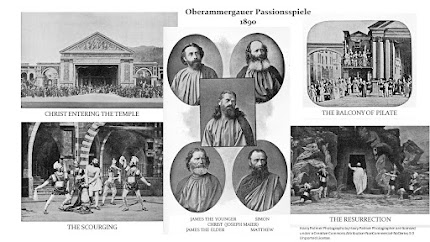
The Passion Play
1890

By 1850, more than 45,000 attendees gathered from far and wide. By 1890, The Passion Play drew in an audience of over 100,000, including famous composers such as Franz Liszt and Richard Wagner. Mad King Ludwig II was even impressed and gifted the community with a sculpture. Even so, it wasn’t until 1900 that a new, permanent stage was built, and it remains there to this day with multiple improvements, including seating, a heated floor, and a retractable glass roof to ward off the moist mountain weather.

Although the early organizers had promised to put on the play every ten years, this wasn’t always possible. Human intervention messed with the timeline a few times, but in all, the oath was fulfilled to the best of their ability. Below are some of the highlights of disruption, however, the play only had to be canceled twice and postponed four times.

-      1770, canceled due to a ban by then Prince-elector Maximillian III Joseph of the Holy Roman Empire who declared, "The theatre stage is no place for the greatest secret of our holy religion."

-      1920, postponed until 1922 due to the German’s WWI defeat and the political unrest that followed.

-      1940, canceled due to WWII.

-      2020, postponed until 2022 due to the coronavirus pandemic.

Special performances were granted in 1934 and 1984 to commemorate the 300th and 350th anniversaries respectively.

Requirements for the production have changed little over the years. Only citizens of Oberammergau who have lived there twenty years or more are allowed to participate—men, women, and children—which utilizes a good chunk of the community. The male actors must begin growing their beards the year beforehand by Ash Wednesday. There have, on occasion, been challenges to the traditions. For example, prior to 1984, all participating women were to be under the age of 35, however, three women took their equality case to court and won. Interestingly, as of 1990, Mary the mother of Jesus was to be single, but this standard was broken with much controversy when a married mom was chosen for the first time solely because of her acting skills. Also, in the early, years only Catholics could participate. Eventually, Protestants were allowed. Then, as of 1990, Muslims are now included.

Over the 4 centuries and 42 productions, the Passion Play itself has not only been revered but, alas, bruised at times due to various human egos. As aforementioned, it was canceled due to a church leader deeming it irreverent. In 1934, it was taken over by the Nazi regime during the commemorative anniversary and used as propaganda to promote their political agenda. The official poster was appropriated with the words “Germany invites you!” It also had the misfortune of being accused of antisemitism in 1960, and then three decades later was rewritten to include more of the Jewish traditions.

The fact that the Oberammergauer Passionsspiele keeps chugging along is a testament to the passion of the citizens who will not let their oath to God die. 

An excellent overview of each year the play was performed can be found HERE.

Check out this short video: “Highlights of the 2022 Passion Play at Oberammergau


A TIME-SLIP NOVEL

A secret. A key. Much was buried on the Titanic, but now it's time for resurrection.


Follow two intertwining stories a century apart. 1912 - Matriarch Olive Stanford protects a secret after boarding the Titanic that must go to her grave. 2012 - Portland real estate agent Ember Keaton-Jones receives the key that will unlock the mystery of her past... and her distrusting heart.
To buy: Amazon


Kathleen E. Kovach is a Christian romance author published traditionally through Barbour Publishing, Inc. as well as indie. Kathleen and her husband, Jim, raised two sons while living the nomadic lifestyle for over twenty years in the Air Force. Now planted in northeast Colorado, she's a grandmother and a great-grandmother—though much too young for either. Kathleen has been a longstanding member of American Christian Fiction Writers. An award-winning author, she presents spiritual truths with a giggle, proving herself as one of God's peculiar people.


Tuesday, September 12, 2023

Königssee – ECHO. . .Echo. . .echo

By Kathy Kovach

In the southeastern tip of Bavaria near Berchtesgaden lies an aquatic ribbon known as Königssee, the third deepest lake in Germany. This narrow waterway stretches 4.8 miles long by 1 mile at its widest point. Wedged into a rift between steep mountains, it was formed by glaciers during the last ice age. Pure, unadulterated water makes this alpine lake beautiful with its emerald, mirror-like appearance. In fact, the water is drinkable.

The name, which translates to King’s Lake, came not from any particular king but more than likely from the nobles who made the area their favorite hunting grounds. Imagine the peaceful calm, where the isolation of steep rock cliffs makes it possible to hear every sound.

Advertisement 1936
In the late 1800s, approximately 200 oarsmen shuttled thousands of visitors from the town of Schönau am Königssee the length of the lake. At roughly the halfway point sat St. Bartholomä where visitors could disembark to view the church and take hikes.

St. Bartholomä
At the St. Bartholomä pier, a petite monastery, originally built in 1134 by the Provosts of Berchtesgaden, stood watch. In 1697, it was rebuilt in the Baroque style that looked as though it would be more at home in a Russian village with its wine-red domes instead of spires. It was actually patterned after the Salzburg Cathedral. The name came from the apostle Saint Bartholomew, the patron saint of alpine farmers and dairymen. Appropriate as this was who made up the local population.

Modern electric boat
Boats have always been allowed on the lake. However, when motorized ones were introduced, they were banned as they disrupted the serene atmosphere. Soundless battery-powered electric boats—as well as an electric train to bring visitors into the area—were introduced in 1909 restoring order. These vessels carried 38 passengers, allowing even more people to enjoy this unique vacation spot.
With tourism in full swing, some entertainment was in order. About a third of the way along the length of Königssee, the boats entered a passage with sheer rock walls on either side, an ideal spot for an echo. The crew brought out a black-powder pistol and aimed it at one of the walls. The echo bounced back and forth between the rock faces as many as seven times. One would think that if peace, quiet, and calm were so strictly enforced, why would they disrupt nature with a gun blast? Apparently, that concern reached the right ears, and in 1930 a different demonstration took its place—the flugelhorn, a type of trumpet, but more mellow in tone. A member of the crew, often the skipper, would aim the instrument and play a classical tune that echoed back and harmonized with itself. (This magnificent display is still offered today. I’ve heard it myself several times, and it never ceases to amaze.)
Lake Obersee
Sailing past the little canyon, the electric boat silently motored to the aforementioned pier where the visitors could get out and stretch their legs. If the two-hour tour wasn’t enough, the more adventurous could hike to the fabulous Röthbach Falls or continue the cruise to disembark at the far end of the lake. From there, they could trek to Lake Obersee, a small, secluded body of water that perfectly mirrored the surrounding peaks. 

A popular tradition in alpine settings dating back to 3000 BC was Almabtrieb, the herding of cows from their summer pasture high in the hills to their winter pasture below. In most areas, the cattle were either herded or transported by truck or train. At Königssee, the only way to get them from here to there was by boat as the terrain was nearly impossible to navigate around the lake.
A charming custom surrounding this moving of cattle took place in the fall, coupled with Octoberfest. A lead cow was chosen and given a homemade headdress constructed of evergreen limbs, flowers, and bells. The bovine who followed were also adorned, albeit not as elaborately. The parade would commence, and the villagers donned their lederhosen and celebrated with folk singing, dancing, and, of course, beer. In most towns in Bavaria, the parade took place along the streets and on through to the countryside beyond. At Königssee, the cows were given their festive gear after they disembarked from their special raft and then were taken on to their winter home.

The tradition of decorating the cows dates back to the mid-18th century in Austria. Allegedly, adorning the livestock would ward off evil spirits. This belief eventually faded away, but the delightful tradition continued on.

Who knew, when glaciers passed through this area all those eons ago, that Königssee would become such a rich area for locals and visitors to revel in.

God knew.

Enjoy these two videos showcasing Konigssee, St. Bartholomä, and the echo.


A TIME-SLIP NOVEL

A secret. A key. Much was buried on the Titanic, but now it's time for resurrection.


Follow two intertwining stories a century apart. 1912 - Matriarch Olive Stanford protects a secret after boarding the Titanic that must go to her grave. 2012 - Portland real estate agent Ember Keaton-Jones receives the key that will unlock the mystery of her past... and her distrusting heart.
To buy: Amazon


Kathleen E. Kovach is a Christian romance author published traditionally through Barbour Publishing, Inc. as well as indie. Kathleen and her husband, Jim, raised two sons while living the nomadic lifestyle for over twenty years in the Air Force. Now planted in northeast Colorado, she's a grandmother and a great-grandmother—though much too young for either. Kathleen has been a longstanding member of American Christian Fiction Writers. An award-winning author, she presents spiritual truths with a giggle, proving herself as one of God's peculiar people.


Saturday, August 12, 2023

Don’t Lick the Walls - Salt Mine Berchtesgaden

By Kathy Kovach

Watzmann Mountain above Berchtesgaden
One of my favorite places to visit in Bavaria, Germany is the town of Berchtesgaden. Rich with history and lush with beauty, it’s nestled within the folds of rolling alpine forests and bejeweled by crystal clear lakes and rivers. Towering above in majesty is Watzmann Mountain, named after a nefarious king whose exploits I’ll leave for another day.

The little village has undergone many changes of ownership, from Augustine monks beginning in 1300 A.D. to an Austrian annexation in 1805. After a brief period of French rule in 1809, it finally found its legs as it came into the kingdom of Bavaria in 1810.

Even before the monks, the area was rich in salt deposits, and mining began in the early 12th Century. This sparked rivalry with two other salt-bearing, Austrian towns, now known as Hallein and Salzburg.
Mine entrance
The Berchtesgaden Salt Mine of today was actually created in the 1500s but didn’t become a fully developed state operation until the mid-1800s.

The salt, encased in composite rock, is flushed out with fresh water, leaving behind beautiful caverns. Although the mine is still in operation today, yielding 900,000 cubic meters of brine annually, (that’s over two million gallons!) it is now open to tourists. And might I say, even though a salt mine sounds dull, it’s far from it.

Visiting there was like taking a step back in time. Ushered into a room, our group was instructed to don period coveralls made of heavy material and cloth hats. Not only would these keep us warm as we ventured into the depth of the 54-degree Fahrenheit mine, but they, also, gave us a sense of history.
My family is toward the back. I'm not there as this was the second time we visited the mine, and I stayed back with my mother-in-law who had no desire to go underground.
From there, a small train, with a bench down the center that we straddled, took us into the mine. We soon disembarked and followed our tour guide into a dimly lit tunnel. On our way, we were told about the salt in the stone walls. Curious children moistened their fingers and slid them along the rock. Then they licked the salt off of them. Okay, some adults did it too. Fine. I did it, as well, but only after peer pressure from the others on the tour. I’d be surprised if they allowed that today now that we’re more germ aware.
First of two slides
Eventually, we came to the first of two slides, this one being 34 meters high. It descends to another level into a cavern that has opened up before us. This, we’re told, is how the miners would enter the mine quickly, much like a fireman’s pole, I would image. Other avenues, a path and a staircase, were provided for the less adventurous or for those with physical constraints. My husband and I were much younger then. We grouped our family of four, held on to each other, and swooshed to the bottom, much like the miners of old, except we squealed all the way to the bottom. The 250-year-old cavern, dubbed the Salt Cathedral, had, at one time, been filled with water.
Dedication plaque at grotto
Around the corner, a beautiful grotto, a tribute to the “Fairytale King” Ludwig II, created a small sanctuary with stacked square stones and blocks of backlit salt. I could find no pictures in public domain to use, showing the beauty of this little room. However, it can be viewed on this interactive map. Just click on #5. Truly breathtaking.
Lake at bottom of cavern
Moving on, there were other points of interest, which you can see on the aforementioned map link. Eventually, we came to the second slide which provided a 40-meter drop down to a small crystal clear mirror lake—earning the name by mirroring the ceiling above—at the bottom of a large cavern. A raft awaited us, and we boarded in small groups to be pulled to the other side. This cavern had been solid rock at one time, but as the water was pumped in, the salt was dissolved and extracted, forming a cave with the lake at the bottom.

The Berchtesgaden Salt Mine tourist attraction has been updated since we visited forty years ago. A light show has been added to the lake, and there are other high-tech stops along the 800-meter path. I’m happy, though, to have experienced it in the purer form.

Before our final exit, we came to the 14-ton bronze Reichenbach pump that once moved the brine uphill 356 meters (1168 feet) through wooden pipes. Ingenious in its design, it was one of two pumps commissioned in 1816 and was fully operational by Dec 22, 1817. It remained in constant operation until February 19, 1927.

This interactive map, as I mentioned above, shows all of the stops in the mine. The pictures are well done and beautiful.
Outside of mine
The contemporary town of Berchtesgaden is proud of its “white gold” legacy as the industry still thrives today.


A TIME-SLIP NOVEL

A secret. A key. Much was buried on the Titanic, but now it's time for resurrection.


Follow two intertwining stories a century apart. 1912 - Matriarch Olive Stanford protects a secret after boarding the Titanic that must go to her grave. 2012 - Portland real estate agent Ember Keaton-Jones receives the key that will unlock the mystery of her past... and her distrusting heart.
To buy: Amazon


Kathleen E. Kovach is a Christian romance author published traditionally through Barbour Publishing, Inc. as well as indie. Kathleen and her husband, Jim, raised two sons while living the nomadic lifestyle for over twenty years in the Air Force. Now planted in northeast Colorado, she's a grandmother and a great-grandmother—though much too young for either. Kathleen has been a longstanding member of American Christian Fiction Writers. An award-winning author, she presents spiritual truths with a giggle, proving herself as one of God's peculiar people.


Monday, June 12, 2023

The Eagle's Nest: Sweet Little Teahouse, or Diabolical Lair

By Kathy Kovach

High above the town of Berchtesgaden in Bavaria, Germany, sits a man-made structure known as the Eagle’s Nest, or Kehlsteinhaus. Now an eatery, it once hosted the most influential figures in Nazi history. First and foremost, Adolph Hitler.

In fact, it was built for the reviled leader by his private secretary who was head of the Nazi Party Chancellery, Martin Bormann. He, along with the SS (Shutzstaffel, which is German for Protective Echelon) built it, some say, to inaugurate his birthday on April 20, 1939. Others don't subscribe to that belief. Our tour guide the day my family visited, a middle-aged German national with a sharp wit, leaned toward the former. He stated that when he turned 50, no one gave him a tea house atop an alp. At the time, it cost 30 million ℛℳ (Reichsmarks) to build, which is about 247 million USD today. 
Hitler's summer house, Berghof, in Obersalzberg
Whatever the reason, Hitler only visited fourteen times, thirteen of them before the declaration of war in 1939. The chalet is literally on top of a mountain with fantastic panoramic views in 360-degree splendor. Hitler had vertigo and couldn’t remain up there for long. He preferred the Berghof, his summer house below the mountain in Obersalzberg, where he resided most of his years as Führer.

How does one reach the rocky outcrop ridge known as the Kehlstein (hence the naming of the house) at 6,017 feet above sea level?

By elevator.
Inside 407' long tunnel.

Tunnel entrance during WWII.

Tunnel entrance today.
Yes, the SS thought of everything. They drilled a tunnel below into the mountainside. At the end of the tunnel, they drilled straight up and installed a large elevator shaft that ran directly into the house. The tunnel was large enough for automobiles to drive into so the glorious leaders of the Nazi regime need not walk the 407 feet into the mountain. However, the vehicles then had to back out as there was nowhere to turn about.

Marble lined the tunnel as nothing about this project was done halfway. The beauty of the architecture was marred, however, by the knowledge that machine gun nests were also installed at the end of the tunnel, hidden behind a false wall. No one was getting to the elevator who didn’t belong.
Brass thirty-five-person elevator
Speaking of ornate, the thirty-five-person elevator was surfaced with polished brass, Venetian mirrors, and splendid green leather. However, Hitler refused to use the elevator, frightened that a lightning strike would hit the wench mechanism at the top and make him plummet to his death. There were a couple of instances of lightning during construction, but no one had the nerve to inform him of those for fear he'd never visit. In the decades the elevator has been in operation, there hasn’t been a single incident of malfunction. It’s said that he took a car up to the summit, but if the road is still there, it’s not accessible to the public.
Red marble fireplace marred when allied forces removed chinks for souvenirs.
Inside the Eagle’s Nest, one was greeted in a reception area with a red marble fireplace, a gift from Benito Mussolini. The floors were heated, as well, creating a cozy atmosphere in the often frigid area. A large oriental-style carpet, a present from Japanese Emperor Hirohito, covered the reception hall floor. The main floor of the lodge only had six rooms and a terrace but was adequate.
Kehlsteinhaus terrace today, with umbrellas.
Even though the birthday boy rarely visited, choosing only to do so when entertaining high officials or plotting dastardly deeds, others took advantage of the stunning space. Hitler’s mistress, Eva Braun, made the place her own and even offered it to her sister for her wedding ceremony.
Obersalzberg raid
Then came the end of WWII. On April 25, 1945, Allied forces sent a bombing raid, concentrating their efforts on Obersalzberg where Hitler had set up his operations and lived in his summerhouse. However, the little tea chalet remained untouched.

Allied armies captured this mountaintop paradise and used it as a military command post until 1960. Little regard was taken upon seizure. Chinks of red marble were broken off the fireplace for souvenirs. Art disappeared. And the stash of expensive wine was taken and consumed as victory.

In 1960, Kehlsteinhaus was released back to the state of Bavaria. Now owned by a charitable trust, the Eagle’s Nest is a popular tourist stop, housing a restaurant and beer garden.
One of five tunnels on the Kehlsteinstrasse (the road leading up to the Eagle's Nest.)

Hairpin curve on the Kehlsteinstrasse.
I’ve personally been there twice. Once with a club I belonged to, and then with my family. The harrowing road up the mountainside is just as dangerous as it was in the 1930s and 40s. The only way up is on a bus made especially for the narrow, one-way road and a dizzyingly sharp hairpin curve halfway up. At one point, I was looking straight down into a ravine as the bus’s body swung out and over nothing but air.

I loved it!

Despite the evil plans that were perpetuated in that charming tea house, the Eagle’s Nest has been redeemed and now provides comfort and refreshment for all who enter.

Did I mention the heated floors?


Here is an excellent video of a vlogger visiting Kehlsteinhaus. It’s about thirty minutes, but you can fast-forward through some of the talking. Be sure to hang in there for the tour outside and take in the stunning views surrounding the area.


A TIME-SLIP NOVEL

A secret. A key. Much was buried on the Titanic, but now it's time for resurrection.


Follow two intertwining stories a century apart. 1912 - Matriarch Olive Stanford protects a secret after boarding the Titanic that must go to her grave. 2012 - Portland real estate agent Ember Keaton-Jones receives the key that will unlock the mystery of her past... and her distrusting heart.
To buy: Amazon


Kathleen E. Kovach is a Christian romance author published traditionally through Barbour Publishing, Inc. as well as indie. Kathleen and her husband, Jim, raised two sons while living the nomadic lifestyle for over twenty years in the Air Force. Now planted in northeast Colorado, she's a grandmother—and soon-to-be great-grandmother—though much too young for that. Kathleen has been a longstanding member of American Christian Fiction Writers. An award-winning author, she presents spiritual truths with a giggle, proving herself as one of God's peculiar people.


Wednesday, May 24, 2023

A Brief History of Blue Jeans


by Jennifer Uhlarik


Like many people, most of my life, I have worn blue jeans. They are a favorite garment of mine—relaxed and comfortable, yet durable too. How about you? Have you ever wondered where the blue jeans we love first got their start? 


Levi Strauss

If you want to trace the blue jean back to its roots, you’ll need to go to Buttenheim, Bavaria in February of 1829. It was here that Hirsch and Rebecca Strauss welcomed their seventh child, Levi, to their flock. Levi spent his first eighteen years there, even while several of his older siblings emigrated to America. However, in 1846, family patriarch Hirsch Strauss succumbed to tuberculosis, and Rebecca, two of the Strauss sisters, and Levi, packed up and followed the family to New York.


Strauss with other members of his extended family

Jonas and Louis Strauss were an industrious pair who created a booming wholesale dry goods business in the heart of Manhattan. The J. Strauss Brother & Co. store provided all manner of “dry goods”—i.e. anything from dry grocery items like flour, sugar, coffee, and tobacco, to sewing supplies, to cookware and utensils, and even some premade clothing. Upon his arrival in New York, Levi began learning the family business and often worked as an itinerant peddler of goods from the family store.


Levi Strauss & Co. storefront, San Francisco


In 1849, gold was discovered in California, and droves of starry-eyed people set out for the western coast of the continent. By the early 1850s, the Strauss family realized the gold rush wasn’t just a flash in the pan, so it was decided they would expand their store to California, and Levi would be the one to open the new location. In 1854, he arrived in San Francisco and set up shop, importing quality goods from his brothers, items like clothing, bedding, combs, and handkerchiefs, among other things. He also made tents, blankets, and wagon covers.


Jacob Davis


The same year that Levi Strauss set up shop in San Francisco, Latvian-born immigrant Jacob Davis came to America, landing in New York, and across the next thirteen years, moved around the United States and Canada. But by 1867, the Latvian tailor finally returned to San Francisco, and eventually settled in Reno, Nevada, where he set up a tailor shop. He bought many of his supplies, including the heavy-duty cotton duck cloth and cotton denim, from the San Francisco-based Levi Strauss & Co. store.


Diagram from
Patent Application

It was in 1871 that Davis contacted Strauss with an idea. Jacob had found an improvement on the heavy-duty pants he’d been sewing for woodcutters and railroad workers. He found that adding a copper rivet at the corners of the pockets and other high-stress points in the garment, they held up better. But he couldn’t keep up with the demand for the reinforced garments. Realizing the boon he had created, he set out to file for a patent—a somewhat costly prospect for a tailor. So he contacted his sewing supplier, Levi Strauss, to see if he might help with the application filing fee. Strauss agreed, and in 1872, the pair requested the patent for the riveted “waist overalls”. The patent came through on May 20, 1873.


Strauss moved Davis to San Francisco to oversee the new manufacturing facility of these waist overalls. At first, the manufacturing was nothing more than seamstresses producing quantities of the garments in their homes, but as word got out about the quality workwear, Strauss opened an actual factory for the garment.


Strauss lived to be seventy-three, and upon his death, he left the Levi Strauss & Co. business to his four nephews—Jacob, Louis, Sigmund, and Abraham, the sons of his sister, Fanny. Davis lived several years more, reaching the age of seventy-seven. Both men are buried in Colma, California, but their legacy lives in on the Levi Strauss & Co. brand of clothing.


It’s Your Turn: Were you aware that the iconic brand of Levi’s was the actual beginning of the blue jean garment? Did you realize that it went back to the 1870s?


Award-winning, best-selling novelist Jennifer Uhlarik has loved the western genre since she read her first Louis L’Amour novel. She penned her first western while earning a writing degree from University of Tampa. Jennifer lives near Tampa with her husband, son, and furbabies. www.jenniferuhlarik.com


NOW AVAILABLE


Love’s Fortress by Jennifer Uhlarik


A Friendship From the Past Brings Closure to Dani’s Fractured Family


When Dani Sango’s art forger father passes away, Dani inherits his home. There, she finds a book of Native American drawings, which leads her to seek museum curator Brad Osgood’s help to decipher the ledger art. Why would her father have this book? Is it another forgery?


Brad Osgood longs to provide his four-year-old niece, Brynn, the safe home she desperately deserves. The last thing he needs is more drama, especially from a forger’s daughter. But when the two meet “accidentally” at St. Augustine’s 350-year-old Spanish fort, he can’t refuse the intriguing woman.


Broken Bow is among seventy-three Plains Indians transported to Florida in 1875 for incarceration at ancient Fort Marion. Sally Jo Harris and Luke Worthing dream of serving on a foreign mission field, but when the Indians reach St. Augustine, God changes their plans. However, when Sally Jo’s friendship with Broken Bow leads to false accusations, it could cost them their lives.


Can Dani discover how Broken Bow and Sally Jo’s story ends and how it impacted her father’s life?