Showing posts with label Germany. Show all posts

Saturday, January 18, 2025

The Grimm Brothers by Nancy J. Farrier

 What do you think of when you read the title, “The Grimm Brothers”? My guess is you imagine a volume of fairy tales, including popular favorites like Snow White, Cinderella, Rapuzel, or Hansel and Gretel. But how did those stories come to be? Who are the famous brothers behind the fairy tales?


Jacob and Wilhelm Grimm 1847
By Hemann Biow, Public Domain, Wikimedia Commons

Jacob Grimm was born in January 1785, and his brother Wilhelm was born in February 1786. They were the 2nd and 3rd oldest of nine children, three of whom died as infants. When Jacob was six years old, his father accepted a position as city magistrate in Steinau, Germany. From 1791 to 1796, the Grimms lived in a nice house, with servants, a carriage provided, and tutors for the children.


Grimm house 1791-1796
Photo by Alexander Hoernigk, Wikimedia Commons 

Life took a downward turn in 1796, when their father died of pneumonia. The Grimms lost their home and all their luxuries, having to depend on the help of their grandfather and aunt. Jacob was now the oldest of the children and thus responsible for their welfare at age eleven. Wilhelm shared the responsibility with Jacob and for the next two years they listened to the advice of their grandfather.


In 1798, Jacob and Wilhelm’s aunt paid for their admittance to attend the Friedrichsgymnasium school in Kassel. The two brothers studied hard and were at the top of their class. They discovered a love of learning and went on to attend the University of Marburg where they studied law. It was here they had a professor who instilled a love of history and philology leading the brothers to study medieval German literature.


In 1805, Jacob had to quit his studies, taking a job with the Hessian War Commission. His family was in such extreme poverty that they had meager portions and only ate once a day. 


Drawing by Ludwig Emil Grimm - 1843
Wikimedia Commons


By 1808, Jacob quit the war commission and became a librarian in Kassel. His mother died, leaving him total responsibility for his younger siblings. Jacob was able to pay for his brother Ludwig to attend art school. Later Ludwig would illustrate some of their books, and he did sketches of his brothers.


While working at the library, they had a friend, Clemens Brentano, who asked them to collect fairy tales that he could use in a book. They sent Brentano copies of 54 stories. They were glad they sent the copies when Brentano lost the manuscripts they’d sent him. When Brentano lost interest in publishing the fairy tales, the brothers gathered the 54 stories, plus 32 more and published a first volume of fairy tales. They published another 70 fairy tales in 1815.


The original fairy tales were dark and never intended to be children’s literature. The stories were for adults and carried warnings within their text. Many of the stories were about the stark living conditions of the times. 


Front/title page of Kinder-und Hausmärchen
Illustrated by Ludwig Grimm, Wikimedia Commons


Hansel and Gretel, by Arthur Rackham 
Wikimedia Commons


An earlier story they published, The Children of Famine, started like this: “Once upon a time there was a woman with two daughters, and they had become so poor that they no longer had even a piece of bread to put in their mouths. Their hunger became so great that their mother became unhinged and desperate. Indeed, she said to her children, “I’ve got to kill you so that I can get something to eat.”


In their later life, Jacob and Wilhelm worked on writing a German dictionary. They were retired from teaching and writing fairy tales, enjoying the challenge of word studies. The dictionary was not complete when they died. Wilhelm died first in 1859 of an infection, and Jacob took his death hard. He became reclusive, working only on the dictionary, until his death in 1863.


Berlin Memorial Plaque, by OTFW, Berlin
Wikimedia Commons


The brothers had been so close all their lives, I can only imagine how hard it was for Jacob to lose Wilhelm. I remember reading Grimm’s fairy tales as a young girl and loving them. How about you? Do you like fairy tales? Are you familiar with them?


In December, I published my first fairy tale based book, a novella, Fairy Tale Christmas. This story is loosely inspired by Grimm’s fairy tale, Water of Life. You can find it here.


Princess Ivyana’s father, the King, is on his deathbed, and she and her sisters are given an impossible task: to find the Water of Life, the only known cure. But no one knows how to find this elusive water, and when her sisters go missing, Ivy is left as her father's only hope.

The only one willing to help Ivy is Kivin Tonnas, a lowly stable hand. Accompanied by Kivin and her maid, Ivy sets out on a dangerous journey to find the Water of Life. But Kivin harbors a secret, one that even he doesn't know. He is under a curse, and only Ivy can break it. As they journey together, their forbidden love grows, but will it be enough to overcome their differences? 


Nancy J Farrier is an award-winning, best-selling author who lives in Southern Arizona in the Sonoran Desert. She loves the Southwest with its interesting historical past. When Nancy isn’t writing, she loves to read, do needlecraft, play with her cats and dog, and spend time with her family. You can read more about Nancy and her books on her website: nancyjfarrier.com.

Tuesday, December 12, 2023

Inspiring Hope and Joy at Nuremberg’s Christkindlesmarkt

By Kathy Kovach

Nuremberg Christkindlesmarkt in front of Frauenkirche (church)

Who doesn’t love a good craft bazaar, especially at Christmas? Holiday music piping through the booths, cinnamon and vanilla wafting from the cookie table, the glittering shiny baubles and curios enticing the patron to draw near. And the colors!

Ever wonder where this tradition started?

Well, keep wondering, because no one knows.

It’s possible this marketing opportunity first became popular as early as 1530. However, it’s unclear whether sellers gathered specifically for Christmas or simply for a winter bazaar to hock their crafts and wares. The first real proof of a true holiday event showed up in writing in the year 1628. It was found at the bottom of an oval 19-centimeter-long spruce bentwood box decorated with flowers. The inscription read, “Sent to Regina Susanna Harßdörfferin by Miss Susanna Eleonora Erbsin (or Elbsin) on the occasion of the Christmas Market of 1628”. The box now resides at Germanisches Nationalmuseum.

The trinket was bought in Nuremberg, Germany—the second largest city in Bavaria after Munich—which is said to be the home of the first Christkindlesmarkt, or Christmas Market.

Who is the Christkind?

The Protestant reformer Martin Luther is the one who introduced the Christkind (or Christkindl) as the giver of gifts in 1545. Previously, that title went to the benevolent Saint Nicholas who brought gifts to children on December 6th. Martin Luther was determined to remove the Catholic reference of a saint to focus on the Christ. Hence, in his own household, the Christ Child began bringing presents on December 25th. Lutherans adopted the practice as did many German Catholics. The tradition still holds for many countries today.

The Christ Child refers to Jesus from ages birth to twelve. Tradition holds that a small, angelic-like being was the Christkind who brought gifts to children in their homes. They never witnessed this, but a small bell would ring somewhere in the house to indicate His leaving. They would then run to the tree to see what they received.

The Nuremberg Christkindlesmarkt became the standard kickoff to the holiday season, much like our Black Friday sales. By 1737, the number of craftsmen grew to 140, all from Nuremberg.

While we love fairs and festivals, often stocking up on unique gifts for family and friends, the German market went deeper. As of 1933, the Christkind set the tone before anyone could drop a pfennig (penny). An actress had been hired and, dressed as the Christkind Angel—the symbol of the Spirit of Christmas—she read a prologue from the church balcony welcoming everyone into a season of hope and good will toward men. Bells rang, a children’s choir sang, and the Christkindlesmarkt became the established kickoff to the holiday season.

The Christkind Angel on the balcony of Frauenkirche

The market had been canceled a few times in its history, most notably during World War II. It resumed in 1948 amidst the bombed ruins of the church where it started with a new prologue of hope, given once again by the beautiful, winged Christkind Angel. You can read that welcoming poem HERE.

Nuremberg in ruins 1945. Frauenkirche in background.

Christmas markets have spread worldwide, most adopting the same appearance, crafts, and tastes as those associated with Germany. But the most important to remember is the Christkind, welcoming one and all, and putting the emphasis on what is really important, the Reason for the Season, Emmanuel, God with us.

On a personal note:

I’ve had a blast spending time in Germany with you this year. As I’ve mentioned before, my husband was in the Air Force and we were blessed to live in several places throughout his 23-year career. Most notably, we were stationed at Rhein Main AFB in Frankfurt not once, but twice! We volunteered for the second tour to be able to show our two sons what they were too little to appreciate the first time around. Our youngest was born over there. Our favorite area was Bavaria, a state in southern Germany. The alpine region helped soothe our homesickness for the Colorado Rocky Mountains where we both grew up.

As my Christmas present to you, following are links to all of the articles I’ve written this year in case you’ve missed them or wish to revisit. Merry Blessed Christmas and a Happy Holy New Year!

JANUARY - King Ludwig II: Fairytale King of Bavaria

FEBRUARY - King Ludwig II: Moon King of Bavaria

MARCH - King Ludwig II: Mad King

APRIL - The Miracle of Ettal Abbey

MAY - Rothenburg – Saved by a Tankard of Wine

JUNE - The Eagle’s Nest: Sweet Little Teahouse, or Diabolical Lair

JULY - Rhine Aflame, Germany’s Independence Day

AUGUST - Don’t Lick the Walls – Salt Mine Bertchesgaden

SEPTEMBER - Königssee – ECHO. . .Echo. . .echo

OCTOBER - A Fairytale City of Art

NOVEMBER - A Passion for the Passion Play


A TIME-SLIP NOVEL

A secret. A key. Much was buried on the Titanic, but now it's time for resurrection.


Follow two intertwining stories a century apart. 1912 - Matriarch Olive Stanford protects a secret after boarding the Titanic that must go to her grave. 2012 - Portland real estate agent Ember Keaton-Jones receives the key that will unlock the mystery of her past... and her distrusting heart.
To buy: Amazon


Kathleen E. Kovach is a Christian romance author published traditionally through Barbour Publishing, Inc. as well as indie. Kathleen and her husband, Jim, raised two sons while living the nomadic lifestyle for over twenty years in the Air Force. Now planted in northeast Colorado, she's a grandmother and a great-grandmother—though much too young for either. Kathleen has been a longstanding member of American Christian Fiction Writers. An award-winning author, she presents spiritual truths with a giggle, proving herself as one of God's peculiar people.


Sunday, November 12, 2023

A Passion for the Passion Play

By Kathy Kovach


Last month, I wrote about the artsy hamlet of Oberammergau in Bavaria, Germany, which included the Passion Play that has been performed every decade for the past 400 years, with only a few exceptions. In that article, I focused on the origin, which began as an oath in exchange for the Lord’s protection during a time of plague. Go to this LINK to learn more.

The Passion of Christ, a depiction of our Savior’s suffering, death, and resurrection, is too significant to gloss over. Therefore, I’d like to spend more time on the play to which the German citizens have spent centuries dedicating their lives.

In the early years, a wooden platform had been set up at the church in the graveyard where the victims of the Bubonic Plague were buried. This is what prompted the oath to dedicate the play to God and perform it every ten years if He would spare the rest of the residents. Popularity grew, and by the mid-18th century, it was moved to a nearby field to accommodate the growing number of visitors. 

The first script in 1634 was based on 15th-century medieval manuscripts and later edited in 1664. There have been many edits and rewritten versions since then. At some point, it was decided to change the dates to those years ending in a zero. Thus, 1680 began those decadal years, culminating in what it is today with 2000 citizens involved . . . all local villagers . . . all ages and genders . . . from acting to set design. Can you imagine putting on a production like that for nearly four centuries?

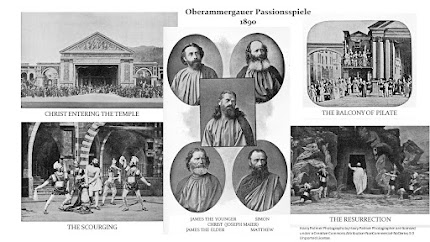
The Passion Play
1890

By 1850, more than 45,000 attendees gathered from far and wide. By 1890, The Passion Play drew in an audience of over 100,000, including famous composers such as Franz Liszt and Richard Wagner. Mad King Ludwig II was even impressed and gifted the community with a sculpture. Even so, it wasn’t until 1900 that a new, permanent stage was built, and it remains there to this day with multiple improvements, including seating, a heated floor, and a retractable glass roof to ward off the moist mountain weather.

Although the early organizers had promised to put on the play every ten years, this wasn’t always possible. Human intervention messed with the timeline a few times, but in all, the oath was fulfilled to the best of their ability. Below are some of the highlights of disruption, however, the play only had to be canceled twice and postponed four times.

-      1770, canceled due to a ban by then Prince-elector Maximillian III Joseph of the Holy Roman Empire who declared, "The theatre stage is no place for the greatest secret of our holy religion."

-      1920, postponed until 1922 due to the German’s WWI defeat and the political unrest that followed.

-      1940, canceled due to WWII.

-      2020, postponed until 2022 due to the coronavirus pandemic.

Special performances were granted in 1934 and 1984 to commemorate the 300th and 350th anniversaries respectively.

Requirements for the production have changed little over the years. Only citizens of Oberammergau who have lived there twenty years or more are allowed to participate—men, women, and children—which utilizes a good chunk of the community. The male actors must begin growing their beards the year beforehand by Ash Wednesday. There have, on occasion, been challenges to the traditions. For example, prior to 1984, all participating women were to be under the age of 35, however, three women took their equality case to court and won. Interestingly, as of 1990, Mary the mother of Jesus was to be single, but this standard was broken with much controversy when a married mom was chosen for the first time solely because of her acting skills. Also, in the early, years only Catholics could participate. Eventually, Protestants were allowed. Then, as of 1990, Muslims are now included.

Over the 4 centuries and 42 productions, the Passion Play itself has not only been revered but, alas, bruised at times due to various human egos. As aforementioned, it was canceled due to a church leader deeming it irreverent. In 1934, it was taken over by the Nazi regime during the commemorative anniversary and used as propaganda to promote their political agenda. The official poster was appropriated with the words “Germany invites you!” It also had the misfortune of being accused of antisemitism in 1960, and then three decades later was rewritten to include more of the Jewish traditions.

The fact that the Oberammergauer Passionsspiele keeps chugging along is a testament to the passion of the citizens who will not let their oath to God die. 

An excellent overview of each year the play was performed can be found HERE.

Check out this short video: “Highlights of the 2022 Passion Play at Oberammergau


A TIME-SLIP NOVEL

A secret. A key. Much was buried on the Titanic, but now it's time for resurrection.


Follow two intertwining stories a century apart. 1912 - Matriarch Olive Stanford protects a secret after boarding the Titanic that must go to her grave. 2012 - Portland real estate agent Ember Keaton-Jones receives the key that will unlock the mystery of her past... and her distrusting heart.
To buy: Amazon


Kathleen E. Kovach is a Christian romance author published traditionally through Barbour Publishing, Inc. as well as indie. Kathleen and her husband, Jim, raised two sons while living the nomadic lifestyle for over twenty years in the Air Force. Now planted in northeast Colorado, she's a grandmother and a great-grandmother—though much too young for either. Kathleen has been a longstanding member of American Christian Fiction Writers. An award-winning author, she presents spiritual truths with a giggle, proving herself as one of God's peculiar people.


Wednesday, July 12, 2023

Rhine Aflame, Germany's Independence Day

By Kathy Kovach

Celebrations with fireworks have long been an American tradition to commemorate our independence from British rule. Germany has a similar custom with festivities that last throughout the summer. These events are known as Rhein en Flammen, translated Rhine in Flames or Rhine Aflame.

Upper Middle Rhine Valley
Five dates from May to September mark that country’s independence from oppressive tolls. In medieval times, corrupt landowners collected outrageous levies along the Rhine River and its tributaries. The residents celebrate their freedom at various places along the banks throughout the summer. It stretches forty miles from Koblenz to Rüdesheim and includes some forty castles, both fully functional and in ruins. My family enjoyed one in particular that took place along the Upper Middle Rhine, aka the Rhine River Valley.

Marksburg Castle
Take note that these castles along the Rhine aren’t of the opulent palace variety, as were Mad King Ludwig’s lavish and gaudy residences. These were fortified to withstand enemy attacks—fortresses. In German, a schloss is a palace, but a burg is a fortress. The most formidable, in my opinion, was the Marksburg. It wasn’t hard to imagine virile, gallant men strategizing around a rough-hewn table, making plans to lay siege and conquer.

Pfaltzgrafenstein Castle
For a millennium, from 800 to 1800, the castles along the Rhine were used as a form of revenue for the Holy Roman Empire. Chains were stretched from shore to shore to effectively stop shipping merchants traveling along the major commercial thoroughfare. One small fortress was the Pfaltz, a toll booth as it were, built in the middle of the river for the purpose of taking silver coins or an “in kind” toll of cargo from the ships. This practice continued throughout the Roman Empire’s reign.

In the mid-13th Century, when Frederick II died, there was no emperor—and therefore, no accountability. This kicked off a twenty-three-year period called the Great Interregnum. During this time, unscrupulous landowners, or robber barons, took advantage by exacting exorbitant tolls from the merchants. However, they wouldn’t stop there. Cargo would often be pillaged and entire ships stolen. One baron even kidnapped the Queen of Holland. The Rhine League, a coalition formed in 1254, excised swift judgement, capturing the Reitberg Castle and rescuing the queen.

This league, in German called the Rheinischer Bund, was made up of three different factions: 1) cities protecting their own merchants, 2) princely members (upper nobility), 3) knightly members (lower nobility). The nobility owned their own castles and had a legal right to collect tolls. The cities totaled a hundred in all, and there were thirty nobles who participated.
🙶The League sought, through a general peace along the Rhine, for the security of trade routes and suppression of unjust new tolls. The League further sought to reduce the onslaughts of the feudal lords through economic sanctions and the destruction of robber castles.🙷 (Mueller-Mertens, Paterna, and Steinmetz, p. 769; a translation)
Rudolf I
The league policed the area until the first king of Germany, Rudolf of Habsburg, took power in 1273. Using the integrity and methods of the Rhine League, the new king besieged and destroyed the offending fortresses.

The Rheinlanders were so ecstatic that in 1274 they celebrated with fireworks all up and down the Rhine. A celebration that has continued to this day. With several stations along the river, people can either take a party cruise to witness the festivity from the water, or they can post themselves strategically to see several castles as a plethora of fireworks burst forth in grand finale fashion that seemed to last forever at each castle in turn. Flares are also positioned in the windows to symbolize the burning of the robber castles.

It's quite a sight!

We Americans commemorate our independence with bursts of color that represent the rockets red glare and the bombs bursting in air. In like fashion, so do the Germans who escaped an unjust toll system and corrupt landowners who took extreme advantage.


A TIME-SLIP NOVEL

A secret. A key. Much was buried on the Titanic, but now it's time for resurrection.


Follow two intertwining stories a century apart. 1912 - Matriarch Olive Stanford protects a secret after boarding the Titanic that must go to her grave. 2012 - Portland real estate agent Ember Keaton-Jones receives the key that will unlock the mystery of her past... and her distrusting heart.
To buy: Amazon


Kathleen E. Kovach is a Christian romance author published traditionally through Barbour Publishing, Inc. as well as indie. Kathleen and her husband, Jim, raised two sons while living the nomadic lifestyle for over twenty years in the Air Force. Now planted in northeast Colorado, she's a grandmother and a great-grandmother, though much too young for either. Kathleen has been a longstanding member of American Christian Fiction Writers. An award-winning author, she presents spiritual truths with a giggle, proving herself as one of God's peculiar people.


Wednesday, April 12, 2023

The Miracle of Ettal Abbey

By Kathy Kovach

Ettal Abbey
Snuggled in the Bavarian alpine foothills 11km from the castle Linderhof is a monastery with decidedly divine roots. One would think all churches dedicated to God would fall under that category, but Ettal Abbey has a charming legend that one could argue was a miracle.

Though Ettal is a small quaint village, it boasts one of the largest Benedictine monasteries in Germany that was established on April 28, 1330.
King Ludwig IV of Bavaria, Grand Duke of Hessen
The founder, King Ludwig IV the Bavarian (not to be confused with Mad King Ludwig II  who came along five centuries later), had an illustrious, if not tumultuous, military political career in Rome and Munich. He crowned himself Holy Roman Emperor in 1328 and three months later deposed Pope John XXII on grounds of heresy. Two years later after a power struggle, the pope excommunicated him. He was the last Bavarian king until 1742.
Madonna and Child, circa 1420
Not the original Ettal statue
My family had the privilege to visit this beautiful Baroque church some years ago. During the tour, the guide explained that while King Ludwig IV traveled back to Bavaria from Italy, he and his men were attacked on the road. Badly beaten and stripped of his royal clothing, he was the only survivor. With his dignity in tatters, a “grey monk” appeared to him. He insured Ludwig safe passage if he would promise one thing—to honor the Virgin Mary in the Ampferang forest. Upon his oath to do so, the monk placed a statue (or possibly a painting) of the Madonna and Child in his hands, instructing him to build a monastery and display the holy likeness inside as a figurative foundation.
Genuflecting horse
Ludwig did, indeed, travel safely to Bavaria, but he had no idea where this forest was located. He found a hunter who happily guided him into the alpine woodland. Ludwig’s horse followed dutifully until it stopped suddenly and refused to budge any farther. It then genuflected (bowed with one knee) three times. There may have been other, more strategic places to build a monastery, but Ludwig took this as a sign. Thus, the village of Ettal and its Benedictine monastery were birthed.

Ettal Abbey has had its ups and downs throughout history, at one point becoming secularized in 1803. The grounds changed hands several times with talks of turning it into a penitentiary, a wire and brass factory, and a rescue house for neglected children. As none of these came to fruition, the path was clear for the re-establishment of the monastery in 1900. The new owner gave the buildings to the Benedictines of Sheyern Abbey who became dedicated to the restoration of the order.


World War II came along and the monastery became the temporary home to Dietrich Bonhoeffer, the German pastor, theologian, and double agent against Hitler and the Nazi regime. He spent a few months there as a guest of the abbot, while he worked on his book Ethics.

The walled abbey

Pulpit

Confessional

Dom Fresco

Side altars

Despite the destruction of some its buildings in a fire in the 18th century, Ettal Abbey has risen from the ashes and thrives today. Thirty-plus monks make their home there and live under the Benedictine rule Ora et Labora (pray and work). Besides a school, on the premises sits a brewery known for producing world-class beer that is exported to fifty countries. Herbal liqueurs made from a centuries-old recipe are also distilled there. These businesses, in addition to the tourism of the building and grounds, help finance the operations.

The Lord had plans for the little village of Ettal and the abbey 600 years ago
and it started with a horse kneeling in obedience to its King.


PLEASE VISIT THE BLOG TO COMMENT ON THIS POST

A TIME-SLIP NOVEL

A secret. A key. Much was buried on the Titanic, but now it's time for resurrection.


Follow two intertwining stories a century apart. 1912 - Matriarch Olive Stanford protects a secret after boarding the Titanic that must go to her grave. 2012 - Portland real estate agent Ember Keaton-Jones receives the key that will unlock the mystery of her past... and her distrusting heart.
To buy: Amazon


Kathleen E. Kovach is a Christian romance author published traditionally through Barbour Publishing, Inc. as well as indie. Kathleen and her husband, Jim, raised two sons while living the nomadic lifestyle for over twenty years in the Air Force. Now planted in northeast Colorado, she's a grandmother—and soon-to-be great-grandmother—though much too young for that. Kathleen has been a longstanding member of American Christian Fiction Writers. An award-winning author, she presents spiritual truths with a giggle, proving herself as one of God's peculiar people.


Thursday, January 12, 2023

King Ludwig II: The Fairytale King of Bavaria


By Kathy Kovach

King Ludwig II
Years ago, my family had the privilege of living in Frankfurt, Germany via the U. S. Air Force. In fact, we moved there twice, encompassing six-and-a-half years in that beautiful country.

One of our favorite things to do was “castle hopping”. Germany has a plethora of palaces, fortresses, castles, and burgs. Some more lavish than others. Some forbidding stone structures made for defense. And some, built after the age of such fantastic opulence. Three of these were the architectural marvels of King Ludwig II.

Ludwig Otto Friedrich Wilhelm von Wittelsbach (1845-1886) ascended to the throne at 18 years of age in 1864 and ruled for 22 years until his death. Perhaps because he’d begun his reign at such an early age, he became known by many monikers. The Dream King, Swan King, Fairytale King, and eventually, Mad King Ludwig. These names should tell you all you need to know about this man’s character. He lived in his own reality and had the means to implement it.

King Louis XIV
Heavily influenced by King Louis XIV and the Palace of Versailles, as well as the composer Richard Wagner, Ludwig went on to build three castles in Bavaria, all very different from each other, but equally over the top. In an age where these types of architecture were outdated, and no longer needed for strategic or defensive purposes, Ludwig ventured on.

Neuschwanstein Castle


Disney's Sleeping Beauty Castle
1959
Walt Disney Pictures and Buena Vista Distribution
The first castle, Neuschwanstein, was started in 1869 on a mountaintop just above his childhood home. He’d had visions as a boy to build a structure up on the peak with soaring fairytale towers. Is it any wonder that our modern-day Imagineer Walt Disney would use this castle as the backdrop for his production Sleeping Beauty and would also adopt it as his personal icon? Neuschwanstein literally translates to “New Swan Castle” in honor of one of Wagner’s operas referencing “the Swan Knight”. 
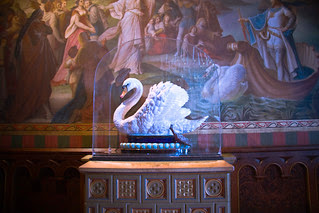
In addition, the swan was the family’s royal bird, and its likeness can be seen everywhere on the grounds.

A cave room, or small grotto, was artificially built between the salon and study. Sporting colored lights, stalactites, and a waterfall, one could enter as if simply walking through a hallway. At one point, however, a glass door slides into the “rock” and opens into the conservatory, a small room with a chair and table and a large window with a perfect view of the alpine foothills. This site has a couple of good images of the grotto and conservatory.

If the outside of the castle with its pristine white limestone walls and sky-blue spires recalls the age of German knights and damsels in distress, the inside invokes thoughts of romance. Gilded opulence and art murals depicting Wagner’s most famous operas meet the eye at every turn.

Throne Room

Singer's Hall

Ludwig's bedroom

Cupola

Drawing Room

Study

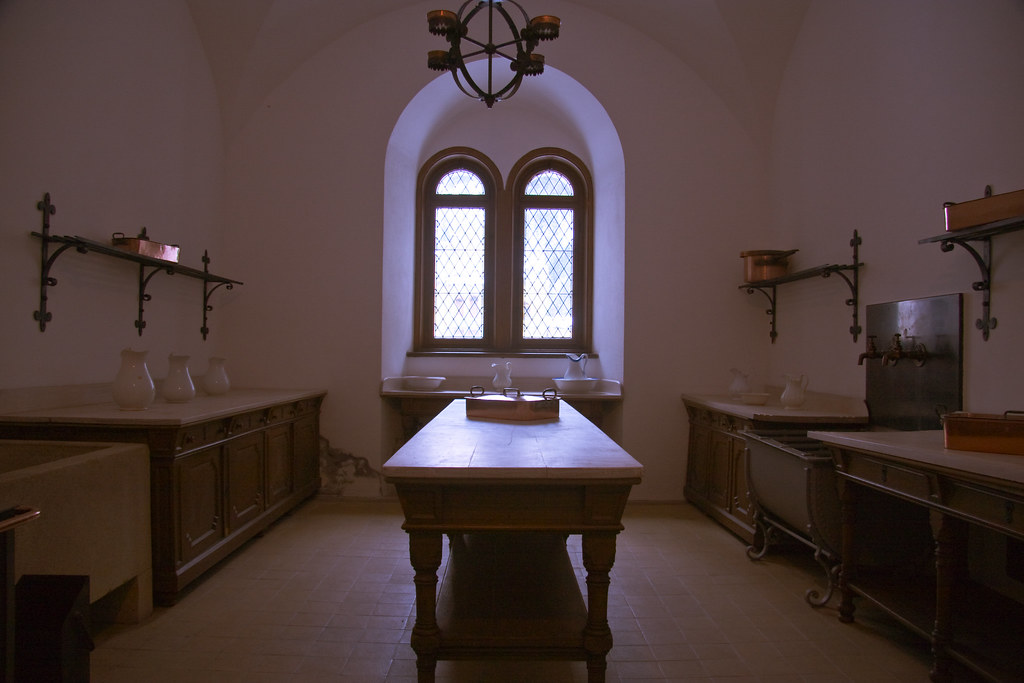
Kitchen
Quite a stark change from the opulence in the rest of the castle!
Only fourteen rooms were finished by the time of Ludwig’s death, and he had only stayed there a total of 186 days. Mere weeks after he died, the castle was opened for visitors to help pay off his enormous debt realized while building his three projects. He never used state funds but dwindled his personal royal account to the point where he had to borrow money.

King Ludwig II was deposed and declared mad due to his overspending on fanciful projects. One evening in 1886, he and Dr. Bernhard von Guddenchief of the Munich Asylum
 and the psychiatrist tasked to supervise himwent on a walk and never came back. They were both found drowned in the nearby lake. There are several theories surrounding the events of that night. Some say Ludwig killed the doctor and then, in a suicidal act, threw himself into the lake. It was also reported that even though the official cause of death for Ludwig was suicidal drowning, the autopsy showed no water in his lungs. Some say Gudden had been hit on the head and strangled. Another theory states that Ludwig was getting into a boat that would take him to another point along the lake where loyalists would help him escape. However, when he stepped into the boat he was shot and died. Political coverups ensued. At this time, the deaths of both men remain a mystery.
Coronation Portrait
I'll be highlighting King Ludwig's other two castles, Linderhof and Herrenchiemsee, later in the year. He certainly led a fairytale life, but it's sad that he never had his happily ever after.


A TIME-SLIP NOVEL

A secret. A key. Much was buried on the Titanic, but now it's time for resurrection.


Follow two intertwining stories a century apart. 1912 - Matriarch Olive Stanford protects a secret after boarding the Titanic that must go to her grave. 2012 - Portland real estate agent Ember Keaton-Jones receives the key that will unlock the mystery of her past... and her distrusting heart.
To buy: Amazon


Kathleen E. Kovach is a Christian romance author published traditionally through Barbour Publishing, Inc. as well as indie. Kathleen and her husband, Jim, raised two sons while living the nomadic lifestyle for over twenty years in the Air Force. Now planted in northeast Colorado, she's a grandmother—and soon-to-be great-grandmother—though much too young for that. Kathleen has been a longstanding member of American Christian Fiction Writers. An award-winning author, she presents spiritual truths with a giggle, proving herself as one of God's peculiar people.