Showing posts with label Betsy Ross. Show all posts

Monday, June 29, 2026

FLAG DAY, JUNE 14, 1777

 
I think of myself as a patriot. I believe the United States is the greatest country in the world. We have a lot of problems, but if we can get back to the way the Founding Fathers meant for it to be, we’ll be in better shape. We fly our flag year-round and when June gets here, I bring out the Americana decorations. I remember saying the Pledge of Allegiance at school and celebrating Lincoln’s and Washington’s birthdays. With Flag Day being earlier this month, I decided to find out the history. How it began and how long it took for the United States to honor it.


In 1777, the Continental Congress decided our country needed a flag. They made a resolution on June 14, 1777 that stated, “The flag of the United Stated shall be of thirteen stripes of alternate red and white, with a union of thirteen stars of white on a field of blue, representing the new constellation.” The new flag was carried into the Battle of Brandywine on September 11, 1777.

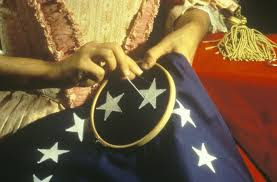
 It’s generally believed that Betsy Ross made that first flag, although it can’t be proved with documentation, according to the US Flag Store. They said there were around fifty flag makers and upholsterers in Philadelphia at that time. The Philadelphia Incorporated tells a different story. Apparently, Betsy had receipts for a large sum of money paid to her in May 1777 to make flags. It’s possible the first American flag was one she made. She continued in her career for fifty years.

On June 14, 1861, it was reported that Hartford, Conneticut held a Flag Day celebration. Almost three decades later, a New York City Professor George Bloch, principal of a free kindergarten for the poor, had his school hold patriotic ceremonies to celebrate the Flag Day resolution. The State Department of Education noticed and had all public schools observe the day from then on.


Late 1800s

The state legislature soon passed a law saying public schools should hold observances of Lincoln’s birthday, Washington’s birthday, Memorial Day and Flag Day. In 1897, New York’s governor passed a resolution mandating all public buildings to display the flag.

After earlier attempts failed, on May 7,1937, Pennsylvania became the first state to declare June 14 a legal holiday. Now it’s celebrated nationwide, but it's only legal in Pennsylvania. Looking back a little bit, we can see that President Wilson, in 1916, and President Coolidge in 1927, issued a proclamation to make June 14 officially Flag Day. Finally, on August 3, 1949, Congress approved the observance of National Flag Day. President Truman signed it into law. 

I thought it was interesting to see how quickly states were added.


1861, 34 States 

1889, 42 States


1897, 45 States


1959, 50 States


Linda lives in west central Ohio with her husband and grandson. She earned a degree in psychology from Anderson University, where she learned that the voices in her head were actually characters from stories waiting to be told.

Linda has been writing since childhood, but her publishing career started with writing columns and a middle-grade serial for the South Charleston Spectator. A retired librarian, she now enjoys being a full-time author in her home office. She writes not only to entertain but to encourage readers with God’s faithfulness.

You are invited to visit her website, Linda Hoover Books, to learn more about her and her books. You can stay in touch when you subscribe to her newsletter, and as a thank you, you’ll receive a novella, Joel & Ella.


Wednesday, March 25, 2026

The Women of the Postage Stamps--Part 2

By Jennifer Uhlarik


Hello, readers! Hope you are having a wonderful March. Last month, I started a series of blog posts on the women who had been featured on American postage stamps, and we looked at the first eight ladies on the list. Here I am again, continuing the series, especially since this is the month when we celebrate Women’s History. Let’s see who else was honored with their likeness on American stamps.


Jane Addams was the ninth woman to be featured on a stamp. Does anyone know what she was famous for? Born in 1860, Ms. Addams was a very accomplished woman who had many feathers in her cap. Among them were being recognized as the founder of social work; an activist for women’s suffrage; co-founder of Chicago’s Hull House, which offered shelter, aid, and social services to poor immigrant families; co-founder of the ACLU; and the first female winner of the Nobel Peace Prize (which she shared with Nicolas Murray Butler). Her stamp debuted in 1940.


It would be another eight years before a woman was featured on a U.S. postage stamp, but in 1948, there were four women given that honor. The first of them was Clara Barton. Clara was born on Christmas Day 1821, and eleven years later, the shy girl began nursing her brother after he suffered a serious head injury (from which he recovered fully). This set her on a path toward nursing, with a few stops in between. During the Civil War, her efforts in caring not only for soldiers’ wounds, but also helping to write letters home, boost morale, and provide bandages and clothing, she became known as the “Florence Nightingale of America” and the ”Angel of the Battlefield.” After the war, she assisted families in finding their missing loved ones who, often, were buried in unmarked graves after the four-year conflict. And in 1881, she succeeded in a years-long campaign to bring the Red Cross, which she’d originally learned about during a trip to Switzerland, to America’s shores. Clara Barton was not only featured on a stamp in 1948, but also a second time in 1995.


1948 Stamp

1994 Stamp


The second woman to be commemorated on a postage stamp in 1948 was Juliette Gordon Low. Throughout her lifetime, the Savannah, Georgia, native learned many skills, including painting, shorthand, horseback riding, hunting, woodworking, metalworking, and often also helped in charity work. After a failed marriage, Juliette Gordon Low met the founder of the Boy Scouts in 1911 in England, and was so impressed with the program, she brought its companion organization, the Girl Guides, to Savannah. It was later renamed the Girl Scouts of America, and continues to be a thriving organization today.


Next came Moina Michael, who was a teacher by trade. However, she found herself in Europe during the outbreak of World War 1 in 1914. When the United States entered the war three years later, she took a leave of absence from her teaching position to assist at the New York-based training facility of the YWCA. Inspired by the lines of John McCrae’s famous poem, “In Flanders Field,” Moina Michael vowed to always wear a red poppy in remembrance of those lost during the war. This later became the inspiration to make and sell silk poppies to raise money for the disabled veterans. Due to her efforts, the poppy was an adopted by the American Legion Auxiliary as its symbol of remembrance.


The last woman’s stamp in 1948 featured three prominent women—not just one. The stamp was known as the “100 Years of Progress of Women” stamp, and featured Elizabeth Stanton, Carrie Chapman Catt, and Lucretia Mott, for their work in the Women’s Rights movement and women’s suffrage. 


It was another four years before a woman appeared on a postage stamp again. In 1952, the honoree was Betsy Ross, the woman who is credited with sewing our fledgling nation’s first flag. 


In 1954, Sacagawea was featured for the first time, along with Lewis and Clark, in their famed expedition to explore the Louisiana Territory. (She was also honored in 1994, this time by herself). Of Shoshoni heritage, Sacagawea was only a teenaged girl when her French trapper husband, Toussaint Charbonneau, was asked by the explorers to act as guide and interpreter for their journey. Sacagawea accompanied the party across thousands of miles, becoming pregnant with and delivering her first child along the way.


1954 Sacagawea Stamp, featuring the
Louis and Clark expedition

1994 Sacagawea Stamp


Nearly a decade went by without another woman-centric postage stamp. In 1963, Amelia Earhart was chosen for the honor. As I’m sure most of you know, Ms. Earhart was an accomplished pilot with many “firsts” to her name. She was the first woman passenger to ride across the Atlantic in a plane, the later became the first female pilot to fly across the Atlantic in a non-stop flight. She founded an organization for other female pilots, and went missing and was eventually proclaimed dead in her attempt to become the first female pilot to circumnavigate the globe.


Amelia Earhart Stamp in 1963


First Lady Eleanor Roosevelt was also given her own postage stamp in 1963—and twice more, in 1984 and 1998. Since her husband, Franklin Delano Roosevelt, served four terms as President of the United States, she is the longest termed First Lady in our nation’s history. She redefined the role of FLOTUS, becoming the first to hold regular press conferences, write regular newspaper and magazine articles, host regular radio broadcasts, and speak at national conventions. After her husband’s death, she went on to work for the betterment of Human Rights with the UN Commission of Human Rights and served as the first Chair of the Presidential Commission on the Status of Women during the John F. Kennedy presidency, among other things. She continues to be one of the most respected people of the 20th Century according to various polls across many years. No wonder she’s been the guest of honor on our postage stamps three different times.


1963 Eleanor Roosevelt stamp

1984 Eleanor Roosevelt Stamp

1998 Eleanor Roosevelt Stamp


I hope you’re enjoying the snapshot of these women. There are certainly quite a number, so we’ll continue our look at these honorees next month. Until then…


It’s Your Turn: Which of the women who were honored with their own stamp do you find the most impressive, and why?


Jennifer Uhlarik
 discovered western novels at twelve when she swiped the only “horse” book from her brother’s bookshelf. Across the next decade, she devoured westerns and fell in love with the genre. While attaining a B.A. in writing from the University of Tampa, she began penning her own story of the Old West. She has finaled in and won numerous writing competitions and appeared on various best-seller lists. Besides writing, she’s been a business owner, a schoolteacher, a marketing director, a historical researcher, a publisher, and a full-time homemaker. She lives near Tampa, Florida, with her husband and fur children.


Available Now: Love and Order: A Three-Part Old West Romantic Mystery


Wanted: 

Family, Love, and Justice


One Old West Mystery Solved Throughout Three Short Romantic Stories


Separated as children when they were adopted out to different families from an orphan train, the Braddock siblings have each grown up and taken on various jobs within law enforcement and criminal justice.


Youngest child, Callie, has pushed past her insecurities to pursue a career as a Pinkerton agent. Middle child, Andi, has spent years studying law under her adoptive father’s tutelage. And the eldest and only son, Rion, is a rough-and-tumble bounty hunter. 


When the hunt for a serial killer with a long history of murders reunites the brother and sisters in Cambria Springs, Colorado, they find themselves not only in a fight for justice, but also a fight to keep their newly reunited family intact. How will they navigate these challenges when further complicated by unexpected romances?


Wednesday, June 26, 2024

Sewing Together A Nation by Cindy Regnier


In our elementary school history lessons, we all heard the account of a patriot by the name of Betsy Ross making the first American flag in 1776. True story. Maybe. No one is entirely sure. Let’s explore it a bit.

No one outside her circle of family, friends and acquaintances ever heard the name of Elizabeth Griscom Ross during her lifetime. The story of her flag creation was first told to the Historical Society of Pennsylvania almost a century later in 1870 by William Canby, Betsy’s grandson

 Canby declared that his grandmother had frequently told him the story of receiving a visit from General George Washington in the spring of 1776.Washington’s purpose in calling on the widow of John Ross was to present her with a drawing of a flag with 13 red and white stripes and 13 six pointed stars, asking is she would be willing to craft a flag matching the design. After studying Washington’s sketch, Betsy recommended arranging the stars in a circle and reducing the points to five instead of 6 because the cloth could be folded and cut out with a single snip. (Charles Wilson Peale’s 1779 painting of George Washington following the 1777 Battle of Princeton features a flag with six-pointed stars.)  When Washington agreed, Ross consented to sew the banner. A year later in June of 1777, Congress officially adopted the design as the country’s emblem.

No official documentation has been discovered that confirms Betsy’s creation, however it is widely believed that her deceased husband’s uncle George Ross, a signer of The Declaration of Independence, recommended her to Washington for the task. Mrs. Ross was likely acquainted with Washington who is said to have attended the same church as Betsy’s family. Further, it is documented by receipts from the Pennsylvania Navy Board that Ross did make flags in ship colors. It may even be that Ross had a part in coming up with the name “United States of America,” though there is no evidence to support that claim. Ross’s daughter, niece and granddaughter all collaborated Canby’s story with signed affidavits published in Harper’s New Monthly Magazine in 1873. From there, the story’s journey to the American history books was quickly completed.

Betsy would have been quite young at the creation of the flag. Records show that she married in 1773 at the age of 21, eloping with John Ross, the son of an Episcopal rector. Her marriage resulted in her expulsion from the Quaker church. Undaunted, the Rosses started their own upholstery shop, and John joined the military. He died after only two years of marriage. In June 1777, Betsy married Joseph Ashburn, a sailor, and gave birth to two daughters. He died In 1782 in a British prison. A year later, Betsy married John Claypoole, a man she had known in Philadelphia’s Quaker community who had been imprisoned in England with Ashburn. They went on to have five daughters. Over the next decades, Betsy Claypoole and her daughters sewed upholstery and made flags, banners and standards for the new nation. She died in 1836, at age 84.

 So, what do you think? Is the evidence enough to establish that Betsy Ross did indeed make the first flag? Perhaps it doesn’t really matter if her story is legend or fact. American children still grow up learning about her contribution to American independence. On January 2, 1952, the Betsy Ross stamp was issued to celebrate the 200-year anniversary of her birth. It featured an image of Ross and the flag on her lap. Good enough for me. Way to sew, Betsy!

Scribbling in notebooks has been a habit of Cindy Regnier since she was old enough to hold a pencil. Born and raised in Kansas, she writes stories of historical Kansas, especially the Flint Hills area where she spent much of her childhood. Her experiences with the Flint Hills setting, her natural love for history, farming and animals, along with her interest in genealogical research give her the background and passion to write heart-fluttering historical romance.

Saturday, June 11, 2016

OLD GLORY

History of the United States of America Flag
by Martha Rogers

With Flag Day coming on June 14, I thought it would be interesting to learn more about our flag. The actual beginnings of our flag as we know it, are surrounded by controversy and differing opinions. Although Betsy Ross is the name most associated with the origin of the flag, a congressman named Francis Hopkinson is most likely the one to have designed it. In fact, one historian said the flag was not the design of any one person, but the compilation of many. Betsy Ross is claimed to have been the producer of flag, but evidence for and against her family claims exists.

Reasons for doubt:
·         No records show any one person or committee assigned to design the flag.
·         No evidence George Washington and Betsy Ross knew each other
·         No mention ever made any diaries or letters of Washington
·         Flag Resolution of 1777 first documented meeting with discussion or debate about a flag.

Support:
·         George Washington was in Philadelphia in the spring of 1776 where he served on a committee that approved money for acquisition of tents and other sundry articles for the Continental Army.
·         On May 29, 1777, Betsy Ross was a paid a large sum of money from the Pennsylvania State Navy Board for making flags.
·         Rachel Fletcher, Betsy’s daughter gave an affidavit of the story.
·         Paintings depicting Betsy with George and sewing on the flag lend support to the story.

Before the official new flag was commissioned, the very first flag flown for the Revolutionary troops was the Union Flag carried the first year.

After that, the “Betsy Ross” flag is seen in most depictions.


However, until 1912 there were no stipulations for the order of the stars or the proportions of the flag. The only two requirements were that the stars be on the blue background, and there were to be 13 red and white alternating stripes, except for the years 1795 to 1818 when the flag had 15 stripes. At that time, the flag went back to 13 stripes and one star for each state, with new states to be added on the 4th of July following the states admission.

Here are a few of the various forms displayed before the standard was adopted.


In 1912, Taft established the proportions for the flag and provided the arrangement of stars to be six rows of eight each with a single point of the five-pointed star be upward. The staggered rows came into being with an Executive Order by President Eisenhower in 1959. Later that year, the star arrangement become nine rows staggered horizontally and eleven rows staggered vertically.

In the early years of the flag, it was seen only with army troops and at special celebrations of our country. It flew over forts, federal buildings, and at other government functions. It flew at Ft. McHenry during the famous battle when Francis Scott Key penned the words to the song, The Star Spangled Banner, which became our National Anthem. That flag rests in the Smithsonian Institute today.


As the years progressed and people became more patriotic, the flag was flown at more and more events and especially at Flag Day exercises and celebrations. 


On June 14, 1889, George Balch, a kindergarten teacher in New York City, planned appropriate ceremonies for the children of his school, and his idea of observing Flag Day was later adopted by the State Board of Education of New York. On June 14, 1891, the Betsy Ross House in Philadelphia held a Flag Day celebration, and on June 14 of the following year, the New York Society of the Sons of the Revolution, celebrated Flag Day.

Following the suggestion of Colonel J Granville Leach (at the time historian of the Pennsylvania Society of the Sons of the Revolution), the Pennsylvania Society of Colonial Dames of America on April 25, 1893 adopted a resolution requesting the mayor of Philadelphia and all others in authority and all private citizens to display the Flag on June 14th. Leach went on to recommend that thereafter the day be known as 'Flag Day', and on that day, school children be assembled for appropriate exercises, with each child being given a small Flag.

President Wilson established a Flag Day and it was celebrated for years, but June 14th became the official date in an Act of Congress signed by President Truman in 1949.

Certain rules of etiquette surround the use, display, and retirement of the American flag fondly known as Old Glory. These are the rules in general:


The flag should be lighted at all times, either by sunlight or by an appropriate light source.

The flag should be flown in fair weather, unless the flag is designed for inclement weather use.

The flag should never be dipped to any person or thing. It is flown upside down only as a distress signal.

The flag should not be used for any decoration in general. Bunting of blue, white and red stripes is available for these purposes. The blue stripe of the bunting should be on the top.

The flag should never be used for any advertising purpose. It should not be embroidered, printed or otherwise impressed on such articles as cushions, handkerchiefs, napkins, boxes, or anything intended to be discarded after temporary use. Advertising signs should not be attached to the staff or halyard.

The flag should not be used as part of a costume or athletic uniform, except that a flag patch may be used on the uniform of military personnel, fireman, policeman and members of patriotic organizations.

The flag should never have any mark, insignia, letter, word, number, figure, or drawing of any kind placed on it, or attached to it.

The flag should never be used for receiving, holding, carrying, or delivering anything.

When the flag is lowered, no part of it should touch the ground or any other object; it should be received by waiting hands and arms. To store the flag it should be folded neatly and ceremoniously.

The flag should be cleaned and mended when necessary.

When a flag is so worn it is no longer fit to serve as a symbol of our country, it should be destroyed by burning in a dignified manner.

There are others, but these are the main ones to be followed by American citizens. It is flown at half-mast on the occasion of deaths of prominent leaders such as the President or military/government leaders. 

One of the most famous pictures of our flag in war times is the one of it being raised on Iwo Jima. I was a young girl when I saw it in the newsreels and then on a magazine cover. It is a picture I'll never forget.


This week as we celebrate Flag Day and honor Old Glory, remember the battles she has seen, the many coffins of military heroes she has covered, and the ones commemorated by flying her at half-mast.

If, like me, you learned something new about the flag today, tell me what you learned or some other fact not mentioned here.


Martha Rogers is a free-lance writer and writes a weekly devotional for ACFW. Martha and her husband Rex live in Houston where they enjoy spending time with their grandchildren.  A former English and Home Economics teacher, Martha loves to cook and experimenting with recipes and loves scrapbooking when she has time. She is the Director of the Houston Christian Writers Conference held in August each year. She has written three historical series, Winds Across the Prairie and Seasons of the Heart and The Homeward Journey. Her new contemporary series, Love in the Bayou City of Houston and novellas, Christmas Blessing, Love Comes to Bluebonnet Inn, and Garden of Love are now available on Amazon.  

Find Martha at:  www.marthawrogers.com