Showing posts with label Cumberland River. Show all posts

Saturday, June 13, 2026

Two Kentucky Towns That Moved: How Eddyville and Kuttawa Survived Lake Barkley

Imagine seventy years ago, walking a street in Eddyville, Kentucky, a small town on the banks of the Cumberland River.

You’d hear the whistle of the Illinois Central train as it passes through town. On the river, steamboats and barges travel upstream and down. The street is lined with frame houses and small businesses. Since the town is the county seat of Lyon County, much activity centers around government offices. The waterfront is only a few blocks away.

The "Castle on the Cumberland" sat on a bluff above the
Cumberland River until the creation of Lake Barkley.

On a bluff south of town, a huge ornate structure overshadows the town. Nicknamed the “Castle on the Cumberland,” this is the Kentucky State Penitentiary, opened in 1889 and the state’s only maximum security facility.

Aerial view of the Kentucky State Penitentiary at Eddyville
before much of the surrounding area
was inundated by Lake Barkley


Today, the prison and a few houses built on that bluff are all that remain. The rest of the original town lies under Lake Barkley, created when the U.S. Corps of Engineers built Barkley Dam starting in 1959.

Unlike some towns lost to Kentucky Lake, as I described in my last post, Eddyville survived—but in a new location.

Eddyville and neighboring Kuttawa were the primary towns affected by the creation of Lake Barkley. Residents of both, built on low-lying areas adjacent to the river, had endured frequent floods. But following the massive January 1937 flood devastated western Kentucky communities on the Tennessee, Cumberland and Ohio Rivers, the U.S. government began to build dams for flood control.

After Kentucky Dam was completed on the Tennessee River in 1944, local residents heard rumors of another dam on the parallel Cumberland River. By the mid-1950s, the rumors were confirmed, and residents whose land would be inundated wondered where they would go.

A Lyon County native, Lee S. Jones, had become a wealthy tax lawyer in Louisville and had begun buying farmland in the Fairview community about three miles north of Eddyville. He approached the Eddyville City Council with a plan to move the town. Each person or business owning land in either Eddyville or Kuttawa that would be inundated by the new lake would be given a free parcel in the relocated town on the land he provided.

Map showing the locations of Old and New Eddyville and Kuttawa after Lake Barkley was formed.
The Kentucky State Penitentiary, which did not move, is near the site of the original town of Eddyville, now underwater.

On August 28, 1959, a ceremony was held for “Dedication and Free Deed Day” at the new site. A large group of people assembled in a field, and Mr. Jones presented deeds for about 60 residential lots. The town grew from there, and in 2020, the population was 2,246.

Creation of the lake forced relocation of the Illinois Central Railroad and many county roads, as well as U.S. 62 and U.S. 68. Many of those abandoned roads now lie beneath the water, although when the lake is at its lowest during winter pool, old roadbeds and abandoned bridge approaches can sometimes be seen.

One surviving residence, nestled in the shadow of the penitentiary, now houses the Rose Hill Museum, which depicts the history of Lyon County and the Between the Rivers region through its collections.

Nearby Kuttawa was built on terraces overlooking the river, and many of its original residences on higher ground survived. However, much of the business district, built on low-lying ground, was covered by the lake.

Main street of Kuttawa, Ky, in 1939 (National Archives photo)
At its peak as a bustling rivertown in the early 20th century, the population of Kuttawa reached 1,100; in the 2020 census, it numbered 637.

The route of the Illinois Central Railroad passed through Kuttawa, and portions of the old rail alignment can still be traced beneath the lake and are sometimes visible in aerial imagery or during low water. Building foundations and pavement occasionally emerge during winter drawdown, too.

Kuttawa is the subject of Drowned Town, a novel by Jane Moore Waldrop. Using interconnected stories, the book explores the emotional reality of displacement—the feeling of losing not just property, but identity, memory, and community.

In many ways, Eddyville and Kuttawa represent many communities that have been relocated in the name of progress. On the shores of Lake Barkley, the past can seem surprisingly close.

SOURCES:

Eddyville, Kentucky

Kuttawa, Kentucky

Welcome to Lake Barkley!

Learn About Lake Barkley | KentuckyLake.com

Eddyville, Kentucky - Four Rivers Explorer

Exploring The Ruins Of Old Kuttawa - Four Rivers Explorer

A Day at Rose Hill: Uncovering Lyon County’s Hidden Gems – Kentucky Historic Travels

Multi-award-winning author Marie Wells Coutu finds beauty in surprising places, like undiscovered treasures, old houses, and gnarly trees. All three books in her Mended Vessels series, contemporary stories based on the lives of biblical women, have won awards in multiple contests. She is currently working on historical romances set in her native western Kentucky in the 1930s and ‘40s. An unpublished novel, Shifting Currents, placed second in the inspirational category of the nationally recognized Maggie Awards. Learn more at www.MarieWellsCoutu.com.

When the lights of Broadway dim, Delia leaves the city behind. But will her family welcome her home again?

The historical short story, “All That Glistens,” was inspired by an old photo of a woman from the Between the Rivers area of western Kentucky. The story was included in the 2023 Saturday Evening Post Great American Fiction collection and is now available free when you sign up for Marie's newsletter here. In her newsletter, she shares about her writing, historical tidbits, recommended books, and sometimes recipes.


Wednesday, September 7, 2022

Nashville's Historic Broadway Street

By Michelle Shocklee

If you've ever visited Nashville, you probably ventured downtown to Broadway Street. This famous avenue in the heart of Music City is known throughout the world for its honky-tonks, some with recognizable names like Luke Bryan's Luke's 32 Bridge and Blake Shelton's Ole Red. The music down Broadway Street is LOUD and the crowds are THICK, but it's a place most visitors to Nashville want to experience at least once. 

Nashville's Broadway Street

Yet Broadway Street hasn't always been a crazy, noisy tourist attraction.

Nashville was founded in the late 1770s by pioneers from North Carolina and began as a fort on the banks of the Cumberland River. In 1784 it was incorporated as a town by the North Carolina legislature and became a city in 1806. In 1843 it became the state capital.

Riverboats on the Cumberland

The Cumberland River was a vital part of the city's growth. Not only did riverboats provide transportation to and from the city for newly arriving residents, import and export depended on the waterway. Broad Street, as it was originally known, ended at the shipping docks and wharfs on the Cumberland. It  became a street lined with hardware stores, feed stores, and various other businesses.

During the Civil War, both armies used the Cumberland to access Nashville. One soldier's diary describes thousands of Union soldiers spilling out from newly arrived ships and heading into the city up Broad Street. The famous street appears in my book Count the Nights by Stars when Priscilla follows it in 1897 to attend the Tennessee Centennial Exposition, and in 1961 when Audrey and Jason walk down its sidewalks, enjoying the Christmas decorations in department store windows.

Looking down Broad Street toward the Cumberland River

Nashville grew after the war. Not only with freed slaves, but with displaced southerners. The city flourished. The first public high school was built on Broad Street. Union Station opened October 9, 1900 at the far end of Broad Street as a Louisville & Nashville Railroad station. It had a long history before it shut down in October 1979. When a new post office was built on Broad Street in 1935, it was located adjacent to Union Station. A connecting passageway between the two was used to transport mail to and from trains for more than three decades.

Ryman Auditorium

The most famous building in downtown Nashville is, of course, the Ryman Auditorium. While not located on Broadway (but is less than a block away), it is known as the “Mother Church of Country Music.” The iconic  auditorium hosted the Grand Ole Opry for thirty-plus years and is credited as the reason Broadway Street became what we now see today.

Starting in the 1930s, Jimmy Rodgers began singing in the honky-tonks on Lower Broadway. As his fame grew, other aspiring singers and songwriters were drawn to the area. The heart of the country music scene, the four-block stretch of Broadway earned the nickname Honky-Tonk Highway, a moniker akin to Bourbon Street in New Orleans and Beale Street in Memphis. The bars and music venues launched the careers of many legendary performers. When the Grand Ole Opry moved out of the Ryman Auditorium in the 1970s, Broadway fell on hard times. Twenty years later, the reopening of the iconic music hall (although it no longer hosted the Grand Ole Opry) helped to revitalize the area. 

Today, Broadway Street is a destination unto itself. From morning until late at night, live music is heard in every bar and restaurant lining the street. Tourists flock from all over the world to catch acts that may or may not launch the career of the next Country Music star!

Your turn: Have you been to Broadway Street? What did you think?


Michelle Shocklee i
s the author of several historical novels, including Under the Tulip Tree, a Christy Awards and Selah Awards finalist. Her work has been included in numerous Chicken Soup for the Soul books, magazines, and blogs. Married to her college sweetheart and the mother of two grown sons, she makes her home in Tennessee, not far from the historical sites she writes about. Visit her online at www.MichelleShocklee.com


               COUNT THE NIGHTS BY STARS

1961. After a longtime resident at Nashville’s historic Maxwell House Hotel suffers a debilitating stroke, Audrey Whitfield is tasked with cleaning out the reclusive woman’s room. There, she discovers an elaborate scrapbook filled with memorabilia from the Tennessee Centennial Exposition. Love notes on the backs of unmailed postcards inside capture Audrey’s imagination with hints of a forbidden romance . . . and troubling revelations about the disappearance of young women at the exposition. Audrey enlists the help of a handsome hotel guest as she tracks down clues and information about the mysterious “Peaches” and her regrets over one fateful day, nearly sixty-five years earlier.
https://www.tyndale.com/p/count-the-nights-by-stars/9781496459930


Wednesday, March 9, 2022

Kentucky Fun Facts: Natural Wonders and Notable Distinctions

By Tiffany Amber Stockton


Last month, I covered the life and history of Daniel Boone, a famous Kentucky pioneer. If you missed that post, you can read it here. This month, I decided to share a few fast facts and little tidbits about Kentucky itself. So, here we go!


FAST FACTS ABOUT KENTUCKY

To begin, I thought it would be fun to share the five (5) different way of pronouncing the state's largest city: Louisville. They are: Louie-Ville, Luis-Ville, Loo-a-Vull, Loo-A-Ville, and Luhvul. Try each one out for yourself. See which one rolls off the tongue the smoothest. Me? I'm either Louie-Ville or Loo-a-Vull, depending upon my mood and audience. :)

Now, believe it or not, Kentucky was actually a country before it was a state in the U.S. Prior to the Revolutionary War, only the thirteen colonies existed as official designations from England. Other areas of this land, though, had been established as well. Kentucky began as a country delineated by the rivers and mountains as its borders. After the war, it became part of Virginia but soon decided it wanted a better government, so it applied for statehood. The city of Louisville was named after King Louis XIV, who came to their aid during the Revolutionary War. So, officially, the city's pronunciation is more in line with the king for which it was named. Locals, however, might have other opinions!

Moving ahead to the next war in the U.S., Kentucky is sadly the state with the highest number of casualties from the War of 1812, over half of the total from all troops who served. There were about twenty-four thousand (24,000) who died, which accounts for about 64% of the total deaths. For the next fifty (50) years, patriots from all over the state continued to fight for and protect the U.S. Although Kentucky sided with the Confederacy during the Civil War, the population here was deeply divided, and many Kentucky residents actually fought for the North.

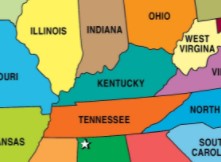
Outside of war, Kentucky has become quite famous for a number of record-breaking things. For instance, did you know Kentucky touches seven (7) other U.S. states (Ohio, Indiana, Illinois, Missouri, Tennessee, Virginia, West Virginia)? It is second only to Missouri and Tennessee, which are tied in first place with 8 border states each.

It is also second (2nd) only to Alaska with the most miles of running water! Hard to believe, isn't it? The diverse rivers and waterways unfold to a length of 1,068 commercially navigable miles which is over 1,770 kilometers.

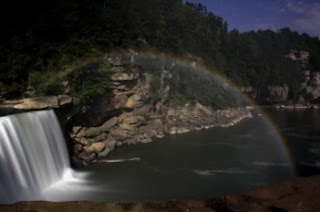
Nestled in and among all that water is an immense forest rich with natural resources and breath-taking waterfalls. One of those waterfalls is nicknamed "the Niagara of the South" or "Little Niagara," and is found along the Cumberland River just west of Corbin, which also happens to be my home. Not only does more than 1,000 cubic feet of water flow over the falls every second, but these falls have the distinction of being one (1) of only seven (7) places in the world to produce a moonbow from the water's reflection of the moonlight! This is due to the direction the waterfall faces in relation to the moon and how the light hits the falls. Rainbows are popular and common with waterfalls, but moonbows are quite rare. Color cannot be captured with a standard camera or cell phone. You need a long exposure from a tripod-mounted SLR camera and a lot of patience. You also need a full moon and a clear sky.

If you're a fan of natural wonders, Kentucky is also home to the largest and longest cave system in the world! Mammoth Cave is a national park in central Kentucky, and it's also one of the oldest tourist attractions, having received its national park distinction on July 1, 1941. My family will be visiting there in August this year, so I'll be sure to throw in some photos here as a little bonus.

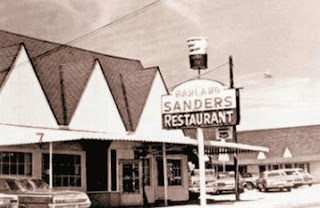
And finally, before I drop a few fast facts, I can't conclude these notable distinctions without mentioning the world's second largest fast food chain. I could probably wager a bet that every single person reading this post has had at least one meal here in his/her lifetime. It's the chain that bears the state's name and features a favorite American food: Kentucky Fried Chicken. The KFC trademark and image of Colonel Sanders have been with the restaurant from the start, which occurred in the town of Corbin on September 24, 1952. Today, there are over 20,000 restaurants around the world, and the combination of special ingredients in its original recipe is (say it with me) "finger-lickin' good!"

By the way, there is only one location here in Corbin, and it's on the original site where Colonel Sanders founded the restaurant alongside a local gas station. Today, it's marked by the Sanders Café and Museum attached to a KFC restaurant. People travel from all over the world to this spot and claim the chicken made here is the best KFC they've ever had. I definitely prefer it to even the locations in London and Williamsburg to the north and south of Corbin, but you'll have to come for a visit and try it yourself to see if you agree. (winks)


Here we go with some fast facts:

  • Known primarily as an agricultural area into the 20th century, Kentucky is also a major U.S. coal producer.
  • The U.S. military bases Fort Knox and Fort Campbell are found in Kentucky.
  • Bluegrass music is famous in Kentucky, pioneered by Kentucky native Bill Monroe. He was a mandolinist, singer, and songwriter, and the music style originated in the Appalachian region of southeast Kentucky.
  • Thomas Edison once worked at a Western Union office in Louisville and had no intention of leaving, but he was fired when he accidentally spilled sulfuric acid on his boss's furniture. Of course, he soon became a famous inventor, so it all worked out!
  • Mother's Day originated in Kentucky. Mary Towles Sasseen celebrated the first mother’s day to honor her mother. The recognition goes to her in 1887 as the founder of Mother’s Day.
  • The tune of "Happy Birthday to You" was written by two Kentuckian sisters. The American songwriter Mildred Hill, along with her sister Patty Hill, wrote the music that is now world-famous.
  • Bowling Green has the world's only Corvette plant.
  • The 3M plant in Cythiana is the only one that produces the legendary Post-It Notes.
  • Black Mountain is the highest point in Kentucky at 4, 145 feet right near the border with Virginia.
  • The state bird is the Kentucky cardinal.
  • The state's nickname is given because of the unique grass that grows here. It appears blue in the springtime because of the buds that grow amidst the blades.

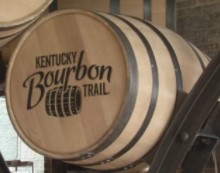
Last but not least, I am leaving you with an astounding yet comical fact. There are more barrels of bourbon in Kentucky than the total number of its state citizens.

Yes, you read that right. I kid you not. More than 7.5 million barrels of bourbon are here in Kentucky, and the barrel inventory of Kentucky is one of the highest inventories in the world. The number of state citizens? Just 4.5 million.


NOW IT'S YOUR TURN:

* What tidbits or notable things can be found in YOUR state?

* Have you ever visited Kentucky? Where did you go and what did you see?

* Which fact about Kentucky was your favorite from today's post?

Leave answers to these questions or any comments you might have on this post in the box below. Come back on the 9th of April to learn about The Kentucky Derby.

For those interested in my "fictional" life as an author and industry news about other authors, subscribe to my newsletter. Receive a FREE omitted chapter from my book, A Grand Design, just for subscribing!


BIO
Tiffany Amber Stockton has been crafting and embellishing stories since childhood, when she was accused of having a very active imagination and cited with talking entirely too much. Today, she has honed those skills to become an award-winning, best-selling author and speaker who is also an advocate for literacy as an educational consultant with Usborne Books. She loves to share life-changing products and ideas with others to help improve their lives in a variety of ways.

She lives with her husband and fellow author, Stuart Vaughn Stockton, along with their two children and two cats in Kentucky. She has sold twenty-four (24) books so far and is represented by Tamela Murray of the Steve Laube Agency. You can find her on Facebook and GoodReads.