Showing posts with label Dickens. Show all posts

Wednesday, December 20, 2023

Pawnbrokers in Victorian Era England

by Edwina Kiernan


As industrialization took hold of Victorian society, so did economic disparities. Pawn shops soon became vital in providing a financial lifeline, especially to those struggling in the shadows of the Victorian class structure.


It was mostly the poverty-stricken lower classes and the struggling middle class who found most use of their services. But, occasionally, higher class men in need of ready cash would dare to grace their premises, too. After all, times were hard, and the need for short-term financial relief was a constant reality. Thus, pawnbrokers soon became the go-to solution for individuals struggling with economic hardship.


Not only could clients pawn their personal possessions for some quick cash, but those excluded from traditional financial institutions could almost use pawn shops as a makeshift bank.


Transactions were simple: individuals could bring in valuables such as jewelry, watches, or household items, and receive a loan based on the estimated value of the collateral. The pawned items would then be held as security until the borrower repaid the loan with interest.


Victorian engagement ring, made of Burmese pink sapphires arranged as a double heart


Owing to the era’s radical industrialization, the working class often held unstable employment, and sudden economic downturns were not uncommon. Pawnbrokers offered a safety net, allowing individuals to secure funds swiftly without the added stress of dealing with the bureaucratic hurdles of traditional banking.


But while pawn shops were a welcome lifeline for many Victorians, many others placed a stigma on those who frequented them. The higher classes often viewed pawnbrokers as the last resort for the desperate and destitute, even though the reality was more nuanced, as middle-class families made frequent use of their services when times grew increasingly more difficult.


Victorian pawn shops were often dimly lit, cramped spaces adorned with an eclectic array of items – from pocket watches to family heirlooms. The process of pawning an item involved negotiation, assessment of value, and the inevitable exchange of collateral for cash. The pawnbroker's keen eye for appraising goods became a skill in itself, as the pawnbrokers themselves needed to discern the true worth of such diverse items.


As the prominence of pawnbrokers increased, so did the need for regulation. The Pawnbrokers Act of 1872 in the United Kingdom laid the foundation for governing these establishments. The legislation aimed to protect both pawnbrokers and borrowers by establishing guidelines for fair transactions, interest rates, and the duration of loans. This legal framework contributed to the legitimization of pawnbroking as a respected financial service.


The Victorian era left an indelible mark on literature and culture, and pawn shops found their way into various works of fiction. Charles Dickens, a keen observer of societal injustices, often depicted pawnbrokers in his novels. In David Copperfield, for instance, the protagonist pawns his coat to survive, highlighting the ubiquity of pawn shops as a means of financial survival. In A Christmas Carol, a few of Scrooge’s acquaintances are eager to pawn his possessions in his vision of Christmas Yet To Come. And in my own novel, Restoring Miss Hastings, high-class gentleman Edmund Derringer reluctantly makes use of the local pawnbroker’s services as he tries to build back the family wealth he lost in an ill-chosen speculation.


From A Chistmas Carol, by Charles Dickens. Fred Barnard's illustration shows Scrooge's charlady and laundrywoman joining the undertaker's man to pawn his belongings, in the process revealing how they really felt about him.

Today, the legacy of Victorian pawn shops extends beyond the nineteenth century. These establishments laid the groundwork for modern pawnbroking, adapting to societal changes and technological advancements. While the stereotype of pawn shops as havens for the desperate persists, contemporary pawnbrokers continue to provide the same valuable financial services to a new generation of those who need them. Yet again, a Victorian legacy lives on, serving as a testament to the resilience of those who, in times of need, sought solace and financial relief within the walls of the pawnbroker’s premises.


Did You Know?

A pawnbroker's shop features in my novel, Restoring Miss Hastings... and you can grab a free copy by clicking the link or graphic below! :)

Penniless and alone, a stranger takes her in. But will her presence ruin his plans to restore all he’s lost? Get your FREE copy here: Restoring Miss Hastings


About The Author:

Edwina Kiernan is an award-winning author of Christian Historical Romance. She lives in rainy Ireland with her husband and son, and uses her pen to point people to Jesus - the Living Word. She also drinks more types of tea than most people realize even exist. Find out more at EdwinaKiernan.com, and sign up for her weekly newsletter for lots of fun, fiction, freebies and faith.

Friday, November 11, 2016

Galveston Isand

Not Just a Beach
by Martha Rogers


Galveston is another Texas city with a fascinating past. She’s part Southern, part Texas and uniquely her own. She has more history than many cities much larger than she is. Galveston has always been “a town in its own right,” and even today she is often referred to as “The Republic of Galveston Island.”

The first people to land on the island besides the natives were the Spaniards led by Cabeza de Vaca who shipwrecked on the island around 1528. The inhabitants at that time were the Akokisa and Karankawa Indians who camped, fished, and buried their dead there in the marshes.

The explorer lived among them for several years as a medicine man and slave. He died there among the natives. Later, in the late 1600’s, the French came led by La Salle who claimed the area for King Louis. He named the island St. Louis.

In the 1780’s, Bernardo Galvez, a Spanish colonial governor, sent Jose de Evia to map out the area along the Gulf of Mexico from Texas to New Orleans. Evia named the water between the island and the mainland of Texas, Galveston Bay. Later the city took the name but Galvez died before ever seeing the island named for him.

When the settlers came, the first known one was a pirate. The privateer Jean Lafitte established a colony in 1817. When Lafitte was forced to leave, he burned the town behind him. From the ashes, Michel Menard and Samuel Williams with others rebuilt the town, and many of the homes of these early pioneers are still standing.

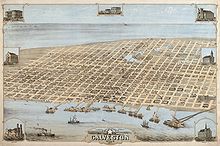
Early map of Galveston: 

 Of course everything is bigger in Texas. After she was incorporated in 1839, Galveston took no time in becoming the most active port west of New Orleans and growing to the largest city in Texas at the time.
By SMU Central University Libraries - Busy Dock Scene, Galveston, Texas. Public Domain, 

Galveston had to be first in a number of things, among them were the first opera house, first hospital, first golf course and the first country club. She was one of the richest cities in the world per capita. All major railroads served the city and over half of Texas’ cotton crop was exported through Galveston. The Strand had become not only the financial center of Galveston and Texas, but much of the Southwest as well.

One of the luxury hotels in the 19th century. 


By 1900, the town had become the fourth largest in Texas following Houston, Dallas and San Antonio with a population around 37,000. Then the 1900 Storm hit the island with one-third of the city destroyed and over 6,000 lives lost.


Those who remained were determined to restore the city and make it safer. They did so by raising the entire level of Galveston by eight feet with 17 feet at the seawall slanting down so water would run off into the bay. It worked when fifteen years later, another storm hit and only eight lives were lost.

Despite their efforts, the city never returned to its former glory. Even her shipping suffered when Houston built a ship channel and the vessels sailed up the channel to larger city. An economic decline in the mid-1960’s caused many of the beautiful old buildings to fall into disrepair and some were demolished.  

Ashton Villa is one of the homes built in 1859 that was restored. 


The 36-block business district was fully restored with the persistence of Cynthia and George Mitchell. Once known as the “Wall Street of the Southwest,” opulent Victorian buildings and residences lined the streets with banks, wholesale houses, shipping companies, auction houses, and sailor boarding houses. The buildings restored by the Mitchells were held to the highest standard of preservation and restoration. They have been recipients of numerous awards. They overhauled the downtown historic Victorian style buildings and it became an historic landmark with 2,000 buildings scattered across Galveston listed in the National Register of Historic Places.

One of the Historical Markers: 


Two huge events occur every year on the island. One is Mardi Gras which turns the town into a carnival with parades and parties down the street spanned by Mardi Gras arches built by world famous architects. This 75 year old tradition was restored in 1985 after it had been lost during WWII.

The second event is Dickens on the Strand which takes place in December and takes the city back to the Victorian times of Charles Dickens for the Christmas season.  


Another event that is well attended is the annual Historic Home Tour held in May before the real heat and humidity of Texas take over. Here is one of the homes featured on the tour. This home was built in 1893.


Taking a stroll through the area and visiting the many shops and eating places along the way is a step back in time. Modern improvements make the time spent in the historic district of Galveston an enjoyable experience.

What historical places have you visited?

Here's my latest novel, just in time for Christmas.

Christmas at Stoney Creek


News reporter Tom Whiteman befriends a homeless man, Joe, and brings him home to Stoney Creek, a town that accepts people for who they are and not how they appear. Tom’s journalistic instincts suggest there’s more to the old man than appearances tell. A carpenter by trade, Joe works at odd jobs around town and makes many new friends including Faith Delmont, a girl who grew up with Tom. Contradictions in the man’s manners and way of speaking whet Tom’s nose for news and raises even more questions. As he and Faith seek the truth, they learn that God’s love can turn tragedy and loss to triumph and true love comes to those who seek it.     


Martha Rogers is a free-lance writer and multi-published author from Realms Fiction of Charisma Media and Winged Publications. She was named Writer of the Year at the Texas Christian Writers Conference in 2009. She is a member of ACFW and writes the weekly Verse of the Week for the ACFW Loop. ACFW awarded her the Volunteer of the Year in 2014. Her first electronic series from Winged Publications, Love in the Bayou City of Texas, debuted in the spring of 2015.  Martha is a frequent speaker for writing workshops and the Texas Christian Writers Conference. She is a retired teacher and lives in Houston with her husband, Rex. Their favorite pastime is spending time with their eleven grandchildren and four great-grandchildren